
Dayvigo 5 & 10 5 mg, 10 mg Tablet
PDF Leaflet Revision Date: 10 January 2025
Clinical Summary
Quick overview from the medicine insert
Indication
Treatment of adult patients with insomnia.
Dosage (summary)
5 mg once nightly before bed; may increase to 10 mg based on response.
Special Populations
- Hepatic impairment
- Elderly
- Renal impairment
Pregnancy & Breastfeeding
Not recommended in pregnancy; safety during breastfeeding not established.
Key Drug Interactions
- Strong/moderate CYP3A inhibitors
- Strong/moderate CYP3A inducers
- Alcohol
Contraindications
- Hypersensitivity to lemborexant
- Narcolepsy
Common side effects
- Somnolence
- Headache
- Nightmares
Counselling Points
- Avoid alcohol while taking DAYVIGO.
- Caution against driving or operating machinery.
- Monitor for signs of complex sleep behaviours.
Serious warnings
- CNS depressant effects
- Risk of daytime impairment
- Worsening of depression/suicidal ideation
Important Disclaimer
The Dayvigo 5 & 10 5 mg, 10 mg Tablet professional information leaflet below is the property of Eisai Pharmaceuticals Africa and is provided on Medinsert exactly as issued, with no.. alterations or editorial changes. We make every effort to keep content current by updating documents as soon as new versions become available. Medinsert serves as a trusted access point for healthcare professionals, but does not replace official sources or clinical judgement. For more details, please read our full disclaimer. read more>>
 Healthcare Professionals Only
This content is for registered healthcare professionals
Sign in or create a free account to read the full package insert.
Free for HPCSA-registered professionals. Powered by Medinsert.
Clinical Particulars
Section 4 of the official insert — extracted exactly as issued, no alterations
4.1 Therapeutic indications
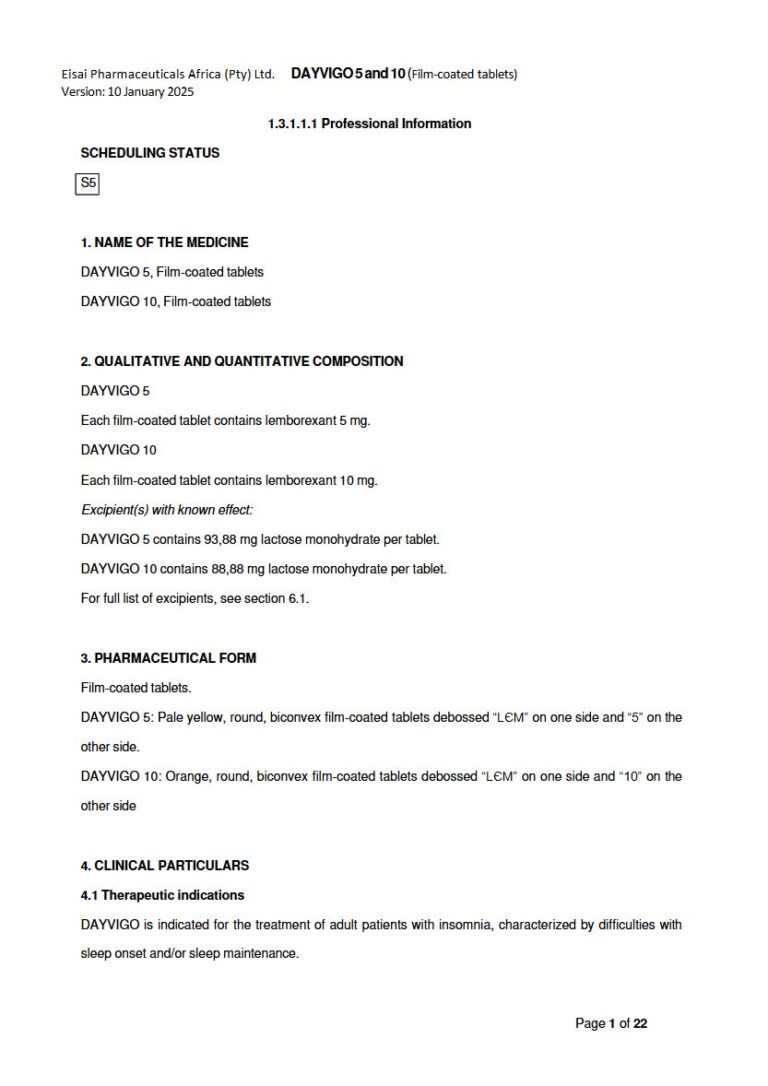
DAYVIGO is indicated for the treatment of adult patients with insomnia, characterized by difficulties with sleep onset and/or sleep maintenance.
4.2 Posology and method of administration
Posology
The recommended dosage of DAYVIGO is 5 mg taken no more than once per night, immediately before going to bed, with at least 7 hours remaining before the planned time of awakening. The dose may be increased to the maximum recommended dose of 10 mg based on clinical response and tolerability.
Dosage recommendations for concomitant use with CYP3A Inhibitors or CYP3A Inducers
Co-administration with Strong or Moderate CYP3A Inhibitors
Avoid concomitant use of DAYVIGO with strong or moderate CYP3A inhibitors (see section 4.5).
Co-administration with Weak CYP3A Inhibitors
The maximum recommended dosage of DAYVIGO is 5 mg no more than once per night when co-administered with weak CYP3A inhibitors (see section 4.5).
Co-administration with Strong or Moderate CYP3A Inducers
Avoid concomitant use of DAYVIGO with strong or moderate CYP3A inducers (see section 4.5).
Special populations
Hepatic impairment
The maximum recommended dose of DAYVIGO is 5 mg no more than once per night in patients with moderate (Child-Pugh class B) hepatic impairment (see section 5.2 Pharmacokinetic properties, Special populations). DAYVIGO is not recommended in patients with severe hepatic impairment (see section 4.4)
Renal Impairment
No dose adjustment is required in patients with mild, moderate, or severe renal impairment.
Elderly
Elderly (u2265 65 years of age): No clinically meaningful differences in safety or effectiveness were observed between elderly patients u2265 65 years of age and younger patients at the recommended doses. No dose adjustment is required in elderly patients.
Patients with compromised respiratory function
Effects of DAYVIGO on respiratory function should be considered if prescribed to patients with compromised respiratory function. In a study of patients with mild obstructive sleep apnoea (apnoea-hypopnoea index >5 and <15 events per hour of sleep), DAYVIGO did not increase the frequency of apnoeic events or cause oxygen desaturation. DAYVIGO has not been studied in patients with chronic obstructive pulmonary disease or moderate to severe obstructive sleep apnoea (OSA).
Paediatric population
The safety and effectiveness of DAYVIGO have not been established in paediatric patients.
Method of administration
DAYVIGO tablets are intended for oral administration. Time to sleep onset may be delayed if taken with or soon after a meal.
4.3 Contraindications
- Hypersensitivity to lemborexant or to any of the excipients (see section 6.1)
- DAYVIGO is contraindicated in patients with narcolepsy.
4.4 Special warnings and precautions for use
CNS Depressant Effects and Daytime Impairment
DAYVIGO is a central nervous system (CNS) depressant that can impair daytime wakefulness even when used as prescribed. CNS depressant effects may persist in some patients for up to several days after discontinuing DAYVIGO. Medical practitioners should advise patients about the potential for next day somnolence. Driving ability was impaired in some subjects taking DAYVIGO 10. The risk of daytime impairment is increased if DAYVIGO is taken with less than a full night of sleep remaining or if a higher than recommended dose is taken (see section 4.2). If DAYVIGO is taken in these circumstances, patients should be cautioned against driving and other activities requiring complete mental alertness. Co-administration with other CNS depressants (e.g., benzodiazepines, opioids, tricyclic antidepressants, alcohol) increases the risk of CNS depression, which can cause daytime impairment. Dosage adjustments of DAYVIGO and of concomitant CNS depressants may be necessary when administered together because of potentially additive effects. The use of DAYVIGO with other medicine to treat insomnia is not recommended. Patients should be advised not to consume alcohol in combination with DAYVIGO because of additive effects (see section 4.5). Because DAYVIGO can cause drowsiness, patients, particularly the elderly, are at a higher risk of falls (see section 5.2 Elderly use).
Sleep Paralysis, Hypnagogic/Hypnopompic Hallucinations, and Cataplexy-like Symptoms
Sleep paralysis, an inability to move or speak for up to several minutes during sleep-wake transitions, and hypnagogic/hypnopompic hallucinations, including vivid and disturbing perceptions, can occur with the use of DAYVIGO. Medical practitioners should explain the nature of these events to patients when prescribing DAYVIGO. Symptoms similar to mild cataplexy can occur with DAYVIGO. Such symptoms can include periods of leg weakness lasting from seconds to a few minutes, can occur either at night or during the day, and may not be associated with an identified triggering event (e.g., laughter or surprise).
Complex Sleep Behaviours
Complex sleep behaviours, including sleep-walking, sleep-driving, and engaging in other activities while not fully awake (e.g., preparing and eating food, making phone calls, having sex), have been reported to occur with the use of hypnotics such as DAYVIGO. These events can occur in hypnotic-nau00efve as well as in hypnotic-experienced persons. Patients usually do not remember these events. Complex sleep behaviours may occur following the first or any subsequent use of DAYVIGO, with or without the concomitant use of alcohol and other CNS depressants (see section 4.5). Discontinue DAYVIGO immediately if a patient experiences a complex sleep behaviour.
Compromised Respiratory Function
The effect of DAYVIGO on respiratory function should be considered if prescribed to patients with compromised respiratory function. In a study of patients with mild obstructive sleep apnoea (OSA) (apnoea-hypopnea index <15 events per hour of sleep), DAYVIGO did not increase the frequency of apnoeic events or cause oxygen desaturation. DAYVIGO has not been studied in patients with chronic obstructive pulmonary disease (COPD) or moderate to severe OSA. Clinically meaningful respiratory effects of DAYVIGO in COPD or moderate to severe OSA cannot be excluded.
Worsening of Depression/Suicidal Ideation
In clinical studies of DAYVIGO in patients with insomnia, the incidence of suicidal ideation or any suicidal behaviour, as assessed by questionnaire, was higher in patients receiving DAYVIGO than in those receiving placebo (0,3 % for DAYVIGO 10 mg, 0,4 % for DAYVIGO 5 mg, and 0,2 % for placebo). In primarily depressed patients treated with hypnotics, worsening of depression and suicidal thoughts and actions (including completed suicides) have been reported. Suicidal tendencies may be present in such patients and protective measures may be required. Intentional overdose is more common in this group of patients; therefore, the lowest number of tablets that is feasible should be prescribed at any one time. The emergence of any new behavioural sign or symptom of concern requires careful and immediate evaluation.
Need to Evaluate for Co-morbid Diagnoses
Because sleep disturbances may be the presenting manifestation of a medical and/or psychiatric disorder, treatment of insomnia should be initiated only after careful evaluation of the patient. The failure of insomnia to remit after 7 to 10 days of treatment may indicate the presence of a primary psychiatric and/or medical illness that should be evaluated. Worsening of insomnia or the emergence of new cognitive or behavioural abnormalities may be the result of an unrecognized underlying psychiatric or medical disorder and can emerge during the course of treatment with sleep-promoting medicines such as DAYVIGO.
Abuse of DAYVIGO and dependence
Abuse
Abuse is the intentional, non-therapeutic use of a drug or medicine, even once, for its desirable psychological or physiological effects. Abuse potential was analysed in a controlled trial that enrolled recreational hypnotic users, and the potential abuse of DAYVIGO 10 was found to be greater than that of placebo in the comparative trial (p-value: 0.995 that DAYVIGO 10 and placebo are not similar).
Dependence
Physical dependence is a state that develops as a result of physiological adaptation in response to repeated medicine use, manifested by withdrawal signs and symptoms after abrupt discontinuation or a significant dose reduction of a medicine. In animal studies and clinical trials evaluating physical dependence, chronic administration of lemborexant did not produce withdrawal signs or symptoms upon medicine discontinuation. This suggests that lemborexant does not produce physical dependence.
Excipients
DAYVIGO contains lactose. Patients with rare hereditary problems of galactose intolerance, total lactase deficiency or glucose-galactose malabsorption should not take this medicine.
4.5 Interaction with other medicines and other forms of interaction
Effect of other medicine on DAYVIGO
Strong, Moderate, and Weak CYP3A Inhibitors
Concomitant use with a strong (itraconazole, clarithromycin), moderate (fluconazole, verapamil), or weak (ranitidine) CYP3A inhibitor increases lemborexant AUC and C max which may increase the risk of DAYVIGO adverse reactions (see section 5.2 Pharmacokinetic properties). Avoid concomitant use of DAYVIGO with strong or moderate CYP3A inhibitors. The maximum recommended dose of DAYVIGO with weak CYP3A inhibitors is 5 mg (see section 4.2 Special populations).
Strong and Moderate CYP3A Inducers
Concomitant use with a strong (rifampin, carbamazepine, St. Johnu2019s wort) or moderate (efavirenz, modafinil) CYP3A inducer decreases lemborexant exposure, which may reduce DAYVIGO efficacy (see section 5.2 Pharmacokinetic properties). Avoid concomitant use of DAYVIGO with strong or moderate CYP3A inducers (see section 4.2 Special populations).
Alcohol
Concomitant use of alcohol increases lemborexant C max and AUC. Coadministration of DAYVIGO with alcohol produced a numerically greater negative impact on postural stability and memory as compared with alcohol alone when assessed near the t max of DAYVIGO (2 hours post-dose) (see section 5.1 Pharmacodynamic properties). Avoid alcohol consumption with DAYVIGO (see section 4.4 Warnings and Special Precautions).
Effect of DAYVIGO on other medicine
CYP2B6 Substrates
Concomitant use of DAYVIGO decreases the AUC of medicine that are CYP2B6 substrates (bupropion, methadone), which may result in reduced efficacy for these concomitant medications (see section 5.2 Pharmacokinetic properties). Patients receiving DAYVIGO and CYP2B6 substrates concurrently should be monitored for adequate clinical response. Increasing the doses of CYP2B6 substrates may be considered as needed.
In Vitro Studies with Substrates of Transporters
Lemborexant and its major metabolite (M10) do not have the potential to inhibit P-gp, BCRP, BSEP, OAT1, OAT3, OATP1B1, OATP1B3, OCT1, OCT2, MATE1, and MATE2-K.
4.6 Fertility, pregnancy and lactation
Pregnancy
DAYVIGO is not recommended in pregnancy. There are no available data on DAYVIGO use in pregnant women to evaluate for medicine-associated risks of major birth defects, miscarriage or adverse maternal or foetal outcomes. In animal reproduction studies, oral administration of lemborexant to pregnant rats and rabbits during the period of organogenesis caused toxicities only at high multiples of the human exposure at the maximum recommended human dose (MRHD) based on AUC. The no observed adverse effect levels (NOAEL) are approximately >100 and 23 times the MRHD based on AUC in rats and rabbits, respectively. Similarly, oral administration of lemborexant to pregnant and lactating rats caused toxicities only at high multiples of the human exposure at the MRHD based on AUC. The NOAEL is 93 times the MRHD based on AUC (see section 5.3 Data). Safety during pregnancy has not been established.
Breastfeeding
There are no data on the presence of lemborexant in human milk, the effects on the breastfed infant, or the effects on milk production. Lemborexant and its metabolites are present in the milk of lactating rats at concentrations higher than in maternal plasma. When a medicine is present in animal milk, it is likely that the medicine will be present in human milk. The developmental and health benefits of breastfeeding should be considered along with the motheru2019s clinical need for DAYVIGO and any potential adverse effects on the breastfed infant from DAYVIGO or from the underlying maternal condition. Safety during breastfeeding has not been established.
4.7 Effects on ability to drive and use machines
Driving ability was impaired in some subjects taking DAYVIGO 10 mg (see section 5.1, Special safety studies, Effects on driving). The risk of daytime impairment is increased if DAYVIGO is taken with less than a full night of sleep remaining or if a higher than recommended dose is taken (see section 4.2). If DAYVIGO is taken in these circumstances, patients should be cautioned against driving and other activities requiring complete mental alertness.
4.8 Undesirable effects
The safety of DAYVIGO was evaluated in 1418 adult patients with insomnia disorder (age 18 to 88 years) from two controlled efficacy trials (Study 1 and Study 2). Study 1 was a 6-month placebo-controlled trial assessing DAYVIGO 5 or 10 mg once nightly, followed by a 6-month parallel-group extension period in which patients initially treated with DAYVIGO continued on the same dose, and patients who received placebo were re-randomized to receive DAYVIGO 5 or 10 mg once nightly. In Study 1, 434 patients were treated with DAYVIGO for one year. Study 2 was a 30-day placebo- and active-controlled trial assessing DAYVIGO 5 or 10 mg once nightly.
a. Summary of the safety profile
The most common adverse reaction (reported in 5 % or more of patients treated with DAYVIGO and at least twice the rate of placebo) in Study 1 (the first 30 days) and Study 2 was somnolence (10 % for DAYVIGO 10 mg, 7 % for DAYVIGO 5 mg, and 1 % for placebo).
b. Tabulated list of adverse reactions
Table 1 presents the adverse reactions by MedDRA system organ class. The frequencies of the adverse reactions are based on the pooled data from the first 30 days of Study 1 (6-month controlled efficacy trial) and Study 2 (1-month controlled efficacy trial) where the incidence was u22652 % in DAYVIGO-treated patients and greater than in placebo-treated patients. Within each system organ class, the ADRs are ranked by frequency, with the most frequent reactions first. Within each frequency grouping, ADRs are presented in order of decreasing seriousness. The frequency category for each adverse drug reaction is based on the following convention: very common (u22651/10); common (u22651/100 to <1/10); uncommon (u22651/1,000 to <1/100); rare (u22651/10,000 to <1/1,000); very rare (<1/10,000).
Table 1: Adverse reactions reported in u22652 % of DAYVIGO-treated patients and at a greater frequency than placebo-treated Patients during the first 30 days of Study 1 and Study 2
MedDRA system organ class (SOC)
Placebo DAYVIGO n=528 (%) 5 mg n=580 (%) 10 mg n=582 (%)
Nervous system disorders
Common: Somnolence or fatigue* 1,3 6,9 9,6
Common: Headache 3,4 5,9 4,5
Psychiatric disorders
Common: Nightmare or abnormal dreams 0,9 0,9 2,2
* Combines preferred terms somnolence, lethargy, fatigue, sluggishness
c. Description of selected adverse reactions
CNS Depressant Effects and Daytime Impairment (see section 4.4). Sleep Paralysis, Hypnagogic/Hypnopompic Hallucinations, and Cataplexy-like Symptoms (see section 4.4). Complex Sleep Behaviours (see section 4.4). Patients with Compromised Respiratory Function (see section 4.4).
d. Other Adverse Reactions Observed During Clinical Trials (Studies 1 and 2)
Other adverse reactions of <2 % incidence but greater than placebo are shown below. The following list does not include adverse reactions 1) for which a medicine cause was remote, 2) that were so general to be uninformative, or 3) that were not considered to have clinically significant implications.
- Sleep paralysis was reported in 1,6 % and 1,3 % of patients receiving DAYVIGO 10 mg and 5 mg, respectively, compared to no reports for placebo. Hypnagogic hallucinations were reported in 0,7 % and 0,1 % of patients receiving DAYVIGO 10 mg and 5 mg, respectively, compared to no reports for placebo (see section 4.4).
- Two events of complex sleep behaviour were reported, both in patients receiving DAYVIGO 10 mg (see section 4.4).
Adverse Reactions Resulting in Discontinuation of Treatment during clinical trials
The frequencies of discontinuation due to adverse reactions in Study 1 (the first 30 days) and Study 2 were 2,6 % and 1,4 % for patients treated with 10 mg and 5 mg DAYVIGO, respectively, compared to 1,5 % for patients in the placebo group. The most common adverse reactions leading to discontinuation of DAYVIGO were somnolence (1,0 % for 10 mg, 0,7 % for 5 mg, and 0,4 % for placebo) and nightmares (0,3 % for 10 mg, 0,3 % for 5 mg, and 0 % for placebo). The frequencies of discontinuation due to adverse reactions in the 6-month placebo-controlled period of Study 1 were 8,3 % and 4,1 % for patients treated with DAYVIGO 10 mg and 5 mg, respectively, compared to 3,8 % for patients in the placebo group. The most common reasons for discontinuation of DAYVIGO and occurring in more than one patient within a treatment arm were somnolence (2,9 % for 10 mg, 1,0 % for 5 mg, and 0,6 % for placebo), nightmares (1,3 % for 10 mg, 0,3 % for 5 mg, and 0% for placebo), and palpitations (0,6 % for 10 mg, 0 % for 5 mg, and 0 % for placebo).
e. Paediatric population
The safety and effectiveness of DAYVIGO have not been established in paediatric patients.
f. Other special populations
No adverse reactions that is applicable to a specific population were reported.
4.9 Overdose
There is limited clinical experience with DAYVIGO overdose. In clinical pharmacology studies, healthy subjects who were administered multiple doses of up to 75 mg (7,5 times the maximum recommended dose) of DAYVIGO showed dose-dependent increases in the frequency of somnolence. There is no available specific antidote to an overdose of DAYVIGO. In the event of overdose, standard medical practice for the management of any overdose should be used. In managing overdose, provide supportive care, including close medical supervision and monitoring and consider the possibility of multiple medicine involvement. The value of dialysis in the treatment of overdosage has not been determined with lemborexant. As lemborexant is highly protein-bound, haemodialysis is not expected to contribute to elimination of lemborexant.
