
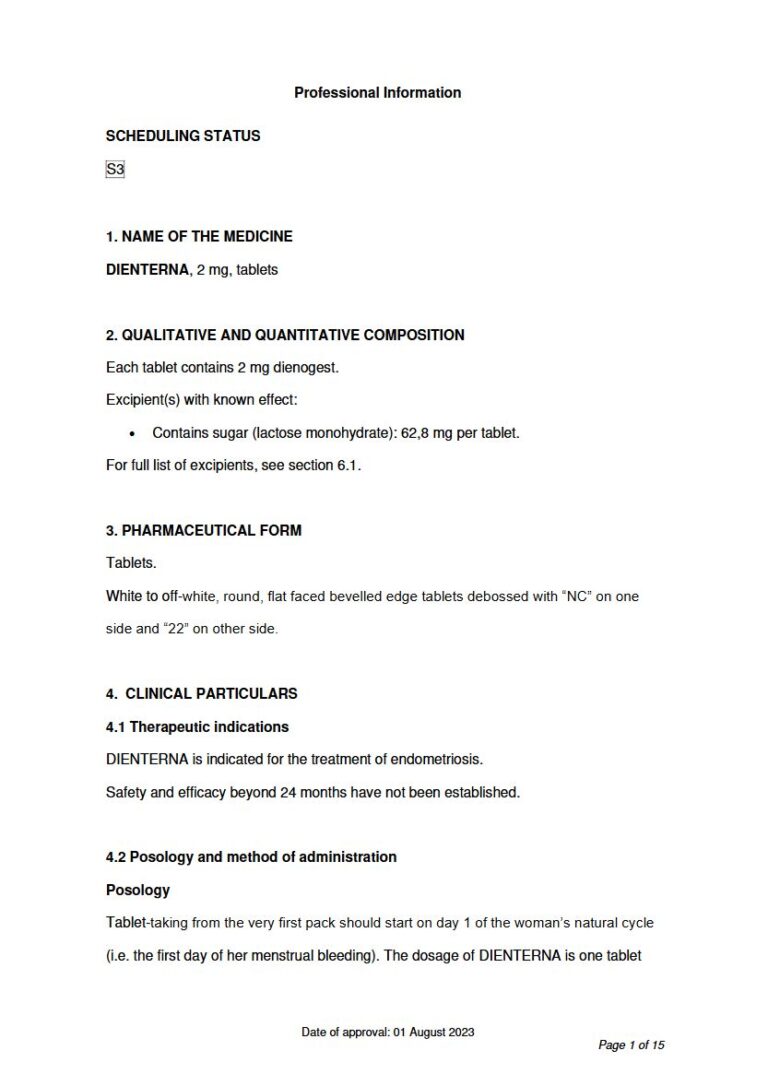
Dienterna 2 2 mg Tablet
PDF Leaflet Revision Date: 01 August 2023
Clinical Summary
Quick overview from the medicine insert
Indication
Treatment of endometriosis.
Dosage (summary)
1 tablet daily, starting on day 1 of menstrual cycle, without breaks.
Special Populations
- Adolescents
- Diabetic patients
Pregnancy & Breastfeeding
Contraindicated in pregnancy and breastfeeding.
Key Drug Interactions
- CYP3A4 inducers
- CYP3A4 inhibitors
Contraindications
- Hypersensitivity to dienogest
- Known or suspected pregnancy
- Breastfeeding
- History of venous thromboembolism
- Cardiovascular diseases
- Severe hepatic disease
- Sex hormone-dependent malignancies
- Undiagnosed vaginal bleeding
Common side effects
- Headache
- Breast discomfort
- Depressed mood
- Acne
- Changes in menstrual bleeding
Counselling Points
- Take at the same time daily
- Use non-hormonal contraception if needed
- Report any unusual bleeding or severe side effects
Serious warnings
- Risk of thromboembolism
- Potential for decreased bone mineral density
- Monitor for severe uterine bleeding
Important Disclaimer
The Dienterna 2 2 mg Tablet professional information leaflet below is the property of Trinity Pharma and is provided on Medinsert exactly as issued, with no.. alterations or editorial changes. We make every effort to keep content current by updating documents as soon as new versions become available. Medinsert serves as a trusted access point for healthcare professionals, but does not replace official sources or clinical judgement. For more details, please read our full disclaimer. read more>>
 Healthcare Professionals Only
This content is for registered healthcare professionals
Sign in or create a free account to read the full package insert.
Free for HPCSA-registered professionals. Powered by Medinsert.
Clinical Particulars
Section 4 of the official insert — extracted exactly as issued, no alterations
4.1 Therapeutic indications
DIENTERNA is indicated for the treatment of endometriosis. Safety and efficacy beyond 24 months have not been established.
4.2 Posology and method of administration
Posology
Tablet- taking from the very first pack should start on day 1 of the womanu2019s natural cycle (i.e. the first day of her menstrual bleeding). The dosage of DIENTERNA is one tablet daily without any break, taken preferably at the same time each day with some liquid as needed. Tablets must be taken throughout 28 days without regard for bleeding. When a pack is finished the next one should be started without interruption. The efficacy of DIENTERNA may be reduced in the event of missed tablets, vomiting, and/ or diarrhoea (if occurring within 3 to 4 hours after tablet taking). In the event of missed tablet(s), the woman should take one tablet only, as soon as she remembers, and should then continue next day to take tablet at her usual time. A tablet not absorbed due to vomiting or diarrhoea should likewise be replaced by one tablet.
Method of administration
For oral use.
4.3 Contraindications
DIENTERNA should not be used in the presence of any condition listed below. Should any of the conditions appear during the use of DIENTERNA, the use of DIENTERNA must be discontinued immediately:
- Hypersensitivity to dienogest or to any of the excipients listed in section 6.1.
- Known or suspected pregnancy (see section 4.6).
- Breastfeeding (see section 4.6).
- History of or active venous thromboembolic disorder.
- Arterial and cardiovascular diseases, past or present (e.g. myocardial infarction, cerebrovascular events, ischaemic heart disease).
- Diabetes mellitus with vascular involvement.
- Presence or history of severe hepatic disease as long as liver function values have not returned to normal.
- Presence or history of liver tumours (benign or malignant).
- Known or suspected sex hormone-dependent malignancies.
- Undiagnosed vaginal bleeding.
4.4 Special warnings and precautions for use
Serious uterine bleeding
Uterine bleeding, for example in women with adenomyosis uteri or uterine leiomyomata, may be aggravated with the use of DIENTERNA. If bleeding is heavy and continuous over time, this may lead to anaemia (severe in some cases). In the event of anaemia, discontinuation of DIENTERNA should be considered.
Changes in menstrual bleeding pattern
The majority of patients treated with DIENTERNA experience changes in their menstrual bleeding pattern (see section 4.8).
Circulatory disorders
From epidemiological studies there is little evidence for an association between progestogen-only preparations as in DIENTERNA and an increased risk of myocardial infarction or cerebral thromboembolism. Rather, the risk of cardiovascular and cerebral events is related to increasing age, hypertension, and smoking. In women with hypertension the risk of stroke may be slightly enhanced by DIENTERNA. Although not statistically significant, some studies indicate that there may be a slightly increased risk of venous thromboembolism (deep venous thrombosis, pulmonary embolism) associated with the use of progestogen-only preparations. Generally recognized risk factors for venous thromboembolism (VTE) include a positive personal or family history (VTE in a sibling or a parent at a relatively early age), age, obesity, prolonged immobilization, major surgery or major trauma. In case of long-term immobilization, it is advisable to discontinue the use of DIENTERNA (in the case of elective surgery at least four weeks in advance) and not to resume treatment until two weeks after complete remobilization.
The increased risk of thromboembolism in the puerperium must be considered. Treatment should be stopped at once if there are symptoms of an arterial or venous thrombotic event or suspicion thereof.
Tumours
There is a risk of having breast cancer diagnosed in patients using DIENTERNA. In rare cases, benign liver tumours, and even more rarely, malignant liver tumours have been reported in users of hormonal substances such as the one contained in DIENTERNA. In isolated cases, these tumours have led to life-threatening intra-abdominal haemorrhages. A hepatic tumour should be considered in the differential diagnosis when severe upper abdominal pain, liver enlargement or signs of intra-abdominal haemorrhage occur in women taking DIENTERNA.
Osteoporosis
Changes in bone mineral density (BMD). The use of dienogest 2 mg (as in DIENTERNA) was monitored in adolescents (12 to <18 years) over a treatment period of 12 months. The use of dienogest 2 mg was associated with a decrease in bone mineral density (BMD) in the lumbar spine (L2-L4). Loss of BMD is of particular concern during adolescence and early adulthood, a critical period of bone accretion. It is unknown if BMD decrease in this population will reduce peak bone mass and increase the risk for fracture in later life. In patients who are at an increased risk of osteoporosis a careful risk-benefit assessment should be performed before starting DIENTERNA because endogenous estrogen levels are moderately decreased during treatment with DIENTERNA.
Adequate intake of calcium and Vitamin D, whether from the diet or from supplements, is important for bone health in women of all ages.
Other conditions
- Patients who have a history of depression should be carefully observed and the medicine discontinued if the depression recurs to a serious degree.
- Dienogest generally does not appear to affect blood pressure in normotensive women. However, if a sustained clinically significant hypertension develops during the use of DIENTERNA, it is advisable to withdraw therapy and treat the hypertension.
- Recurrence of cholestatic jaundice and/or pruritus which occurred first during pregnancy or previous use of sex steroids necessitates the discontinuation of DIENTERNA.
- Dienogest may have a slight effect on peripheral insulin resistance and glucose tolerance. Diabetic women, especially those with a history of gestational diabetes mellitus, should be carefully observed while taking DIENTERNA.
- Chloasma may occasionally occur, especially in women with a history of chloasma gravidarum. Women with a tendency to chloasma should avoid exposure to the sun or ultraviolet radiation whilst taking DIENTERNA.
- Pregnancies that occur among users of progestogen-only preparations used for contraception are more likely to be ectopic than are pregnancies among users of combined oral contraceptives. Therefore, in women with a history of extrauterine pregnancy or an impairment of tube function, the use of DIENTERNA should be decided on only after carefully weighing the benefits against the risks.
- Patients are advised to use non-hormonal methods of contraception (barrier contraception, e.g. condom) to prevent unwanted pregnancies.
- Persistent ovarian follicles (often referred to as functional ovarian cysts) may occur during the use of DIENTERNA. Most of these follicles are asymptomatic, although some may be accompanied by pelvic pain.
Lactose
DIENTERNA contains lactose (as lactose monohydrate): Patients with the rare hereditary problems of galactose intolerance, total lactase deficiency or glucose-galactose malabsorption should not take DIENTERNA.
4.5 Interactions with other medicines and other forms of interaction
Effects of other medicines on DIENTERNA
Individual enzyme-inducers or inhibitors (CYP3A4): Progestogens, including DIENTERNA, are metabolised mainly by the cytochrome P450 system (CYP3A4) located both in the intestinal mucosa and in the liver. Therefore, inducers or inhibitors of CYP3A4 may affect the metabolism of DIENTERNA.
An increased clearance of sex hormones due to enzyme induction may reduce the therapeutic effect of DIENTERNA and may result in undesirable effects e.g. change in bleeding profile. A reduced clearance of sex hormones due to enzyme inhibition may increase the therapeutic effects of DIENTERNA and may result in undesirable effects.
Substances with enzyme-inducing properties: Interaction can occur with medicines (e.g. phenytoin, barbiturates, primidone, carbamazepine, rifampicin and possibly oxcarbazepine, topiramate, felbamate, griseofulvin, nevirapine and products containing St. Johnu2019s wort) that induces microsomal enzymes (e.g. cytochrome P450 enzymes) which can result in increased clearance of sex hormones and diminished efficacy of dienogest. Maximum enzyme induction is generally not seen for 2 to 3 weeks but may then be sustained for at least 4 weeks after cessation of therapy.
Substances with enzyme-inhibiting properties: Known CYP3A4 inhibitors like azole antifungals (e.g. ketoconazole, itraconazole, fluconazole), cimetidine, verapamil, macrolides (e.g. erythromycin, clarithromycin and roxithromycin), diltiazem, protease inhibitors (e.g. ritonavir, saquinavir, indinavir, nelfinavir), antidepressants (e.g. nefazodone, fluvoxamine, fluoxetine) may increase plasma levels of progestogens and result in undesirable effects.
Effects of DIENTERNA on other medicines
Based on in vitro inhibition studies, a clinically relevant interaction of DIENTERNA with the cytochrome P450 enzyme mediated metabolism of other medicines is unlikely.
Other forms of interactions
The use DIENTERNA may influence the results of certain laboratory tests, including biochemical parameters of liver, thyroid, adrenal and renal function, plasma levels of (carrier) proteins (e.g. corticosteroid binding globulin and lipid/lipoprotein fractions), parameters of carbohydrate metabolism and parameters of coagulation and fibrinolysis. Changes generally remain within the normal laboratory range.
Interaction with food. A standardized high fat meal did not affect the bioavailability of 2 mg dienogest tablets.
4.6 Fertility, pregnancy and lactation
Pregnancy
There is limited data from the use of dienogest in pregnant women. The administration of DIENTERNA during pregnancy is contraindicated (see section 4.3). If pregnancy occurs during the use of DIENTERNA, further intake should be stopped.
Breastfeeding
DIENTERNA should not be used by breastfeeding women (see section 4.3).
Fertility
Based on the available data, ovulation is inhibited in the majority of patients during treatment with DIENTERNA. However, DIENTERNA is not a contraceptive. If contraception is required a non-hormonal method should be used (see section 4.4). Based on available data, the menstrual cycle returns to normal within 2 months after cessation of treatment with DIENTERNA.
4.7 Effects on ability to drive and use machines
DIENTERNA has no influence on the ability to drive and use machines. No effects on the ability to drive or use machines have been observed in users of medicines containing dienogest.
4.8 Undesirable effects
a. Summary of the safety profile
Undesirable effects are more common during the first months after the start of treatment with DIENTERNA and subside with continued treatment. There may be changes in bleeding pattern, such as spotting, irregular bleeding or amenorrhea. The following undesirable effects have been reported in users of dienogest (as in DIENTERNA). The most frequently reported undesirable effects are headache, breast discomfort, depressed mood and acne. Furthermore, the majority of patients treated experience changes in their menstrual bleeding pattern.
b. Tabulated summary of adverse reactions
| System Organ Class | Frequency | Adverse reaction |
|---|---|---|
| Blood and lymphatic system disorders | Less frequent | Anaemia. |
| Metabolism and nutrition disorders | Frequent | Weight increased. |
| Less frequent | Weight decreased, increased appetite. | |
| Psychiatric disorders | Frequent | Depressed mood, sleep disorder, nervousness, loss of libido, altered mood. |
| Less frequent | Anxiety, depression, mood swings. | |
| Nervous system disorders | Frequent | Headache, migraine. |
| Less frequent | Autonomic nervous system Imbalance, disturbance in attention. | |
| Eye disorders | Less frequent | Dry eyes. |
| Ear and labyrinth disorders | Less frequent | Tinnitus. |
| Cardiac disorders | Less frequent | Unspecified circulatory system disorder, palpitations. |
| Vascular disorders | Less frequent | Hypotension. |
| Respiratory, thoracic and mediastinal disorders | Less frequent | Dyspnoea. |
| Gastrointestinal disorders | Frequent | Nausea, abdominal pain, flatulence, abdominal distention, vomiting. |
| Less frequent | Diarrhoea, constipation, abdominal discomfort, gastrointestinal inflammation, gingivitis. | |
| Skin and subcutaneous tissue disorders | Frequent | Acne, alopecia. |
| Less frequent | Dry skin, hyperhidrosis, pruritus, hirsutism, onychoclasis, dandruff, dermatitis, abnormal hair growth, photosensitivity reaction, pigmentation disorder. | |
| Musculoskeletal and connective tissue disorders | Frequent | Back pain. |
| Less frequent | Bone pain, muscle spasm, pain in extremity, heaviness in extremities. | |
| Renal and urinary disorders | Less frequent | Urinary tract infection. |
| Reproductive system and breast disorders | Frequent | Breast discomfort, ovarian cyst, hot flush, uterine/vaginal bleeding including spotting. |
| Less frequent | Vaginal candidiasis, vulvovaginal dryness, genital discharge, pelvic pain, atrophic vulvovaginitis, breast mass, fibrocystic breast diseases, breast induration. | |
| General disorders and administrative site conditions | Frequent | Asthenic conditions, irritability. |
| Less frequent | Oedema. |
c. Description of selected adverse reactions
Uterine bleeding irregularities: The following bleeding patterns were observed: amenorrhea, infrequent bleeding, frequent bleeding, irregular bleeding, prolonged bleeding, and normal bleeding.
Decrease of bone mineral density: In an uncontrolled study with 111 adolescent women (12 to <18 years) who were treated with dienogest 2 mg, 103 had BMD measurements. Approximately 72 % of these study participants experienced a decrease in BMD of the lumbar spine (L2-L4) after 12 months of use (see section 4.4).
Reporting of suspected adverse reactions
Reporting suspected adverse reactions after authorisation of the medicine is important. It allows continued monitoring of the benefit/risk balance of the medicine. Healthcare professionals are asked to report any suspected adverse reactions to SAHPRA via the u201c6.04 Adverse Drug Reaction Reporting Formu201d, found online under SAHPRAu2019s publications: https://www.sahpra.org.za/Publications/Index/8
4.9 Overdose
Symptoms
Acute toxicity studies performed with dienogest (as in DIENTERNA) did not indicate a risk of acute adverse effects in case of inadvertent intake of a multiple of the daily therapeutic dose. A daily intake of 20 to 30 mg dienogest (10 to 15 times higher dose than in DIENTERNA) over 24 weeks of use was very well tolerated. However, overdosage may potentiate the adverse effects reported under section 4.4 (u201cSpecial warnings and precautions for useu201d) and section 4.8 (u201cUndesirable effectsu201d).
Treatment
There is no specific antidote, treatment is symptomatic and supportive.
