
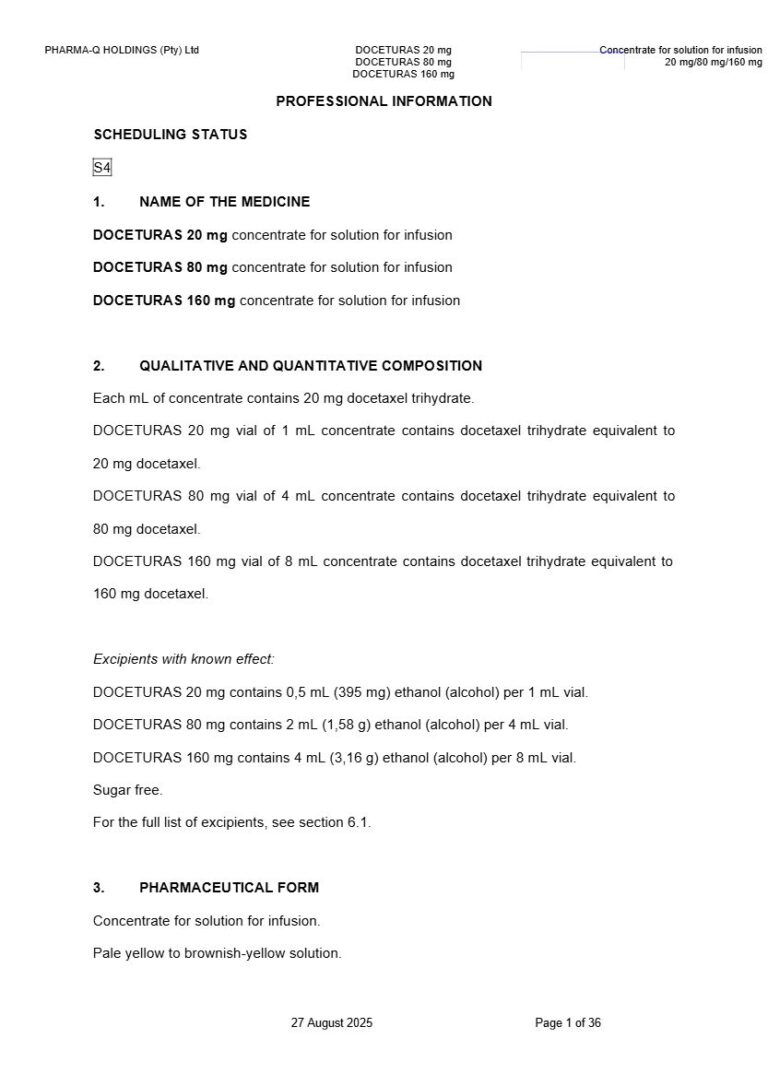
Doceturas 160 Mg Solution
PDF Leaflet Revision Date: 27 August 2025
Clinical Summary
Quick overview from the medicine insert
Indication
Treatment of various cancers including breast, lung, ovarian, and prostate cancer.
Dosage (summary)
75-100 mg/mu00b2 every 3 weeks; premedication with dexamethasone recommended.
Special Populations
- Hepatic impairment
- Elderly
- Paediatric population
Pregnancy & Breastfeeding
Contraindicated in pregnancy and lactation; teratogenic effects observed.
Key Drug Interactions
- CYP3A4 inhibitors
- Dexamethasone
- Cisplatin
Contraindications
- Hypersensitivity to docetaxel
- Neutrophil count < 1500 cells/mmu00b3
- Severe liver impairment
Common side effects
- Neutropenia
- Alopecia
- Nausea
- Vomiting
- Fluid retention
Counselling Points
- Monitor for signs of hypersensitivity
- Avoid pregnancy during treatment
- Report any severe side effects immediately
Serious warnings
- Severe hypersensitivity reactions
- Fluid retention
- Potential for severe liver toxicity
Important Disclaimer
The Doceturas 160 Mg Solution professional information leaflet below is the property of Pharma-Q Holdings and is provided on Medinsert exactly as issued, with no.. alterations or editorial changes. We make every effort to keep content current by updating documents as soon as new versions become available. Medinsert serves as a trusted access point for healthcare professionals, but does not replace official sources or clinical judgement. For more details, please read our full disclaimer. read more>>
 Healthcare Professionals Only
This content is for registered healthcare professionals
Sign in or create a free account to read the full package insert.
Free for HPCSA-registered professionals. Powered by Medinsert.
Clinical Particulars
Section 4 of the official insert — extracted exactly as issued, no alterations
4.1 Therapeutic indications
Breast cancer
nDOCETURAS, in combination with doxorubicin, is indicated for the treatment of patients with locally advanced or metastatic breast cancer who have not previously received cytotoxic therapy for this condition. DOCETURAS monotherapy is indicated for the treatment of patients with locally advanced or metastatic breast cancer, after failure of cytotoxic therapy. DOCETURAS, in combination with capecitabine, is indicated for the treatment of patients with locally advanced or metastatic breast cancer after failure of cytotoxic chemotherapy. Previous therapy should have included an anthracycline.
nNon-small cell lung cancer
nDOCETURAS, in combination with cisplatin, is indicated for the treatment of patients with unresectable, locally advanced or metastatic non-small cell lung cancer, who have not previously received chemotherapy for this condition. DOCETURAS is indicated for the treatment of patients with locally advanced or metastatic non-small cell lung cancer, even after failure of platinum-based chemotherapy.
nOvarian cancer
nDOCETURAS is indicated, after failure of first-line or subsequent chemotherapy, for treatment of metastatic carcinoma of the ovary.
nProstate cancer
nDOCETURAS, in combination with prednisone or prednisolone, is indicated for the treatment of patients with androgen-independent (hormone refractory) metastatic prostate cancer.
4.2 Posology and method of administration
Posology
nA premedication consisting of a corticosteroid (see below for prostate cancer), such as oral dexamethasone 16 mg per day (e.g. 8 mg twice daily) for 3 days, starting one day prior to DOCETURAS administration, unless contraindicated, can be used. For prostate cancer, given the concurrent use of prednisone or prednisolone, the recommended premedication regimen is oral dexamethasone 8 mg administered 12 hours, 3 hours and 1 hour before the DOCETURAS infusion. DOCETURAS is administered as a one-hour infusion every three weeks.
nBreast cancer
nIn first-line treatment, DOCETURAS 75 mg/m2 is administered in combination therapy with doxorubicin (50 mg/m2). For second-line monotherapy for previously treated patients, the recommended dosage of DOCETURAS therapy is 100 mg/m2 in monotherapy. In combination with capecitabine, the recommended dose of DOCETURAS is 75 mg/m2 every three weeks, combined with capecitabine at 1 250 mg/m2 orally twice daily (within 30 minutes after a meal) for 2 weeks followed by a 1-week rest period. For capecitabine dose calculation according to body surface area, see capecitabine approved professional information (PI).
nNon-small cell lung cancer
nIn combination therapy (chemotherapy-nau00efve patients): The recommended dosage regimen is DOCETURAS 75 mg/m2 immediately followed by cisplatin 75 mg/m2 over 30 u2013 60 minutes. In monotherapy (for previously treated patients): The recommended dosage of DOCETURAS therapy is 100 mg/m2 as a single medicine.
nOvarian cancer
nThe recommended dosage of DOCETURAS therapy is 100 mg/m2.
nProstate cancer
nThe recommended dose of DOCETURAS is 75 mg/m2. Prednisone or prednisolone 5 mg orally twice daily is administered continuously. Patients should be observed closely, especially during the first and second infusion of DOCETURAS, because of the risk of hypersensitivity reactions.
nDosage adjustments during treatment
nGeneral ONLY the medical practitioner can modify the schedule of administration. DOCETURAS should be administered when the neutrophil count is u2265 1 500 cells/mm3. Patients who experienced either febrile neutropenia, neutrophil count < 500 cells/mm3 for more than one week, severe or cumulative cutaneous reactions or severe neurosensory signs and/or symptoms during DOCETURAS therapy, should have the dosage of DOCETURAS reduced during the subsequent cycle, from 100 mg/m2 to 75 mg/m2 and/or from 75 mg/m2 to 60 mg/m2. If the patient continues to experience these reactions at 60 mg/m2, treatment should be discontinued.
nCombination therapy with DOCETURAS for non-small cell lung cancer
nFor patients who were dosed initially at DOCETURAS 75 mg/m2 in combination with cisplatin, and whose nadir of platelet count during the previous course of therapy was < 25 000 cells/mm3, or in patients who experience febrile neutropenia, or in patients with serious non-haematological toxicities, the DOCETURAS dosage in subsequent cycles should be reduced to 65 mg/m2. For cisplatin dosage adjustments, see the cisplatin approved PI.
nCombination therapy with DOCETURAS for breast cancer
nPatients who receive adjuvant therapy for breast cancer and who experience febrile neutropenia should receive granulocyte colony-stimulating factor (G-CSF) in all subsequent cycles. Patients who continue to experience this reaction should remain on G-CSF and have their DOCETURAS dose reduced to 60 mg/m2. If G-CSF is not used, the DOCETURAS dose should be reduced from 75 to 60 mg/m2. For capecitabine dose modifications when combined with DOCETURAS, see capecitabine approved PI. For patients developing the first appearance of grade 2 toxicity which persists at the time of the next DOCETURAS/capecitabine treatment, delay treatment until resolved to grade 0 u2013 1, and resume at 100 % of the original dose. For patients developing the second appearance of grade 2 toxicity, or the first appearance of grade 3 toxicity, at any time during the treatment cycle, delay treatment until resolved to grade 0 u2013 1, then resume treatment with DOCETURAS 55 mg/m2. For any subsequent appearances of toxicities, or any grade 4 toxicities, discontinue the DOCETURAS dose.
nFor DOCETURAS dose modifications due to hepatic impairment, see section 4.4.
nSpecial populations
nPatients with hepatic impairment Patients with bilirubin > ULN (upper limit of normal) should generally not receive DOCETURAS. Also, patients with AST (aspartate aminotransferase) and/or ALT (alanine transaminase) > 1,5 x ULN concomitant with alkaline phosphatase > 2,5 x ULN should generally not receive DOCETURAS.
nPaediatric population The safety and effectiveness of DOCETURAS in children have not been established (see section 4.3).
nElderly population Based on a population pharmacokinetic analysis, there are no special instructions for use in elderly patients. For capecitabine dosage reduction when combined with DOCETURAS, see capecitabine approved PI.
nMethod of administration DOCETURAS should be administered by intravenous infusion only.
4.3 Contraindications
- n
- Hypersensitivity to docetaxel or to any of the ingredients in DOCETURAS (see section 6.1). n
- Patients with baseline neutrophil count of < 1 500 cells/mm3. n
- Pregnancy and lactation, as DOCETURAS is teratogenic in animals (see section 4.6). n
- The safe use of DOCETURAS in children has not been established. n
- Patients with severe liver impairment, since there are no data available (see sections 4.4). n
- Contraindications for other medicines also apply when combined with DOCETURAS. n
4.4 Special warnings and precautions for use
DOCETURAS should be administered under the supervision of a qualified medical practitioner experienced in the use of antineoplastic medicines. Appropriate management of complications is possible only when adequate diagnostic and treatment facilities are readily available. The incidence of treatment-related mortality associated with DOCETURAS therapy is increased in patients with abnormal liver function and in patients receiving higher doses. DOCETURAS should generally not be given to patients with serum bilirubin levels > upper limit of normal (ULN), or to patients with AST and/or ALT > 1,5 x ULN concomitant with alkaline phosphatase levels > 2,5 x ULN. Patients with elevations of bilirubin or abnormalities of transaminases concurrent with alkaline phosphatase are at increased risk for the development of grade 4 neutropenia, febrile neutropenia, infections, severe thrombocytopenia, severe stomatitis, severe skin toxicity and toxic death. Bilirubin, AST or ALT and alkaline phosphatase values should be obtained prior to each cycle of DOCETURAS therapy and reviewed by the treating medical practitioner. DOCETURAS therapy should not be given to patients with neutrophil counts of < 1 500 cells/mm3. In order to monitor the occurrence of neutropenia, which may be severe and result in infection, frequent blood cell counts should be performed on all patients receiving DOCETURAS.
nSevere hypersensitivity reactions characterised by hypotension and/or bronchospasm or generalised rash/erythema occurred in 2,2 % of patients who received the recommended 3-day dexamethasone premedication. Hypersensitivity reactions requiring discontinuation of docetaxel were reported in some patients who did not receive premedication. These reactions resolved after discontinuation of the infusion and the administration of appropriate therapy.
nDOCETURAS must not be given to patients who have a history of severe hypersensitivity reactions to DOCETURAS or to other medicines formulated with polysorbate 80. Severe fluid retention occurred in 6,5 % of patients despite use of a 3-day dexamethasone premedication regimen. It was characterised by one or more of the following events: poorly tolerated peripheral oedema, generalised oedema, pleural effusion requiring urgent drainage, dyspnoea at rest, cardiac tamponade or pronounced abdominal distension (due to ascites). For breast and non-small cell lung cancers, premedication consisting of an oral corticosteroid, such as dexamethasone 16 mg per day (e.g. 8 mg twice per day) for 3 days starting 1 day prior to DOCETURAS administration, unless contraindicated, can reduce the incidence and severity of fluid retention as well as the severity of hypersensitivity reactions. For prostate cancer, the premedication is oral dexamethasone 8 mg, 12 hours, 3 hours and 1 hour before DOCETURAS infusion (see section 4.2).
nHaematology Neutropenia is the most frequent adverse reaction of docetaxel, as in DOCETURAS. Neutrophil nadirs occurred at a median of 7 days, but this interval may be shorter in heavily pre-treated patients. Frequent monitoring of complete blood counts should be conducted on all patients receiving DOCETURAS. Patients should be retreated with DOCETURAS when neutrophils recover to a level u2265 1 500 cells/mm3 (see section 4.2). In the case of severe neutropenia (< 500 cells/mm3 for seven days or more) during a course of DOCETURAS therapy, a reduction in dose for subsequent courses of therapy or the use of appropriate symptomatic measures are recommended (see section 4.2).
nIn patients treated with docetaxel as in DOCETURAS in combination with cisplatin and 5-fluorouracil (TCF), febrile neutropenia and neutropenic infection occurred at lower rates when patients received prophylactic G-CSF. Patients treated with TCF should receive prophylactic G-CSF to mitigate the risk of complicated neutropenia (febrile neutropenia, prolonged neutropenia or neutropenic infection). Patients receiving TCF should be closely monitored (see sections 4.2 and 4.8).
nIn patients treated with docetaxel as in DOCETURAS in combination with doxorubicin and cyclophosphamide (TAC), febrile neutropenia and/or neutropenic infection occurred at lower rates when patients received primary G-CSF prophylaxis. Primary G-CSF prophylaxis should be considered in patients who receive adjuvant therapy with TAC for breast cancer to mitigate the risk of complicated neutropenia (febrile neutropenia, prolonged neutropenia or neutropenic infection). Patients receiving TAC should be closely monitored (see sections 4.2 and 4.8).
nGastrointestinal reactions Caution is recommended for patients with neutropenia, particularly at risk for developing gastrointestinal complications. Although majority of cases occurred during the first or second cycle of docetaxel, as in DOCETURAS, containing regimen, enterocolitis could develop at any time, and could lead to death as early as on the first day of onset. Patients should be closely monitored for early manifestations of serious gastrointestinal toxicity (see sections 4.2, 4.4 and 4.8).
nHypersensitivity reactions Patients should be observed closely for hypersensitivity reactions especially during the first and second infusions. Hypersensitivity reactions may occur within a few minutes following the initiation of the infusion of DOCETURAS, thus facilities for the treatment of hypotension and bronchospasm should be available. If hypersensitivity reactions occur, minor symptoms such as flushing or localised cutaneous reactions do not require interruption of therapy. However, severe reactions, such as severe hypotension, bronchospasm or generalised rash/erythema require immediate discontinuation of DOCETURAS and appropriate therapy. Patients who have developed severe hypersensitivity reactions should not be re-challenged with DOCETURAS. Patients who have previously experienced a hypersensitivity reaction to paclitaxel may be at risk to develop hypersensitivity reaction to docetaxel, as in DOCETURAS, including more severe hypersensitivity reaction. These patients should be closely monitored during initiation of therapy with DOCETURAS.
nCutaneous reactions Localised skin erythema of the extremities (palms of the hands and soles of the feet) with oedema followed by desquamation has been observed. Severe symptoms such as eruptions followed by desquamation which lead to interruption or discontinuation of docetaxel treatment were reported (see section 4.2). Severe cutaneous adverse reactions (SCARs) such as Stevens-Johnson syndrome (SJS), toxic epidermal necrolysis (TEN) and acute generalised exanthematous pustulosis (AGEP) have been reported with docetaxel, as in DOCETURAS, treatment. Patients should be informed about the signs and symptoms of serious skin manifestations and closely monitored. If signs and symptoms suggestive of these reactions appear discontinuation of DOCETURAS should be considered.
nFluid retention Patients with severe fluid retention such as pleural effusion, pericardial effusion and ascites should be monitored closely.
nRespiratory disorders Acute respiratory distress syndrome, interstitial pneumonia/ pneumonitis, interstitial lung disease, pulmonary fibrosis and respiratory failure have been reported and may be associated with fatal outcome. Cases of radiation pneumonitis have been reported in patients receiving concomitant radiotherapy. If new or worsening pulmonary symptoms develop, patients should be closely monitored, promptly investigated and appropriately treated. Interruption of DOCETURAS therapy is recommended until diagnosis is available. Early use of supportive care measures may help improve the condition. The benefit of resuming DOCETURAS treatment must be carefully evaluated.
nPatients with liver impairment In patients treated with DOCETURAS at 100 mg/m2 as single medicine who have serum transaminase levels (ALT and/or AST) > 1,5 times the ULN concurrent with serum alkaline phosphatase levels > 2,5 times the ULN, there is a higher risk of developing severe adverse reactions, such as toxic deaths including sepsis and gastrointestinal haemorrhage which can be fatal, febrile neutropenia, infections, thrombocytopenia, stomatitis and asthenia. Therefore, the recommended dose of DOCETURAS in those patients with elevated liver function test (LFTs) is 75 mg/m2 and LFTs should be measured at baseline and before each cycle (see section 4.2). For patients with serum bilirubin levels > ULN and/or ALT and AST > 3,5 times the ULN concurrent with serum alkaline phosphatase levels > 6 times the ULN, no dose-reduction can be recommended and DOCETURAS should not be used unless strictly indicated. In combination with cisplatin and 5-fluorouracil for the treatment of patients with gastric adenocarcinoma, the pivotal clinical study excluded patients with ALT and/or AST > 1,5 x ULN associated with alkaline phosphatase > 2,5 x ULN and bilirubin > 1 x ULN; for these patients, no dose-reductions can be recommended and DOCETURAS should not be used unless strictly indicated. No data are available in patients with hepatic impairment treated by DOCETURAS in combination in the other indications.
4.5 Interactions with other medicines
The quantity of alcohol in DOCETURAS may alter the effects of other medicines. In vitro studies have shown that the metabolism of docetaxel, as in DOCETURAS, may be modified by the concomitant administration of compounds which induce, inhibit or are metabolised by (and thus may inhibit the enzyme competitively) cytochrome P450-3A such as ciclosporin, ketoconazole and erythromycin. As a result, caution should be exercised when treating patients with these medicines as concomitant therapy, since there is a potential for a significant interaction. In case of combination with CYP3A4 inhibitors, the occurrence of DOCETURAS adverse reactions may increase, as a result of reduced metabolism. If the concomitant use of a strong CYP3A4 inhibitor (e.g. ketoconazole, itraconazole, clarithromycin, indinavir, nefazodone, nelfinavir, ritonavir, saquinavir, telithromycin and voriconazole) cannot be avoided, a close clinical surveillance is warranted and a dose adjustment of DOCETURAS may be suitable during the treatment with strong CYP3A4 inhibitors (see section 4.4).
nDocetaxel pharmacokinetics in the presence of prednisone was studied in patients with metastatic prostate cancer. Docetaxel is metabolised by CYP3A4 and prednisone is known to induce CYP3A4. No statistically significant effect of prednisone on the pharmacokinetics of docetaxel, as in DOCETURAS was observed. Docetaxel is highly protein bound (> 95 %). Although the possible in vivo interaction of docetaxel with concomitantly administered medicines has not been investigated formally, in vitro interactions with tightly protein-bound medicines such as erythromycin, diphenhydramine, propranolol, propafenone, phenytoin, salicylate, sulfamethoxazole and sodium valproate did not affect protein binding of docetaxel, as in DOCETURAS. In addition, dexamethasone did not affect protein binding of docetaxel, as in DOCETURAS. Docetaxel did not influence the binding of digoxin.
nThe pharmacokinetics of docetaxel, doxorubicin and cyclophosphamide were not influenced by their co-administration. Limited data from a single uncontrolled study were suggestive of an interaction between docetaxel and carboplatin. When combined to docetaxel, as in DOCETURAS, the clearance of carboplatin was approximately 50 % higher than values previously reported for carboplatin monotherapy.
4.6 Fertility, pregnancy and lactation
Women of childbearing potential / Contraception in males and females
nContraceptive measures must be taken by both men and women during treatment. It should be taken by women for at least three months after cessation of DOCETURAS therapy and by men 6 months after cessation of therapy.
nPregnancy
nThe use of DOCETURAS is contraindicated in pregnancy as docetaxel is teratogenic in animals.
nBreastfeeding
nThe use of DOCETURAS is contraindicated in lactation.
nFertility
nMen being treated with DOCETURAS are advised not to father a child during and up to 6 months after treatment and to seek advice on conservation of sperm prior to treatment.
4.7 Effects on ability to drive and use machines
No studies on the effects of DOCETURAS on the ability to drive a vehicle and use machines have been performed. The amount of alcohol in DOCETURAS and the side effects may impair a patientu2019s ability to perform tasks requiring attention (see sections 4.4 and 4.8). Patients should be advised to exercise caution when driving a vehicle and operating machines.
4.8 Undesirable effects
Summary of the safety profile
nThe most frequent reported adverse reactions of docetaxel, as in DOCETURAS, alone are neutropenia, anaemia, alopecia, nausea, vomiting, stomatitis, diarrhoea and asthenia. The severity of adverse events may be increased when DOCETURAS is given in combination with other chemotherapeutic medicines.
nBlood and lymphatic system disorders
nFrequent: Bone marrow suppression and other haematological adverse reactions include neutropenia, febrile neutropenia, thrombocytopenia, anaemia and infections. Neutropenia is reversible and not cumulative. The median time to nadir is 7 days and the median duration of severe neutropenia (< 500 cells/mm3) is 7 days. Fever in absence of infection, has been reported in patients with non-small cell lung cancer.
nLess frequent: Bleeding episodes have occurred and were rarely associated with severe thrombocytopenia (< 50 000 cells/mm3).
nImmune system disorders
nFrequent: Hypersensitivity reactions may occur, usually within a few minutes following the start of the infusion of DOCETURAS and are mostly mild to moderate. Symptoms are flushing, rash with or without pruritus, chest tightness, back pain, dyspnoea and drug fever or chills. Severe reactions characterised by hypotension and/or bronchospasm or generalised rash/erythema, requiring therapeutic intervention, may occur. These may resolve after discontinuation of the infusion and institution of appropriate therapy.
nMetabolism and nutrition disorders
nLess frequent: Fluid accumulation: Peripheral oedema, pleural effusion, pericardial effusion, ascites, increased capillary permeability and increased body mass, have been reported. The peripheral oedema usually starts at the lower extremities and may become generalised with an increase in body mass of 3 kg or more after 4 cycles or a cumulative dose u2265 400 mg/m2. Fluid retention is cumulative in incidence and severity. The onset of moderate and severe retention is delayed in patients with premedication compared with patients without premedication. However, it has been reported in some patients during the early courses of therapy. The median time to fluid retention reversibility is 16,4 weeks (range 0 to 42 weeks) in patients receiving the recommended premedication. Fluid retention has not been accompanied by acute episodes of oliguria or hypotension. Fluid retention has been less frequently reported in patients receiving the recommended premedication compared with patients without premedication. Dehydration and pulmonary oedema have been reported.
nNervous system disorders
nFrequent: Neurosensory signs (characterised by paraesthesia, dysaesthesia or pain, including burning). Neuromotor events (mainly characterised by weakness). Cases of convulsion or transient loss of consciousness have been observed with DOCETURAS administration. These reactions may appear during the infusion of DOCETURAS.
nEye disorders
nLess frequent: Lacrimation, with or without conjunctivitis, individual cases of lacrimal duct obstruction resulting in excessive tearing, transient visual disturbances (flashes, flashing lights, scotomata), typically occurring during DOCETURAS infusion and in association with hypersensitivity reactions.
nCardiovascular system disorders
nLess frequent: Venous thromboembolic events, myocardial infarction, left ventricular dysfunction, unstable angina, dysrhythmia, sinus tachycardia, atrial flutter or paroxysmal atrial tachycardia.
nVascular disorders
nLess frequent: Hypertension, hypotension.
nRespiratory, thoracic and mediastinal disorders
nFrequent: Dyspnoea may occur and is associated with acute hypersensitivity reactions, respiratory infections and cancerous lung involvement.
nLess frequent: Cough and epistaxis. Acute respiratory distress syndrome, interstitial pneumonia, pulmonary fibrosis and radiation recall phenomena have been reported.
nGastrointestinal system disorders
nFrequent: Gastrointestinal effects, such as nausea, vomiting, diarrhoea and abdominal pain, constipation, stomatitis, oesophagitis and taste perversion. Gastrointestinal bleeding, anorexia. Occurrences of dehydration due to gastrointestinal events, gastrointestinal perforation, ischaemic colitis, colitis and neutropenic enterocolitis.
nLess frequent: Ileus and intestinal obstruction.
nHepatobiliary system disorders
nLess frequent: Increases in serum levels of AST, ALT, bilirubin and alkaline phosphatase > 2,5 times ULN, hepatitis.
nSkin and subcutaneous tissue disorders
nFrequent: Reversible cutaneous reactions (characterised by a rash, including localised eruptions mainly on the feet and hands, but also on the arms, face or thorax, and frequently associated with pruritus). Eruptions generally occurred within one week after the DOCETURAS infusion. Nail disorders may occur (characterised by hypo- or hyperpigmentation and sometimes pain and onycholysis).
nLess frequent: Severe symptoms, such as eruptions followed by desquamation, may lead to interruption or discontinuation of DOCETURAS treatment. Bullous eruptions, such as erythema multiforme or Stevens-Johnson syndrome.
nMusculoskeletal, connective tissue and bone disorders
nFrequent: Arthralgia and myalgia.
nGeneral disorders and administrative site conditions
nFrequent: Infusion site reactions are generally mild and consist of hyperpigmentation, inflammation, redness or dryness of the skin, phlebitis or extravasation and swelling of the vein. Generalised or localised pain (including chest pain without any cardiac or respiratory involvement), alopecia and asthenia.
nCombination therapy with DOCETURAS in the adjuvant treatment of breast cancer: Clinically important treatment related adverse events in patients receiving docetaxel, as in DOCETURAS, in combination with doxorubicin and cyclophosphamide:
nInfections and infestations Frequent: Infection.
nBlood and lymphatic system disorders Frequent: Anaemia, neutropenia, fever in absence of infection, thrombocytopenia, febrile neutropenia and neutropenic infection.
nImmune system disorders Frequent: Hypersensitivity reactions.
nMetabolism and nutrition disorders Frequent: Peripheral oedema, increased or decreased body mass.
nLess frequent: Lymph oedema.
nNervous system disorders Frequent: Sensory neuropathy, syncope.
nLess frequent: Neuro-cortical adverse events, motor neuropathy and neuro-cerebellar adverse events.
nEye disorders Less frequent: Lacrimation disorder, conjunctivitis.
nCardiac disorders Less frequent: Cardiac dysrhythmias.
nVascular disorders Frequent: Vasodilation.
nLess frequent: Hypotension, phlebitis.
nRespiratory, thoracic and mediastinal disorders Less frequent: Cough.
nGastrointestinal disorders Frequent: Anorexia, nausea, stomatitis, vomiting, diarrhoea, taste perversion, constipation. Less frequent: Abdominal pain.
nSkin and subcutaneous tissue disorders Frequent: Alopecia, skin toxicity and nail disorders.
nMusculoskeletal, connective tissue and bone disorders Frequent: Myalgia, arthralgia.
nReproductive system and breast disorders Frequent: Amenorrhoea.
nGeneral disorders and administrative site conditions Frequent: Asthenia.
4.9 Overdose
There were a few reports of overdose. There is no known antidote for docetaxel, as in DOCETURAS overdose. In case of overdose, the patient should be kept in a specialised unit and vital functions closely monitored. In cases of overdose, exacerbation of adverse events may be expected. Patients should receive therapeutic G-CSF as soon as possible after discovery of overdose. Other appropriate symptomatic measures should be taken, as needed.
