
Dorzopt Forte 20 mg, 5 mg Eye drops solution
PDF Leaflet Revision Date: 05 September 2023
Clinical Summary
Quick overview from the medicine insert
Indication
Treatment of elevated intra-ocular pressure in glaucoma and ocular hypertension.
Dosage (summary)
One drop in affected eye(s) twice daily.
Special Populations
- Paediatric patients under 2 years
- Hepatic impairment
Pregnancy & Breastfeeding
Not recommended during pregnancy; timolol excreted in breast milk.
Key Drug Interactions
- Additive effects with systemic beta-blockers
- Increased hypotensive effects with calcium channel blockers
Contraindications
- Hypersensitivity to dorzolamide/timolol
- Reactive airway disease
- Severe renal impairment
Common side effects
- Burning/stinging
- Blurred vision
- Headache
- Dizziness
Counselling Points
- Remove contact lenses before use
- Wait 15 mins before reinserting lenses
- Monitor for signs of allergic reactions
Serious warnings
- Systemic absorption may cause cardiovascular/respiratory reactions
- Caution in patients with asthma or COPD
Important Disclaimer
The Dorzopt Forte 20 mg, 5 mg Eye drops solution professional information leaflet below is the property of Austell Pharmaceuticals and is provided on Medinsert exactly as issued, with no.. alterations or editorial changes. We make every effort to keep content current by updating documents as soon as new versions become available. Medinsert serves as a trusted access point for healthcare professionals, but does not replace official sources or clinical judgement. For more details, please read our full disclaimer. read more>>
 Healthcare Professionals Only
This content is for registered healthcare professionals
Sign in or create a free account to read the full package insert.
Free for HPCSA-registered professionals. Powered by Medinsert.
Clinical Particulars
Section 4 of the official insert — extracted exactly as issued, no alterations
4.1 Therapeutic indications
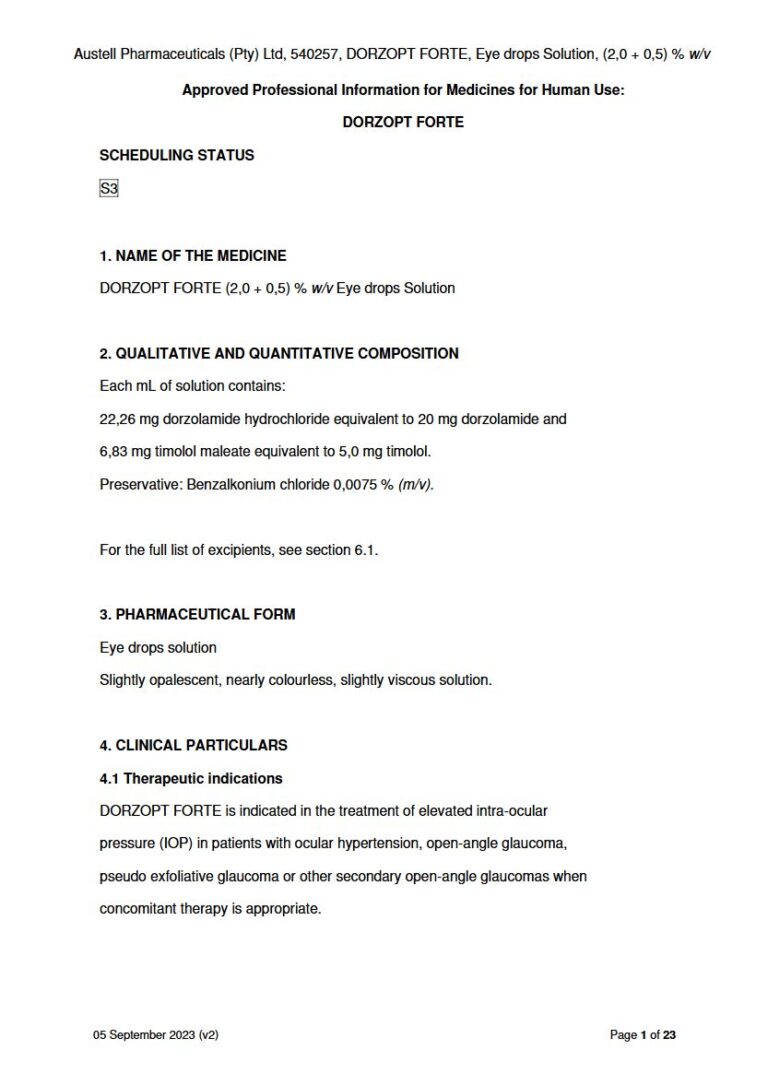
DORZOPT FORTE is indicated in the treatment of elevated intra-ocular pressure (IOP) in patients with ocular hypertension, open-angle glaucoma, pseudo exfoliative glaucoma or other secondary open-angle glaucomas when concomitant therapy is appropriate.
4.2 Posology and method of administration
Posology
The dose is one drop of DORZOPT FORTE in the affected eye(s) two times daily.
Paediatric population
Safety and efficacy in paediatric patients below the age of 2 years have not been established. Although DORZOPT FORTE has been used in children 2 to 6 years of age, however data on safety and efficacy are insufficient to recommend a safe and effective dose.
Method of administration
DORZOPT FORTE is for ocular use only. When substituting DORZOPT FORTE for another ophthalmic antiglaucoma medicine, discontinue the other medicine after proper dosing on one day, and start DORZOPT FORTE on the next day. If another topical ophthalmic medicine is being used, DORZOPT FORTE and the other medicine should be administered at least ten minutes apart.
4.3 Contraindications
- Hypersensitivity to dorzolamide and/or timolol or to any of the excipients listed in section 6.1.
- Reactive airway disease including bronchial asthma or a history of bronchial asthma, or severe chronic obstructive pulmonary disease
- Sinus bradycardia, sick sinus syndrome, sino-atrial block, second or third degree atrioventricular block not controlled with pacemaker, overt cardiac failure, cardiogenic shock
- Severe renal impairment (CrCl < 30 mL/min) or hyperchloraemic acidosis
The above are based on the components and are not unique to the combination. DORZOPT FORTE contains the preservative benzalkonium chloride, which may be deposited in soft contact lenses; therefore, DORZOPT FORTE should not be administered while wearing these lenses. The lenses should be removed before application of the drops and not be reinserted earlier than 15 minutes after use (see section 4.4).
4.4 Special warnings and precautions for use
Cardiovascular/Respiratory Reactions
Topically applied ophthalmic medicine timolol is absorbed systemically. Due to beta-adrenergic component, timolol, cardiovascular, pulmonary and other adverse reactions may occur. Incidence of systemic ADRs after topical ophthalmic administration is lower than for systemic administration. To reduce the systemic absorption, see section 4.2.
Cardiac Disorders
In patients with cardiovascular diseases (e.g. coronary heart disease, Prinzmetal's angina and cardiac failure) and hypotension therapy with beta-blockers should be critically assessed and the therapy with other active substances should be considered. Patients with cardiovascular diseases should be watched for signs of deterioration of these diseases and of adverse reactions.
Due to its negative effect on conduction time, beta-blockers should only be given with caution to patients with first degree heart block.
Vascular Disorders
Patients with severe peripheral circulatory disturbance/disorders (i.e. severe forms of Raynaud's disease or Raynaud's syndrome) should be treated with caution.
Respiratory Disorders
Respiratory reactions, including death due to bronchospasm in patients with asthma have been reported following administration of some ophthalmic beta-blockers. DORZOPT FORTE should be used with caution, in patients with mild/moderate chronic obstructive pulmonary disease (COPD).
Hepatic Impairment
This medicine has not been studied in patients with hepatic impairment and should therefore be used with caution in such patients.
Immunology and Hypersensitivity
Topically applied ophthalmic medicines may be absorbed systemically. Dorzolamide contains a sulfonamido group, which also occurs in sulfonamides. Therefore, the same types of adverse reactions found with systemic administration of sulfonamides may occur with topical administration, including severe reactions such as Stevens-Johnson syndrome and toxic epidermal necrolysis. If signs of serious reactions or hypersensitivity occur, discontinue use of DORZOPT FORTE.
Local ocular adverse effects, similar to those observed with dorzolamide hydrochloride eye drops, have been seen with DORZOPT FORTE. If such reactions occur, discontinuation of DORZOPT FORTE should be considered.
While taking beta-blockers, patients with a history of atopy or a history of severe anaphylactic reaction to a variety of allergens may be more reactive to repeated challenge with such allergens and may be unresponsive to the usual dose of adrenaline used to treat anaphylactic reactions.
Concomitant Therapy
The effect on intra-ocular pressure or the known effects of systemic beta-blockade may be potentiated when timolol as contained in DORZOPT FORTE is given to the patients already receiving a systemic beta-blocking medicine. The response of these patients should be closely observed. The use of two topical beta-adrenergic blocking medicines is not recommended (see section 4.5). The use of dorzolamide as contained in DORZOPT FORTE and oral carbonic anhydrase inhibitors is not recommended.
Withdrawal of Therapy
If discontinuation of ophthalmic timolol is needed in patients with coronary heart disease, therapy should be withdrawn gradually.
4.5 Interaction with other medicines and other forms of interaction
Specific medicine interaction studies have not been performed with DORZOPT FORTE. In clinical studies, dorzolamide and timolol was used concomitantly with the following systemic medications without evidence of adverse interactions: ACE- inhibitors, calcium channel blockers, diuretics, non-steroidal anti-inflammatory medicines including aspirin, and hormones (e.g. oestrogen, insulin, thyroxine). There is a potential for additive effects resulting in hypotension and/or marked bradycardia when ophthalmic beta-blockers solution is administered concomitantly with oral calcium channel blockers, catecholamine-depleting medicines or beta-adrenergic blocking medicines, antidysrhythmics (including amiodarone), digitalis glycosides, parasympathomimetics, guanethidine, narcotics, and monoamine oxidase (MAO) inhibitors.
Potentiated systemic beta-blockade (e.g., decreased heart rate, depression) has been reported during combined treatment with CYP2D6 inhibitors (e.g. quinidine, selective serotonin uptake inhibitors such as fluoxetine, paroxetine) and timolol. Although DORZOPT FORTE alone has little or no effect on pupil size, mydriasis resulting from concomitant use of ophthalmic beta-blockers and adrenaline (epinephrine) has been reported occasionally. Beta-blockers may increase the hypoglycaemic effect of antidiabetic medicines. Oral beta-adrenergic blocking medicines may exacerbate the rebound hypertension which can follow the withdrawal of clonidine.
4.6 Fertility, pregnancy and lactation
Pregnancy
DORZOPT FORTE should not be used during pregnancy. The safety of DORZOPT FORTE in pregnant women has not been established (see section 4.3).
Dorzolamide
No adequate clinical data in exposed pregnancies are available. In rabbits, dorzolamide produced teratogenic effect at maternotoxic doses.
Timolol
There are no adequate data for the use of timolol in pregnant women. Timolol should not be used during pregnancy. To reduce the systemic absorption, see section 4.2.
Breastfeeding
It is not known whether dorzolamide is excreted in human milk. Timolol maleate does appear in human milk. Because of the potential for serious adverse reactions on the nursing infant, a decision should be made whether to discontinue nursing or discontinue DORZOPT FORTE.
4.7 Effects on ability to drive and use machines
No studies on the effects on the ability to drive and use machines have been performed. Possible side effects such as blurred vision, dizziness and syncope which may affect some patients' ability to drive and/or operate machinery.
4.8 Undesirable effects
In clinical studies, the observed adverse reactions have been consistent with those that were reported previously with dorzolamide hydrochloride and/or timolol maleate. During clinical studies, 1035 patients were treated with dorzolamide hydrochloride and/or timolol maleate. Approximately 2,4 % of all patients discontinued therapy with this medicine because of local ocular adverse reactions, approximately 1,2 % of all patients discontinued because of local adverse reactions suggestive of allergy or hypersensitivity (such as lid inflammation and conjunctivitis). Timolol is absorbed into the systemic circulation. This may cause similar undesirable effects as seen with systemic beta-blocking medicines. Incidence of systemic adverse drug reactions (ADRs) after topical ophthalmic administration is lower than for systemic administration. The table below shows all ADRs observed during clinical trials and postmarket spontaneous reports.
4.9 Overdose
No data are available in humans in regard to overdose by accidental or deliberate ingestion of DORZOPT FORTE. Signs and symptoms
There have been reports of inadvertent overdoses with timolol maleate ophthalmic solution resulting in systemic effects similar to those seen with systemic beta-adrenergic blocking medicines such as dizziness, headache, shortness of breath, bradycardia, bronchospasm, and cardiac arrest. The most common signs and symptoms to be expected with overdoses of dorzolamide are electrolyte imbalance, development of an acidotic state, and possibly central nervous system effects. Only limited information is available with regard to human overdose by accidental or deliberate ingestion of dorzolamide hydrochloride. With oral ingestion, somnolence has been reported. With topical application the following have been reported: nausea, dizziness, headache, fatigue, abnormal dreams, and dysphagia.
Treatment
Treatment should be symptomatic and supportive. Serum electrolyte levels (particularly potassium) and blood pH levels should be monitored. Studies have shown that timolol does not dialyse readily.
