
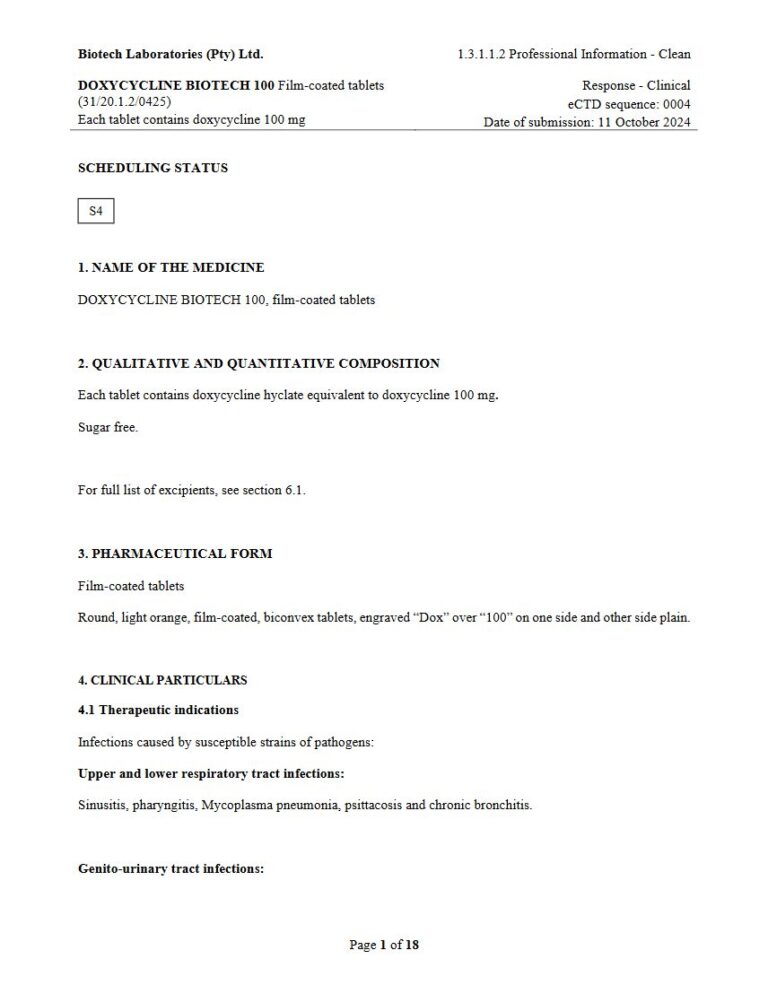
Doxycycline Biotech 100 100 mg FC tablets.
PDF Leaflet Revision Date: 03 March 2025
Clinical Summary
Quick overview from the medicine insert
Indication
Infections caused by susceptible strains of pathogens.
Dosage (summary)
Adults: 100 mg twice daily on day 1, then 100 mg daily.
Special Populations
- Renal impairment
- Hepatic impairment
- Elderly
Pregnancy & Breastfeeding
Contraindicated in pregnancy and lactation due to risk of teeth discoloration.
Key Drug Interactions
- Diminished absorption with milk and antacids
- May increase anticoagulant effects
- Decreased effectiveness of oral contraceptives
Contraindications
- Hypersensitivity to doxycycline
- Pregnancy
- Lactation
- Children under 12 years
- Systemic lupus erythematosus
Common side effects
- Nausea
- Vomiting
- Photosensitivity
- Tooth discoloration
- Headache
Counselling Points
- Take with adequate liquid
- Avoid sunlight exposure
- Monitor for signs of liver damage
Serious warnings
- Serious skin reactions
- Pseudomembranous colitis
- Benign intracranial hypertension
Important Disclaimer
The Doxycycline Biotech 100 100 mg FC tablets. professional information leaflet below is the property of Biotech Laboratories and is provided on Medinsert exactly as issued, with no.. alterations or editorial changes. We make every effort to keep content current by updating documents as soon as new versions become available. Medinsert serves as a trusted access point for healthcare professionals, but does not replace official sources or clinical judgement. For more details, please read our full disclaimer. read more>>
 Healthcare Professionals Only
This content is for registered healthcare professionals
Sign in or create a free account to read the full package insert.
Free for HPCSA-registered professionals. Powered by Medinsert.
Clinical Particulars
Section 4 of the official insert — extracted exactly as issued, no alterations
4.1 Therapeutic indications
Infections caused by susceptible strains of pathogens: Upper and lower respiratory tract infections: Sinusitis, pharyngitis, Mycoplasma pneumonia, psittacosis and chronic bronchitis. Genito-urinary tract infections: Non-specific urethritis (only if the strain is sensitive), lymphogranuloma venereum, chancroid and granuloma inguinale, gonococcal salpingitis, epididymitis, acute epididymo-orchitus, endocervical infections, syphilis and gonorrhoea (in cases of penicillin allergy). Opthalmic: Trachoma and inclusion conjunctivitis. Intestinal: Cholera, Whippleu2019s disease and tropical sprue. Miscellaneous: Rickettsial infections, brucellosis, tularaemia, actinomycosis, Lyme disease, yaws, relapsing fever, leptospirosis during the early infective phase.
4.2 Posology and method of administration
Posology
Adults
The usual dose is 100 mg twice daily on the first day, then 100 mg daily.
Paediatric population
DOXYCYCLINE BIOTECH 100 should not be used in children aged younger than 12 years due to the risk of teeth discolouration. (see section 4.3, 4.4 and 4.8).
Method of administration
For oral administration
Should be taken either one hour before meals or two hours after meals. Should be taken with adequate liquid and with the patient in the upright position, to avoid lodging of tablets in the distal oesophagus as this may result in local corrosive irritation and ulceration (see section 4.4 and 4.8).
4.3 Contraindications
- Hypersensitivity to doxycycline hyclate, other tetracyclines or to any of the excipients of DOXYCYCLINE BIOTECH 100 listed in section 6.1.
- In patients with impaired renal function.
- DOXYCYCLINE BIOTECH 100 should not be given in pregnancy. DOXYCYCLINE BIOTECH 100 crosses the placenta and are deposited in foetal bones and teeth (see section 4.6).
- Pregnant women are particularly susceptible to severe doxycycline-induced liver damage (see section 4.6).
- DOCYCYCLINE BIOTECH 100 should not be given to lactating women or to children younger than 12 years of age as permanent discolouration of the childu2019s teeth may occur (see section 4.6).
- DOXYCYCLINE BIOTECH 100 should not be given to patients with systemic lupus erythematosus (see section 4.8).
4.4 Special warnings and precautions for use
Paediatric population
The use of medicines of the tetracycline class during tooth development (last half of pregnancy; infancy and childhood to the age of 12 years) may cause permanent discolouration of the teeth (yellow-grey-brown) (see section 4.3). This adverse reaction is more common during long-term use of the medicines but has been observed following repeated short-term courses. Enamel hypoplasia has also been reported.
Photosensitivity
Photosensitivity manifested by an exaggerated sunburn reaction has been observed in some individuals taking tetracyclines, including DOXYCYCLINE BIOTECH 100. Patients likely to be exposed to direct sunlight or ultraviolet light should be advised that this reaction can occur with tetracycline medicines and treatment should be discontinued at the first evidence of skin erythema.
Use in patients with impaired hepatic function
DOXYCYCLINE BIOTECH 100 should be used with caution in patients with liver function impairment. Abnormal hepatic function has been reported and has been caused by both the oral and parenteral administration of tetracyclines as contained in DOXYCYCLINE BIOTECH 100. Frail or elderly patients are susceptible to the hepatotoxic and anti-anabolic effects of DOXYCYCLINE BIOTECH 100. Do not use concomitantly with hepatotoxic medicines (see section 4.5).
Use in patients with renal impairment
Excretion of DOXYCYCLINE BIOTECH 100 by the kidney is about 40 %/72 hours in individuals with normal renal function. This percentage excretion may fall to a range as low as 1 - 5 %/72 hours in individuals with severe renal insufficiency (creatinine clearance below 10 mL/min). Studies have shown no significant difference in the serum half-life of DOXYCYCLINE BIOTECH 100 in individuals with normal and severely impaired renal function. Haemodialysis does not alter the serum half-life of doxycycline. The anti-anabolic action of the tetracyclines as contained in DOXYCYCLINE BIOTECH 100 may cause an increase in blood urea. Studies to date indicate that this anti-anabolic effect does not occur with the use of DOXYCYCLINE BIOTECH 100 in patients with impaired renal function.
Serious skin reactions
Serious skin reactions, such as exfoliative dermatitis, erythema multiforme, Stevens-Johnson syndrome, toxic epidermal necrolysis, and drug reaction with eosinophilia and systemic symptoms (DRESS) have been reported in patients receiving DOXYCYCLINE BIOTECH 100 (see section 4.8). If serious skin reactions occur, DOXYCYCLINE BIOTECH 100 should be discontinued immediately, and appropriate therapy should be instituted.
Microbiological overgrowth
The use of antibiotics may occasionally result in over-growth of non-susceptible organisms, including Candida. If a resistant organism appears, the antibiotic should be discontinued and appropriate therapy instituted.
Pseudomembranous colitis
Pseudomembranous colitis has been reported with nearly all antibacterial medicines, including DOXYCYCLINE BIOTECH 100, and has ranged in severity from mild to life-threatening. It is important to consider this diagnosis in patients who present with diarrhoea after the administration of antibacterial medicines.
Clostridium difficile associated diarrhoea (CDAD) has been reported with use of nearly all antibacterial medicines, including DOXYCYCLINE BIOTECH 100, and may range in severity from mild diarrhoea to fatal colitis. Treatment with antibacterial medicines alters the normal flora of the colon leading to overgrowth of C. difficile. C. difficile produces toxins A and B, which contribute to development of CDAD. Hypertoxin producing strains of C. difficile cause increased morbidity and mortality, as these infections can be refractory to antimicrobial therapy and may require colectomy. CDAD should be considered in all patients who present with diarrhoea after antibiotic treatment. Careful medical history is necessary since CDAD has been reported to occur over two months after the administration of antibacterial medicines.
Oesophagitis
Oesophagitis and oesophageal ulcerations have been reported in patients receiving capsule and tablet forms of medicines in the tetracycline class, including DOXYCYCLINE BIOTECH 100. Most of these patients took medications immediately before going to bed or with inadequate amounts of fluid.
Porphyria
There have been rare reports of porphyria in patients receiving tetracyclines such as DOXYCYCLINE BIOTECH 100.
Benign intracranial hypertension
Bulging fontanelles in infants have been reported in individuals receiving tetracyclines. Benign intracranial hypertension (pseudotumor cerebri) has been associated with the use of tetracyclines including doxycycline (e.g., DOXYCYCLINE BIOTECH 100). Benign intracranial hypertension (pseudotumor cerebri) is usually transient, however cases of permanent visual loss secondary to benign intracranial hypertension (pseudotumor cerebri) have been reported with tetracyclines including doxycycline. If visual disturbance occurs during treatment, prompt ophthalmologic evaluation is warranted. Since intracranial pressure can remain elevated for weeks after medicine cessation patients should be monitored until they stabilise. Concomitant use of isotretinoin or other systemic retinoids and DOXYCYCLINE BIOTECH 100 should be avoided because isotretinoin is also known to cause benign intracranial hypertension (pseudotumor cerebri). (See section 4.5).
Venereal disease
When treating venereal diseases, where coexistent syphilis is suspected, proper diagnostic procedures, including darkfield examinations, should be utilised. In all such cases, monthly serological tests should be made for at least four months.
Beta-haemolytic streptococci infections
Infections due to Group A beta-haemolytic Streptococci should be treated for at least 10 days.
Myasthenia gravis
Due to a potential for weak neuromuscular blockade, care is advisable in patients with symptoms of myasthenia gravis as this may be aggravated in patients with this problem.
Systemic lupus erythematosus
DOXYCYCLINE BIOTECH 100 should not be used in patients suffering from SLE (see section 4.3).
Jarisch-Herxheimer reaction
Some patients with spirochete infections may experience a Jarisch-Herxheimer reaction shortly after doxycycline (e.g., DOXYCYCLINE BIOTECH 100) treatment is started. Patients should be reassured that this is a usually self-limiting consequence of antibiotic treatment of spirochete infections.
Methoxyflurane
Caution is advised when DOXYCYCLINE BIOTECH 100 is used with methoxyflurane (see section 4.5). The use of expired DOXYCYCLINE BIOTECH 100 may lead to a Fanconi-type syndrome which is characterised by polyuria and polydipsia with nausea, vomiting, proteinuria, glucosuria, acidosis, aminoaciduria, hypophosphatemia and hypocalcaemia (see section 4.8).
4.5 Interaction with other medicines and other forms of interaction
Absorption of DOXYCYCLINE BIOTECH 100 is diminished by milk, alkalis, aluminium hydroxide and other di and tri-valent cations such as calcium, iron, oral zinc, bismuth preparations and magnesium if they are given concomitantly. Dosages should be maximally separated.
There have been reports of prolonged prothrombin time in patients taking warfarin and DOXYCYCLINE BIOTECH 100. DOXYCYCLINE BIOTECH 100 depress plasma prothrombin activity therefore doses of anticoagulant may need to be reduced if given concomitantly.
Phenobarbital, carbamazepine, primidone and phenytoin may increase the metabolism of DOXYCYLINE BIOTECH 100 (reduces half-life). An increase in the daily dosage of DOXYCYCLINE BIOTECH 100 should be considered.
Penicillin should not be given concomitantly with DOXYCYCLINE BIOTECH 100 as antagonism in action may occur, since bacteriostatic medicines may interfere with the bactericidal action of penicillin.
DOXYCYCLINE BIOTECH 100 may diminish the effectiveness of oral contraceptives.
The concurrent use of DOXYCYCLINE BIOTECH 100 and methoxyflurane has been reported to result in serious nephrotoxicity.
Alcohol may decrease the half-life of DOXYCYCLINE BIOTECH 100.
DOXYCYCLINE BIOTECH 100 may increase the plasma concentration of ciclosporin. Co-administration should only be undertaken with appropriate monitoring.
Rifampicin that induces hepatic enzymes may accelerate the decomposition of DOXYCYCLINE BIOTECH 100, thereby decreasing its half-life. Sub-therapeutic doxycycline concentrations may result. Monitoring concurrent use is advised and an increase in DOXYCYCLINE BIOTECH 100 dose may be required.
Concomitant use of isotretinoin or other systemic retinoids and DOXYCYCLINE BIOTECH 100 should be avoided. Each of these medicines used alone has been associated with benign intracranial hypertension (pseudotumor cerebri). (See section 4.4).
False elevations of urinary catecholamine levels may occur due to interference with the fluorescence test.
4.6 Fertility, pregnancy and lactation
Pregnancy
DOXYCYCLINE BIOTECH 100 should not be given in pregnancy. DOXYCYCLINE BIOTECH 100 crosses the placenta and are deposited in foetal bones and teeth (see section 4.3). Pregnant women are particularly susceptible to severe doxycycline-induced liver damage (see section 4.3).
Breastfeeding
DOXYCYCLINE BIOTECH 100 should not be given to lactating women as permanent discolouration of the childu2019s teeth may occur (see section 4.3).
4.7 Effects on ability to drive and use machines
Visual disturbances such as blurring of vision may occur during treatment with DOXYCYCLINE BIOTECH 100 and in such cases; patients must refrain from driving or operating machinery.
4.8 Undesirable effects
Tabulated summary of adverse reactions
MedDRA System Organ Class
Infections and infestations
- Frequent: Vaginal infection, candida infection
- Less frequent:
- Frequency unknown:
Blood and lymphatic system disorders
- Frequent: Haemolytic anaemia, neutropenia, thrombocytopenia, eosinophilia
- Less frequent:
- Frequency unknown:
Immune system disorders
- Frequent: Hypersensitivity reactions (including anaphylactic shock, anaphylactic reaction, anaphylactoid reaction, angioedema, exacerbation of systemic lupus erythematosus, pericarditis, serum sickness, Henoch- Schonlein purpura, hypotension, dyspnoea, tachycardia, peripheral oedema and urticaria)
- Less frequent:
- Frequency unknown:
Endocrine disorders
- Frequent:
- Less frequent: Brown-black microscopic discolouration of thyroid glands
- Frequency unknown:
Metabolism and nutrition disorders
- Frequent: Porphyria, decreased appetite
- Less frequent:
- Frequency unknown: Vitamin deficiencies may occur
Nervous system disorders
- Frequent: Headache
- Less frequent:
- Frequency unknown: Benign intracranial hypertension (pseudotumor cerebri)*, fontanelle bulging
Psychiatric disorders
- Frequent:
- Less frequent: Anxiety
- Frequency unknown:
Ear and labyrinth disorders
- Frequent:
- Less frequent: Tinnitus
- Frequency unknown:
Vascular disorders
- Frequent:
- Less frequent: Flushing
- Frequency unknown:
Gastrointestinal disorders
- Frequent: Nausea, vomiting, enamel hypoplasia (usually only after long-term use), anorexia
- Less frequent: Dyspepsia (heartburn/ gastritis), pancreatitis, pseudomembranous colitis, Clostridium difficile colitis, oesophageal ulcer, oesophagitis, enterocolitis, inflammatory lesions (with monilial overgrowth) in the anogenital region, dysphagia, abdominal pain, diarrhoea, glossitis, stomatitis
- Frequency unknown:
Hepato-biliary disorders
- Frequent: Hepatic failure, hepatitis, hepatotoxicity, jaundice, abnormal hepatic function
- Less frequent:
- Frequency unknown:
Skin and subcutaneous tissue disorders
- Frequent: Photosensitivity reaction, rash including maculopapular and erythematous rashes, Jarisch- Herxheimer reaction (see section 4.4)
- Less frequent: Drug Reaction with Eosinophilia and Systemic Symptoms (DRESS), toxic epidermal necrolysis, Stevens-Johnson syndrome, erythema multiforme, exfoliative dermatitis, photoonycholysis
- Frequency unknown:
Musculoskeletal, connective tissue disorders
- Frequent: Arthralgia, myalgia
- Less frequent:
- Frequency unknown:
Renal and urinary disorders
- Frequent: Increased blood urea
- Less frequent:
- Frequency unknown:
* Symptoms included blurring of vision, scotomata and diplopia. Permanent visual loss has been reported.
a Reversible and superficial discolouration of permanent teeth has been reported with the use of DOXYCYCLINE BIOTECH 100 but frequency cannot be estimated from available data.
Reporting of suspected adverse reactions
Reporting suspected adverse reactions after authorisation of the medicine is important. It allows continued monitoring of the benefit/risk balance of the medicine. Healthcare providers are asked to report any suspected adverse reactions to SAHPRA via the Med Safety APP (Medsafety X SAHPRA) and eReporting platform (who- umc.org) found on SAHPRA website.
4.9 Overdose
In the event of overdosage, appropriate supportive and symptomatic treatment is indicated. Dialysis does not alter serum half-life and thus would not be of benefit in treating cases of overdosage.
