
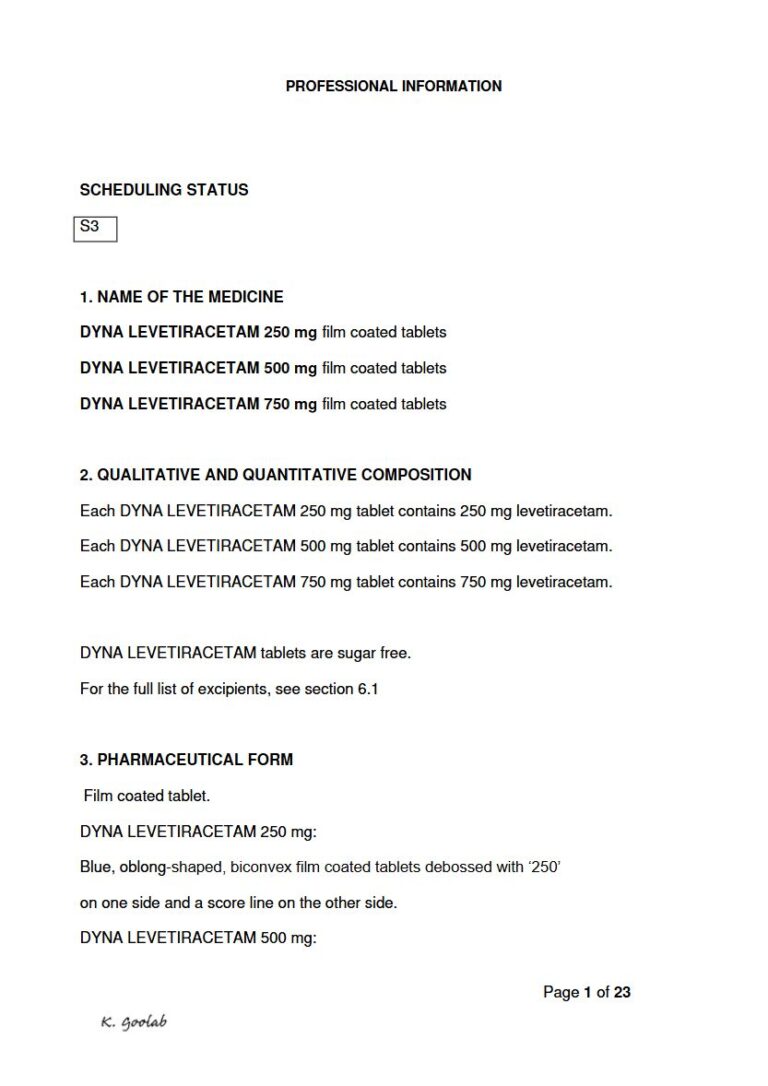
Dyna Levetiracetam 250 mg, 500 mg, 750 mg FC tablet.
PDF Leaflet Revision Date: 11 January 2023
Clinical Summary
Quick overview from the medicine insert
Indication
Monotherapy and adjunctive therapy for epilepsy.
Dosage (summary)
Starting at 250 mg twice daily, max 1500 mg twice daily for monotherapy; 500 mg twice daily for adjunctive therapy, max 3000 mg.
Special Populations
- Elderly
- Renal impairment
- Hepatic impairment
Pregnancy & Breastfeeding
Contraindicated in pregnancy and lactation.
Key Drug Interactions
- Methotrexate
- Probenecid
- Other antiepileptics
Contraindications
- Hypersensitivity to levetiracetam
- Pregnancy
- Lactation
Common side effects
- Somnolence
- Headache
- Dizziness
- Fatigue
- Nasopharyngitis
Counselling Points
- Take with or without food
- Do not double dose if missed
- Monitor for mood changes
Serious warnings
- Risk of suicidal thoughts and behavior
- Monitor for psychiatric symptoms
Important Disclaimer
The Dyna Levetiracetam 250 mg, 500 mg, 750 mg FC tablet. professional information leaflet below is the property of Pharma Dynamics and is provided on Medinsert exactly as issued, with no.. alterations or editorial changes. We make every effort to keep content current by updating documents as soon as new versions become available. Medinsert serves as a trusted access point for healthcare professionals, but does not replace official sources or clinical judgement. For more details, please read our full disclaimer. read more>>
 Healthcare Professionals Only
This content is for registered healthcare professionals
Sign in or create a free account to read the full package insert.
Free for HPCSA-registered professionals. Powered by Medinsert.
Clinical Particulars
Section 4 of the official insert — extracted exactly as issued, no alterations
4.1 Therapeutic indications
DYNA LEVETIRACETAM is indicated as monotherapy in the treatment of partial onset seizures with or without secondary generalisation in patients from 16 years of age with newly diagnosed epilepsy.
DYNA LEVETIRACETAM is indicated as adjunctive therapy:
- in the treatment of partial onset seizures with or without secondary generalisation in adults and children over 16 years of age with epilepsy.
- in the treatment of myoclonic seizures in adults and adolescents from 12 years of age with Juvenile Myoclonic Epilepsy.
- in the treatment of primary generalised tonic-clonic seizures in adults and children from 16 years of age with idiopathic generalised epilepsy.
4.2 Posology and method of administration
Monotherapy:
Adults and adolescents from 16 years of age:
The starting dose is 250 mg twice daily which should be increased to an initial therapeutic dose of 500 mg twice daily after two weeks. The dose can be further increased by 250 mg twice daily every two weeks depending on the clinical response. The maximum daily dose is 1 500 mg twice daily.
Add-on therapy:
Adults and adolescents older than 12 years (weighing 50 kg or more when indicated (see section 4.1)):
As adjunctive therapy, the therapeutic dose is 500 mg twice daily. The dose can be started on the first day of treatment. Depending upon the clinical response and tolerance, the daily dose can be increased up to 1 500 mg twice daily. Dose changes can be made in 500 mg twice daily increments or decrements every two to four weeks. The maximum daily dose is 3 000 mg.
Special populations
Elderly: Adjustment of the dose is recommended in elderly patients with compromised renal function (see Patients with renal impairment below).
Patients with renal impairment: The DYNA LEVETIRACETAM dose should be individualised according to renal function. Refer to the table below and adjust the dose as indicated.
Dosing adjustment for adult patients with impaired renal function:
| Group | Creatinine clearance (mL/min) | Dosage and frequency |
|---|---|---|
| Normal | > 80 | 500 to 1 500 mg twice daily |
| Mild | 50 u2013 79 | 500 to 1 000 mg twice daily |
| Moderate | 30 u2013 49 | 250 to 750 mg twice daily |
| Severe | < 30 | 250 to 500 mg twice daily |
| End-stage renal disease patients undergoing dialysis | 1 | 500 to 1 000 mg once daily |
A 750 mg loading dose is recommended on the first day of treatment with DYNA LEVETIRACETAM. Following dialysis, a 250 mg to 500 mg supplemental dose is recommended. To use this dosing table, an estimate of the patientu2019s creatinine clearance (eCLcr) in mL/min is needed. The CLcr can be estimated from the serum creatinine (Scr) concentration using the modified formula of Cockcroft and Gault (for use in adults): eCLcr (mL/min) = [140 u2013 age] x Wt (kg) x constant*
Scr (u03bc mol/L) *Constant = 1,23 for males and 1,04 for females (0,85 x 1,23 = 1,04)
Patients with hepatic impairment: No dose adjustment is needed in patients with mild to moderate hepatic impairment. In patients with severe hepatic impairment, the creatinine clearance may underestimate the renal insufficiency. Therefore a 50 % reduction of the daily maintenance dose is recommended when the creatinine clearance is < 70 mL/min.
Paediatric population
Infants and children under the age of 12 years:
Monotherapy
The safety and efficacy of DYNA LEVETIRACETAM in children and adolescents below 16 years as monotherapy treatment have not been established. No data are available.
Add-on therapy
Infants and children under the age of 12 years: There are insufficient data available for the use of DYNA LEVETIRACETAM in children under the age of 12 years.
Adolescents (12 to 17 years) weighing less than 50 kg, when indicated (see section 4.1):
The initial therapeutic dose is 10 mg/kg twice daily. This dose can be started on the first day of treatment. Depending upon the clinical response and tolerability, the dose can be increased up to 30 mg/kg twice daily. Dose changes should not exceed increases or decreases of 10 mg/kg twice daily every two weeks. The lowest effective dose should be used. Dosage in children 50 kg or greater is the same as in adults. The doctor should prescribe the most appropriate pharmaceutical form and strength according to weight and dose.
Recommended dosage for children and adolescents with normal renal function:
| Weight | Starting dose (10 mg/kg twice daily) | Maximum dose (30 mg/kg twice daily) |
|---|---|---|
| 15 kg* | 150 mg twice daily | 450 mg twice daily |
| 20 kg* | 200 mg twice daily | 600 mg twice daily |
| 25 kg | 250 mg twice daily | 750 mg twice daily |
| From 50 kg** | 500 mg twice daily | 1 500 mg twice daily |
* Another formulation of levetiracetam should be used.
** Dosage in children and adolescents 50 kg or more is the same as in adults.
Method of administration
The film coated tablets should be taken orally, swallowed with liquid, and may be taken with or without food. The daily dose is administered in two equally divided doses.
Missed dose: If a dose is missed, the tablet should be taken as soon as the missed dose is remembered. Two tablets should not be taken to make up for the missed dose.
4.3 Contraindications
- Hypersensitivity to levetiracetam or other pyrrolidine derivatives, or to any of the ingredients of DYNA LEVETIRACETAM
- Pregnancy and lactation.
4.4 Special warnings and precautions for use
Suicide, suicide attempt, suicidal ideation and behaviour have been reported in patients treated with anti-epileptic medicines (including levetiracetam as in DYNA LEVETIRACETAM). Analysis of randomized placebo-controlled trials of anti-epileptic medicines has shown a small increased risk of suicidal thoughts and behaviour. The mechanism of this risk is not known. Patients should be monitored for signs of depression and/or suicidal ideation and behaviours and appropriate treatment should be considered. Patients (and caregivers of patients) should be advised to seek medical advice should signs of depression and/or suicidal ideation or behaviour emerge (see section 4.8).
Reduced doses of DYNA LEVETIRACETAM are recommended for patients with renal impairment (see section 4.2). Patients receiving dialysis may be given a loading dose of 750 mg when starting DYNA LEVETIRACETAM followed by doses of 500 to 1 000 mg once daily, a supplemental dose of 250 to 500 mg is recommended after dialysis. In patients with severely impaired hepatic function, assessment of renal function is recommended before dose selection (see section 4.2).
The use of DYNA LEVETIRACETAM has been very rarely associated with acute kidney injury, with a time to onset ranging from a few days to several months. DYNA LEVETIRACETAM should be used with caution in patients with severe hepatic impairment. No dose adjustment is needed in patients with mild to moderate hepatic impairment. In patients with severe hepatic impairment, see section 4.2.
Rare cases of decreased blood cell counts (neutropenia, agranulocytosis, leukopenia, thrombocytopenia, and pancytopenia) have been described in association with DYNA LEVETIRACETAM administration, generally at the beginning of the treatment. Complete blood cell counts are advised in patients experiencing important weakness, pyrexia, recurrent infections, or coagulation disorders (see section 4.8).
DYNA LEVETIRACETAM may cause psychotic symptoms and behavioural abnormalities including irritability and aggressiveness. Patients treated with DYNA LEVETIRACETAM should be monitored for developing psychiatric signs suggesting important mood and/or personality changes. If such behaviours are noticed, treatment adaptation or gradual discontinuation should be considered. If discontinuation is considered, please refer to section 4.2.
Withdrawal of DYNA LEVETIRACETAM or transition to or from another type of anti-epileptic therapy should be made gradually (e.g., 500 mg twice daily decrements every two to four weeks in adults; 10 mg/kg twice daily decrements every two weeks in children) to avoid precipitating an increase in the frequency of seizures.
Paediatric population: Available data in children did not suggest impact on growth and puberty. However, long term effects on learning, intelligence, growth, endocrine function, puberty, and childbearing potential in children remain unknown.
4.5 Interaction with other medicines and other forms of interaction
- Potential interactions with existing anti-epileptic medicines (such as phenytoin, carbamazepine, valproic acid, phenobarbital, lamotrigine, gabapentin, and primidone) have not been demonstrated.
- Probenecid (500 mg daily), a renal tubular secretion blocking agent, has been shown to inhibit the renal clearance of the primary metabolite but not of levetiracetam. Nevertheless, the concentration of this metabolite remains low. It is expected that other medicines excreted by active tubular secretion could also reduce the renal clearance of the metabolite. The effect of levetiracetam on probenecid was not studied. The effect of levetiracetam on other actively secreted medicines e.g., NSAIDs and sulphonamides is unknown.
- Concomitant administration of levetiracetam and methotrexate has been reported to decrease methotrexate clearance, resulting in increased/prolonged blood methotrexate concentration to potentially toxic levels. Blood methotrexate and levetiracetam levels should be carefully monitored in patients treated concomitantly with the two medicines.
- DYNA LEVETIRACETAM did not influence the pharmacokinetics of oral contraceptives (ethinyl oestradiol and levonorgestrel), endocrine parameters (luteinising hormone (LH) and progesterone) were not modified. DYNA LEVETIRACETAM 2 000 mg daily did not influence the pharmacokinetics of digoxin and warfarin, prothrombin times were not modified. Co-administration with digoxin, oral contraceptives or warfarin had no influence on the pharmacokinetics of levetiracetam.
- No information on the influence of antacids on the absorption of levetiracetam is available.
- There have been isolated reports of decreased levetiracetam efficacy when the osmotic laxative macrogol has been concomitantly administered with oral levetiracetam. Therefore, macrogol should not be taken orally for one hour before and for one hour after taking levetiracetam.
- The extent of absorption of levetiracetam was not altered by food, but the rate of absorption was slightly reduced.
- No information on the interaction of levetiracetam with alcohol is available.
4.6 Fertility, pregnancy, and lactation
Pregnancy: DYNA LEVETIRACETAM is contraindicated in pregnancy and lactation (see section 4.3).
Breastfeeding: Levetiracetam is excreted in human breast milk. Patients using DYNA LEVETIRACETAM must not breastfeed.
4.7 Effects on ability to drive and use machines
Caution is recommended in patients performing skilled tasks, e.g. driving vehicles or operating machinery. At the beginning of treatment or after a dosage increase, some patients may experience somnolence or other CNS related symptoms.
4.8 Undesirable effects
a. Summary of the safety profile
The most frequently reported adverse reactions were nasopharyngitis, somnolence, headache, fatigue, and dizziness. The safety profile of levetiracetam is generally similar across age groups (adult and paediatric patients) and across the approved epilepsy indications.
b. Tabulated list of adverse effects
| System Organ Class | Frequency | Side effects |
|---|---|---|
| Infections and Infestations | Frequent | Nasopharyngitis |
| Less frequent | Infection | |
| Blood and lymphatic system disorders | Less frequent | Leukopenia*, neutropenia*, pancytopenia*, thrombocytopenia*, agranulocytosis |
| Immune system disorders | Less frequent | Drug reaction with eosinophilia and systemic symptoms (DRESS), Hypersensitivity (including angioedema and anaphylaxis). |
| Metabolism and nutrition disorders | Frequent | Anorexia |
| Less frequent | Decreased weight*, increased weight, hyponatraemia | |
| Psychiatric disorders | Frequent | Anxiety, depression, hostility, aggression, insomnia, nervousness, irritability |
| Less frequent | Psychotic disorders*, mood swings*, agitation, personality disorder, emotional lability, suicide attempt*, suicidal ideation*, completed suicide*, abnormal behaviour*, hallucination*, anger*, confusional state*, panic attack affect, mood swings, thinking abnormal* | |
| Nervous system disorders | Frequent | Dizziness, headache, somnolence, convulsion, balance disorder, lethargy, tremor |
| Less frequent | Paraesthesia*, amnesia, memory impairment, abnormal coordination, ataxia, disturbance in attention, choreoathetosis, dyskinesia, hyperkinesia | |
| Eye disorders | Frequent | Diplopia, blurred vision |
| Ear and labyrinth disorders | Frequent | Vertigo |
| Respiratory, thoracic, and mediastinal disorders | Frequent | Pharyngitis, rhinitis, cough |
| Less frequent | Sinusitis | |
| Gastrointestinal disorders | Frequent | Diarrhoea, dyspepsia, nausea, vomiting, abdominal pain |
| Less frequent | Pancreatitis. | |
| Hepato-biliary disorders | Less frequent | Abnormal liver function tests*, hepatic failure*, hepatitis* |
| Skin and subcutaneous tissue disorders | Frequent | Rash |
| Less frequent | Alopecia, eczema*, pruritus*, toxic epidermal necrolysis*, Stevens-Johnson syndrome*, erythema multiforme* | |
| Musculoskeletal, connective tissue and bone disorders | Frequent | Ataxia, muscular weakness, myalgia |
| Less frequent | Rhabdomyolysis and blood creatine phosphokinase increased** | |
| Renal and urinary disorders | Less frequent | Acute kidney injury |
| General disorders and administrative site conditions | Frequent | Asthenia, fatigue |
| Injury and poisoning | Less frequent | Injury |
*Post marketing side effects
**Prevalence is significantly higher in Japanese patients when compared to non-Japanese patients
c. Description of selected adverse reactions
The risk of anorexia is higher when levetiracetam is co-administered with topiramate. In several cases of alopecia, recovery was observed when levetiracetam was discontinued. Bone marrow suppression was identified in some of the cases of pancytopenia. Cases of encephalopathy generally occurred at the beginning of the treatment (few days to a few months) and were reversible after treatment discontinuation.
d. Paediatric population
The adverse reaction profile of levetiracetam is generally similar across age groups and across the approved epilepsy indications. Safety results in paediatric patients in placebo-controlled clinical studies were consistent with the safety profile of levetiracetam in adults except for behavioural and psychiatric adverse reactions which were more common in children than in adults.
4.9 Overdose
Signs and symptoms: Experience with levetiracetam overdose is limited. Symptoms that may occur with DYNA LEVETIRACETAM overdose include drowsiness, aggression, agitation, coma, depressed level of consciousness, respiratory depression, and somnolence.
Management of overdose: There is no specific antidote for DYNA LEVETIRACETAM overdose. Treatment should be symptomatic and supportive. Emesis or gastric lavage should be attempted if indicated. Standard haemodialysis should be considered, particularly, in selected patients based on clinical state of renal impairment. The dialyser extraction efficiency is 60 % for levetiracetam and 74 % for the primary metabolite.
