
Dyna Pentoxifylline 400 mg Slow release FC tablet.
PDF Leaflet Revision Date: 15 December 2022
Clinical Summary
Quick overview from the medicine insert
Indication
Symptomatic relief of intermittent claudication and Raynaudu2019s syndrome.
Dosage (summary)
1 tablet 2-3 times daily after meals.
Special Populations
- Renal impairment
- Hepatic impairment
- Elderly
Pregnancy & Breastfeeding
Contraindicated in pregnancy and breastfeeding.
Key Drug Interactions
- Antihypertensive medicines
- Anticoagulants
- Theophylline
- Ciprofloxacin
- Ketorolac
Contraindications
- Hypersensitivity to pentoxifylline
- Cerebral haemorrhage
- Severe cardiac dysrhythmias
- Acute myocardial infarction
- Porphyria
Common side effects
- Dizziness
- Nausea
- Vomiting
- Hypotension
- Thrombocytopenia
Counselling Points
- Take after meals with liquid.
- Monitor for signs of bleeding.
- Avoid driving if dizzy.
Serious warnings
- Risk of bleeding
- Anaphylactic reactions
- Caution in hypotensive patients
Important Disclaimer
The Dyna Pentoxifylline 400 mg Slow release FC tablet. professional information leaflet below is the property of Pharma Dynamics and is provided on Medinsert exactly as issued, with no.. alterations or editorial changes. We make every effort to keep content current by updating documents as soon as new versions become available. Medinsert serves as a trusted access point for healthcare professionals, but does not replace official sources or clinical judgement. For more details, please read our full disclaimer. read more>>
 Healthcare Professionals Only
This content is for registered healthcare professionals
Sign in or create a free account to read the full package insert.
Free for HPCSA-registered professionals. Powered by Medinsert.
Clinical Particulars
Section 4 of the official insert — extracted exactly as issued, no alterations
4.1 Therapeutic indications
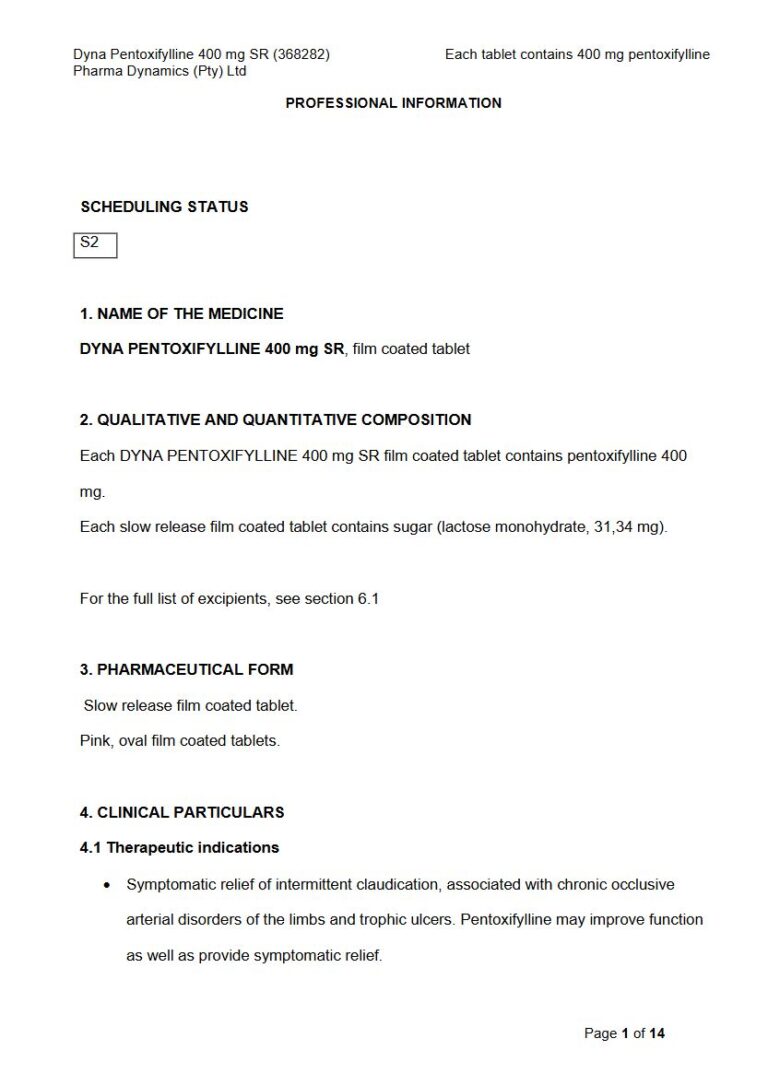
u2022 Symptomatic relief of intermittent claudication, associated with chronic occlusive arterial disorders of the limbs and trophic ulcers. Pentoxifylline may improve function as well as provide symptomatic relief.
u2022 Raynaudu2019s syndrome.
4.2 Posology and method of administration
Unless otherwise prescribed by a doctor, the usual dose is one DYNA PENTOXIFYLLINE 400 mg SR film coated tablet taken two to three times daily.
Special populations
Renal impairment
In patients with impairment of renal function (creatinine clearance below 30 mL/min) a dose reduction of approximately 30 % to 50 % may be necessary (see sections 4.4 and 5.2).
Hepatic impairment
A dose reduction is necessary in patients with severely impaired liver function (see sections 4.4 and 5.2).
Hypotension
Treatment should be started at low dose levels in hypotensive patients or patients whose circulation is unstable as well as in patients who would be at particular risk from a reduction in blood pressure (e.g., patients with severe coronary heart disease or relevant stenosis of blood vessels supplying the brain); in such cases, the dose must be increased gradually.
Paediatric population
DYNA PENTOXIFYLLINE 400 mg SR is not indicated for use in children as safety and efficacy have not been established in this patient group.
Method of administration
DYNA PENTOXIFYLLINE 400 mg SR should be taken after meals, swallowed whole with sufficient amounts of liquid (approximately half a glass). Mothers on DYNA PENTOXIFYLLINE 400 mg SR should not breastfeed (see section 4.6). Missed dose: Doctors should advise patients who forget to take DYNA PENTOXIFYLLINE 400 mg SR to take a dose as soon as possible and then continue with the normal dose. Patients should not take a double dose to compensate for the missed dose.
4.3 Contraindications
u2022 hypersensitivity to pentoxifylline or other methyl xanthines or any of the ingredients of DYNA PENTOXIFYLLINE 400 mg SR
u2022 cerebral haemorrhage, extensive retinal haemorrhage, severe cardiac dysrhythmias and acute myocardial infarction
u2022 porphyria
u2022 pregnancy and lactation.
4.4 Special warnings and precautions for use
At the first signs of an anaphylactic/anaphylactoid reaction, DYNA PENTOXIFYLLINE 400 mg SR must be discontinued immediately, and a physician must be informed.
DYNA PENTOXIFYLLINE 400 mg SR should be used with caution in patients with severe cardiac dysrhythmias, myocardial infarction, ischaemic heart disease or hypotensive patients.
DYNA PENTOXIFYLLINE 400 mg SR may potentiate the effect of antihypertensive medicines (see section 4.5).
Use with caution in patients with cirrhosis. Particularly careful monitoring is required in patients with severely impaired renal function (creatinine clearance below 30 mL/min). The dose of DYNA PENTOXIFYLLINE 400 mg SR may need to be adjusted in renal and hepatic impaired patients.
Use with caution in patients with an increased bleeding tendency such as anticoagulant medicine or coagulant disorders. Events of bleeding (e.g., skin mucosa) have been reported in patients treated with pentoxifylline with and without anticoagulants or platelet aggregation inhibitors. The serious cases are predominantly concentrated in the gastrointestinal, genitourinary, multiple site and surgical wound areas and are associated with bleeding risk factors. Thrombocytopenia has occurred.
Reports of aseptic meningitis were predominantly in patients with underlying connective tissue disorders.
High parenteral doses of DYNA PENTOXIFYLLINE 400 mg SR may enhance the hypoglycaemic action of insulin in diabetic patients (see section 4.5).
DYNA PENTOXIFYLLINE 400 mg SR should not be given concomitantly with ketorolac as there is reported to be an increased risk of bleeding and/or prolongation of the prothrombin time.
Careful monitoring is required in patients treated concomitantly with ciprofloxacin (see section 4.5).
Careful monitoring is required in patients treated concomitantly with theophylline (see section 4.5).
Information on excipients of DYNA PENTOXIFYLLINE 400 mg SR
DYNA PENTOXIFYLLINE 400 mg SR contains lactose. Patients with the rare hereditary conditions of lactose or galactose intolerance e.g., galactosaemia, Lapp lactase deficiency or glucose-galactose malabsorption should not take DYNA PENTOXIFYLLINE 400 mg SR. DYNA PENTOXIFYLLINE 400 mg SR contains lactose which may have an effect on the glycaemic control of patients with diabetes mellitus.
4.5 Interaction with other medicines and other forms of interaction
DYNA PENTOXIFYLLINE 400 mg SR has been shown to intensify hypoglycaemic action of insulin and oral hypoglycaemic medicines (see section 4.4). However, no effect on insulin release has been observed following administration of DYNA PENTOXIFYLLINE 400 mg SR. It is recommended that patients using medicine to treat diabetes mellitus be carefully monitored.
Cases of increased anti-coagulant activity have been reported in patients concomitantly treated with DYNA PENTOXIFYLLINE 400 mg SR and anti-vitamin K. Monitoring of anti-coagulant activity in these patients is recommended when DYNA PENTOXIFYLLINE 400 mg SR is introduced, or the dose is changed.
DYNA PENTOXIFYLLINE 400 mg SR may potentiate the effect of anti-hypertensive medicines and the dosage of the latter may need to be reduced.
DYNA PENTOXIFYLLINE 400 mg SR should not be given concomitantly with ketorolac or meloxicam as there is an increased risk of bleeding and/or prolongation of prothrombin time.
Concomitant administration of DYNA PENTOXIFYLLINE 400 mg SR and theophylline may increase theophylline levels in some patients. Therefore, there may be an increase in and intensification of the adverse effects of theophylline.
Concomitant administration of DYNA PENTOXIFYLLINE 400 mg SR and cimetidine, may increase the average steady state plasma concentrations of pentoxifylline, as in DYNA PENTOXIFYLLINE 400 mg SR, and the active metabolite lisofylline.
Concomitant administration of DYNA PENTOXIFYLLINE 400 mg SR with ciprofloxacin may increase the serum concentration of pentoxifylline in some patients. Therefore, there may be an increase in, and intensification of adverse reactions associated with co-administration.
Because of the increased risk of bleeding, the concomitant administration of a platelet aggregation inhibitor (such as clopidogrel, eptifibatide, tirofiban, epoprostenol, iloprost, abciximab, anagrelide, NSAIDs other than selective COX-2 inhibitors, acetylsalicylates (ASA/LAS), ticlopidine, dipyridamole) with DYNA PENTOXIFYLLINE 400 mg SR should be undertaken with caution.
4.6 Fertility, pregnancy and lactation
Pregnancy
DYNA PENTOXIFYLLINE 400 mg SR is contraindicated in pregnancy as safety has not been established (see section 4.3).
Breastfeeding
Pentoxifylline passes into breast milk. DYNA PENTOXIFYLLINE 400 mg SR is contraindicated in breastfeeding as safety has not been established (see section 4.3).
4.7 Effects on ability to drive and use machines
DYNA PENTOXIFYLLINE 400 mg SR can cause side effects such as dizziness. During DYNA PENTOXIFYLLINE 400 mg SR administration, patients should be cautioned about engaging in activities requiring rapid and precise responses such as driving a vehicle or operating machinery.
4.8 Undesirable effects
Tabulated summary of adverse reactions
System Organ Class Frequency Side effects
Blood and lymphatic system disorders Less frequent Frequency unknown Thrombocytopenia Leukopenia/neutropenia
Immune system disorders Less frequent Hypersensitivity reaction, anaphylactic/anaphylactoid reaction such as angioedema, bronchospasm and shock
Psychiatric disorders Less frequent Agitation, sleep disorder
Nervous system disorders Less frequent Dizziness, headache, aseptic meningitis*
Cardiac disorders Less frequent Palpitations, cardiac dysrhythmias, angina, tachycardia, angina pectoris
Vascular disorders Less frequent Hypotension, haemorrhage**
Respiratory, thoracic and mediastinal disorders Less frequent Bronchospasm
Gastrointestinal disorders Frequent Frequency unknown Nausea, epigastric discomfort, abdominal distension, vomiting, diarrhoea, gastric pressure, fullness, Hyper salivation
Hepatobiliary disorders Less frequent Cholestasis
Skin and subcutaneous tissue disorders Less frequent Frequency unknown Flushing, pruritus, erythema, urticaria, hot flushes Rash
Investigations Less frequent Transaminases increased
* See aseptic meningitis warning under section 4.4.
** See bleeding warning under section 4.4.
Reporting of suspected adverse reactions
Reporting suspected adverse reactions after authorisation of the medicine is important. It allows continued monitoring of the benefit/risk balance of the medicine. Healthcare professionals are asked to report any suspected adverse reactions to SAHPRA via the online service for adverse drug reaction reporting by following the link: https://www.sahpra.org.za/Publications/Index/8 . An email can be sent directly to the company, [email protected] to ensure safety of the product.
4.9 Overdose
Signs and symptoms:
Initial symptoms of acute overdose with DYNA PENTOXIFYLLINE 400 mg SR may be nausea, dizziness, tachycardia or hypotension. Furthermore, signs such as fever, agitation, flushing, loss of consciousness, areflexia, tonic-clonic convulsions and coffee ground vomiting as a sign of gastro-intestinal bleeding may occur. No specific antidote is known.
Management of overdose:
In addition to general measures for the management of poisoning, blood pressure should be closely monitored. A drip infusion of a plasma expander should be applied if there is a severe drop in blood pressure. An adequate airway must be maintained. Convulsions can be controlled with diazepam. Particular attention to supporting the cardiovascular system is required.
