
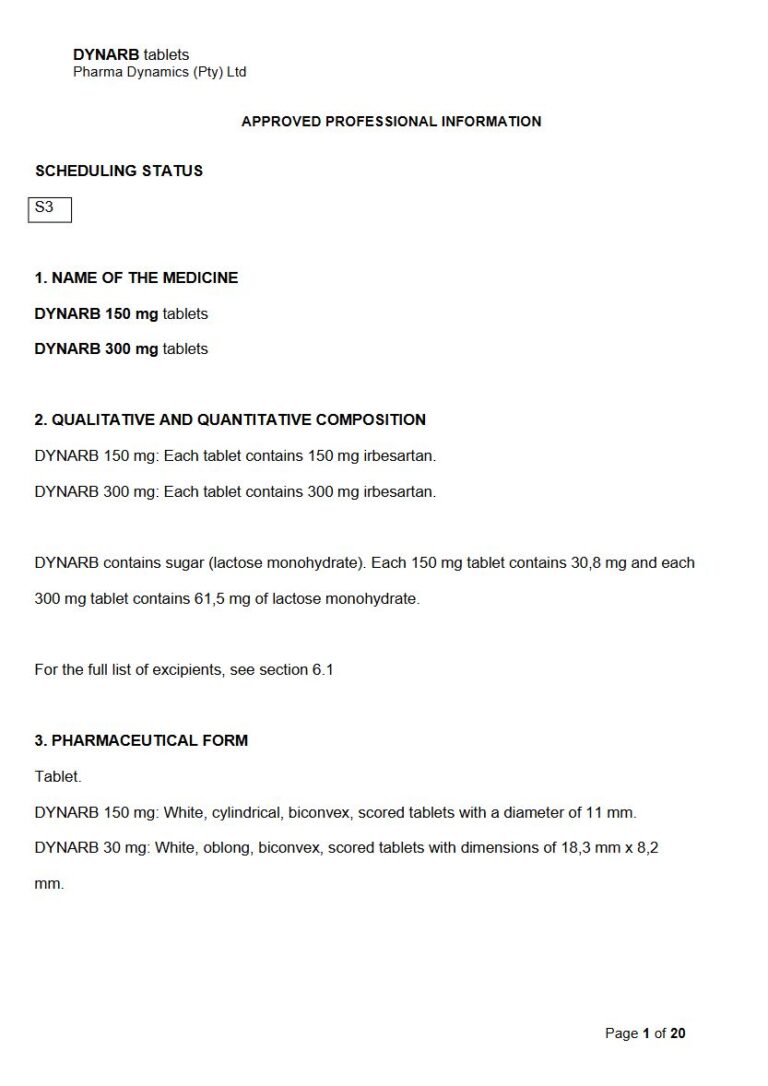
Dynarb 150 mg, 300 mg Tablet.
PDF Leaflet Revision Date: 09 May 2025
Clinical Summary
Quick overview from the medicine insert
Indication
Treatment of essential hypertension and diabetic nephropathy in type 2 diabetes.
Dosage (summary)
150 mg once daily, may increase to 300 mg if needed.
Special Populations
- Elderly
- Renal impairment
- Hepatic impairment
Pregnancy & Breastfeeding
Contraindicated in pregnancy; not recommended during breastfeeding.
Key Drug Interactions
- Fluoroquinolones
- Lithium
- Potassium-sparing diuretics
- NSAIDs
Contraindications
- Hypersensitivity to irbesartan
- History of angioedema
- Severe renal impairment
- Severe hepatic impairment
- Bilateral renal artery stenosis
Common side effects
- Dizziness
- Headache
- Fatigue
- Hyperkalaemia
Counselling Points
- Take with or without food
- Monitor blood pressure regularly
- Avoid potassium supplements
Serious warnings
- Risk of hypotension in volume-depleted patients
- Potential for renal impairment
Important Disclaimer
The Dynarb 150 mg, 300 mg Tablet. professional information leaflet below is the property of Pharma Dynamics and is provided on Medinsert exactly as issued, with no.. alterations or editorial changes. We make every effort to keep content current by updating documents as soon as new versions become available. Medinsert serves as a trusted access point for healthcare professionals, but does not replace official sources or clinical judgement. For more details, please read our full disclaimer. read more>>
 Healthcare Professionals Only
This content is for registered healthcare professionals
Sign in or create a free account to read the full package insert.
Free for HPCSA-registered professionals. Powered by Medinsert.
Clinical Particulars
Section 4 of the official insert — extracted exactly as issued, no alterations
4.1 Therapeutic indications
DYNARB is indicated for:
- the treatment of essential hypertension. It may be used either alone or in combination with other antihypertensive medicines
- the treatment of diabetic nephropathy associated with elevated serum creatinine and proteinuria (> 300 mg/day) in patients with type 2 diabetes and hypertension.
4.2 Posology and method of administration
Posology
Adults
The usual recommended initial and maintenance dose is 150 mg once daily. In patients insufficiently controlled with 150 mg once daily, the dose of DYNARB can be increased to 300 mg or other anti-hypertensive medicines may be added.
Special populations
In patients with hypertension and type 2 diabetic renal disease
The preferred maintenance dose is 300 mg of DYNARB once daily.
Elderly patients and patients with renal or hepatic impairment
Generally, no dosage reduction is necessary in the elderly or in patients with mild to moderately impaired renal function or impaired hepatic function (mild to moderate degree).
Patients with intravascular volume depletion
A lower initial dose of DYNARB is recommended (see section 4.4 Hypotension-volume-depleted patients).
Paediatric population
The safety and efficacy of DYNARB in children aged 0 to 18 has not been established. No recommendation on posology can be made.
Method of administration
For oral use. DYNARB can be taken with or without food.
Missed dose
Doctors should advise patients who forget to take DYNARB to take a dose as soon as possible and then continue with the normal dose. Patients should not take a double dose to compensate for the missed dose.
4.3 Contraindications
Contraindications to be presented in bullet format where relevant
- hypersensitivity to irbesartan or to any of the ingredients of DYNARB (see section 6.1)
- a history of angioedema related to previous therapy with ACE inhibitors or angiotensin receptor blockers (ARBs). These patients must never again be given these medicines
- hereditary or idiopathic angioedema
- hypertrophic obstructive cardiomyopathy (HOCM)
- severe renal function impairment (creatinine clearance less than 30 mL/min)
- moderate to severe renal impairment in patients concomitantly using fluoroquinolones
- severe hepatic impairment
- bilateral renal artery stenosis
- renal artery stenosis in patients with a single kidney, or a transplanted kidney
- aortic stenosis
- concomitant therapy with potassium sparing diuretics such as spironolactone, triamterene, amiloride (see section 4.5)
- porphyria
- lithium therapy: Concomitant administration with DYNARB may lead to toxic blood concentrations of lithium (see section 4.5)
- pregnancy and lactation (see section 4.6)
- the concomitant use of DYNARB with renin inhibitors such as aliskiren-containing products is contraindicated (see sections 4.4 and 4.5).
Safety and efficacy in paediatric patients has not been established.
4.4 Special warnings and precautions for use
Should a woman become pregnant while receiving DYNARB, treatment must be stopped promptly and switched to a different class of antihypertensive medicine (see sections 4.3 and 4.6).
Hypotension - volume - depleted patients
DYNARB has been associated with hypotension in hypertensive patients without other co-morbid conditions. Symptomatic hypotension may be expected to occur in sodium/volume-depleted patients such as those treated with diuretics and/or salt restriction, or on haemodialysis. Volume and/or sodium-depletion should be corrected before initiating therapy with DYNARB or a lower starting dose (DYNARB 75 mg) should be considered.
Intravascular volume depletion
Symptomatic hypotension, especially after the first dose, may occur in patients who are volume and/or sodium depleted by vigorous diuretic therapy, dietary salt restriction, excessive perspiration, dialysis and diarrhoea or vomiting. Such conditions should be corrected before the administration of DYNARB or a lower starting dose should be considered (see section 4.2).
Renal impairment and kidney transplantation
When DYNARB is used in patients with impaired renal function, a periodic monitoring of potassium and creatinine serum levels is recommended (see section 4.5). As a consequence of inhibiting the renin-angiotensin-aldosterone system, changes in renal function may be anticipated in susceptible individuals. There is no experience regarding the administration of DYNARB in patients with a recent kidney transplantation.
Renovascular hypertension
There is an increased risk of severe hypotension and renal insufficiency when patients with bilateral renal artery stenosis or stenosis of the artery to a single functioning kidney are treated with medicines that affect the renin-angiotensin-aldosterone system. A similar effect should be anticipated with angiotensin-II receptor antagonists such as DYNARB (see section 4.3). The use of DYNARB in patients with bilateral renal artery stenosis or stenosis of the artery to a single functioning kidney is contraindicated (see section 4.3).
Heart failure
In patients with heart failure, with or without renal impairment, there is a risk of acute hypotension, uraemia, oliguria and (often acute) renal failure and/or death.
Hypertensive patients with type 1 and 2 diabetes
DYNARB should be used with caution in diabetics with reduced awareness of hypoglycaemia.
Hypertensive patients with type 2 diabetes and renal disease
The effects of irbesartan both on renal and cardiovascular events were not uniform across all subgroups, in an analysis carried out in the study with patients with advanced renal disease. In particular, they appeared less favourable in women and non-white subjects.
Fluoroquinolones and ARBs
Concomitant use of fluoroquinolones and ARBs may precipitate acute kidney injury in patients especially those with moderate to severe renal impairment and elderly patients (see section 4.3). Renal function should be assessed before initiating treatment and monitored during treatment with fluoroquinolones or ARBs whether used separately and/or concomitantly.
Lithium
The combination of lithium and DYNARB is contraindicated (see sections 4.3 and 4.5).
Hyperkalaemia
Hyperkalaemia may occur during the treatment with DYNARB, especially in the presence of renal impairment, overt proteinuria due to diabetic renal disease, and/or heart failure. Close monitoring of serum potassium in patients at risk is recommended (see section 4.5).
Dual blockade of the renin - angiotensin - aldosterone system (RAAS)
There is evidence that the concomitant use of ACE-Inhibitors, angiotensin II receptor blockers (ARBs) or aliskiren may increase the risk of hypotension, hyperkalaemia and decreases renal function (including acute renal failure). Dual blockade of RAAS through the combined use of DYNARB and renin inhibitors such as aliskiren is therefore contraindicated (see section 4.3). DYNARB should not be used concomitantly with renin inhibitors such as aliskiren (see section 4.3).
ACE-inhibitors and angiotensin II receptor blockers should not be used concomitantly in patients with diabetic nephropathy.
Aortic and mitral valve stenosis, obstructive hypertrophic cardiomyopathy
Special caution is indicated in patients suffering from aortic or mitral stenosis, or obstructive hypertrophic cardiomyopathy.
Primary aldosteronism
Patients with primary aldosteronism may not respond to antihypertensive medicines acting through inhibition of the renin-angiotensin system. Therefore, the use of DYNARB is not recommended.
Coronary heart disease and cerebrovascular disease
Excessive blood pressure decrease in patients with ischaemic cardiomyopathy or ischaemic cardiovascular disease could result in a myocardial infarction or stroke.
Hypoglycaemia
DYNARB may induce hypoglycaemia, particularly in diabetic patients. In patients treated with insulin or antidiabetics an appropriate blood glucose monitoring should be considered; a dose adjustment of insulin or antidiabetics may be required when indicated (see section 4.5).
Ethnic groups
DYNARB may be less effective in lowering blood pressure in black patients than in non-black patients, possibly because of higher prevalence of low-renin states in the black hypertensive population.
Use in elderly
There is no reported age-related difference in the efficacy or safety profile of DYNARB.
Information on excipients of DYNARB
Patients with rare hereditary problems of galactose intolerance, total lactase deficiency or glucose-galactose malabsorption should not take this medicine.
Paediatric population
Irbesartan has been studied in paediatric populations aged 6 to 16 years old but the current data are insufficient to support an extension of the use in children until further data become available (see section 4.3).
4.5 Interaction with other medicines and other forms of interaction
Combinations containing any of the following medicines, may interact with DYNARB
- fluoroquinolones: concomitant use of ARBs and fluoroquinolones may precipitate acute kidney injury. The mechanism of the possible interaction between the different classes of medicines, over and above different mechanisms of kidney damage, is unknown (see section 4.3)
- dual blockade of the RAAS with ARBs, ACE inhibitors, or aliskiren: Clinical trial data has shown that dual blockade of the renin-angiotensin-aldosterone-system (RAAS) through the combined use of ACE inhibitors, angiotensin II receptor blockers or renin inhibitors such as aliskiren is associated with a higher frequency of adverse events such as hypotension, hyperkalaemia and decreased renal function (including acute renal failure) compared to the use of a single RAAS-acting medicine (see sections 4.3 and 4.4)
- diuretics and other hypertensive medicines: may increase the hypotensive effects of DYNARB. However, DYNARB may be administered with other antihypertensive medicines, such as beta-blockers, long-acting calcium channel blockers, and thiazide diuretics. Prior treatment with high dose diuretics may result in volume depletion and a risk of hypotension when initiating therapy with DYNARB (see section 4.4)
- lithium: serum lithium concentrations and toxicity have been reported during concomitant administration of lithium with DYNARB, therefore, this combination is contraindicated (see section 4.3)
- potassium - sparing diuretics, potassium supplements: concomitant use of DYNARB and potassium-sparing diuretics, potassium supplements or salt substitutes containing potassium may, or other medicines that may increase serum potassium levels (such as heparin) may lead to increases in serum potassium, and is therefore not recommended (see section 4.4). The use of potassium-sparing diuretics together with DYNARB is contraindicated (see section 4.3)
- non - steroidal anti - inflammatory medicines (NSAIDs): when angiotensin II antagonists, such as DYNARB, are administered simultaneously with NSAIDs (i.e. selective COX-2 inhibitors, aspirin (> 3 g/day) and non-selective NSAIDs), attenuation of the antihypertensive effect may occur. Concomitant use of DYNARB and NSAIDs may lead to an increased risk of worsening of renal function, including possible acute renal failure, and an increase in serum potassium, especially in patients with poor pre-existing renal function. These effects may be reversible. The combination should be administered with caution, especially in the elderly, volume-depleted (including those on diuretic therapy) or with compromised renal function. Patients should be adequately hydrated and consideration should be given to monitoring renal function after initiation of concomitant therapy, and periodically thereafter
- repaglinide: irbesartan has the potential to inhibit OATP1B1. In a clinical study, it was reported that irbesartan increased the C max and AUC of repaglinide (substrate of OATP1B1) by 1.8-fold and 1.3-fold, respectively, when administered 1 hour before repaglinide. In another study, no relevant pharmacokinetic interaction was reported, when the two medicines were co-administered. Therefore, dose adjustment of antidiabetic treatment such as repaglinide may be required (see section 4.4)
Additional interaction information:
- the pharmacokinetics of DYNARB are not affected by the co-administration with nifedipine, warfarin or hydrochlorothiazide
- the pharmacokinetics of digoxin or simvastatin are not altered by co-administration of DYNARB
- the effects of CYP2C9 inducers such as rifampicin on the pharmacokinetic of irbesartan have not been evaluated.
4.6 Fertility, pregnancy and lactation
Safety in pregnancy and lactation has not been established (see section 4.3).
Women of childbearing potential
Women of childbearing age should ensure effective contraception.
Pregnancy
When pregnancy is planned or confirmed DYNARB should be discontinued. Medicines affecting the renin-angiotensin system, such as DYNARB can cause embryonal toxicity, foetal and neonatal morbidity and mortality when administered to pregnant women. DYNARB passes through the placenta and can be presumed to cause disturbance in foetal blood pressure regulatory mechanisms. The use of DYNARB during the first trimester of pregnancy has been associated with an increased risk of birth defects, in particular, to the cardiovascular and the central nervous systems. Oligohydramnios as well as hypotension, oliguria and anuria in new-borns, have been reported after administration of DYNARB in the second and third trimester. Cases of defective skull ossification have been observed. Prematurity and low birth mass can occur (see sections 4.3 and 4.4). Patients planning pregnancy should be changed to alternative antihypertensive treatments, which have an established safety profile for use in pregnancy.
Breastfeeding
It is not known whether irbesartan is distributed into breast milk. However, because of potential for adverse effects in the breastfeeding infant, DYNARB should not be administered to breastfeeding mothers. Available pharmacodynamic/toxicological data in rats have shown excretion of irbesartan or its metabolites in milk.
Fertility
Irbesartan had no effect upon fertility of treated rats and their offspring up to the dose levels inducing the first signs of parental toxicity.
4.7 Effects on ability to drive and use machines
Based on its pharmacodynamic properties, irbesartan is unlikely to affect the ability to drive and use machines, however, DYNARB can cause side effects such as dizziness and fatigue. Patients should be cautioned about engaging in activities requiring rapid and precise responses such as driving a vehicle or operating machinery until they know how DYNARB affects them.
4.8 Undesirable effects
Tabulated list of adverse effects
System Organ Class
Frequency
Side effects
- Blood and lymphatic system disorders
- Less frequent
- Frequency unknown
- Neutropenia, hyperkalaemia
- Anaemia, thrombocytopenia
- Immune system disorders
- Less frequent
- Hypersensitivity reactions** (e.g. urticaria, angioedema, rash, anaphylactic shock)
- Endocrine disorders
- Less frequent
- Pancreatitis
- Metabolism and nutrition disorders
- Frequency unknown
- Hyperkalaemia* and **, hypoglycaemia**
- Nervous system disorders
- Frequent
- Frequency unknown
- Dizziness, headache**, orthostatic dizziness*
- Migraine
- Ear and labyrinth disorders
- Frequent
- Frequency unknown
- Vertigo**
- Tinnitus
- Cardiac disorders
- Less frequent
- Tachycardia, hypotension
- Vascular disorders
- Frequent
- Less frequent
- Orthostatic hypotension*
- Vasculitis, flushing
- Respiratory, thoracic and mediastinal disorders
- Less frequent
- Cough, respiratory tract infection
- Gastrointestinal disorders
- Frequent
- Less frequent
- Nausea, vomiting
- Diarrhoea, dyspepsia/heartburn, dysgeusia, gastrointestinal disturbances
- Hepatobiliary disorders
- Less frequent
- Abnormal liver function**, cholestatic jaundice**, hepatitis**
- Skin and subcutaneous tissue disorders
- Less frequent
- Leukocytoclastic vasculitis, rash, urticaria, pruritus, Henoch-Schonlein purpura
- Musculoskeletal, connective tissue and bone disorders
- Frequent
- Frequency unknown
- Musculoskeletal pain*
- Arthralgia**, myalgia** (in some cases associated with increased plasma creatine kinase levels), muscle cramps, rhabdomyolysis, asthenia**
- Renal and urinary disorders
- Less frequent
- Impaired renal function, renal failure in patients at risk**
- Pregnancy, puerperium and perinatal conditions
- Frequency unknown
- Teratogenic potential
- Reproductive system and breast disorders
- Less frequent
- Sexual dysfunction
- General disorders and administrative site conditions
- Frequent
- Less frequent
- Frequency unknown
- Fatigue
- Chest pain, back pain
- Oedema
- Investigations
- Frequent
- Decrease in haemoglobin in patients with advanced diabetic renal disease, increased plasma creatine kinase
* Adverse effects reported in diabetic hypertensive patients.
** Post marketing Reporting of suspected adverse reactions
Reporting suspected adverse reactions after authorisation of the medicine is important. It allows continued monitoring of the benefit/risk balance of the medicine. Healthcare professionals are requested to report any suspected adverse drug reactions to SAHPRA via the Med Safety APP (Medsafety X SAHPRA) and eReporting platform (who-umc.org) found on SAHPRA website. An email can be sent directly to the company, [email protected], to ensure safety of the product.
4.9 Overdose
Signs and symptoms
Experience in adults exposed to doses of up to 900 mg/day for 8 weeks revealed no toxicity. The most common signs and symptoms observed are bradycardia, hypotension or tachycardia.
Management of overdose
No specific information is available on the treatment of overdosage with irbesartan. The patient should be closely monitored and treatment should be symptomatic and supportive. Suggested measures include induction of emesis. Activated charcoal may be useful in the treatment of overdose. DYNARB is not removed from the body by haemodialysis.
