
Epiduo 0.1 % / 2.5 % Gel
Clinical Summary
Quick overview from the medicine insert
Important Disclaimer
The Epiduo 0.1 % / 2.5 % Gel professional information leaflet below is the property of Galderma Laboratories South Africa and is provided on Medinsert exactly as issued, with no.. alterations or editorial changes. We make every effort to keep content current by updating documents as soon as new versions become available. Medinsert serves as a trusted access point for healthcare professionals, but does not replace official sources or clinical judgement. For more details, please read our full disclaimer. read more>>
 Healthcare Professionals Only
This content is for registered healthcare professionals
Sign in or create a free account to read the full package insert.
Free for HPCSA-registered professionals. Powered by Medinsert.
Clinical Particulars
Section 4 of the official insert — extracted exactly as issued, no alterations
4.1 Therapeutic indications
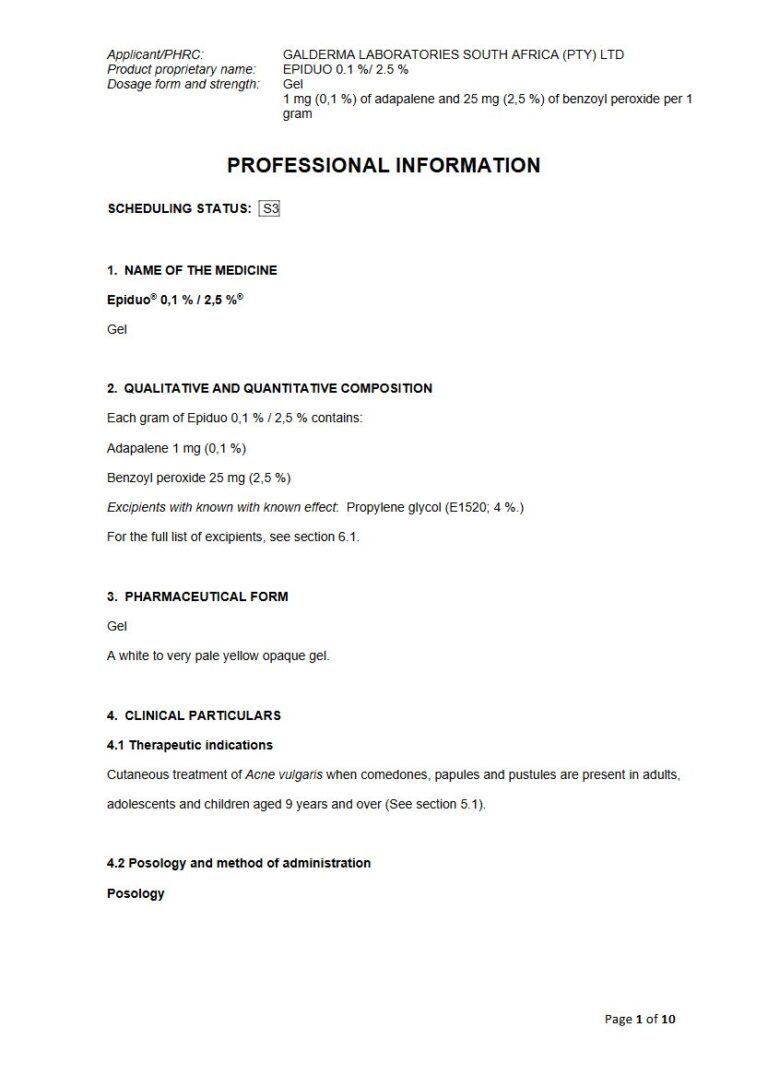
Cutaneous treatment of Acne vulgaris when comedones, papules and pustules are present in adults, adolescents and children aged 9 years and over (See section 5.1).
4.2 Posology and method of administration
Epiduo should be applied to the entire acne affected areas once a day in the evening on a clean and dry skin. A thin film of gel should be applied, with the fingertips, avoiding the eyes, lips and nostrils (See section 4.4).
If irritation occurs, the patient should be directed to apply non-comedogenic moisturisers, to use Epiduo less frequently (e.g. every other day), to suspend use temporarily, or to discontinue use altogether. The duration of treatment should be determined by the doctor on the basis of the clinical condition. Early signs of clinical improvement usually appear after 1 to 4 weeks of treatment.
Special populations
Paediatric population
The safety and effectiveness of Epiduo have not been studied in children below 9 years of age.
Method of administration
For external cutaneous use only.
4.3 Contraindications
- Hypersensitivity to the active ingredients or to any of the excipients listed in section 6.1.
- Pregnancy (see section 4.6)
- Women planning a pregnancy (see section 4.6)
4.4 Special warnings and precautions for use
Epiduo should not be applied to damaged skin, either broken (cuts or abrasions), eczematous or sunburned. Epiduo should not come into contact with the eyes, mouth, nostrils or mucous membranes. If product enters the eye, wash immediately with warm water.
Epiduo contains propylene glycol (E1520) that may cause skin irritation.
If a reaction suggesting sensitivity to any component of the formula occurs, the use of Epiduo should be discontinued. Excessive exposure to sunlight or UV radiation should be avoided. Epiduo should not come into contact with any coloured material including hair and dyed fabrics as this may result in bleaching and discolouration. Epiduo is FOR EXTERNAL USE ONLY.
If skin irritation appears after application of Epiduo, the intensity is generally mild or moderate, with local tolerability signs and symptoms (erythema, dryness, scaling, burning, and pain of skin (including stinging)) peaking during the first week and then subsiding spontaneously. Epiduo contains 40 mg propylene glycol (E1520) per gram, which is equivalent to 40 mg/g (4.0 %). Propylene glycol (E1520) may cause skin irritation.
4.5 Interaction with other medicines and other forms of interaction
Formal interaction studies have not been performed. From previous experience with adapalene and benzoyl peroxide, there are no known interactions with other medicinal products which might be used cutaneously and concurrently with Epiduo. However, other retinoids or benzoyl peroxide or medicines with a similar mode of action should not be used concurrently. Caution should be exercised if cosmetics with desquamative, irritant or drying effects are used, as they may produce additive irritant effects with Epiduo. Absorption of adapalene through human skin is low (see section 5.2), and therefore interaction with systemic medicinal products is unlikely. The percutaneous penetration of benzoyl peroxide in the skin is low and the medicinal substance is completely metabolised into benzoic acid which is rapidly eliminated. Therefore, the potential interaction of benzoic acid with systemic medicinal products is unlikely to occur.
4.6 Fertility, pregnancy and lactation
Safety in pregnancy and lactation has not been established.
Pregnancy: Epiduo is contraindicated (see section 4.3) in pregnancy, or in women planning a pregnancy. Animal studies by the oral route have shown reproductive toxicity at high systemic exposure (see section 5.3). Due to the limited available data and because a very weak cutaneous passage of adapalene is possible, Epiduo should not be used during pregnancy. In case of unexpected pregnancy, treatment should be discontinued.
Breastfeeding: No study on animal or human milk transfer was conducted after topical application of Epiduo Gel. Epiduo should not be used during breastfeeding, especially in case of acne treatment requiring product application on the chest.
Fertility: No human fertility studies were conducted with Epiduo gel.
4.7 Effects on ability to drive and use machines
Epiduo does not affect the ability to drive and use machinery.
4.8 Undesirable effects
a) Summary of the Safety Profile
During clinical trials, a total of 4538 subjects were exposed to Epiduo. A total of 3958 subject with acne vulgaris, aged 9 years and older, were treated with Epiduo once daily for 12 weeks to 12 months. The most commonly reported adverse events are irritative contact dermatitis, dry skin, skin burning, erythema and skin exfoliation. Different degrees of skin irritation appear after application of Epiduo, the intensity is generally mild or moderate, with local tolerability signs and symptoms (erythema, dryness, scaling, burning and pain of skin (stinging pain) peaking during the first week and then subsiding spontaneously.
b) Table 1: Tabulated list of Adverse Events
Epiduo may cause the following adverse reactions at the site of application:
| System organ class (MedDRA) | Frequency | Adverse Drug Reaction |
|---|---|---|
| Skin and subcutaneous tissue disorders | Common (u2265 1/100 to < 1/10) | Dry skin, irritative contact dermatitis, skin burning sensation, skin irritation, erythema, skin exfoliation (scaling) |
| Uncommon (u2265 1/1000 to u2264 1/100) | Pruritus and sunburn |
c) Table 2: Tabulated list of Adverse Events from Post Marketing Studies
Epiduo may cause the following adverse reactions at the site of application as obtained from post marketing surveillance data:
| System organ class (MedDRA) | Frequency | Adverse Drug Reaction |
|---|---|---|
| Immune system | Not known (cannot be estimated from the available data) | Anaphylactic reaction |
| Eye disorders | Not known (cannot be estimated from the available data) | Eyelid oedema |
| Respiratory, thoracic and mediastinal disorders | Not known (cannot be estimated from the available data) | Throat tightness, dyspnoea |
| Skin and subcutaneous tissue disorders | Not known (cannot be estimated from the available data) | Allergic contact dermatitis, swelling face, pain of skin (stinging pain), blisters (vesicles), skin discolouration (hyperpigmentation and hypopigmentation), urticaria, application site burn* |
* Most of the cases of u201capplication site burnu201d were superficial burns but cases with second degree burn or severe burn reactions have been reported. If skin irritation appears after application of Epiduo, the intensity is generally mild or moderate, with local tolerability signs and symptoms (erythema, dryness, scaling, burning and pain of skin (stinging pain) peaking during the first week and then subsiding spontaneously.
Reporting of suspected adverse reactions
Reporting suspected adverse reactions after authorisation of the medicine is important. It allows continued monitoring of the benefit/risk balance of the medicine. Health care providers are asked to report any suspected adverse reactions to SAHPRA via the u201c6.04 Adverse Drug Reactions Reporting Formu201d, found online under SAHPRAu2019s publications: https://www.sahpra.org.za/Publications/Index/8
4.9 Overdose
Epiduo is for once-daily topical use only. In case of accidental ingestion, appropriate symptomatic measures should be taken.
