
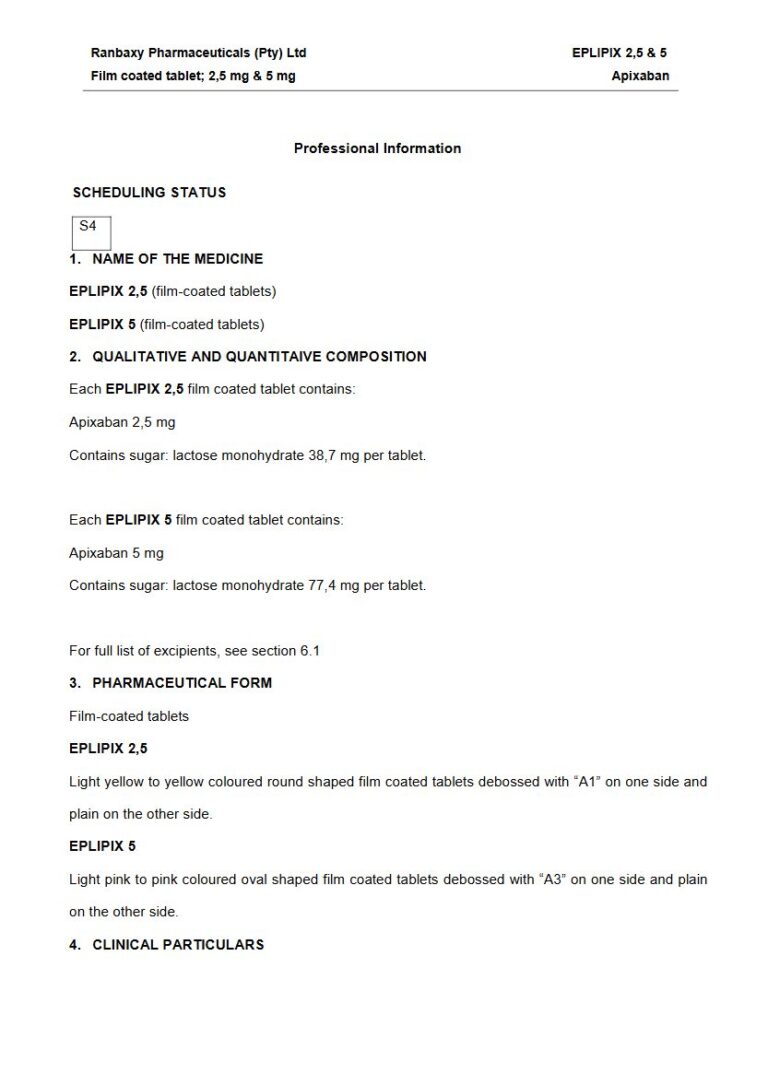
Eplipix 2,5 mg & 5 mg Film-coated tablets
PDF Leaflet Revision Date: 12 May 2025
Clinical Summary
Quick overview from the medicine insert
Indication
Prevention of VTE and stroke in NVAF.
Dosage (summary)
2.5 mg or 5 mg orally twice daily depending on indication.
Special Populations
- Renal impairment
- Hepatic impairment
- Elderly
Pregnancy & Breastfeeding
Not recommended during pregnancy; avoid breastfeeding.
Key Drug Interactions
- Strong CYP3A4 and P-gp inhibitors
- Antiplatelet agents
Contraindications
- Hypersensitivity to apixaban
- Active bleeding
- Severe renal disease
- Severe hepatic impairment
Common side effects
- Haemorrhage
- Contusion
- Epistaxis
- Gastrointestinal haemorrhage
Counselling Points
- Take with or without food
- Monitor for signs of bleeding
- Do not crush tablets unless necessary
Serious warnings
- Risk of bleeding
- Use with caution in patients with bleeding disorders
Important Disclaimer
The Eplipix 2,5 mg & 5 mg Film-coated tablets professional information leaflet below is the property of Ranbaxy Pharmaceuticals and is provided on Medinsert exactly as issued, with no.. alterations or editorial changes. We make every effort to keep content current by updating documents as soon as new versions become available. Medinsert serves as a trusted access point for healthcare professionals, but does not replace official sources or clinical judgement. For more details, please read our full disclaimer. read more>>
 Healthcare Professionals Only
This content is for registered healthcare professionals
Sign in or create a free account to read the full package insert.
Free for HPCSA-registered professionals. Powered by Medinsert.
Clinical Particulars
Section 4 of the official insert — extracted exactly as issued, no alterations
4.1 Therapeutic indications
Prevention of venous thromboembolic events (VTE): elective hip or knee replacement surgery
EPLIPIX is indicated for the prevention of VTE in adult patients who have undergone elective hip or knee replacement surgery.
Prevention of stroke and systemic embolism: nonvalvular atrial fibrillation (NVAF)
EPLIPIX is also indicated to reduce the risk of stroke, systemic embolism and death in patients with NVAF with one or more risk factors.
Treatment of VTE
EPLIPIX is indicated for the treatment of deep vein thrombosis (DVT) and pulmonary embolism (PE) and prevention of recurrent DVT and PE.
4.2 Posology and method of administration
EPLIPIX can be taken with or without food. If a dose is missed, the patient should take EPLIPIX immediately and then continue with twice daily administration as before.
Posology
Recommended dosage
Prevention of VTE: elective hip or knee replacement surgery
The recommended dose of EPLIPIX is 2,5 mg taken orally twice daily. The initial dose should be taken 12 to 24 hours after surgery. In patients undergoing hip replacement surgery, the recommended duration of treatment is 32 to 38 days. In patients undergoing knee replacement surgery, the recommended duration of treatment is 10 to 14 days.
Prevention of stroke and systemic embolism: NVAF
The recommended dose of EPLIPIX is 5 mg taken orally twice daily. Age, body weight, serum creatinine: In patients with at least 2 of the following characteristics, age u2265 80 years, body weight u2264 60 kg, or serum creatinine u2265 1,5 mg/dL (133 micromol/l), the recommended dose of EPLIPIX is 2,5 mg twice daily.
Treatment of DVT and PE
The recommended dose of EPLIPIX is 10 mg taken orally twice daily for 7 days, followed by 5 mg taken orally twice daily.
Prevention of recurrent DVT and PE
The recommended dose of EPLIPIX is 2,5 mg taken orally twice daily after at least 6 months of treatment for DVT or PE.
Body weight
Prevention of VTE: elective hip or knee replacement surgery
No dose adjustment required (see section 5.2).
Prevention of stroke and systemic embolism: NVAF
See section 4.2, Prevention of stroke and systemic embolism: NVAF, Recommended dosage, Age, body weight, serum creatinine.
Treatment of VTE
No dose adjustment required (see section 5.2).
Converting from or to parenteral anticoagulants
In general, switching treatment from parenteral anticoagulants to EPLIPIX (and vice versa) can be done at the next scheduled dose.
Converting from or to warfarin or other vitamin K antagonists (VKA)
When converting patients from warfarin or other VKA therapy to EPLIPIX, discontinue warfarin or other VKA therapy and start EPLIPIX when the international normalised ratio (INR) is below 2,0. When converting from EPLIPIX to warfarin or other VKA therapy, continue EPLIPIX for 48 hours after the first dose of warfarin or other VKA therapy.
Patients undergoing cardioversion
EPLIPIX can be initiated or continued in NVAF patients who may require cardioversion. For patients not previously treated with anticoagulants, at least 5 doses of EPLIPIX 5 mg twice daily (2,5 mg twice daily in patients who qualify for a dose reduction) should be given before cardioversion to ensure adequate anticoagulation. If cardioversion is required before 5 doses of EPLIPIX can be administered, a 10 mg loading dose should be given, followed by 5 mg twice daily. The dosing regimen should be reduced to a 5 mg loading dose followed by 2,5 mg twice daily if the patient meets the criteria for dose reduction. The administration of the loading dose should be given at least 2 hours before cardioversion.
Confirmation should be sought prior to cardioversion that the patient has taken EPLIPIX as prescribed. Decisions on initiation and duration of treatment should take established guideline recommendations for anticoagulant treatment in patients undergoing cardioversion into account.
Special populations
Renal impairment
Prevention of VTE: elective hip or knee replacement surgery
In surgical patients no dose adjustment is necessary in patients with mild, moderate or severe (creatinine clearance 15 - 29 ml/min) renal impairment (see section 5.2). Because, there is limited clinical experience reported in patients with creatinine clearance < 15 ml/min and there are no data reported in patients undergoing dialysis, EPLIPIX is not recommended in these patients (see sections 4.4 and 5.2).
Prevention of stroke and systemic embolism: NVAF
In patients with AF, no dose adjustment is recommended in patients with creatinine clearance 15 to 29 ml/min, except as described under section 4.2, Prevention of stroke and systemic embolism: NVAF. Because there is no clinical experience reported in patients with creatinine clearance < 15 ml/min, a dosing recommendation cannot be provided. There are no data reported in patients undergoing dialysis, therefore, EPLIPIX is not recommended in these patients.
Treatment of VTE
No dose adjustment is necessary in patients with mild, moderate or severe (creatinine clearance 15 u2013 29 mL/min) renal impairment. Because there is limited clinical experience in patients with creatinine clearance < 15 mL/min and no data in patients undergoing dialysis, EPLIPIX is not recommended in these patients (see section 5.2).
Hepatic impairment
EPLIPIX may be used with caution in patients with mild or moderate hepatic impairment (Child Pugh A or B). No dose adjustment is required in patients with mild or moderate hepatic impairment (see sections 4.4 and 5.2). EPLIPIX is not recommended in patients with severe hepatic impairment (see sections 4.4 and 5.2).
Elderly
Prevention of VTE: elective hip or knee replacement surgery
No dose adjustment required (see section 5.2).
Prevention of stroke and systemic embolism: NVAF
See section 4.2, Prevention of stroke and systemic embolism: NVAF, Recommended dosage, Age, body weight, serum creatinine.
Treatment of VTE
No dose adjustment required (see section 5.2).
Paediatric population
The efficacy and safety of EPLIPIX in children below age 18 have not been established. No data are available.
Method of administration: For oral use.
For patients who are unable to swallow whole tablets, EPLIPIX tablets may be crushed and suspended in water, 5 % dextrose in water (D5W), or apple juice, or mixed with applesauce and promptly administered orally (see section 5.2). Alternatively, tablets may be crushed and suspended in 60 mL of water or D5W and promptly delivered through a nasogastric tube (see section 5.2). Crushed EPLIPIX tablets are stable in water, D5W, apple juice, and applesauce for up to 4 hours.
4.3 Contraindications
- Hypersensitivity to the active substance (apixaban) or to any of the excipients listed in section 6.1.
- Active clinically significant bleeding.
- EPLIPIX is not recommended in patients with severe renal disease (CrCI <15 m/min).
- EPLIPIX is not recommended in patients with hepatic disease associated with coagulopathy and clinically relevant bleeding risk.
- EPLIPIX should not be administered with antiplatelet medicines other than aspirin (see section 4.4).
- Patients with antiphospholipid syndrome (APS) with persistent positivity for all three antiphospholipid antibodies (patients with triple positive APS)
4.4 Special warnings and precautions for use
Haemorrhage risk
Patients taking EPLIPIX are to be carefully observed for signs of bleeding. EPLIPIX is recommended to be used with caution in conditions with increased risk of haemorrhage, such as: congenital or acquired bleeding disorders; active ulcerative gastrointestinal disease; bacterial endocarditis; thrombocytopenia; platelet disorders; history of haemorrhagic stroke; severe uncontrolled hypertension; and recent brain, spinal, or ophthalmological surgery. EPLIPIX administration should be discontinued if severe haemorrhage occurs (see section 4.9). In the event of haemorrhagic complications, treatment must be discontinued and the source of bleeding investigated. The initiation of appropriate treatment, e.g., surgical haemostasis or the transfusion of fresh frozen plasma, should be considered. If life-threatening bleeding cannot be controlled by the above measures, administration of prothrombin complex concentrates (PCCs) or recombinant factor VIIa may be considered. Reversal of EPLIPIX pharmacodynamic effects, as demonstrated by changes in the thrombin generation assay, has been demonstrated after administration of 4-factor PCCs in healthy subjects. However, there is no clinical experience with the use of 4-factor PCC medicines to reverse bleeding in individuals who have received EPLIPIX. Currently there is no experience with the use of recombinant factor VIIa in individuals receiving EPLIPIX. Standard anticoagulation tests cannot be used to monitor EPLIPIX (see section 4.5).
Interaction with other medicines affecting haemostasis
The concomitant use of EPLIPIX with antiplatelet medicines increases the risk of bleeding. Care is to be taken if patients are treated concomitantly with non-steroidal anti-inflammatory drugs (NSAIDs), including aspirin. Other platelet aggregation inhibitors or other antithrombotic medicines are not recommended concomitantly with EPLIPIX following surgery (see section 4.5). In patients with atrial fibrillation and a condition that warrants chronic use of aspirin, EPLIPIX may be used with due regard to increased risk of major bleeding. In a clinical trial of patients with atrial fibrillation, concomitant use of aspirin increased the major bleeding risk on EPLIPIX from 1,8 % per year to 3,4 % per year and increased the bleeding risk on warfarin from 2,7 % per year to 4,6 % per year.
Patients with prosthetic heart valves
Safety and efficacy of EPLIPIX have not been studied in patients with prosthetic heart valves, with or without atrial fibrillation. Therefore, the use of EPLIPIX is not recommended in this setting.
Patients with antiphospholipid syndrome
Treatment of patients with established APS is not recommended as evidence regarding safety and efficacy, including the benefit/harm balance of EPLIPIX in patients with APS, is inconclusive/incomplete. There is some evidence that treatment with EPLIPIX may be associated with an increased risk of recurrent arterial thrombotic events in patients with APS compared to treatment of these patients with warfarin, a vitamin K antagonist.
Surgery and invasive procedures
EPLIPIX should be discontinued 2 to 3 days prior to elective surgery or invasive procedures such as neuraxial regional anaesthesia. If surgery or invasive procedures cannot be delayed, exercise appropriate caution taking into consideration an increased risk of bleeding. This risk of bleeding should be weighed against the urgency of intervention.
Temporary discontinuation of EPLIPIX
Discontinue EPLIPIX, in the presence of active bleeding, elective surgery, or invasive procedures that place patients at an increased risk of haemorrhage. Restart EPLIPIX therapy 12 - 24 hours after the danger of haemorrhage has ceased.
Spinal/epidural anaesthesia or puncture
When neuraxial anaesthesia (spinal/epidural anaesthesia) or spinal/epidural puncture is employed, patients treated with antithrombotic medicines, such as EPLIPIX, for prevention of thromboembolic complications are at risk of developing an epidural or spinal haematoma which can result in long-term or permanent paralysis. The risk of these events may be increased by the post-operative use of indwelling epidural catheters or the concomitant use of medicines affecting haemostasis. When an indwelling epidural or intrathecal catheter procedure is planned, EPLIPIX should be stopped 48 hours beforehand. Indwelling epidural or intrathecal catheters must be removed at least 6 hours prior to the first dose of EPLIPIX. The risk may also be increased by traumatic or repeated epidural or spinal puncture. Patients are to be frequently monitored for signs and symptoms of neurological impairment (e.g., numbness or weakness of the legs, bowel or bladder dysfunction). If neurological compromise is noted, urgent diagnosis and treatment is necessary. Prior to neuraxial intervention, the medical practitioner should consider the potential benefit versus the risk in anticoagulated patients or in patients to be anticoagulated for thromboprophylaxis.
Acute PE in haemodynamically unstable patients or patients who require thrombolysis or pulmonary embolectomy
Treatment of VTE
Initiation of EPLIPIX is not recommended as an alternative to unfractionated heparin for the initial treatment of patients with PE who present with haemodynamic instability or who may receive thrombolysis or pulmonary embolectomy.
Interaction with strong inhibitors of both Cytochrome P450 3A4 (CYP3A4) and P-glycoprotein (P-gp)
EPLIPIX can be administered with caution in patients receiving concomitant systemic treatment with strong inhibitors of both Cytochrome P450 3A4 (CYP3A4) and P-glycoprotein (P-gp), such as azole-antimycotics (e.g., ketoconazole, itraconazole, voriconazole and posaconazole), HIV protease inhibitors (e.g., ritonavir). These medicines may increase EPLIPIX exposure by 2-fold (see section 4.5).
Interaction with strong inducers of both CYP3A4 and P-gp
The concomitant use of EPLIPIX with strong CYP3A4 and P-gp inducers (e.g., rifampicin, phenytoin, carbamazepine, phenobarbital (phenobarbitone) or St. Johnu2019s Wort) may lead to a ~50 % reduction in EPLIPIX exposure. Use caution when co-administering EPLIPIX with strong inducers of both CYP3A4 and P-gp (see section 4.5).
For the treatment of DVT or PE, EPLIPIX is not recommended in patients receiving concomitant systemic treatment with strong inducers of both CYP3A4 and P-gp (see section 4.5). For prevention of recurrent DVT and PE, use caution when co-administering EPLIPIX with strong inducers of both CYP3A4 and P-gp (see section 4.5).
Hip fracture surgery
EPLIPIX has not been studied in clinical trials in patients undergoing hip fracture surgery to evaluate efficacy and safety in these patients. Therefore, EPLIPIX is not recommended in these patients.
Laboratory parameters
Clotting tests (e.g., Prothrombin time (PT), INR and activated partial thromboplastin time (aPTT) are affected as expected by the mechanism of action of EPLIPIX (see section 5.1). Changes observed in these clotting tests at the expected therapeutic dose are small and subject to a high degree of variability (see section 5.1). These parameters should not be used to monitor EPLIPIX therapy.
4.5 Interactions with other medicines
Effect of other medicines on EPLIPIX
Inhibitors of CYP3A4 and P-gp
Co-administration of EPLIPIX with ketoconazole (400 mg once a day), a strong inhibitor of both CYP3A4 and P-gp, led to a 2-fold increase in mean EPLIPIX AUC and a 1,6-fold increase in mean EPLIPIX Cmax (see section 4.4, Interaction with inhibitors of both Cytochrome P450 3A4 (CYP3A4) and P-glycoprotein (P-gp)). The dose of EPLIPIX must not exceed 2,5 mg twice daily when used with these medicines. Active substances which are not considered strong inhibitors of both CYP3A4 and P-gp (e.g., diltiazem, naproxen, clarithromycin, amiodarone, verapamil, quinidine) are expected to increase EPLIPIX plasma concentration to a lesser extent. No dose adjustment for EPLIPIX is required when co-administered with medicines that are not strong inhibitors of both CYP3A4 and P-gp. Diltiazem (360 mg once a day), considered a moderate CYP3A4 and a weak P-gp inhibitor, led to a 1,4-fold increase in mean EPLIPIX AUC and a 1,3-fold increase in Cmax. Naproxen (500 mg, single dose), an inhibitor of P-gp but not an inhibitor of CYP3A4, led to a 1,5-fold and 1,6-fold increase in mean EPLIPIX AUC and Cmax, respectively. Clarithromycin (500 mg, twice a day), an inhibitor of P-gp and a strong inhibitor of CYP3A4, led to a 1,6-fold and 1,3-fold increase in mean EPLIPIX AUC and Cmax respectively.
Inducers of CYP3A4 and P-gp
Co-administration of EPLIPIX with rifampicin, a strong inducer of both CYP3A4 and P-gp, led to an approximate 54 % and 42 % decrease in mean EPLIPIX AUC and Cmax, respectively. The concomitant use of EPLIPIX with other strong CYP3A4 and P-gp inducers (e.g., phenytoin, carbamazepine, phenobarbital (phenobarbitone) or St. Johnu2019s Wort) may also lead to reduced EPLIPIX plasma concentrations. No dose adjustment for EPLIPIX is required during concomitant therapy with such medicines, however strong inducers of both CYP3A4 and P-gp should be co-administered with caution (see section 4.4, Interaction with strong inducers of both CYP3A4 and P-gp). For the treatment of DVT and PE, concomitant therapy with strong inducers of both CYP3A4 and P-gp is not recommended (see section 4.4). For the prevention of recurrent DVT and PE, strong inducers of both CYP3A4 and P-gp should be co-administered with caution (see section 4.4).
Anticoagulants, platelet aggregation inhibitors, and NSAIDs
After combined administration of enoxaparin (40 mg single dose) with EPLIPIX (5 mg single dose), an additive effect on anti-FXa activity was reported observed. Pharmacokinetic or pharmacodynamic interactions were not evident in healthy subjects when EPLIPIX was co-administered with aspirin 325 mg once a day. EPLIPIX co-administered with clopidogrel (75 mg once daily) or with the combination of clopidogrel 75 mg and aspirin 162 mg once daily or with prasugrel (60 mg followed by 10 mg once daily) in Phase 1 studies did not show a relevant increase in bleeding time or further inhibition of platelet aggregation compared to administration of the anti-platelet medicines without EPLIPIX. Increases in clotting tests (PT, INR, and aPTT) were consistent with the effects of EPLIPIX alone. However, the co-administration of EPLIPIX with clopidogrel, ticagrelor or other antiplatelet medicines, except aspirin, are not recommended due to the resulting associated increased risk of major bleeds (see section 4.3). Naproxen (500 mg), an inhibitor of P-gp, led to a 1,5-fold and 1,6-fold increase in mean EPLIPIX AUC and Cmax, in healthy subjects, respectively. Corresponding increases in clotting tests were observed for EPLIPIX. No clinically relevant prolongation of bleeding time was observed after concomitant administration of EPLIPIX and naproxen. EPLIPIX should be used with caution when co-administered with NSAIDs (including aspirin) because these medicines typically increase the bleeding risk. Medicines associated with serious bleeding are not recommended concomitantly with EPLIPIX, such as: unfractionated heparins and heparin derivatives (including low molecular weight heparins (LMWH)), FXa inhibiting oligosaccharides (e.g. fondaparinux), direct thrombin II inhibitors (e.g., desirudin), thrombolytic medicines, GPIIb/IIIa receptor antagonists, dipyridamole, dextran, sulfinpyrazone, vitamin K antagonists, and other oral anticoagulants.
It should be noted that unfractionated heparin can be administered at doses necessary to maintain a patent central venous or arterial catheter (see section 4.4, Interaction with other medicines affecting haemostasis).
Other concomitant therapies
No clinically significant pharmacokinetic or pharmacodynamic interactions were observed when EPLIPIX was co-administered with atenolol or famotidine. Co-administration of EPLIPIX 10 mg with atenolol 100 mg did not have a clinically relevant effect on the pharmacokinetics of EPLIPIX. Following administration of the two medicines together, mean EPLIPIX AUC and Cmax were 15 % and 18 % lower than when administered alone. The administration of EPLIPIX 10 mg with famotidine 40 mg had no effect on EPLIPIX AUC or Cmax.
Effect of EPLIPIX on other medicines
In vitro EPLIPIX studies showed no inhibitory effect on the activity of CYP1A2, CYP2A6, CYP2B6, CYP2C8, CYP2C9, CYP2D6 or CYP3A4 (IC50 > 45 u03bcM) and weak inhibitory effect on the activity of CYP2C19 (IC50 > 20 u03bcM) at concentrations that are significantly greater than peak plasma concentrations observed in patients. EPLIPIX did not induce CYP1A2, CYP2B6, CYP3A4/5 at a concentration up to 20 u03bcM. Therefore, EPLIPIX is not expected to alter the metabolic clearance of co-administered medicines that are metabolised by these enzymes. EPLIPIX is not a significant inhibitor of P-gp. In studies conducted in healthy subjects, as described below, EPLIPIX did not meaningfully alter the pharmacokinetics of digoxin, naproxen, or atenolol.
4.6 Fertility, pregnancy and lactation
Safety has not been established.
Pregnancy
EPLIPIX is not recommended during pregnancy. Treatment may increase the risk of haemorrhage during pregnancy and delivery.
Breastfeeding
It is unknown whether EPLIPIX or its metabolites are excreted in human milk. In rat milk, a high milk to maternal plasma ratio (Cmax about 8, AUC about 30) was found, possibly due to active transport into the milk. A risk to newborns and infants cannot be excluded. Women taking EPLIPIX should not breastfeed their infants.
4.7 Effects on ability to drive and use machines
EPLIPIX has no or negligible influence on the ability to drive and use machines.
4.8 Undesirable effects
Summary of the safety profile
The safety of apixaban has been investigated in 7 Phase III clinical studies including more than 21,000 patients: more than 5,000 patients in VTEp studies, more than 11,000 patients in NVAF studies and more than 4,000 patients in the VTE treatment (VTEt) studies, for an average total exposure of 20 days, 1,7 years and 221 days respectively. Common adverse reactions were haemorrhage, contusion, epistaxis, and haematoma (see Table 1 for adverse reaction profile and frequencies by indication). In the VTEp studies, in total, 11 % of the patients treated with apixaban 2,5 mg twice daily experienced adverse reactions. The overall incidence of adverse reactions related to bleeding with apixaban was 10 % in the apixaban vs enoxaparin studies. In the NVAF studies, the overall incidence of adverse reactions related to bleeding with apixaban was 24,3 % in the apixaban vs warfarin study and 9,6 % in the apixaban vs acetylsalicylic acid study. In the apixaban vs warfarin study the incidence of ISTH major gastrointestinal bleeds (including upper GI, lower GI, and rectal bleeding) with apixaban was 0,76 %/year. The incidence of ISTH major intraocular bleeding with apixaban was 0,18 %/year. In the VTEt studies, the overall incidence of adverse reactions related to bleeding with apixaban was 15,6 % in the apixaban vs enoxaparin/warfarin study and 13,3 % in the apixaban vs placebo study.
Table 1: Tabulated adverse reactions
System Organ Class Prevention of VTE in adult patients who have undergone elective hip or knee replacement surgery (VTEp) Prevention of stroke and systemic embolism in adult patients with NVAF, with one or more risk factors (NVAF) Treatment of DVT and PE, and prevention of recurrent DVT and PE (VTEt)
Blood and lymphatic system disorders
Anaemia Frequent Frequent Frequent
Thrombocytopenia Less frequent Less frequent Frequent
Immune system disorders
Hypersensitivity, allergic oedema and Anaphylaxis Less frequent Less frequent Less frequent
Pruritus Less frequent Less frequent Less frequent*
Angioedema Frequency unknown Frequency unknown Frequency unknown
Nervous system disorders
Brain haemorrhage u2020 Frequency unknown Less frequent Frequency unknown
Eye disorders
Eye haemorrhage (including conjunctival haemorrhage) Less frequent Frequent Less frequent
Vascular disorders
Haemorrhage, haematoma Frequent Frequent Frequent
Hypotension (including procedural hypotension) Less frequent Frequent Less frequent
Intra-abdominal haemorrhage Frequency unknown Less frequent Frequency unknown
Respiratory, thoracic and mediastinal disorders
Epistaxis Less frequent Frequent Frequent
Haemoptysis Less frequent Less frequent Less frequent
Respiratory tract haemorrhage Frequency unknown Less frequent Frequency unknown
Gastrointestinal disorders
Nausea Frequent Frequent Frequent
Gastrointestinal haemorrhage Less frequent Frequent Frequent
Haemorrhoidal haemorrhage Frequency unknown Less frequent Less frequent
Mouth haemorrhage Frequency unknown Less frequent Frequent
Haematochezia Less frequent Less frequent Less frequent
Rectal haemorrhage, gingival bleeding Less frequent Frequent Frequent
Retroperitoneal haemorrhage Frequency unknown Less frequent Frequency unknown
Hepatobiliary disorders
Liver function test abnormal, asparate aminotransferase increased, blood alkaline phosphatase increased, blood bilirubin increased Less frequent Less frequent Less frequent
Gamma-glutamyltransferase increased Less frequent Frequent Frequent
Alanine aminotransferase increased Less frequent Less frequent Frequent
Skin and subcutaneous tissue disorders
Skin rash Frequency unknown Less frequent Frequent
Alopecia Less frequent Less frequent Less frequent
Musculoskeletal and connective tissue disorders
Muscle haemorrhage Less frequent Less frequent Less frequent
Renal and urinary disorders
Haematuria Less frequent Frequent Frequent
Reproductive system and breast disorders
Abnormal vaginal haemorrhage, urogenital haemorrhage Less frequent Less frequent Frequent
General disorders and administration site conditions
Application site bleeding Frequency unknown Less frequent Less frequent
Investigations
Occult blood positive Frequency unknown Less frequent Less frequent
Injury, poisoning and procedural complications
Contusion Frequent Frequent Frequent
Post procedural haemorrhage (including post procedural haematoma, wound haemorrhage, vessel puncture site haematoma and catheter site haemorrhage), wound secretion, incision site haemorrhage (including incision site haematoma), operative haemorrhage Less frequent Less frequent Less frequent
Traumatic haemorrhage Frequency unknown Less frequent Less frequent
* There were no occurrences of generalised pruritus in CV185057 (long term prevention of VTE)
u2020 The term u201cBrain haemorrhageu201d encompasses all intracranial or intraspinal haemorrhages (i.e., haemorrhagic stroke or putamen, cerebellar, intraventricular, or subdural haemorrhages).
Reporting of suspected adverse reactions
Reporting suspected adverse reactions after authorisation of the medicine is important. It allows continued monitoring of the benefit/risk balance of the medicine. Health care providers are asked to report any suspected adverse reactions to SAHPRA via the Med Safety APP (Medsafety X SAHPRA) and eReporting platform (who-umc.org) found on SAHPRA website. Applicants may include additional, dedicated contact details for the reporting of side effects directly to the HCR.
4.9 Overdose
There is no antidote to EPLIPIX. Overdose of EPLIPIX may result in a higher risk of bleeding. Administration of activated charcoal 2 and 6 hours after ingestion of a 20-mg dose of EPLIPIX reduced mean EPLIPIX AUC by 50 % and 27 %, respectively, and had no impact on Cmax. Mean half-life of EPLIPIX decreased from 13,4 hours when EPLIPIX was administered alone to 5,3 hours and 4,9 hours, respectively, when activated charcoal was administered 2 and 6 hours after EPLIPIX. Thus, administration of activated charcoal may be useful in the management of EPLIPIX overdose or accidental ingestion. Haemodialysis is unlikely to be an effective means of managing EPLIPIX overdose. Treatment should be symptomatic and supportive.
