
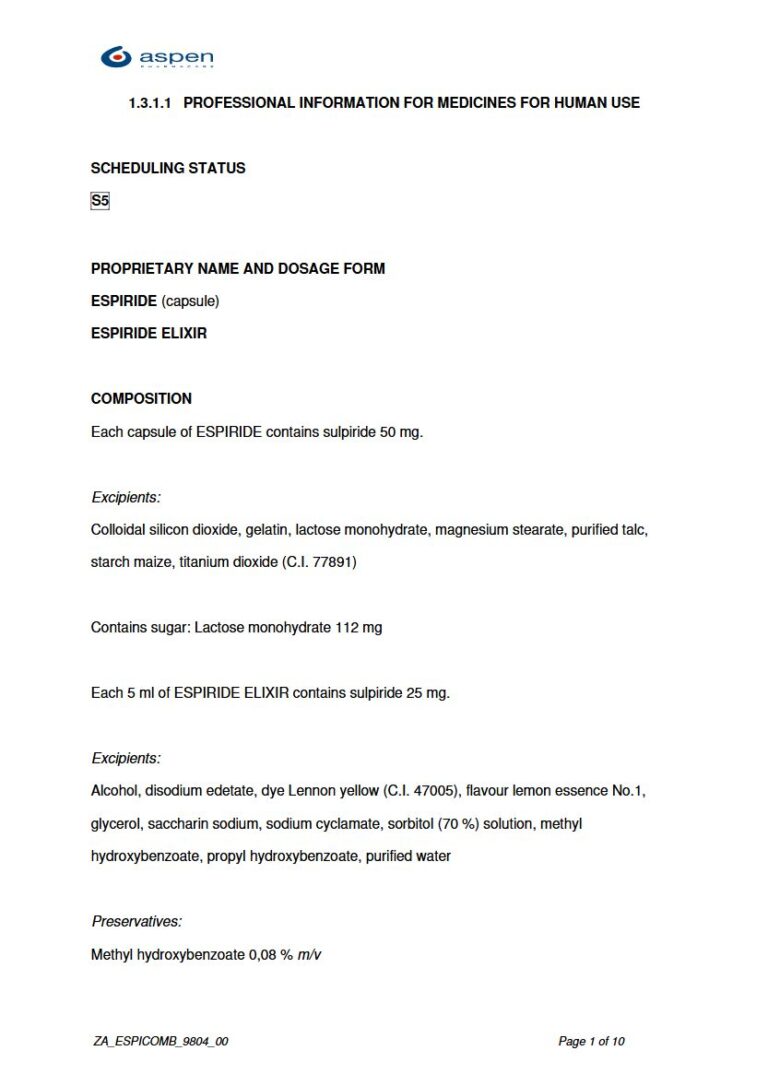
Espiride 5 ml Capsule
PDF Leaflet Revision Date: 14 April 1998
Clinical Summary
Quick overview from the medicine insert
Indication
Management of schizophrenia and reactive depression.
Dosage (summary)
Adults: 200-400 mg twice daily, max 1.2 g; Maintenance: 600-800 mg/day.
Onset of Action / Duration
Onset: 1-2 weeks, Duration: 7-9 hours
Special Populations
- Elderly
- Debilitated patients
- Patients with liver dysfunction
Pregnancy & Breastfeeding
Safety in pregnancy not established; use caution in breastfeeding.
Key Drug Interactions
- Anticholinergics
- CNS depressants
- Antacids
Contraindications
- Sensitivity to sulpiride
- Phaeochromocytoma
- Acute porphyria
Common side effects
- Sedation
- Extrapyramidal disorders
- Hypertension
- Weight gain
Counselling Points
- Avoid alcohol
- Monitor for mood changes
- Do not operate machinery
Serious warnings
- Caution in cardiovascular disease
- Risk of agranulocytosis
- Withdrawal symptoms
Important Disclaimer
The Espiride 5 ml Capsule professional information leaflet below is the property of Pharmacare and is provided on Medinsert exactly as issued, with no.. alterations or editorial changes. We make every effort to keep content current by updating documents as soon as new versions become available. Medinsert serves as a trusted access point for healthcare professionals, but does not replace official sources or clinical judgement. For more details, please read our full disclaimer. read more>>
 Healthcare Professionals Only
This content is for registered healthcare professionals
Sign in or create a free account to read the full package insert.
Free for HPCSA-registered professionals. Powered by Medinsert.
Clinical Particulars
Section 4 of the official insert — extracted exactly as issued, no alterations
4.1 Therapeutic indications
Reactive depression, depression associated with psychoses of other origins. Prophylaxis and treatment of depressive psychoses. Schizophrenia, particularly with the symptoms of hallucination, autism, aggressiveness and with withdrawn-inhibited types of schizophrenia. Acute delirium, acute hallucinatory and confused states. Behaviour disorders in all age groups where abnormal aggressive symptoms are in the forefront. ESPIRIDE is a useful adjunct in the medical treatment of duodenal ulceration of psychosomatic origin. For the treatment of vertigo. It also has an anti-emetic action.
4.2 Posology and method of administration
For the treatment of schizophrenia:
Adults: Initial dose of 200 mg to 400 mg twice daily, increasing if necessary to a maximum of 1,2 g twice daily. Maintenance dose 600 mg to 800 mg per day in divided doses for as long as necessary.
Common, milder psychiatric conditions of shorter duration and behavioural disorders:
Adults: 100 mg to 200 mg daily up to 300 mg per day, in divided doses. For maintenance treatment, reduce or increase as necessary.
Children (6 to 12 years): 3 to 5 mg/kg body mass per day in divided doses.
For gastro-enterology:
Adults: 150 mg to 300 mg daily in divided doses. Maintenance and duration of treatment according to patientu2019s requirements.
For the treatment of vertigo:
Adults: 150 mg to 300 mg daily in divided doses depending upon the intensity of the vertigo. Slowly decrease the dosage before totally withdrawing ESPIRIDE. ESPIRIDE should be given in reduced doses to elderly patients.
4.3 Contraindications
Sensitivity to sulpiride or phenothiazines. ESPIRIDE should not be administered to patients with phaeochromocytoma, with bone-marrow depression and only with caution to patients with hypertension. Contraindicated in hypomanic patients, in the manic or pre-manic phase of manic-depressive psychosis and in patients with acute mania as it may exacerbate symptoms. ESPIRIDE is considered to be unsafe in patients with acute porphyria. The safety in pregnancy has not been established.
4.4 Special warnings and precautions for use
Slow decrease in dosages before total withdrawal. ESPIRIDE should be used with caution in patients with cardiovascular or respiratory disease, or other conditions in which a sudden drop in blood pressure would be undesirable. If it is used in conjunction with other medicine, likely to cause postural hypotension, an adjustment of dosage may be necessary. It should be used with caution in patients with existing tachycardia or cardiac insufficiency and in patients with liver dysfunction or a history of jaundice. It should be used with care in patients with Parkinsonism (see INTERACTIONS). Patients receiving long term therapy should have regular examinations for abnormal pigmentation or ocular changes. Care is required in patients receiving anticonvulsant therapy (see INTERACTIONS). ESPIRIDE should be used with care in elderly and debilitated patients.
4.5 Interactions with other medicines
The anti-Parkinsonian actions of agents such as levodopa may be diminished by concurrent administration of ESPIRIDE (see WARNINGS AND SPECIAL PRECAUTIONS). The bioavailability of ESPIRIDE is reduced when given together with sucralfate or an antacid containing aluminium and magnesium hydroxides. It is recommended that if used concurrently that ESPIRIDE be given before rather than with or after sucralfate or antacids. ESPIRIDE may enhance the anticholinergic properties of atropine and tricyclic anti-depressants. ESPIRIDE should not be given in conjunction with other medicine that might cause leucopenia such as phenylbutazone and the thiouracil derivatives. The anti-emetic actions of ESPIRIDE may mask the symptoms of disorders such as gastrointestinal obstruction. The antihypertensive action of adrenergic neuron blocking medicines, such as guanethidine, is reduced by ESPIRIDE. ESPIRIDE enhances the activity of central nervous system depressants including alcohol, anaesthetics, hypnotics and narcotic analgesics and doses of these agents may need to be reduced. The anticonvulsant properties of diazepam, phenobarbitone, phenytoin, or other anticonvulsants, are not enhanced by ESPIRIDE, but ESPIRIDE may conversely, lower the convulsive threshold (see WARNINGS AND SPECIAL PRECAUTIONS).
4.6 Fertility, pregnancy and lactation
The safety in pregnancy has not been established.
4.7 Effects on ability to drive and use machines
ESPIRIDE may lead to drowsiness and impaired concentration which may be aggravated by simultaneous intake of alcohol or other central nervous system depressant agents. Patients should not operate hazardous machinery or drive motor vehicles or perform potentially hazardous tasks where loss of concentration may lead to accidents.
4.8 Undesirable effects
The side effects of ESPIRIDE are mild sedation and extrapyramidal disorders which include acute dystonia, a Parkinsonism-like syndrome, akathisia and the neuroleptic malignant syndrome; tardive dyskinesia and perioral tremor may subsequently develop. Sleep disturbances, overstimulation and agitation may occur. Hypertension, fatigue, impotence, amenorrhoea, galactorrhoea, gynaecomastia and mass gain have been reported. Minor abnormalities in liver function tests may occur. Other adverse effects of ESPIRIDE therapy may include minimal antimuscarinic effects such as dry mouth, constipation, urinary retention and mydriasis, as well as insomnia, depression, convulsions, nasal congestion, tachycardia, cardiac arrhythmias, electrocardiographic changes, postural hypotension, miosis, blurred vision, and inhibition of ejaculation. Allergic reactions include urticaria, exfoliative dermatitis, erythema multiforme and contact sensitivity. Jaundice has occurred and is probably allergic in origin. Prolonged therapy may lead to deposition of pigment in the skin, or more frequently the eyes; corneal and lens opacities have been observed. Photosensitivity reactions also occur. Various haematological disorders, including haemolytic anaemia, aplastic anaemia, thrombocytopenic purpura and a potentially fatal agranulocytosis have occurred in patients receiving ESPIRIDE. Most cases of agranulocytosis have occurred within 4 to 10 weeks of starting treatment and symptoms such as sore throat or fever should be watched for and white cell counts instituted should they appear. ESPIRIDE alters endocrine and metabolic functions. Patients have experienced hyperglycaemia and altered glucose tolerance and increased serum-cholesterol concentrations. Body temperature regulation is impaired and may result in both hypo- or hyperthermia depending on environment. Following the abrupt discontinuation of large doses, withdrawal symptoms may include nausea, vomiting, gastritis and tremors.
4.9 Overdose
Symptoms: See SIDE EFFECTS.
Treatment: In severe overdosage the stomach should be emptied by aspiration and lavage. Emetics should not be used. Treatment is symptomatic and supportive.
