
Ethionamide Macleods 250 Mg Tablets
PDF Leaflet Revision Date: 08 August 2025
Clinical Summary
Quick overview from the medicine insert
Indication
Second line treatment of tuberculosis caused by sensitive strains of Mycobacterium tuberculosis.
Dosage (summary)
Adults: 15-20 mg/kg/day, max 1 g/day.
Special Populations
- Hepatic impairment
- Depression
- Diabetes
Pregnancy & Breastfeeding
Contraindicated in pregnancy and breastfeeding.
Key Drug Interactions
- CNS toxicity with cicloserin
- Increased hepatotoxicity with rifampicin
- Additive neurological effects with isoniazid
Contraindications
- Hypersensitivity to ethionamide
- Severe hepatic impairment
- Pregnancy
Common side effects
- Diarrhoea
- Nausea
- Dizziness
- Hepatitis
Counselling Points
- Take with meals to minimize GI side effects
- Avoid alcohol
- Monitor for psychiatric symptoms
Serious warnings
- Monitor liver function
- Risk of neurotoxic effects
- Avoid in porphyria
Important Disclaimer
The Ethionamide Macleods 250 Mg Tablets professional information leaflet below is the property of Macleods Pharmaceuticals and is provided on Medinsert exactly as issued, with no.. alterations or editorial changes. We make every effort to keep content current by updating documents as soon as new versions become available. Medinsert serves as a trusted access point for healthcare professionals, but does not replace official sources or clinical judgement. For more details, please read our full disclaimer. read more>>
 Healthcare Professionals Only
This content is for registered healthcare professionals
Sign in or create a free account to read the full package insert.
Free for HPCSA-registered professionals. Powered by Medinsert.
Clinical Particulars
Section 4 of the official insert — extracted exactly as issued, no alterations
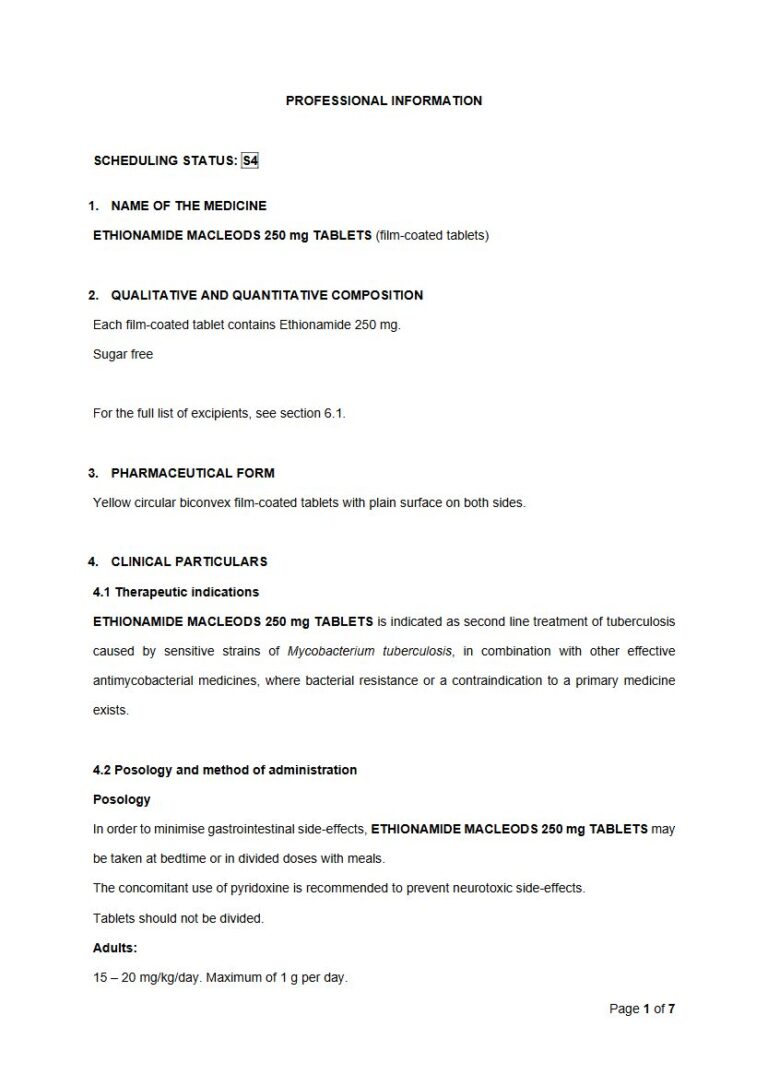
4.1 Therapeutic indications
ETHIONAMIDE MACLEODS 250 mg TABLETS is indicated as second line treatment of tuberculosis caused by sensitive strains of Mycobacterium tuberculosis, in combination with other effective antimycobacterial medicines, where bacterial resistance or a contraindication to a primary medicine exists.
4.2 Posology and method of administration
Posology
In order to minimise gastrointestinal side-effects, ETHIONAMIDE MACLEODS 250 mg TABLETS may be taken at bedtime or in divided doses with meals. The concomitant use of pyridoxine is recommended to prevent neurotoxic side-effects. Tablets should not be divided.
Adults: 15 u2013 20 mg/kg/day. Maximum of 1 g per day.
Children: Over 10 years: As for adults. Under 10 years: 10 mg/kg/day increasing gradually to 15 u2013 20 mg/kg/day. Maximum dose of 750 mg/day.
Method of administration
Oral use
4.3 Contraindications
- Hypersensitivity to ethionamide or any of the ingredients listed in Section 6.1
- Patients sensitive to isoniazid, pyrazinamide or niacin may also be sensitive to ETHIONAMIDE MACLEODS 250 mg TABLETS.
- Severe hepatic impairment/disease.
- Pregnancy.
- Safety in lactation has not been established.
4.4 Special warnings and precautions for use
Use with care in patients with depression or other psychiatric illness, liver impairment, chronic alcoholism, epilepsy, hypothyroidism and diabetes. Avoid in porphyria. ETHIONAMIDE MACLEODS 250 mg TABLETS should not be administered to patients with impaired hepatic function. Liver function tests should be carried out before and monthly during treatment with ETHIONAMIDE MACLEODS 250 mg TABLETS. ETHIONAMIDE MACLEODS 250 mg TABLETS should be discontinued if there is a five-fold increase in hepatic enzyme levels even in the absence of symptoms. Concurrent administration of pyridoxine or nicotinamide has been suggested to prevent or relieve neurotoxic effects. Caution is advised in administering ETHIONAMIDE MACLEODS 250 mg TABLETS in patients with depression or other psychiatric illness. Difficulty may be experienced in the management of diabetes mellitus. Periodic monitoring of blood glucose, thyroid function and visual function is recommended.
Many patients, due to gastrointestinal side-effects, cannot tolerate therapeutic doses of ETHIONAMIDE MACLEODS 250 mg TABLETS and have to stop treatment. Tolerance may be improved by reducing the dose, changing the time of administration, or by the concurrent administration of an antiemetic medicine.
4.5 Interactions with other medicines and other forms of interaction
Cross resistance may occur with thioacetazone. Additive neurological effects may occur with isoniazid. There is an increased risk of CNS toxicity when used concurrently with cicloserin and terizidone. Convulsions have been reported when ETHIONAMIDE MACLEODS 250 mg TABLETS is administered with cicloserin and special care should be taken when the treatment regimen includes both of these medicines. Excessive alcohol ingestion should be avoided as a psychotic reaction can occur. The incidence of hepatotoxicity is increased when ETHIONAMIDE MACLEODS 250 mg TABLETS is given with rifampicin.
4.6 Fertility, pregnancy and lactation
Pregnancy
ETHIONAMIDE MACLEODS 250 mg TABLETS is contraindicated during pregnancy.
Breastfeeding
ETHIONAMIDE MACLEODS 250 mg TABLETS is contraindicated during breastfeeding.
Fertility
No information is available.
4.7 Effects on ability to drive and use machines
ETHIONAMIDE MACLEODS 250 mg TABLETS may cause dizziness and/or drowsiness. Patients should be instructed that if they experience these symptoms they should avoid potentially hazardous tasks such as driving or operating machinery.
4.8 Undesirable effects
Tabulated list of adverse reactions
MedDRA System organ class
Frequency
Adverse reactions
Blood and lymphatic system
Less frequent
Thrombocytopaenia and purpura
Immune system disorders
Less frequent
Hypersensitivity reactions
Endocrine disorders
Less frequent
Endocrine disturbances
Metabolism and nutrition disorders
Less frequent
Difficulty in the management of diabetes mellitus, hypoglycaemia, hypothyroidism or goitre.
Psychiatric disorders
Less frequent
Depression, anxiety, psychosis, restlessness.
Nervous system disorders
Less frequent
Dizziness, drowsiness, headache, seizures, peripheral neuropathy responsive to pyridoxine and a pellagra-like encephalopathy responsive to niacin.
Eye disorders
Less frequent
Optic neuritis, diplopia, blurred vision.
Vascular disorders
Less frequent
Postural hypotension
Gastrointestinal disorders
Frequent
Diarrhoea, vomiting, nausea, abdominal pain, excessive salivation, metallic taste, stomatitis, anorexia and weight loss.
Hepato - biliary disorders
Frequent
Hepatitis with or without jaundice, transient increase in serum bilirubin, AST and ALT.
Skin and subcutaneous tissue disorders
Less Frequent
Alopecia, photosensitivity, dermatitis (including photodermatitis), acne
Musculoskeletal, connective tissue and bone disorders
Less Frequent
Arthralgia
Reproductive system and breast disorders
Less frequent
Gynaecomastia, amenorrhoea, impotence.
General disorders and administrative site conditions
Less frequent
Asthenia
Reporting of suspected adverse reactions
Reporting suspected adverse reactions after authorisation of the medicine is important. It allows continued monitoring of the benefit/risk balance of the medicine. Health care providers are asked to report any suspected adverse reactions to SAHPRA via the Med Safety APP (Medsafety X SAHPRA) and eReporting platform (who-umc.org) found on SAHPRA website or to Macleods Pharmaceuticals SA (Pty) Ltd. at [email protected].
4.9 Overdose
An acute overdosage may lead to an accentuation of the symptoms listed under u2018Side effectsu2019. Treatment should be symptomatic and supportive.
