
Eurostib 200 mg Tablet
PDF Leaflet Revision Date: 11 October 2022
Clinical Summary
Quick overview from the medicine insert
Indication
Treatment of advanced renal cell carcinoma, hepatocellular carcinoma, and differentiated thyroid carcinoma.
Dosage (summary)
400 mg daily (2 x 200 mg tablets) taken twice daily.
Special Populations
- Elderly
- Hepatic impairment
- Renal impairment
Pregnancy & Breastfeeding
Contraindicated in pregnancy and lactation; potential for teratogenic effects.
Key Drug Interactions
- Warfarin
- Docetaxel
- Neomycin
Contraindications
- Hypersensitivity to sorafenib
- Pregnancy
- Lactation
Common side effects
- Diarrhoea
- Fatigue
- Alopecia
- Rash
- Hand foot skin reaction
Counselling Points
- Avoid pregnancy during treatment
- Monitor blood pressure regularly
- Report any signs of bleeding
Serious warnings
- Hypertension
- Cardiac ischaemia
- Gastrointestinal perforation
- QT prolongation
Important Disclaimer
The Eurostib 200 mg Tablet professional information leaflet below is the property of Eurolab and is provided on Medinsert exactly as issued, with no.. alterations or editorial changes. We make every effort to keep content current by updating documents as soon as new versions become available. Medinsert serves as a trusted access point for healthcare professionals, but does not replace official sources or clinical judgement. For more details, please read our full disclaimer. read more>>
 Healthcare Professionals Only
This content is for registered healthcare professionals
Sign in or create a free account to read the full package insert.
Free for HPCSA-registered professionals. Powered by Medinsert.
Clinical Particulars
Section 4 of the official insert — extracted exactly as issued, no alterations
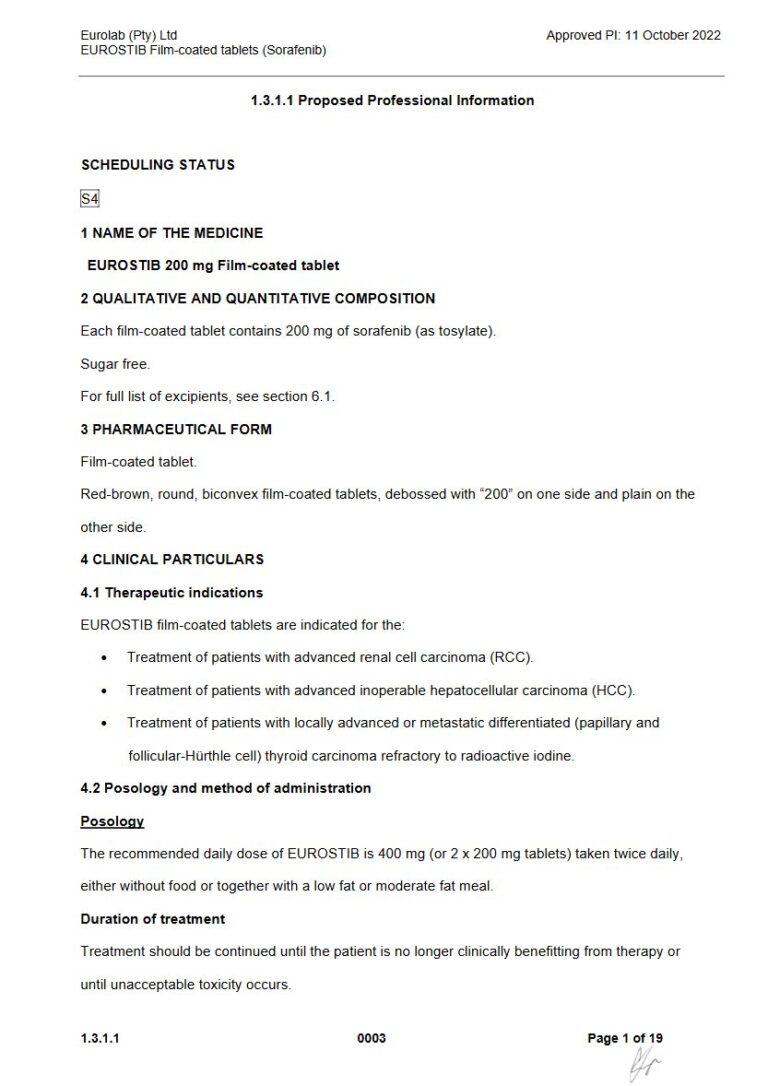
4.1 Therapeutic indications
EUROSTIB film-coated tablets are indicated for the:
- Treatment of patients with advanced renal cell carcinoma (RCC).
- Treatment of patients with advanced inoperable hepatocellular carcinoma (HCC).
- Treatment of patients with locally advanced or metastatic differentiated (papillary and follicular-Hu00fcrthle cell) thyroid carcinoma refractory to radioactive iodine.
4.2 Posology and method of administration
Posology
The recommended daily dose of EUROSTIB is 400 mg (or 2 x 200 mg tablets) taken twice daily, either without food or together with a low fat or moderate fat meal.
Duration of treatment
Treatment should be continued until the patient is no longer clinically benefitting from therapy or until unacceptable toxicity occurs.
Posology adjustments (dose titration, dose adjustment and special monitoring advice)
Dose reduction for hepatocellular carcinoma and advanced renal cell carcinoma: Management of suspected adverse reactions may require temporary interruption and/or dose reduction of EUROSTIB therapy. When dose reduction is necessary during treatment of hepatocellular carcinoma (HCC) and advanced renal carcinoma (RCC), the EUROSTIB dose should be reduced to 400 mg daily.
Suggested dose modifications for skin toxicity with HCC and RCC:
- Grade 1 (mild) Any Institute supportive measures immediately and continue EUROSTIB treatment.
- Grade 2 (moderate) First Institute supportive measures immediately and consider a decrease EUROSTIB dose to 400 mg daily for 28 days u2022 If toxicity returns to grade 0 to 1 after dose reduction, increase EUROSTIB to full dose after 28 days If toxicity does not return to grade 0 to 1 despite dose reduction, interrupt EUROSTIB treatment for a minimum of 7 days, until toxicity has resolved to grade 0 to 1 u2022 When resuming treatment after dose interruption, resume EUROSTIB at reduced dose of 400 mg daily for 28 days u2022 If toxicity is maintained at grade 0 to 1 at reduced dose, increase EUROSTIB to full dose after 28 days
- Second or Third As for first occurrence, but upon resuming EUROSTIB treatment, decrease dose to 400 mg daily indefinitely
- Fourth Discontinue EUROSTIB treatment
Grade 3 (severe) First Institute supportive measures immediately and interrupt EUROSTIB treatment for a minimum of 7 days and until toxicity has resolved to grade 0 to 1 u2022 When resuming treatment after dose interruption, resume EUROSTIB at reduced dose of 400 mg daily for 28 days u2022 If toxicity is maintained at grade 0 to 1 at reduced dose, increase EUROSTIB to full dose after 28 days
Second As for first occurrence, but upon resuming EUROSTIB treatment, decrease dose to 400 mg daily indefinitely
Third Discontinue EUROSTIB treatment.
Dose Reduction for Differentiated Thyroid Carcinoma: Management of suspected side-effects may require temporary interruption and/or dose reduction of EUROSTIB therapy. When dose reduction is necessary during the treatment of differentiated thyroid carcinoma, the EUROSTIB dose should be reduced to 600 mg daily in divided doses (two tablets of 200 mg and one tablet of 200 mg twelve hours apart). If additional dose reduction is necessary, EUROSTIB may be reduced to one tablet of 200 mg twice daily, followed by one tablet of 200 mg once daily. After improvement of non-haematological adverse reactions, the dose of sorafenib may be increased.
Special populations
Paediatric population The safety and effectiveness of EUROSTIB in paediatric patients has not been established.
Elderly (above 65 years), gender and body weight No dose adjustment is required on the basis if patient age (above 65 years), gender or body weight.
Hepatic impairment No dose adjustment is required in patients with Child-Pugh A or B hepatic impairment. EUROSTIB has not been studied in patients with Child-Pugh C hepatic impairment.
Renal impairment No dose adjustment is required in patients with mild, moderate or severe renal impairment not requiring dialysis. EUROSTIB has not been studied in patients undergoing dialysis. Monitoring of fluid balance and electrolytes in patients at risk of renal dysfunction is advised.
Method of administration For oral use. To be swallowed with a glass of water.
4.3 Contraindications
- Hypersensitivity to sorafenib or to any of the excipients listed in section 6.1.
- Pregnancy and lactation (see section 4.6)
4.4 Special warnings and precautions for use
Dermatological toxicities Hand foot skin reaction (palmar-plantar erythrodysaesthesia) and rash represent the most common adverse drug reactions with sorafenib. Rash and hand foot skin reaction are usually CTC (Common Toxicity Criteria) Grade 1 and 2 and generally appear during the first six weeks of treatment with sorafenib. Management of dermatological toxicities may include topical therapies for symptomatic relief, temporary treatment interruption and/or dose modification of sorafenib, or in severe or persistent cases, permanent discontinuation of sorafenib (see section 4.8).
Hypertension An increased incidence of arterial hypertension was observed in sorafenib-treated patients. Hypertension was usually mild to moderate, occurred early in the course of treatment, and was amenable to management with standard antihypertensive therapy. Blood pressure should be monitored regularly and treated, if required, in accordance with standard medical practice. In cases of severe or persistent hypertension, or hypertensive crisis despite institution of antihypertensive therapy, permanent discontinuation of sorafenib should be considered (see section 4.8).
Aneurysms and artery dissections The use of Vascular endothelial growth factor (VEGF) pathway inhibitors in patients with or without hypertension may promote the formation of aneurysms and/or artery dissections. Before initiating EUROSTIB, this risk should be carefully considered in patients with risk factors such as hypertension or history of aneurysm.
Hypoglycaemia Decreases in blood glucose, in some cases clinically symptomatic and requiring hospitalisation due to loss of consciousness, have been reported during sorafenib treatment. In case of symptomatic hypoglycaemia, sorafenib should be temporarily interrupted. Blood glucose levels in diabetic patients should be checked regularly in order to assess if anti-diabetic medicineu2019s dosage needs to be adjusted.
Haemorrhage An increased risk of bleeding may occur following sorafenib administration. If any bleeding event necessitates medical intervention it is recommended that permanent discontinuation of EUROSTIB should be considered (see section 4.8).
Cardiac ischaemia and/or infarction In a study the incidence of treatment-emergent cardiac ischaemia/infarction events was higher in the sorafenib group (4,9 %) compared with the placebo group (0,4 %). In another study the incidence of treatment-emergent cardiac ischaemia/infarction events was 2,7 % in sorafenib patients compared with 1,3 % in the placebo group. Patients with unstable coronary artery disease or recent myocardial infarction were excluded from these studies. Temporary or permanent discontinuation of EUROSTIB should be considered in patients who develop cardiac ischaemia and/or infarction (see section 4.8).
QT interval prolongation Sorafenib has been shown to prolong the QT/QTc interval, which may lead to an increased risk for ventricular dysrhythmias. Use EUROSTIB with caution in patients who have, or may develop prolongation of QTc, such as patients with a congenital long QT syndrome, patients treated with a high cumulative dose of anthracycline therapy, patients taking certain anti-dysrhythmic medicines or other medicines that lead to QT prolongation, and those with electrolyte disturbances such as hypokalaemia, hypocalcaemia, or hypomagnesaemia. When using EUROSTIB in these patients, periodic monitoring with on-treatment electrocardiograms and electrolytes (magnesium, potassium, calcium) should be considered.
Gastrointestinal perforation Gastrointestinal perforation is an uncommon event and has been reported in less than 1 % of patients taking sorafenib. In some cases this was not associated with apparent intra-abdominal tumour. EUROSTIB therapy should be discontinued (see section 4.8).
Hepatic impairment No data is available on patients with Child Pugh C (severe) hepatic impairment. Since sorafenib is mainly eliminated via the hepatic route exposure might be increased in patients with severe hepatic impairment (see sections 4.2 and 5.2).
Warfarin co-administration Infrequent bleeding events or elevations in the International Normalised Ratio (INR) have been reported in some patients taking warfarin while on sorafenib therapy. Patients taking concomitant warfarin or phenprocoumon should be monitored regularly for changes in prothrombin time, INR or clinical bleeding episodes (see sections 4.5 and 4.8).
Wound healing complications No formal studies of the effect of sorafenib on wound healing have been conducted. Temporary interruption of EUROSTIB therapy is recommended for precautionary reasons in patients undergoing major surgical procedures. There is limited clinical experience regarding the timing of reinitiation of therapy following major surgical intervention. Therefore, the decision to resume EUROSTIB therapy following a major surgical intervention should be based on clinical judgement of adequate wound healing.
Elderly population Cases of renal failure have been reported. Monitoring of renal function should be considered.
4.5 Interactions with other medicines and other forms of interaction
Inducers of metabolic enzymes Administration of rifampicin for 5 days before administration of a single dose of sorafenib resulted in an average 37 % reduction of sorafenib AUC. Other inducers of CYP3A4 activity and/or glucuronidation (e.g. Hypericum perforatum also known as St. John's wort, phenytoin, carbamazepine, phenobarbitone, and dexamethasone) may also increase metabolism of sorafenib and thus decrease sorafenib concentrations.
CYP3A4 inhibitors Ketoconazole, a potent inhibitor of CYP3A4, administered once daily for 7 days to healthy male volunteers did not alter the mean AUC of a single 50 mg dose of sorafenib. These data suggest that clinical pharmacokinetic interactions of sorafenib with CYP3A4 inhibitors are unlikely.
CYP2B6, CYP2C8 and CYP2C9 substrates Sorafenib inhibited CYP2B6, CYP2C8 and CYP2C9 in vitro with similar potency. However, in clinical pharmacokinetic studies, concomitant administration of sorafenib 400 mg twice daily with cyclophosphamide, a CYP2B6 substrate, or paclitaxel, a CYP2C8 substrate, did not result in a clinically meaningful inhibition. These data suggest that sorafenib at the recommended dose of 400 mg twice daily may not be an in vivo inhibitor of CYP2B6 or CYP2C8. Additionally, concomitant treatment with sorafenib and warfarin, a CYP2C9 substrate, did not result in changes in mean PT-INR compared to placebo. Thus, also the risk for a clinically relevant in vivo inhibition of CYP2C9 by sorafenib may be expected to be low. However, patients taking warfarin or phenprocoumon should have their INR checked regularly (see section 4.4).
CYP3A4, CYP2D6 and CYP2C19 substrates Concomitant administration of sorafenib and midazolam, dextromethorphan or omeprazole, which are substrates for cytochromes CYP3A4, CYP2D6 and CYP2C19 respectively, did not alter the exposure of these medicines. This indicates that sorafenib is neither an inhibitor nor an inducer of these cytochrome P450 isoenzymes. Therefore, clinical pharmacokinetic interactions of sorafenib with substrates of these enzymes are unlikely.
UGT1A1 and UGT1A9 substrates In vitro, sorafenib inhibited glucuronidation via UGT1A1 and UGT1A9. The clinical relevance of this finding is unknown (see below and section 4.4).
In vitro studies of CYP enzyme induction CYP1A2 and CYP3A4 activities were not altered after treatment of cultured human hepatocytes with sorafenib, indicating that sorafenib is unlikely to be an inducer of CYP1A2 and CYP3A4.
P-gp-substrates In vitro, sorafenib has been shown to inhibit the transport protein p-glycoprotein (P-gp). Increased plasma concentrations of P-gp substrates such as digoxin cannot be excluded with concomitant treatment with sorafenib.
Combination with other anti-neoplastic medicines In clinical studies sorafenib has been administered with a variety of other anti-neoplastic medicines at their commonly used dosing regimens including gemcitabine, cisplatin, oxaliplatin, paclitaxel, carboplatin, capecitabine, doxorubicin, irinotecan, docetaxel and cyclophosphamide. Sorafenib had no clinically relevant effect on the pharmacokinetics of gemcitabine, cisplatin, carboplatin, oxaliplatin or cyclophosphamide.
Paclitaxel/carboplatin Administration of paclitaxel (225 mg/m2) and carboplatin (AUC = 6) with sorafenib (u2264 400 mg twice daily), administered with a 3-day break in sorafenib dosing (two days prior to and on the day of paclitaxel/carboplatin administration), resulted in no significant effect on the pharmacokinetics of paclitaxel. Co-administration of paclitaxel (225 mg/m2, once every 3 weeks) and carboplatin (AUC=6) with sorafenib (400 mg twice daily, without a break in sorafenib dosing) resulted in a 47 % increase in sorafenib exposure, a 29 % increase in paclitaxel exposure and a 50 % increase in 6-OH paclitaxel exposure. The pharmacokinetics of carboplatin were unaffected. These data indicate no need for dose adjustments when paclitaxel and carboplatin are co-administered with sorafenib with a 3-day break in sorafenib dosing (two days prior to and on the day of paclitaxel/carboplatin administration). The clinical significance of the increases in sorafenib and paclitaxel exposure, upon co-administration of sorafenib without a break in dosing, is unknown.
Capecitabine Co-administration of capecitabine (750-1050 mg/m2 twice daily, Days 1-14 every 21 days) and sorafenib (200 or 400 mg twice daily, continuous uninterrupted administration) resulted in no significant change in sorafenib exposure, but a 15-50 % increase in capecitabine exposure and a 0-52 % increase in 5-FU exposure. The clinical significance of these small to modest increases in capecitabine and 5-FU exposure when co-administered with sorafenib is unknown.
Doxorubicin/Irinotecan Concomitant treatment with sorafenib resulted in a 21 % increase in the AUC of doxorubicin. When administered with irinotecan, whose active metabolite SN-38 is further metabolised by the UGT1A1 pathway, there was a 67 - 120 % increase in the AUC of SN-38 and a 26 - 42 % increase in the AUC of irinotecan. The clinical significance of these findings are unknown (see section 4.4).
Docetaxel Docetaxel (75 or 100 mg/m2 administered once every 21 days) when co-administered with sorafenib (200 mg twice daily or 400 mg twice daily administered on Days 2 through 19 of a 21-day cycle with a 3-day break in dosing around administration of docetaxel) resulted in a 36-80 % increase in docetaxel AUC and a 16-32 % increase in docetaxel C max. Caution is recommended when sorafenib is co-administered with docetaxel (see section 4.4).
4.6 Fertility, pregnancy and lactation
Women of childbearing potential / Contraception in males and females Women should avoid becoming pregnant while on therapy with EUROSTIB. Women of childbearing potential must be apprised of the potential hazard to the foetus, which includes severe malformation (teratogenicity), failure to thrive and foetal death (embryotoxicity). Adequate contraception should be used during therapy and for at least 2 weeks after completion of therapy.
Pregnancy EUROSTIB should not be used during pregnancy. There are no data on the use of sorafenib in pregnant women. Studies in animals have shown reproductive toxicity including malformations. In rats, sorafenib and its metabolites were demonstrated to cross the placenta and sorafenib is anticipated to cause harmful effects to the foetus.
Lactation It is not known whether sorafenib is excreted in human milk. In animals, sorafenib and/or its metabolites were excreted in milk. Because sorafenib could harm infant growth and development, women must not breastfeed during EUROSTIB treatment.
Fertility Results from animal studies further indicate that sorafenib can impair male and female fertility.
4.7 Effects on ability to drive and use machines
The development of peripheral sensory neuropathy may affect the ability to drive or to operate machinery. No studies on the effects of the ability to drive and use machines have been performed.
It is not always possible to predict to what extent EUROSTIB may interfere with the daily activities of a patient. Patients should ensure that they do not engage in the above activities until they are aware of the measure to which EUROSTIB affects them.
4.8 Undesirable effects
a. Summary of the safety profile The most important serious adverse reactions were myocardial infarction/ischaemia, gastrointestinal perforation, medicine induced hepatitis, haemorrhage, and hypertension/hypertensive crisis. The most common adverse reactions were diarrhoea, fatigue, alopecia, infection, hand foot skin reaction (corresponds to palmar plantar erythrodysaesthesia syndrome in MedDRA) and rash.
b. Tabulated summary of adverse reactions
SYSTEM ORGAN CLASS FREQUENCY ADVERSE REACTIONS Infections and infestations Frequent Infection, folliculitis. Blood and lymphatic system disorders Frequent Anaemia, leucopoenia, lymphopenia, neutropenia, thrombocytopenia. Immune system disorders Less frequent Anaphylactic reaction, angioedema, hypersensitivity reactions (including skin reactions and urticaria). Endocrine disorders Frequent Hypothyroidism. Less frequent Hyperthyroidism. Metabolism and nutrition disorders Frequent Anorexia, hypocalcaemia, hypoglycaemia, hypokalaemia, hyponatraemia, hypophosphataemia. Less frequent Dehydration. Psychiatric Frequent Depression. Nervous system disorders Frequent Dysgeusia, peripheral sensory neuropathy. Less frequent Reversible posterior leukoencephalopathy. * Frequency unknown Encephalopathy. # Ear and labyrinth disorders Frequent Tinnitus. Cardiac disorders Frequent Congestive heart failure, myocardial ischaemia and infarction. * Less frequent QT prolongation. Vascular disorders Frequent Flushing, haemorrhage (including gastrointestinal*, respiratory tract* and cerebral haemorrhage*), hypertension. Less frequent Hypertensive crisis. * Frequency unknown Aneurysms and artery dissections. Respiratory, thoracic and mediastinal disorders Frequent Dysphonia, rhinorrhoea. Less frequent Interstitial lung disease-like events* (pneumonitis, radiation pneumonitis, acute respiratory distress, etc.) Gastrointestinal disorders Frequent Constipation, diarrhoea, dyspepsia, dysphagia, gastro-oesophageal reflux disease (GORD), nausea, vomiting, stomatitis (including dry mouth and glossodynia). Less frequent Gastritis, gastrointestinal perforations*, pancreatitis. Hepatobiliary disorders Less frequent cholangitis, cholecystitis, medicine induced hepatitis*, increase in bilirubin and jaundice. Skin and subcutaneous tissue disorders Frequent Acne, alopecia, dermatitis exfoliative, dry skin, erythema, hand foot skin reaction **, hyperkeratosis, keratoacanthoma/squamous cell cancer of the skin, pruritis, rash, skin desquamation. Less frequent Eczema, erythema multiforme, leucocytoclastic vasculitis, radiation recall dermatitis, Steven-Johnson syndrome, toxic epidermal necrolysis *. Musculoskeletal and connective tissue disorders Frequent arthralgia, muscle spasms, myalgia. Less frequent Rhabdomyolysis. Renal and urinary disorders Frequent Proteinuria, renal failure. Less frequent Nephrotic syndrome. Reproductive system and breast disorders Frequent Erectile dysfunction. Less frequent Gynaecomastia General disorders and administration site conditions Frequent Asthenia, fatigue, fever, pain (including mouth, abdominal, bone, tumour pain and headache), influenza like illness, mucosal inflammation. Investigations Frequent increased amylase, increased lipase, transient increase in transaminases, weight decreased. Less frequent INR abnormal, prothrombin level abnormal, transient increase in blood alkaline phosphatase. * The adverse reactions may have a life-threatening or fatal outcome. Such events are either uncommon or less frequent than uncommon. ** Hand foot skin reaction corresponds to palmar plantar erythrodysaesthesia syndrome in MedDRA. # Cases have been reported in the post marketing setting. In clinical trials, certain adverse drug reactions such as hand foot skin reaction, diarrhoea, alopecia, weight decrease, hypertension, hypocalcaemia, and keratoacanthoma/squamous cell carcinoma of skin occurred at a substantially higher frequency in patients with differentiated thyroid compared to patients in the renal cell or hepatocellular carcinoma studies.
d. Paediatric population No information.
e. Other special population(s) No information.
Reporting of suspected adverse reactions Reporting suspected adverse reactions after authorisation of the medicine is important. It allows continued monitoring of the benefit/risk balance of the medicine. Healthcare professionals are asked to report any suspected adverse reactions to SAHPRA via the u201c6.04 Adverse Drug Reaction Reporting Formu201d, found online under SAHPRAu2019s publications: https://www.sahpra.org.za/Publications/Index/8
4.9 Overdose
There is no specific treatment for EUROSTIB overdose. The highest dose of sorafenib studied clinically is 800 mg twice daily. The adverse events observed at this dose were primarily diarrhoea and dermatological events. In the event of suspected overdose, EUROSTIB should be withheld and supportive care instituted where necessary.
