
Ferinject 50 mg/ 500 mg Solution for injection/infusion.
PDF Leaflet Revision Date: 28 March 2025
Clinical Summary
Quick overview from the medicine insert
Indication
Treatment of iron deficiency in adults when oral iron is ineffective or cannot be used.
Dosage (summary)
Individualized based on body weight and Hb level; max 1000 mg/week.
Special Populations
- Elderly
- Haemodialysis-dependent chronic kidney disease
Pregnancy & Breastfeeding
Use in pregnancy only if necessary; limited data available. Safety in lactation not established.
Key Drug Interactions
- Reduced absorption of oral iron if given within 5 days of parenteral iron
Contraindications
- Hypersensitivity to ferric carboxymaltose
- Non-iron deficiency anemia
- Iron overload
Common side effects
- Nausea
- Injection site reactions
- Hypophosphataemia
- Headache
- Flushing
Counselling Points
- Monitor for allergic reactions
- Avoid mixing with other medications
- Report any unusual symptoms immediately
Serious warnings
- Risk of anaphylactic reactions
- Monitor for hypophosphataemia
- Caution in hepatic/renal impairment
Important Disclaimer
The Ferinject 50 mg/ 500 mg Solution for injection/infusion. professional information leaflet below is the property of Pharmacare and is provided on Medinsert exactly as issued, with no.. alterations or editorial changes. We make every effort to keep content current by updating documents as soon as new versions become available. Medinsert serves as a trusted access point for healthcare professionals, but does not replace official sources or clinical judgement. For more details, please read our full disclaimer. read more>>
 Healthcare Professionals Only
This content is for registered healthcare professionals
Sign in or create a free account to read the full package insert.
Free for HPCSA-registered professionals. Powered by Medinsert.
Clinical Particulars
Section 4 of the official insert — extracted exactly as issued, no alterations
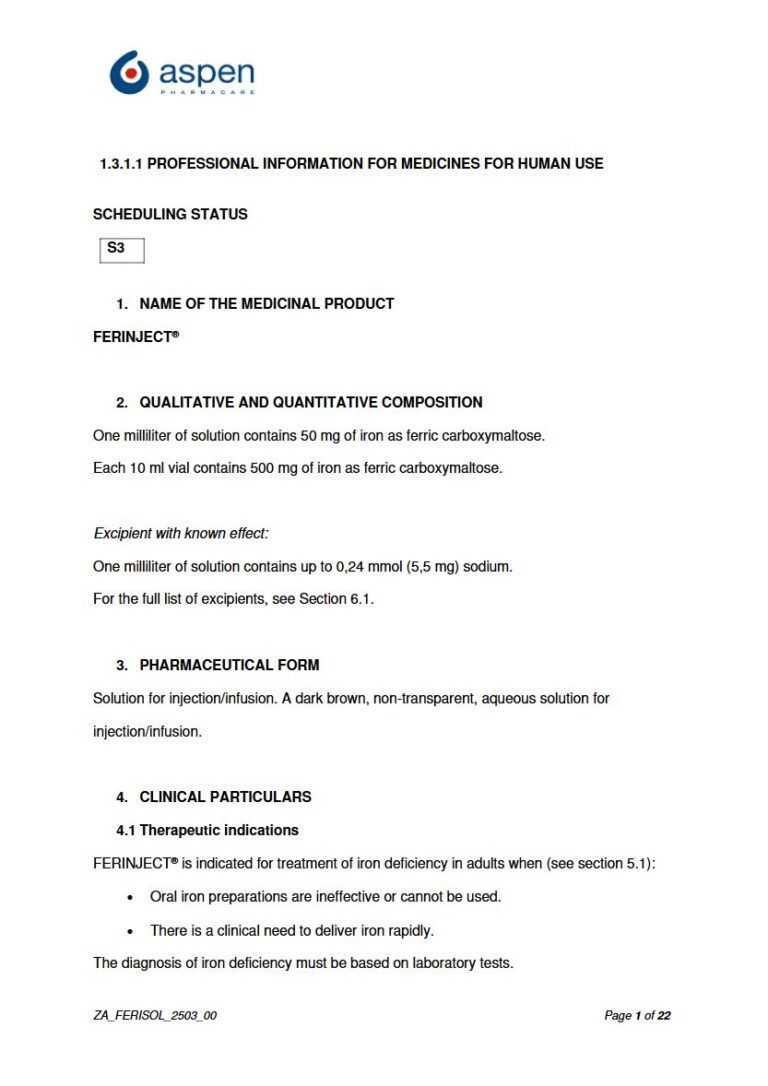
4.1 Therapeutic indications
FERINJECT u00ae is indicated for treatment of iron deficiency in adults when (see section 5.1):
- Oral iron preparations are ineffective or cannot be used.
- There is a clinical need to deliver iron rapidly.
The diagnosis of iron deficiency must be based on laboratory tests.
4.2 Posology and method of administration
Monitor patients carefully for signs and symptoms of hypersensitivity reactions during and following each administration of FERINJECT u00ae. FERINJECT u00ae should only be administered when staff trained to evaluate and manage anaphylactic reactions is immediately available, in an environment where full resuscitation facilities can be assured. The patient should be observed for adverse effects for at least 30 minutes following each FERINJECT u00ae administration (see section 4.4).
Patients may continue to require therapy with FERINJECT u00ae at the lowest dose necessary to maintain target levels of haemoglobin, and other laboratory values of iron storage parameters within acceptable limits.
Maximum tolerated single dose
The adequate cumulative dose of FERINJECT u00ae must be calculated for each patient individually and must not be exceeded.
Posology
The posology of FERINJECT u00ae follows a stepwise approach:
- Determination of the individual iron need.
- Calculation and administration of the iron dose(s).
- Post-iron repletion assessments.
These steps are outlined below:
Step 1: Determination of the iron need
The individual iron need for repletion using FERINJECT u00ae is determined based on the patientu2019s body weight and haemoglobin (Hb) level. Refer to Table 1 for determination of the iron need:
Table 1: Determination of the iron need
| Hb | Patient body weight | g/dL | mmol/L | below 35 kg | 35 kg to < 70 kg | 70 kg and above |
|---|---|---|---|---|---|---|
| < 10 | < 6,2 | 500 mg | 1 500 mg | 2 000 mg | ||
| 10 to < 14 | 6,2 to < 8,7 | 500 mg | 1 000 mg | 1 500 mg | ||
| u2265 14 | u2265 8,7 | 500 mg | 500 mg | 500 mg |
Iron deficiency must be confirmed by laboratory tests as stated in 4.1 (see section 4.1).
Step 2: Calculation and administration of the maximum individual iron dose(s)
Based on the iron need determined above the appropriate dose(s) of FERINJECT u00ae should be administered taking into consideration the following:
A single FERINJECT u00ae administration should not exceed:
- (a) 15 mg/kg body weight (for administration by intravenous injection) or 20 mg iron/kg body weight (for administration by intravenous infusion).
- (b) 1 000 mg of iron (20 mL FERINJECT u00ae)
The maximum recommended cumulative dose of FERINJECT u00ae is 1000 mg of iron (20 mL FERINJECT u00ae) per week.
Step 3: Post-iron repletion assessments
Re-assessment should be performed by the clinician based on the individual patientu2019s condition. The Hb level should be re-assessed no earlier than 4 weeks post final FERINJECT u00ae administration to allow adequate time for erythropoiesis and iron utilization. In the event the patient requires further iron repletion, the iron need should be recalculated using Table 1 above (see section 5.1).
Special Populations
Patients with haemodialysis-dependent chronic kidney disease
A single maximum daily dose of 200 mg iron should not be exceeded in haemodialysis-dependent chronic kidney disease patients (see also section 4.4).
Elderly population
Ferric carboxymaltose has been administered to over 2,000 elderly patients (u2265 65 years of age) according to the approved dosing regimen: injections/infusions of u2264 1,000 mg iron, not more than once per week (non-dialysis-dependent chronic kidney disease, inflammatory bowel disease and chronic heart failure studies), or as bolus injections of u2264 200 mg iron, not more than 3 times per week (haemodialysis-dependent chronic kidney disease and chronic heart failure studies). No special dosage or administration guidelines were applied to elderly patients in these studies, and the dosing schedules were not associated with any significant safety concerns.
Paediatric population
The use of FERINJECT u00ae has not been studied in children, and therefore is not recommended in children under 18 years.
Method of administration
FERINJECT u00ae must only be administered by the intravenous route:
- by injection, or
- by infusion (diluted only in sterile 0,9 % sodium chloride solution), or
- as a bolus injection, undiluted during a haemodialysis session, by direct injection into the venous limb of the dialyzer.
Since FERINJECT u00ae is an alkaline solution, it must not be administered by the subcutaneous or intramuscular route. Paravenous leakage at the administration site must be avoided as leakage may cause pain, inflammation, tissue necrosis, sterile abscess or brown discolouration of the skin (see section 4.8)
Intravenous injection
FERINJECT u00ae may be administered by intravenous injection using undiluted solution. The maximum single dose is 15 mg iron/kg body weight but should not exceed 1 000 mg iron. The administration rates are as shown in Table 2:
4.3 Contraindications
The use of FERINJECT u00ae is contraindicated in cases of:
- Known hypersensitivity to ferric carboxymaltose, other parenteral iron products or to any of the excipients (see section 6.1).
- Anaemia not attributed to iron deficiency, e.g. other microcytic anaemia.
- Evidence of iron overload or disturbances in utilisation of iron.
4.4 Special warnings and precautions for use
Hypersensitivity reactions
Parenterally administered iron preparations can cause hypersensitivity reactions including serious and potentially fatal anaphylactic/anaphylactoid reactions, (see section pre-clinical safety data). Hypersensitivity reactions have also been reported after previously uneventful doses of parenteral iron complexes (see section 4.8). There have been reports of hypersensitivity reactions which progressed to Kounis syndrome (acute allergic coronary arteriospasm that can result in myocardial infarction, see section 4.8). The risk is enhanced for patients with known allergies including medicine allergies, including patients with a history of severe asthma, eczema or other atopic allergy. There is also an increased risk of hypersensitivity reactions to parenteral iron complexes in patients with immune or inflammatory conditions (e.g. systemic lupus erythematosus, rheumatoid arthritis). Therefore, facilities for cardio-pulmonary resuscitation must be available. FERINJECT u00ae should only be administered when staff trained to evaluate and manage anaphylactic reactions are immediately available, in an environment where full resuscitation facilities can be assured. Each patient should be observed for adverse effects for at least 30 minutes following each FERINJECT u00ae administration. If hypersensitivity reactions or signs of intolerance occur during administration, the treatment must be stopped immediately. Facilities for cardio respiratory resuscitation and equipment for handling acute anaphylactic/anaphylactoid reactions should be available, including an injectable 1:1000 adrenaline solution. Additional treatment with antihistamines and/or corticosteroids should be given as appropriate.
Hypophosphataemic osteomalacia
Symptomatic hypophosphataemia leading to osteomalacia and fractures requiring clinical intervention including surgery has been reported in the post marketing setting. Patients should be asked to seek medical advice if they experience worsening fatigue with myalgias or bone pain. Serum phosphate should be monitored in patients who receive multiple administrations at higher doses or long-term treatment, and those with existing risk factors for hypophosphataemia. In case of persisting hypophosphataemia, treatment with FERINJECT u00ae should be re-evaluated.
Hepatic and renal impairment
In patients with liver dysfunction, parenteral iron should only be administered after careful benefit/risk assessment. Parenteral administration of iron must be avoided in patients with hepatic dysfunction, particularly patients with Porphyria Cutanea Tarda (PCT) where iron overload is a precipitating factor. Careful monitoring of iron status is recommended to avoid iron overload. It is known that the application of FERINJECT u00ae may cause transient increases in liver enzymes. In case clinically significant changes in liver enzymes occur, the therapy with FERINJECT u00ae should be discontinued, and reinstitution of therapy can be considered once liver enzymes have returned to baseline levels. No safety data on haemodialysis-dependent chronic kidney disease patients receiving single doses of more than 200 mg iron are available.
Infection
Parenteral iron must be used with caution in cases of acute or chronic infection, asthma, eczema or atopic allergies. It is recommended that the administration of FERINJECT u00ae is stopped in patients with ongoing bacteraemia. Therefore, in patients with chronic infection a benefit/risk evaluation has to be performed, taking into account the suppression of erythropoiesis.
Paediatric population
The use of FERINJECT u00ae has not been studied and should not be used in children under 18 years of age (see section 4.2).
Extravasation
Caution should be exercised to avoid paravenous leakage when administering FERINJECT u00ae. Paravenous leakage of FERINJECT u00ae at the injection site may lead to potentially long lasting brown discolouration and irritation of the skin. In case of paravenous leakage, the administration of FERINJECT u00ae must be stopped immediately.
Excipients: One millilitre of undiluted FERINJECT u00ae contains up to 0,24 mmol (5,5 mg) of sodium. This has to be taken into account in patients on a sodium-controlled diet. This medicine contains 5,5 mg sodium per one millilitre of solution, which is less than the maximum daily intake of 2 g sodium for an adult which WHO recommends.
4.5 Interaction with other medicinal products and other forms of interaction
The absorption of oral iron is reduced when administered concomitantly with parenteral iron preparations. Therefore, if required, oral iron therapy should not be started for at least 5 days after the last administration of FERINJECT u00ae. FERINJECT u00ae must not be mixed with other medicinal products. The compatibility with containers other than polyethylene and glass is not known. FERINJECT u00ae must only be mixed with sterile 0,9 % sodium chloride solution. No other intravenous dilution solutions and therapeutic agents should be used, as there is the potential for precipitation and/or interaction (see sections 4.2, 6.2 and 6.6).
4.6 Fertility, pregnancy and lactation
Pregnancy
There are limited data from the use of FERINJECT u00ae in pregnant women (see section 5.1). A careful benefit/risk evaluation is required before use during pregnancy and FERINJECT u00ae should not be used during pregnancy unless clearly necessary. Iron deficiency occurring in the first trimester of pregnancy can in many cases be treated with oral iron. Treatment with FERINJECT u00ae should be confined to the second and third trimester if the benefit is judged to outweigh the potential risk for both the mother and the foetus. Foetal bradycardia may occur following administration of parenteral irons. It is usually transient and a consequence of a hypersensitivity reaction in the mother. The unborn baby should be carefully monitored during intravenous administration of parenteral irons to pregnant women. Animal data suggest that iron released from FERINJECT u00ae can cross the placental barrier and that its use during pregnancy may influence skeletal development in the foetus (see section 5.3).
Breastfeeding
Safety in lactation has not been established. Clinical studies showed that transfer of iron from FERINJECT u00ae to human milk was negligible (u2264 1 %). Based on data from 200 breastfed infants whose mothers received FERINJECT u00ae, it is unlikely to represent a risk to the nursing child.
Fertility
There are no data on the effect of FERINJECT u00ae on human fertility. Fertility was unaffected following FERINJECT u00ae treatment in animal studies (see section 5.3).
4.7 Effects on ability to drive and use machines
FERINJECT u00ae may have a moderate influence on the patient. After the patient received FERINJECT u00ae, he/she may feel dizzy, confused or lightheaded. FERINJECT u00ae may impair the ability to drive or operate machines.
4.8 Undesirable effects
a) Summary of the safety profile
Table 4 presents the adverse drug reactions (ADRs) reported during clinical studies in which > 8 000 patients received FERINJECT u00ae, as well as those reported from the post-marketing experience (see table footnotes for details). The most commonly reported ADR is nausea (occurring in 2,9 % of the patients), followed by injection/infusion site reactions, hypophosphataemia, headache, flushing, dizziness and hypertension. Injection/infusion site reactions comprise several ADRs which individually are either uncommon or rare. The most serious ADR is anaphylactoid/anaphylactic reactions (rare); fatalities have been reported. See section 4.4 for further details.
Within the following table, side-effects are ranked under the following frequency classification: Very common (u22651/10); common (u22651/100 to <1/10); uncommon (u22651/1,000 to <1/100); rare (u22651/10,000 to <1/1,000); very rare (<1/10,000), including isolated reports.
System Organ Class
| Common | Uncommon | Rare | Frequency unknown |
|---|---|---|---|
| Immune system disorders | Hypersensitivity including anaphylactoid reactions | ||
| Metabolism and nutrition disorders | Hypophosphataemia | ||
| Psychiatric disorders | Anxiety (2) | ||
| Nervous system disorders | Headache, dizziness | Paraesthesia, dysgeusia | Loss of consciousness (1) |
| Cardiac disorders | Tachycardia | Kounis syndrome (1) | |
| Vascular disorders | Flushing, hypertension | Hypotension | Phlebitis, syncope (2), presyncope (2) |
| Respiratory, thoracic and mediastinal disorders | Dyspnoea | Bronchospasm | |
| Gastrointestinal disorders | Nausea | Dysgeusia, vomiting, dyspepsia, abdominal pain, constipation, diarrhoea | Flatulence |
| Skin and subcutaneous tissue disorders | Pruritus, urticaria, erythema, rash | Angioedema (2), pallor (2) distant skin discolouration (2) | Face oedema (1) |
| Musculoskeletal and connective tissue disorders | Myalgia, back pain, arthralgia, pain in extremity, muscle spasms | Hypophosphataemic osteomalacia (1) | |
| General disorders and administration site conditions | Injection/infusion site reactions | Pyrexia, fatigue, chest pain, rigors, peripheral oedema | Malaise, influenza like illness (whose onset may vary from a few hours to several days) (2) |
| Investigations | Decrease of blood phosphorus, Increased aspartate aminostransferase, increased gamma-glutamyltransferase, increased blood lactate dehydrogenase, increased alanine aminotransferase, increased blood alkaline phosphatase | 1 ADRs exclusively reported in the post-marketing setting; estimated as rare. |
ADRs reported in the post-marketing setting which are also observed in the clinical setting.
ADRs reported in the post-marketing setting which are also observed in the clinical setting.
4.9 Overdose
Administration of FERINJECT u00ae in quantities exceeding the amount needed to correct iron deficit at the time of administration may lead to accumulation of iron in storage sites eventually leading to haemosiderosis. Monitoring of iron parameters such as serum ferritin and transferrin saturation may assist in recognising iron accumulation. If iron accumulation has occurred, treat according to standard medical practice, e.g. consider the use of an iron chelator.
