
Fluanxol 0,5 & 1 mg FC tablets
PDF Leaflet Revision Date: 23 December 2024
Clinical Summary
Quick overview from the medicine insert
Indication
Short term treatment of mild to moderate depression.
Dosage (summary)
Adults: Initial 1 mg daily, may increase to 2 mg after 1 week; max 3 mg. Elderly: 0.5 - 1.5 mg daily.
Onset of Action / Duration
Onset: 2-3 days, Duration: Not specified.
Special Populations
- Elderly
- Renal impairment
- Hepatic impairment
Pregnancy & Breastfeeding
Not recommended during pregnancy or breastfeeding; may cause neonatal withdrawal symptoms.
Key Drug Interactions
- CNS depressants
- Lithium
- Tricyclic antidepressants
- Antihypertensives
Contraindications
- Hypersensitivity to flupenthixol
- Severe depression requiring ECT
- CNS depression
- Coma
Common side effects
- Somnolence
- Tachycardia
- Dry mouth
- Dizziness
- Fatigue
Counselling Points
- Monitor for suicidal thoughts
- Avoid alcohol
- Regular eye exams recommended
Serious warnings
- QT prolongation
- Increased risk of suicidal thoughts
- Neuroleptic malignant syndrome
Important Disclaimer
The Fluanxol 0,5 & 1 mg FC tablets professional information leaflet below is the property of HLundbeck and is provided on Medinsert exactly as issued, with no.. alterations or editorial changes. We make every effort to keep content current by updating documents as soon as new versions become available. Medinsert serves as a trusted access point for healthcare professionals, but does not replace official sources or clinical judgement. For more details, please read our full disclaimer. read more>>
 Healthcare Professionals Only
This content is for registered healthcare professionals
Sign in or create a free account to read the full package insert.
Free for HPCSA-registered professionals. Powered by Medinsert.
Clinical Particulars
Section 4 of the official insert — extracted exactly as issued, no alterations
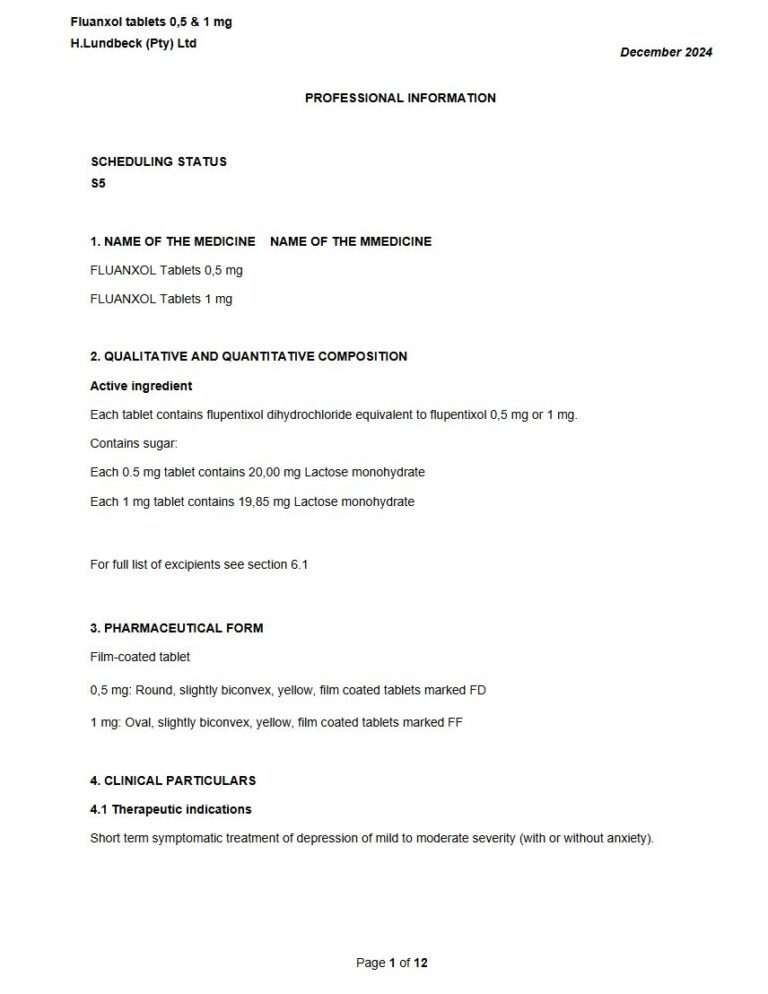
4.1 Therapeutic indications
Short term symptomatic treatment of depression of mild to moderate severity (with or without anxiety).
4.2 Posology and method of administration
Posology
Adults
Standard initial dosage is 1 mg as a single morning dose. After one week the dose may be increased to 2 mg if there is inadequate clinical response. Daily dosage of more than 2 mg should be in divided doses up to a maximum 3 mg. In view of the activating properties of FLUANXOL, it is advisable to give the last dose of the day no later than 4.00 p.m. Patients may respond to FLUANXOL within two or three days. If no effect has been observed within one week at maximum dosage FLUANXOL tablets should be withdrawn.
Elderly
Older patients should receive half the recommended dosages, i.e. 0.5 - 1.5 mg daily. Patients often respond to flupentixol within two or three days. If no effect has been observed within one week of maximum dosage the drug should be withdrawn.
4.3 Contraindications
Hypersensitivity to flupenthixol or to any of the excipients (see section 6.1). FLUANXOL is not recommended for the treatment of severe depression requiring ECT and/or hospitalisation. In states of excitement or overactivity (including mania). Pre-existing CNS depression or coma, bone marrow suppression or phaeochromocytoma. Circulatory collapse, depressed level of consciousness due to any cause (e.g. severe alcohol, barbiturate and opiate intoxications), coma. Pregnancy and lactation (see Section 4.6) Not recommended for children.
4.4 Special warnings and precautions for use
Neuroleptic malignant syndrome may occur. The symptoms are: hyperthermia, muscle rigidity, fluctuating consciousness, instability of the autonomous nervous system.
Treatment:
- Discontinuation of the neuroleptic
- Symptomatic treatment and use of general supportive measures.
- Dantrolene and bromocriptine may be helpful.
Symptoms may persist for longer than a week after discontinuation of FLUANXOL tablets. Increased mortality has been observed more often in patients with pre-existing organic brain syndrome, mental retardation, and opiate and alcohol abuse. FLUANXOL may cause QT prolongation. Persistently prolonged QT intervals may increase the risk of cardiac dysrhythmias, resulting in an increased risk of death. Therefore, FLUANXOL should be used with caution in susceptible individuals (with hypokalaemia, hypomagnesaemia or genetic predisposition) and in patients with a history of cardiovascular disorders, e.g. QT prolongation, significant bradycardia (<50 beats per minute), a recent acute myocardial infarction, uncompensated heart failure, or cardiac dysrhythmia. Concomitant treatment of FLUANXOL tablets with other antipsychotics should be avoided (see section 4.5). Depression is associated with an increased risk of suicidal thoughts, self-harm and suicide (suicide-related events). This risk persists until significant remission occurs. Patients with a history of suicide-related events, or those exhibiting a significant degree of suicidal ideation prior to commencement of treatment are known to be at greater risk of suicidal thoughts or suicide attempts, and should receive careful monitoring during treatment. A meta-analysis of placebo-controlled clinical trials of antidepressant medicines such as FLUANXOL tablets in adult patients with psychiatric disorders showed an increased risk of suicidal behaviour with antidepressants compared to placebo in patients less than 25 years old. Close supervision of patients and in particular those at high risk should accompany medicine therapy especially in early treatment and following dose changes. Patients (and caregivers of patients) should be alerted about the need to monitor for any clinical worsening, suicidal behaviour or thoughts and unusual changes in behaviour and to seek medical advice immediately if these symptoms present. Cases of venous thromboembolism (VTE) have been reported. All possible risk factors for VTE should be identified before and during treatment with FLUANXOL tablets and preventive measures undertaken. Elderly Cerebrovascular - An approximately 3-fold increased risk of cerebrovascular accident (stroke) has been seen in randomised placebo controlled clinical trials in the dementia population with some atypical antipsychotics. The mechanism for this increased risk is not known. An increased risk cannot be excluded. FLUANXOL should be used with caution in patients with risk factors for stroke. Increased mortality in elderly people with dementia - Data from two large observational studies showed that elderly people with dementia who are treated with FLUANXOL tablets are at an increased risk of death compared with those who are not treated. There are insufficient data to give a firm estimate of the precise magnitude of the risk and the cause of the increased risk is not known. Elderly and debilitated patients may be more prone to the adverse effects of FLUANXOL tablets. FLUANXOL is not indicated for the treatment of dementia-related behavioural disturbances. Special precautions Caution should be exercised in patients having: liver disease; cardiac disease or dysrhythmias; severe respiratory disease; renal failure; epilepsy (and conditions predisposing to epilepsy e.g. alcohol withdrawal or brain damage); Parkinson's disease; narrow angle glaucoma; prostatic hypertrophy; hypothyroidism; hyperthyroidism; myasthenia gravis; phaeochromocytoma, diabetes mellitus, and patients who have shown hypersensitivity to thioxanthenes or other antipsychotics. FLUANXOL effects on the vomiting centre may mask the symptoms of overdosage of other agents and or disorders such as gastrointestinal obstructions. Regular eye examinations are advisable for patients receiving long-term FLUANXOL therapy and avoidance of undue exposure to sunlight is recommended. Haematological parameters should be monitored periodically. FLUANXOL should be used with caution in patients with organic brain syndrome, convulsions and advanced hepatic disease. FLUANXOL may modify insulin and glucose responses calling for adjustment of the antidiabetic therapy in diabetic patients. Excipients Patients with rare hereditary problems of galactose intolerance, total lactase deficiency or glucose galactose malabsorption should not take FLUANXOL tablets.
4.5 Interaction with other medicines and other forms of interaction
Combinations requiring precaution for use FLUANXOL may enhance the sedative effect alcohol and the effects of barbiturates and other CNS depressants. FLUANXOL may increase or reduce the effect of antihypertensive medicines. Concomitant use of FLUANXOL and lithium increases the risk of neurotoxicity. Tricyclic antidepressants and FLUANXOL mutually inhibit the metabolism of one another. FLUANXOL may reduce the effect of levodopa and the effect of adrenergic medicines. Concomitant use of FLUANXOL tablets with metoclopramide and piperazine increases the risk of extrapyramidal disorder. Increases in the QT interval related to antipsychotic treatment may be exacerbated by the co-administration of other medicines known to significantly increase the QT interval. Co-administration of such medicines should be avoided.
Relevant classes include:
- class I a and III antidysrhythmics (e.g. quinidine, amiodarone, sotalol, dofetilide)
- some antipsychotics (e.g. thioridazine)
- some macrolides (e.g. erythromycin)
- some antihistamines (e.g. astemizole)
- some quinolone antibiotics (e.g. gatifloxacin, moxifloxacin)
The above list is not exhaustive and other individual medicines known to significantly increase QT interval (e.g. cisapride, lithium) should be avoided. Medicines known to cause electrolyte disturbances such as thiazide diuretica (hypokalaemia) and medicines known to increase the plasma concentration of flupenthixol should also be used with caution as they may increase the risk of QT prolongation and cardiac dysrhythmias, resulting in an increased risk of death (see Section 4.4).
4.6 Fertility, pregnancy and lactation
FLUANXOL should not be used during pregnancy and lactation.
Pregnancy
The newborn babies of mothers treated with FLUANXOL in late pregnancy, or labour, may show signs of intoxication such as lethargy, tremor and hyperexcitability and have a low Apgar score. Neonates exposed to FLUANXOL during the third trimester of pregnancy are at risk of adverse reactions including extrapyramidal and/or withdrawal symptoms that may vary in severity and duration following delivery. There have been reports of agitation, hypertonia, hypotonia, tremor, somnolence, respiratory distress, or feeding disorder. Consequently, newborns should be monitored carefully.
Breastfeeding
Flupenthixol is excreted into the breast milk. Mothers on treatment with FLUANXOL should not breastfeed their babies.
4.7 Effects on ability to drive and use machines
FLUANXOL is a non-sedating drug in the low-moderate dosage range however some sedation is anticipated with increasing dose. Based on the pharmacodynamic and pharmacokinetic profile, reported adverse reactions, FLUANXOL has a minor influence on the ability to drive and use machines.
4.8 Undesirable effects
Extrapyramidal reactions may occur. Tardive dyskinesia may develop. In the listing below a Frequent event is defined as either a very common or common event (>1/100); all other events are defined as Less frequent.
Organ Class Frequency Preferred term
Cardiac disorders Frequent Tachycardia, palpitations Less frequent Electrocardiogram QT prolonged.
Blood and lymphatic system disorders Less frequent Thrombocytopenia, neutropenia, leukopenia, agranulocytosis.
Nervous system disorders Frequent Somnolence, akathisia, hyperkinesia, hypokinesia, tremor, dystonia, dizziness, headache Less frequent Tardive dyskinesia, dyskinesia, parkinsonism, speech disorder, convulsions, neuroleptic malignant syndrome
Eye disorders Frequent Accommodation disorder, abnormal vision Less frequent Oculogyration
Respiratory, thoracic and mediastinal disorders Frequent Dyspnoea
Gastrointestinal disorders Frequent Dry mouth, salivary hypersecretion, constipation, vomiting, dyspepsia, diarrhoea. Less Frequent Abdominal pain, nausea, flatulence
Renal and urinary disorders Frequent Micturition disorder, urinary retention
Pregnancy, puerperium and perinatal conditions Less frequent Neonatal withdrawal syndrome (see 4.6)
Skin and subcutaneous tissue disorders Frequent Hyperhidrosis, pruritus Less frequent Rash, photosensitivity reaction, dermatitis
Musculoskeletal and connective tissue disorder Frequent Myalgia Less frequent Muscle rigidity
Endocrine disorders Less frequent Hyperprolactinaemia.
Metabolism and nutrition disorders Frequent Increased appetite, increased weight Less frequent Decreased appetite, hyperglycaemia, abnormal glucose tolerance
Vascular disorders Less frequent Hypotension, hot flushes, venous thromboembolism
General disorders and administration site conditions Frequent Asthenia, fatigue
Immune system disorders Less frequent Hypersensitivity, anaphylactic reaction
Hepatobiliary disorders Less frequent Abnormal liver function test, jaundice
Reproductive system and breast disorders Less frequent Ejaculation failure, erectile dysfunction, gynaecomastia, galactorrhoea, amenorrhoea
Psychiatric disorders Frequent Insomnia, depression, nervousness, agitation, decreased libido Less frequent Confusional state, suicidal ideation, suicidal behaviour * * Cases of suicidal ideation and suicidal behaviours have been reported during FLUANXOL therapy or early after treatment discontinuation (see section 4.4). Cases of QT prolongation, ventricular dysrhythmias, ventricular fibrillation, ventricular tachycardia, Torsade de Pointes and sudden unexplained death have been reported for FLUANXOL (see section 4.4). Abrupt discontinuation of FLUANXOL may be accompanied by withdrawal symptoms. The most common symptoms are nausea, vomiting, anorexia, diarrhoea, rhinorrhoea, sweating, myalgias, paraesthesias, insomnia, restlessness, anxiety, and agitation. Patients may also experience vertigo, alternate feelings of warmth and coldness, and tremor. Symptoms generally begin within 1 to 4 days of withdrawal and abate within 7 to 14 days.
Reporting of suspected adverse reactions Reporting suspected adverse reactions after authorisation of the medicine is important. It allows continued monitoring of the benefit/risk balance of the medicine. Healthcare providers are asked to report any suspected adverse reactions to SAHPRA via the u201c6.04 Adverse Drug Reactions Reporting Formu201d, found online under SAHPRAu2019s publications: https://www.sahpra.org.za/Publications/Index/8
4.9 Overdose
Symptoms: Somnolence, coma, movement disorders, convulsions, shock, hyperthermia/hypothermia. ECG changes, QT prolongation, Torsades de Pointes, cardiac arrest and ventricular dysrrhythmias have been reported when administered in overdose or when administered together with medicines known to affect the heart.
Treatment
Treatment is symptomatic and supportive. Measures to support the respiratory and cardiovascular systems should be instituted. Epinephrine (adrenaline) should not be used as further lowering of blood pressure may result.
