
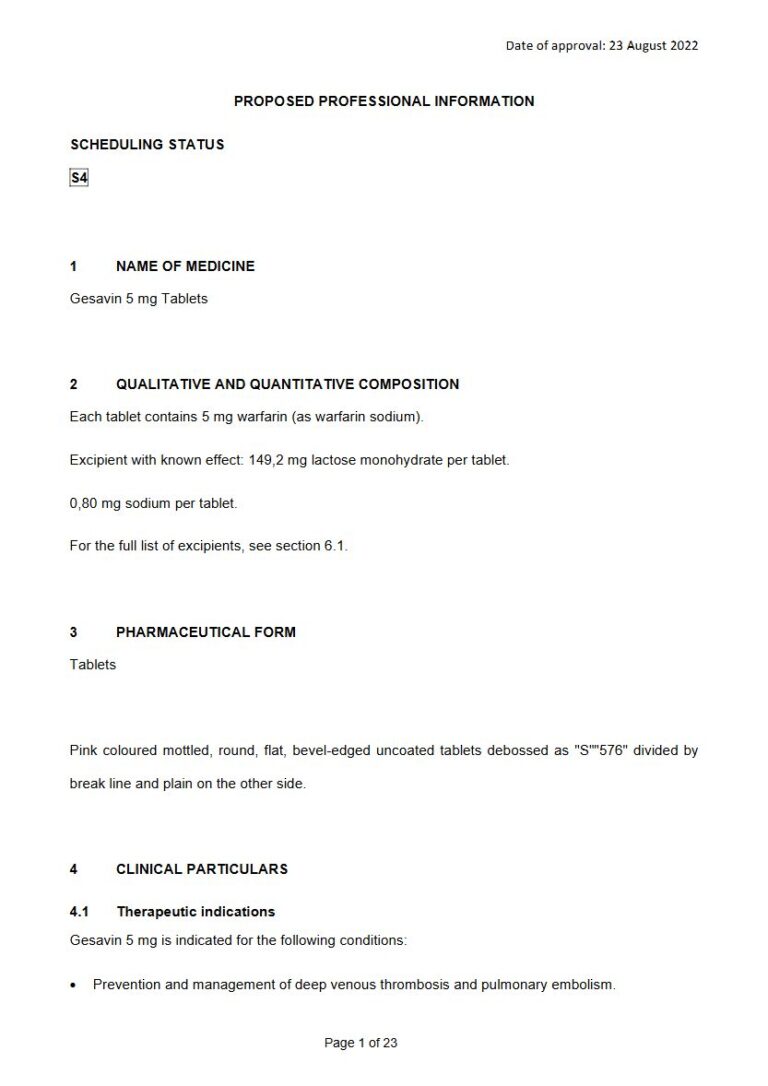
Gesavin 5 Mg Tablets
PDF Leaflet Revision Date: 23 August 2022
Clinical Summary
Quick overview from the medicine insert
Indication
Prevention and management of thromboembolic disorders.
Dosage (summary)
Initial: 10-15 mg daily for 3 days; Maintenance: 2.5-10 mg daily.
Onset of Action / Duration
Onset: 24-36 hours, Duration: 2-5 days
Special Populations
- Elderly
- Renal impairment
- Hepatic impairment
Pregnancy & Breastfeeding
Contraindicated in pregnancy and breastfeeding.
Key Drug Interactions
- NSAIDs
- Antibiotics
- Herbal products (St John's Wort)
Contraindications
- Hypersensitivity to warfarin
- Haemorrhagic states
- Pregnancy
- Severe liver impairment
Common side effects
- Haemorrhage
- Nausea
- Diarrhoea
- Rash
Counselling Points
- Take at the same time daily
- Avoid sudden dietary changes
- Report any signs of bleeding
Serious warnings
- Risk of serious bleeding
- Monitor INR regularly
Important Disclaimer
The Gesavin 5 Mg Tablets professional information leaflet below is the property of Strides Pharma Sa and is provided on Medinsert exactly as issued, with no.. alterations or editorial changes. We make every effort to keep content current by updating documents as soon as new versions become available. Medinsert serves as a trusted access point for healthcare professionals, but does not replace official sources or clinical judgement. For more details, please read our full disclaimer. read more>>
 Healthcare Professionals Only
This content is for registered healthcare professionals
Sign in or create a free account to read the full package insert.
Free for HPCSA-registered professionals. Powered by Medinsert.
Clinical Particulars
Section 4 of the official insert — extracted exactly as issued, no alterations
4.1 Therapeutic indications
Gesavin 5 mg is indicated for the following conditions:
- Prevention and management of deep venous thrombosis and pulmonary embolism.
- Prevention of thromboembolism in:
- Atrial fibrillation
- Prosthetic heart valves
- Post myocardial infarction
- The treatment of transient ischaemic attacks.
4.2 Posology and method of administration
Adults
The administration and dosage of Gesavin 5 mg must be individualised for each patient according to the patient's sensitivity as indicated by the prothrombin time (PT) or international normalised ratio (INR). PT measurements should be carried out before treatment, on the 2nd and 3rd day of treatment and then on alternate days until the maintenance dose is established. Thereafter the patient should be monitored monthly. Satisfactory levels of PT or INR for maintenance vary with the condition treated and the risk of thromboembolism. Currently recommended ranges of therapeutic anticoagulation are the following:
- INR 2.0 u2013 2.5 (PT ratio 1.3 u2013 1.5)
- Prophylaxis of deep vein thrombosis (DVT) including surgery in high risk patients.
- INR 2.0 u2013 3.0 (PT ratio 1.3 u2013 1.5)
- Prophylaxis of DVT in hip surgery and fractured femur operations.
- Prevention of thromboembolism in myocardial infarction, mitral stenosis with embolism, atrial fibrillation and tissue prosthetic heart valves.
- Treatment of DVT, pulmonary embolism, transient ischaemic attacks and systemic embolism.
- INR 3.0 u2013 4.5 (PT ratio 1.5 u2013 2.0)
- Recurrent DVT and pulmonary embolism.
- Arterial disease including myocardial infarction.
- Mechanical prosthetic heart valves.
The correlation between the INR and the PT ratio is based on thromboplastin with an International Sensitivity Index of 2.3. Initial doses are usually within the range of 10 - 15 mg daily for 3 days. Maintenance doses range from 2,5 mg - 10 mg daily.
Elderly
The elderly may be more susceptible to the effects of warfarin, resulting in increased risk of haemorrhage. Lower maintenance doses, weight for weight, than those usually recommended for adults may be required for these patients.
Paediatric population
Safety in children younger than 18 years has not been established.
Method of administration
Oral. Gesavin 5 mg should be taken at the same time each day, preferably on an empty stomach.
4.3 Contraindications
Gesavin 5 mg is contraindicated in:
- Hypersensitivity to warfarin sodium or to any of the excipients listed in section 6.1;
- Haemorrhagic states;
- Haemorrhagic stroke (see section 4.4);
- Clinically significant bleeding;
- Peptic ulcers or other gastrointestinal disease involving bleeding;
- Conditions involving bleeding from respiratory or genito-urinary tract;
- Severe wounds (including surgical);
- Prosthetic heart valves;
- Infective endocarditis;
- Impaired liver function;
- Impaired kidney function;
- Hypertension;
- Cerebrovascular haemorrhage;
- Aneurysm (cerebral or aortic);
- Pericarditis or pericardial effusion;
- Neuro- or ophthalmic surgery (recent or contemplated);
- Surgery involving large exposed raw surfaces;
- Within 72 hours of major surgery with risk of severe bleeding (see section 4.4);
- Polyarthritis;
- Vitamin C deficiency;
- Major regional block anaesthesia;
- Inadequate laboratory facilities or lack of patient cooperation;
- Pregnancy;
- Breastfeeding mothers;
- Within 48 hours postpartum;
- Threatened abortion;
- Medicines where interactions may lead to a significantly increased risk of bleeding (see section 4.5).
4.4 Special warnings and precautions for use
Most side effects with warfarin are a result of over anticoagulation. Therefore, it is important that the need for therapy is reviewed on a regular basis and therapy discontinued when no longer required.
Patient monitoring
Dosage should be individualised for each patient and periodic determinations of prothrombin time should be done (see section 4.2). Patients should be given a patient information leaflet and should be informed of symptoms for which they should seek medical attention. Patients should be given detailed instructions concerning their medicine, the importance of compliance and advice concerning modification of their lifestyle if necessary. The possibility of interactions should be explained. Patients should carry an anticoagulant card or other proof that they are on anticoagulants.
Patients for whom adherence may be difficult should be monitored more frequently.
Commencement of therapy
When Gesavin 5 mg is started using a standard dosing regimen, the INR should be determined daily or on alternate days in the early days of treatment. Once the INR has stabilised in the target range, the INR can be determined at longer intervals (see section 4.2).
Thrombophilia
Patients with protein C deficiency are at risk of developing skin necrosis when starting treatment with Gesavin 5 mg. In patients with protein C deficiency, therapy should be introduced without a loading dose of warfarin, even if heparin is given. Patients with protein S deficiency may also be at risk and it is advisable to introduce warfarin therapy slowly in these circumstances.
Cessation of therapy
Abrupt cessation of anticoagulant therapy is not recommended. The dose should be tapered over three to four weeks.
Haemorrhage
The most frequently reported adverse effect of all oral anticoagulants is haemorrhage. Gesavin 5 mg should not be given to patients where there is a risk of serious haemorrhage (e.g. concomitant NSAID use, recent ischaemic stroke, bacterial endocarditis or previous gastrointestinal bleeding) (see section 4.3).
Risk factors for bleeding include high intensity of anticoagulation (INR > 4.0), age u2265 65, highly variable INRs, a history of gastrointestinal bleeding, uncontrolled hypertension, cerebrovascular disease, serious heart disease, risk of falling, anaemia, malignancy, trauma, renal insufficiency and the use of concomitant medicines (see section 4.5). All patients treated with Gesavin 5 mg should have their INR monitored regularly. Those at high risk of bleeding may benefit from more frequent INR monitoring, careful dose adjustment to desired INR, and a shorter duration of therapy. Patients should be instructed on measures to minimize risk of bleeding and to report symptoms of bleeding immediately. Checking the INR and reducing or omitting doses depending on INR level is essential. If the INR is found to be too high, reduce dose or stop warfarin treatment. Sometimes it will be necessary to reverse anticoagulation. INR should be checked within 2 u2013 3 days to ensure that it is falling. Any concomitant anti-platelet medicines should be used with caution due to an increased risk of bleeding. Unexpected bleeding at therapeutic levels should always be investigated and INR monitored.
Special populations
Special care is required in the elderly, in patients with Vitamin K deficiency and in patients with hyperthyroidism. The rate of warfarin metabolism depends on thyroid status. Therefore, patients with hyper- or hypothyroidism should be closely monitored on starting treatment with Gesavin 5 mg. INR should be monitored more frequently in patients at an increased risk of over coagulation e.g. patients with severe hypertension, liver or renal disease.
Gesavin 5 mg should be used with caution in patients with:
- Prolonged dietary deficiency;
- Infectious diseases or disturbances of intestinal flora, sprue, antibiotic therapy;
- Polycythaemia vera, vasculitis, severe diabetes, allergic or anaphylactic disorders.
Ischaemic stroke
Anticoagulation following an ischaemic stroke increases the risk of secondary haemorrhage into the infarcted brain. In patients with atrial fibrillation, long term treatment with Gesavin 5 mg is beneficial, but the risk of early recurrent embolism is low and therefore a break in treatment after ischaemic stroke is justified. Treatment with Gesavin 5 mg should be re-started 2 - 14 days following ischaemic stroke, depending on the size of the infarct and blood pressure. In patients with large embolic strokes, or uncontrolled hypertension, treatment with Gesavin 5 mg should be stopped for 14 days.
Dental surgery
The management of patients who undergo dental or any surgical procedures requires close liaison between doctors, surgeons and dentists. An adjustment of dosage may be necessary or Gesavin 5 mg need not be stopped before routine dental surgery e.g. tooth extraction.
Surgery
For surgery where there is no risk of severe bleeding, surgery can be performed with an INR of < 2.5. For surgery where there is a risk of severe bleeding, warfarin should be stopped 3 days prior to surgery. Where it is necessary to continue anticoagulation e.g. risk of life-threatening thromboembolism, the INR should be reduced to < 2.5 and heparin therapy should be started. If surgery is required and warfarin cannot be stopped 3 days beforehand, anticoagulation should be reversed with low-dose vitamin K. The timing for re-instating warfarin therapy depends on the risk of post-operative haemorrhage. The need for modification of therapy before elective operative procedures or in women contemplating pregnancy should be discussed. Active peptic ulceration Due to a high risk of bleeding, Gesavin 5 mg is contraindicated in patients with active peptic ulcers.
4.5 Interactions with other medicines
A wide variety of interactions may occur, increasing or diminishing the anticoagulant response with different mechanisms involved. Not all interactions have been identified and some interacting medicines do so by more than one mechanism therefore the nett effect may be unpredictable. Warfarin has a narrow therapeutic range and great care is required with all concomitant therapy. The individual product information for any new concomitant therapy should be consulted for specific guidance on warfarin dose adjustment and therapeutic monitoring. If no information is provided the possibility of an interaction should be considered. Increased monitoring should be considered when commencing any new therapy if there is any doubt as to the extent of interaction.
Mechanisms of interaction include:
- Displacement from albumin binding sites;
- Altering metabolism of medicines by inhibition or induction of hepatic microsomal enzymes;
- Interference with absorption or metabolism of Gesavin 5 mg or vitamin K;
- Additional anticoagulant effects by medicines that inhibit platelet function.
Pharmacodynamic interactions
Medicines that are contraindicated
Concomitant use of medicines used in the treatment or prophylaxis of thrombosis, or other medicines with adverse effects on haemostasis may increase the pharmacological effect of warfarin, increasing the risk of bleeding. Fibrinolytic medicines such as streptokinase and alteplase are contraindicated in patients receiving Gesavin 5 mg.
Medicines which should be avoided if possible
The following medicines should be avoided or administered with caution with increased clinical and laboratory monitoring:
- Clopidogrel;
- NSAIDs (including aspirin and COX-2 specific NSAIDs);
- Sulfinpyrazone;
- Thrombin inhibitors such as bivalirudin or dabigatran;
- Dipyridamole;
- Unfractionated heparins and heparin derivatives or low molecular weight heparins;
- Fondaparinux or rivaroxaban;
- Glycoprotein IIb/IIIa receptor antagonists such as eptifibatide, tirofiban and abciximab;
- Prostacyclin;
- SSRI and SNRI antidepressants;
- Other medicines which inhibit haemostasis, clotting or platelet action.
Low-dose aspirin used in conjunction with Gesavin 5 mg may increase the risk of gastrointestinal bleeding. Gesavin 5 mg may initially be given in conjunction with a heparin in the initial treatment of thrombosis until the INR is in the correct range.
Metabolic interactions
Warfarin is a mixture of enantiomers which are metabolised by different CYP P450 cytochromes. R-warfarin is metabolised primarily by CYP1A2 and CYP3A4. S-warfarin is metabolised primarily by CYP2C9. The efficacy of warfarin is affected primarily when the metabolism of S-warfarin is altered. Medicines that compete as substrates for these cytochromes or inhibit their activity may increase warfarin plasma concentrations and INR, potentially increasing the risk of bleeding. When these medicines are co-administered with Gesavin 5 mg, the warfarin dosage may need to be reduced and the level of monitoring increased. Conversely, medicines which induce these metabolic pathways may decrease warfarin plasma concentrations and INR, potentially leading to reduced efficacy. When these medicines are co-administered with Gesavin 5 mg, the warfarin dosage may need to be increased and the level of monitoring increased. There is a small subset of medicines for which interactions are known, however the clinical effect on the INR is variable. In these cases, increased monitoring on starting and stopping therapy is advised.
Care should also be taken when stopping or reducing the dose of a metabolic inhibitor or inducer once patients are stable on this combination (offset effect).
Listed below are medicines / factors which are known to interact with warfarin in a clinically significant way:
Medicines which potentiate the effect of warfarin
Allopurinol, capecitabine, erlotinib and disulfiram, azole antifungals (ketoconazole and fluconazole), omeprazole, paracetamol (prolonged regular use), propafenone, amiodarone, tamoxifen, methylphenidate, zafirlukast, fibrates, statins (not pravastatin, predominantly associated with fluvastatin), erythromycin, sulfamethoxazole, metronidazole, danazol, diazoxide, aminoglycosides, alcohol, miconazole, triclofos, chloral hydrate, chloramphenicol, phenytoin, erythromycin, quinidine, dextropropoxyphene, vitamin E, glucagon, sulphonamides, sulphonylurea-type antidiabetic medicines, clofibrate, cimetidine, phenylbutazone and other pyrazolones, anabolic steroids, sulphinpyrazone, aspirin and other NSAIDS, thyroid hormones and amiodarone.
Medicines which antagonise the effect of warfarin
Barbiturates, primidone, carbamazepine, griseofulvin, oral contraceptives, rifampicin, azathioprine, phenytoin, glutethimide, vitamin K, glucocorticoids and cholestyramine.
Medicines with variable effect
Corticosteroids, nevirapine and ritonavir.
The following factors may be responsible for an increase in prothrombin time
Carcinoma, collagen disease, congestive heart failure, diarrhoea, elevated temperature, hepatic disorders, infectious hepatitis, jaundice and a poor nutritional state.
The following factors may be responsible for a decrease in prothrombin time
Diabetes mellitus, oedema, hereditary resistance to Gesavin 5 mg therapy, hyperlipaemia and hypothyroidism.
Other interactions
Broad spectrum antibiotics may potentiate the effect of warfarin by reducing the gut flora which produce vitamin K. Similarly, orlistat may reduce absorption of vitamin K. Cholestyramine and sucralfate potentially decrease absorption of warfarin. Increased INR may occur in patients taking glucosamine and Gesavin 5 mg. This combination is not recommended.
Interactions with herbal products
Herbal preparations containing St John's Wort (Hypericum perforatum) must not be used whilst taking Gesavin 5 mg, due to a proven risk of decreased plasma concentrations and reduced clinical effects of warfarin. Many other herbal products have a theoretical effect on warfarin. However, most of these interactions are not proven. Patients should generally avoid taking any herbal medicines or food supplements whilst taking Gesavin 5 mg and should be told to advise their doctor if they are taking any, as more frequent monitoring is advisable.
Alcohol
Acute ingestion of a large amount of alcohol may inhibit the metabolism of warfarin and increase INR. Conversely, chronic heavy alcohol intake may induce the metabolism of warfarin. Moderate alcohol intake can be permitted.
Interactions with food and food supplements
A possible interaction between Gesavin 5 mg and cranberry juice may occur and, in most cases, lead to an increase in INR or bleeding event. Patients should be advised to avoid cranberry products. Increased supervision and INR monitoring should be considered for any patient taking Gesavin 5 mg and regular consumption of cranberry juice. Grapefruit juice may cause a modest rise in INR in some patients taking Gesavin 5 mg. Certain foods such as liver, broccoli, brussels sprouts and green leafy vegetables contain large amounts of vitamin K. Sudden changes in diet can potentially affect control of anticoagulation. Patients should be informed of the need to seek medical advice before undertaking any major changes in diet. Many other food supplements may have a theoretical effect on warfarin. However, most of these interactions are not proven. Patients should generally avoid taking any food supplements whilst taking Gesavin 5 mg and should be told to advise their doctor if they are taking any, as more frequent monitoring is advisable.
4.6 Fertility, pregnancy and lactation
Women of childbearing potential
Women of childbearing age who are taking Gesavin 5 mg should use effective contraception during treatment.
Pregnancy
Gesavin 5 mg is a recognised teratogen. Treatment with Gesavin 5 mg during pregnancy should be avoided (see section 4.3).
Breastfeeding
Treatment with Gesavin 5 mg during breastfeeding should be avoided (see section 4.3).
4.7 Effects on ability to drive and use machines
It is not always possible to predict to what extent Gesavin 5 mg may interfere with the patientu2019s daily activities. Patients should ensure that they do not engage in the above activities until they are aware of the measure to which Gesavin 5 mg affects them.
4.8 Undesirable effects
a. Tabulated summary of adverse reactions
MedDRA System Organ Class Frequency Undesirable effect
Infections and infestations Frequency unknown Fever
Blood and lymphatic system disorders Less frequent Leukopenia, granulocytosis
Immune system disorders Frequency unknown Hypersensitivity
Metabolism and nutrition disorders Less frequent Inhibits vitamin K synthesis, lipid emboli, including systemic atheroemboli and cholesterol emboli
Nervous system disorders Frequency unknown Cerebral haemorrhage, cerebral subdural haematoma
Vascular disorders Frequency unknown Haemorrhage with consequent effects of haematomas and anaemia
Respiratory, thoracic and mediastinal disorders Frequency unknown Haemothorax, epistaxis
Gastrointestinal disorders Less frequent Diarrhoea, nausea, vomiting, bloated stomach or gas, loss of appetite, stomach cramps or pain, melaena Frequency unknown Gastrointestinal haemorrhage, rectal haemorrhage, haematemesis, pancreatitis
Hepatobiliary disorders Frequency unknown Jaundice, hepatic dysfunction, hepatotoxicity, usually asymptomatic and seen on laboratory results, dark urine
Skin and subcutaneous disorders Frequency unknown Rash, alopecia, purpura, u2018purple toesu2019 syndrome, erythematous swollen skin patches leading to ecchymosis, infarction and skin necrosis, calciphylaxis, precipitating venous limb gangrene syndrome, sores, ulcers or white spots in the mouth or throat
Musculoskeletal and connective tissue disorders Less frequent Increased risk of osteoporotic fracture due to vitamin K deficiency. Patients on long-term Gesavin 5 mg treatment may be at increased risk.
Renal and Urinary disorders Less frequent Haematuria, renal damage with resultant oedema and proteinuria, with difficulty in urination
Investigations Frequency unknown Unexplained drop in haematocrit, haemoglobin decreased
b. Reporting of suspected adverse reactions
Reporting suspected adverse reactions after authorisation of the medicine is important. It allows continued monitoring of the benefit/risk balance of the medicine. Health care providers are asked to report any suspected adverse reactions to SAHPRA via the u201c6.04 Adverse Drug Reactions Reporting Formu201d, found online under SAHPRAu2019s publications: https://www.sahpra.org.za/Publications/Index/8
4.9 Overdose
Excessive haemorrhage may occur:
- In the event of an excessively long PT or INR or if there is minor bleeding, omission of one or more doses of warfarin may be sufficient to return levels to the therapeutic range.
- In the event of non-significant bleeding, small doses of oral vitamin K (1 - 5 mg) may be sufficient.
- In the event of serious bleeding, treatment with vitamin K (20 - 40 mg) by slow intravenous administration together with replacement of clotting factors.
