
Gradovir 50 mg FC tablets
PDF Leaflet Revision Date: 17 January 2022
Clinical Summary
Quick overview from the medicine insert
Indication
Treatment of HIV infection in adults.
Dosage (summary)
50 mg once daily for treatment-nau00efve; 50 mg twice daily for integrase inhibitor resistant.
Special Populations
- Elderly
- Renal impairment
- Hepatic impairment
Pregnancy & Breastfeeding
Contraindicated in pregnancy (first trimester) and breastfeeding.
Key Drug Interactions
- Rifampicin decreases dolutegravir levels
- Metformin contraindicated
- Antacids decrease absorption
Contraindications
- Hypersensitivity to dolutegravir
- Moderate/severe hepatic impairment
- Pregnancy (first trimester)
- Lactation
Common side effects
- Nausea
- Diarrhoea
- Headache
- Rash
Counselling Points
- Monitor for hypersensitivity signs
- Use effective contraception
- Avoid breastfeeding
Serious warnings
- Hypersensitivity reactions
- Immune reconstitution syndrome
- Osteonecrosis risk
Important Disclaimer
The Gradovir 50 mg FC tablets professional information leaflet below is the property of Pharmacare and is provided on Medinsert exactly as issued, with no.. alterations or editorial changes. We make every effort to keep content current by updating documents as soon as new versions become available. Medinsert serves as a trusted access point for healthcare professionals, but does not replace official sources or clinical judgement. For more details, please read our full disclaimer. read more>>
 Healthcare Professionals Only
This content is for registered healthcare professionals
Sign in or create a free account to read the full package insert.
Free for HPCSA-registered professionals. Powered by Medinsert.
Clinical Particulars
Section 4 of the official insert — extracted exactly as issued, no alterations
4.1. Therapeutic indications
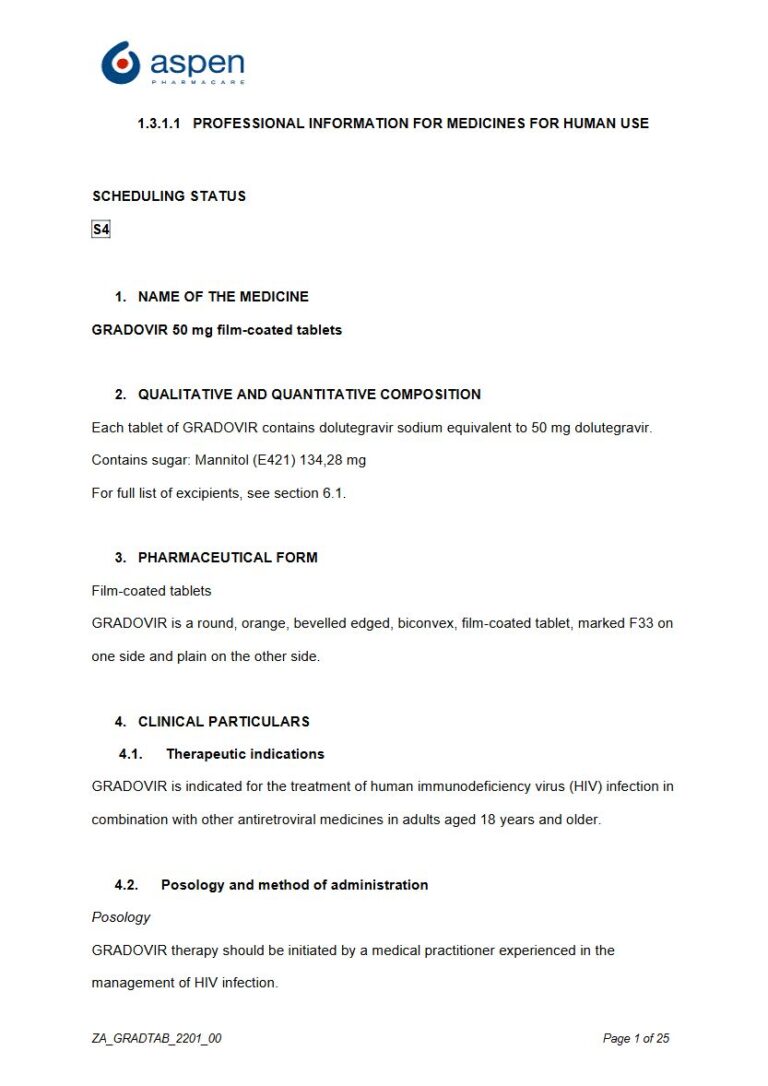
GRADOVIR is indicated for the treatment of human immunodeficiency virus (HIV) infection in combination with other antiretroviral medicines in adults aged 18 years and older.
4.2. Posology and method of administration
Posology
GRADOVIR therapy should be initiated by a medical practitioner experienced in the management of HIV infection.
Adults:
Treatment-nau00efve: For patients initiating antiretroviral therapy for the first time (treatment-nau00efve) the recommended dose of GRADOVIR is 50 mg once daily.
Treatment-experienced, and integrase inhibitor nau00efve: For patients who are treatment experienced and have not previously been treated with an integrase inhibitor, the recommended dose of GRADOVIR is 50 mg once daily.
Integrase inhibitor resistant: For patients with integrase inhibitor resistance, the recommended dose of GRADOVIR is 50 mg twice daily.
Medicine interactions: Rifampicin decreases the blood levels of dolutegravir. A supplementary dose of dolutegravir should be given to patients taking GRADOVIR. There is evidence that the concentration of isoniazid is increased by dolutegravir, as contained in GRADOVIR.
Special populations
Children GRADOVIR should not be used in children.
Elderly population There are limited data available on the use of GRADOVIR in patients aged 65 years and over. However, there is no evidence that elderly patients require a different dose than younger adult patients (see section 5.2).
Renal impairment No dosage adjustment is required in patients with mild, moderate or severe (CrCl < 30 ml/min, not on dialysis) renal impairment. No data are available in subjects receiving dialysis, although differences in pharmacokinetics are not expected in this population (see section 5.2). Treatment with GRADOVIR resulted in an early small increase of mean serum creatinine levels by 10 % to 14 % which remained stable over time and is not considered clinically relevant (see section 4.8).
Hepatic impairment No dosage adjustment is required in patients with mild hepatic impairment (Child-Pugh grade A). GRADOVIR is contraindicated in patients with moderate or severe hepatic impairment (see section 4.3).
Method of administration GRADOVIR is taken orally with or without food.
4.3. Contraindications
GRADOVIR is contraindicated in:
u2022 Patients with hypersensitivity to dolutegravir or to any excipients in GRADOVIR (see section 6.1).
u2022 Combination with dofetilide and pilsicainide (see section 4.5).
u2022 Moderate and severe hepatic impairment.
u2022 Metformin is contraindicated in patients taking GRADOVIR (see section 4.5).
u2022 Lactation (see section 4.6)
u2022 Women who plan to become pregnant, during peri/preconception period and in the first trimester of pregnancy (see section 4.6).
u2022 Women of child-bearing age not using highly effective contraception (see section 4.6).
4.4. Special warnings and precautions for use
Hypersensitivity
Hypersensitivity reactions have been reported with integrase inhibitors, including GRADOVIR and were characterised by rash, constitutional findings and sometimes, organ dysfunction, including liver injury. Discontinue GRADOVIR and other suspect medicines immediately if signs or symptoms of hypersensitivity reactions develop (including, but not limited to, severe rash or rash accompanied by raised liver enzymes, fever, general malaise, fatigue, muscle or joint aches, blisters, oral lesions, conjunctivitis, facial oedema, hepatitis, eosinophilia, angioedema). Clinical status including liver aminotransferases should be monitored and appropriate therapy initiated. Delay in stopping treatment with GRADOVIR or other suspect medicines after the onset of hypersensitivity may result in a life-threatening reaction.
Lipodystrophy and metabolic abnormalities
Combination antiretroviral therapy has been associated with the redistribution/accumulation of body fat, including central obesity, dorso-cervical fat enlargement (buffalo hump), peripheral wasting, facial wasting, breast enlargement and elevated serum lipid and glucose levels in HIV patients. Clinical examination should include evaluation for physical signs of fat redistribution. Patients with evidence of lipodystrophy should have a thorough cardiovascular risk assessment.
Immune reconstitution syndrome
In HIV-infected patients with severe immune deficiency at the time of initiation of antiretroviral therapy (ART), an inflammatory reaction to asymptomatic or residual opportunistic infections may arise and cause serious clinical conditions, or aggravation of symptoms. Typically, such reactions have been observed within the first few weeks or months of initiation of ART. Relevant examples are tuberculosis, cytomegalovirus retinitis, generalised and/or focal atypical mycobacterial infections and Pneumocystis jiroveci (P. carinii) pneumonia. Any inflammatory symptoms must be evaluated without delay and treatment initiated when necessary. Autoimmune disorders (such as Gravesu2019 disease, polymyositis and Guillain-Barru00e9 syndrome) have also been reported to occur in the setting of immune reconstitution, however, the time to onset is more variable and can occur many months after initiation of treatment and sometimes can be an atypical presentation.
Liver chemistry elevations consistent with immune reconstitution syndrome were observed in some hepatitis B and/or C co-infected patients at the start of GRADOVIR therapy. Monitoring of liver chemistries is recommended in patients with hepatitis B and/or C co-infection. Particular diligence should be applied in initiating or maintaining effective hepatitis B therapy (referring to treatment guidelines) when starting dolutegravir-based therapy in hepatitis B co-infected patients (see section 4.8).
Osteonecrosis
Although the aetiology is considered to be multifactorial (including corticosteroid use, alcohol consumption, severe immunosuppression, higher body mass index), cases of osteonecrosis have been reported, particularly in patients with advanced HIV-disease and/or long-term exposure to combination antiretroviral therapy (cART). Patients should be advised to seek medical advice if they experience joint aches and pain, joint stiffness or difficulty in movement.
Hepatic impairment
The unbound fraction of dolutegravir, as contained in GRADOVIR, in the blood is doubled in patients with moderate hepatic impairment. GRADOVIR is contraindicated in patients with moderate or severe hepatic impairment (see section 4.3).
Interactions
Caution should be given to co-administering medicines (prescription and non-prescription) that may change the exposure of GRADOVIR or medicines that may have their exposure changed by GRADOVIR (see sections 4.3 and 4.5).
4.5. Interactions with other medicines
The co-administration of GRADOVIR with etravirine (ETR) is not recommended unless the patient is also receiving concomitant atazanavir + ritonavir (ATV + RTV), lopinavir + ritonavir (LPV + RTV) or darunavir + ritonavir (DRV + RTV) (see section 4.5). The recommended dose of GRADOVIR is 50 mg twice daily when co-administered with efavirenz, nevirapine, tipranavir/ritonavir, or rifampicin (see section 4.5). GRADOVIR should not be co-administered with polyvalent cation-containing antacids. GRADOVIR is recommended to be administered 2 hours before or 6 hours after these medicines (see section 4.5). Metformin concentrations may be increased by GRADOVIR. Metformin is contraindicated in patients taking GRADOVIR (see section 4.3). Co-infection with hepatitis B or C In Phase III studies, patients with hepatitis B and/or C co-infection were permitted to enrol provided that baseline liver chemistry tests did not exceed 5 times the upper limit of normal (ULN). Overall, the safety profile in patients co-infected with hepatitis B and/or C was similar to that observed in patients without hepatitis B or C co-infection, although the rates of AST and ALT abnormalities were higher in the subgroup with hepatitis B and/or C co-infection for all treatment groups. Liver chemistry elevations consistent with immune reconstitution syndrome were observed in some subjects with hepatitis B and/or C co-infection at the start of GRADOVIR therapy, particularly in those whose anti-hepatitis B therapy was withdrawn. Opportunistic infections Patients receiving GRADOVIR or any other antiretroviral therapy may still develop opportunistic infections and other complications of HIV infection. Therefore, patients should remain under close clinical observation by medical practitioners experienced in the treatment of these associated HIV diseases. GRADOVIR should not be used in children.
4.6. Fertility, pregnancy and lactation
Women of childbearing potential
Women of childbearing potential should be counselled about the potential risk of neural tube defects with dolutegravir, as in GRADOVIR, (see below), including consideration of using effective contraceptive measures. Perform pregnancy testing before initiation of GRADOVIR in women of childbearing potential to exclude inadvertent (unintentional) use of GRADOVIR during the first trimester of pregnancy. If a woman plans pregnancy, the benefits and the risks of starting or continuing treatment with dolutegravir, as in GRADOVIR, versus using another antiretroviral regimen should be discussed with her.
Pregnancy
GRADOVIR is contraindicated in mothers who plan to become pregnant, during peri/preconception period and in the first trimester of pregnancy (see section 4.3). Use of dolutegravir, as in GRADOVIR, during pregnancy was associated with a small increase in the prevalence of neural tube defects (0,19 %) compared to non-dolutegravir regimens (0,11 %). Most neural tube defects occur within the first 4 weeks of embryonic development after conception (approximately 6 weeks after the last menstrual period). If a pregnancy is confirmed in the first trimester while on dolutegravir, as in GRADOVIR, the benefits and risks of continuing dolutegravir, as in GRADOVIR, versus switching to another antiretroviral regimen should be discussed with the patient, taking the gestational age and the critical time period of neural tube defect development into account. Dolutegravir, as in GRADOVIR, may be used during the second and third trimester of pregnancy when the expected benefit outweighs the potential risk to the foetus. Dolutegravir, as in GRADOVIR is shown to cross the placenta in humans, leading to significant exposure to the foetus, but the implications of such exposure are not yet known.
Breastfeeding
Mothers taking GRADOVIR should not breastfeed their babies. HIV infected women should not breastfeed their baby in order to avoid transmission of HIV to the baby or follow appropriate guidelines. Dolutegravir, as in GRADOVIR is excreted in human breast milk, and there is significant exposure to the neonate/infants due to slow elimination; the half-life of dolutegravir in the newborn was 33 hr compared to 14 hr in the adults. There is insufficient information on the effects of dolutegravir in neonates/infants.
Fertility
There are no data on the effects of dolutegravir, as in GRADOVIR on human male or female fertility. Animal studies indicate no effects of dolutegravir on male or female fertility.
4.7. Effects on ability to drive and use machines
Patients should be informed that dizziness has been reported during treatment with GRADOVIR. The clinical status of the patient and the adverse event profile of GRADOVIR should be borne in mind when considering the patient's ability to drive or operate machinery. GRADOVIR may affect the ability to drive and use machines. Patients should not drive, use machinery or perform any tasks that require concentration until they are certain that GRADOVIR does not adversely affect their ability to do so safely (see section 4.8).
4.8. Undesirable effects
a) Summary of the safety profile
The most severe adverse reaction, seen in an individual patient, was a hypersensitivity reaction that included rash and severe liver effects (see section 4.4). The most commonly seen treatment emergent adverse reactions were nausea, diarrhoea and headache.
b) Tabulated list of adverse reactions
System organ class Frequent Less frequent Immune system disorders Hypersensitivity, Immune Reconstitution Syndrome (see section 4.4) Psychiatric disorders Insomnia Depression, anxiety Suicidal ideation, suicide attempt (particularly in patients with a pre-existing history of depression or psychiatric illness) Nervous system disorders Headache, dizziness, abnormal dreams Gastrointestinal disorders Nausea, diarrhoea, vomiting, flatulence, upper abdominal pain Abdominal pain, abdominal discomfort Hepatobiliary disorders Hepatitis Acute hepatic failure Skin and subcutaneous tissue disorders Rash, pruritus Musculoskeletal and connective tissue disorders Arthralgia, myalgia General disorders and administrative site conditions Fatigue Investigations Alanine aminotransferase (ALT) and/or Aspartate aminotransferase (AST) elevations, Creatine phosphokinase (CPK) elevations The safety profile was similar across the treatment nau00efve, treatment experienced (and integrase nau00efve) and integrase resistant patient populations.
c) Description of selected adverse reactions
Changes in laboratory chemistries Increases in serum creatinine occurred within the first week of treatment with GRADOVIR and remained stable through 48 weeks. In treatment nau00efve patients a mean change from baseline of 9,96 u03bcmol/l (range: 53 u03bcmol/l to 54,8 u03bcmol/l) was observed after 48 weeks of treatment. Creatinine increases were comparable by background NRTIs and were similar in treatment experienced patients. These changes are not considered to be clinically relevant since they do not reflect a change in glomerular filtration rate (see section 5.1). Small increases in total bilirubin (without clinical jaundice) were observed on GRADOVIR and raltegravir (but not efavirenz) arms. These changes are not considered clinically relevant as they likely reflect competition between GRADOVIR and unconjugated bilirubin for a common clearance pathway (UGT1A1) (see section 5.2). Asymptomatic creatine phosphokinase (CPK) elevations mainly in association with exercise have also been reported with GRADOVIR therapy. Co-infection with Hepatitis B or C In Phase III studies patients with hepatitis B and/or C co-infection were permitted to enrol provided that baseline liver chemistry tests did not exceed 5 times the upper limit of normal (ULN). Overall, the safety profile in patients co-infected with hepatitis B and/or C was similar to that observed in patients without hepatitis B or C co-infection, although the rates of AST and ALT abnormalities were higher in the subgroup with hepatitis B and/or C co-infection for all treatment groups. Liver chemistry elevations consistent with immune reconstitution syndrome were observed in some subjects with hepatitis B and/or C co-infection at the start of dolutegravir therapy, particularly in those whose anti-hepatitis B therapy was withdrawn (see section 4.4).
4.9. Overdose
Symptoms
In overdose, side effects can be precipitated and/or be of increased severity (see section 4.8).
Treatment
Management should be as clinically indicated or as recommended by the national poisons centre, where available. There is no specific treatment for an overdose of GRADOVIR. If overdose occurs, the patient should be treated supportively with appropriate monitoring as necessary. As GRADOVIR is highly bound to plasma proteins, it is unlikely that it will be significantly removed by dialysis.
