
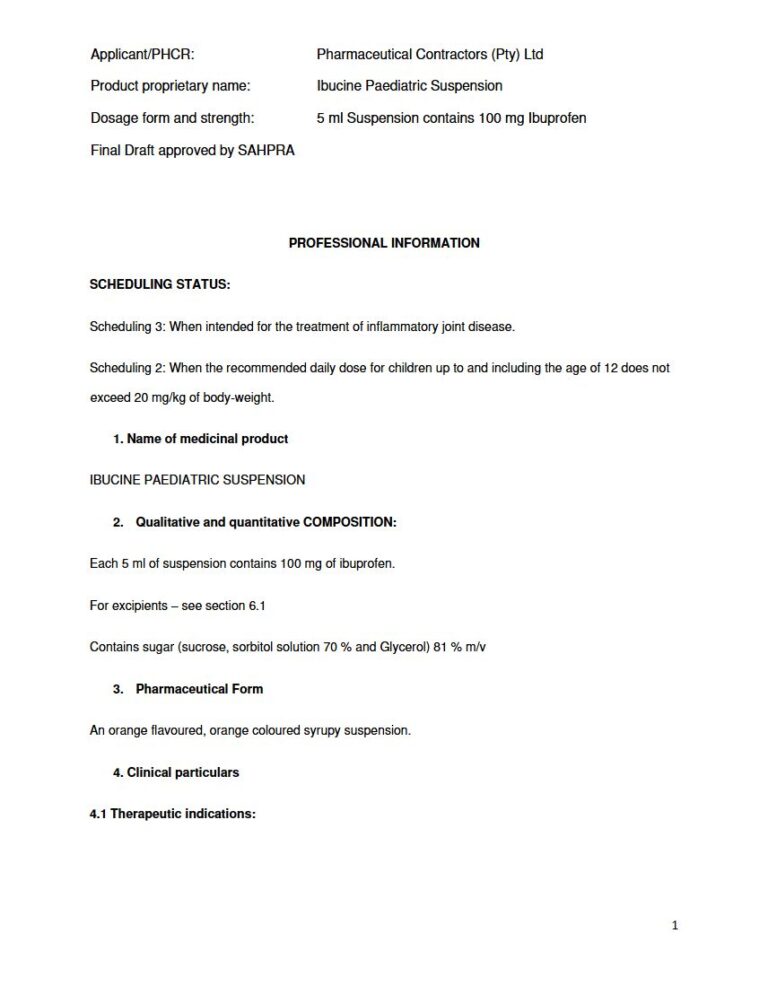
Ibucine Paediatric Suspension 5 ml Suspension
Clinical Summary
Quick overview from the medicine insert
Indication
Management of mild to moderate pain, inflammation, and fever.
Dosage (summary)
Children: 20 mg/kg daily for juvenile rheumatoid arthritis; 5 mg/kg for pain and fever, every 4-6 hours.
Special Populations
- Elderly
- Renal impairment
- Hepatic impairment
Pregnancy & Breastfeeding
Not recommended during the third trimester; minimal excretion in breast milk.
Key Drug Interactions
- Oral anti-coagulants
- Lithium
- Methotrexate
- Cardiac glycosides
Contraindications
- Peptic ulceration
- Hypersensitivity to Ibuprofen
- Third trimester of pregnancy
Common side effects
- Gastro-intestinal disturbances
- Headache
- Dizziness
- Nervousness
Counselling Points
- Take with food to reduce GI upset
- Consult if pain persists beyond 7 days
- Avoid in late pregnancy
Serious warnings
- Caution in patients with peptic ulceration
- Monitor for blood, kidney, liver disorders
Important Disclaimer
The Ibucine Paediatric Suspension 5 ml Suspension professional information leaflet below is the property of Pharmaceutical Contractors and is provided on Medinsert exactly as issued, with no.. alterations or editorial changes. We make every effort to keep content current by updating documents as soon as new versions become available. Medinsert serves as a trusted access point for healthcare professionals, but does not replace official sources or clinical judgement. For more details, please read our full disclaimer. read more>>
 Healthcare Professionals Only
This content is for registered healthcare professionals
Sign in or create a free account to read the full package insert.
Free for HPCSA-registered professionals. Powered by Medinsert.
Clinical Particulars
Section 4 of the official insert — extracted exactly as issued, no alterations
4.1 Therapeutic indications
Ibucine is indicated for the management of mild to moderate pain and inflammation. Ibucine is also used to reduce fever. Ibucine is used in the management of mild to moderate pain and inflammation in, musculoskeletal and joint disorders such as rheumatoid arthritis, peri-articular disorders such as bursitis, and tensosynovitis, and soft tissue disorder such as pains and sprains.
4.2 Posology and method of administration
Children: Juvenile Rheumatoid Arthritis - 20 mg/kg of body mass daily in divided doses with up to 40 mg/kg being given daily if necessary. Ibucine is not recommended for children under 1 year of age or in those weighing less than 7 kg. Pain: 5 mg/kg of body mass. A second dose of 5 mg/kg may be given after 2 hours if pain is not controlled, thereafter 5 mg/kg every 4-6 hours. If pain persists for more than 7 days, consult your physician. Fever: 5 mg/kg of body mass every 4-6 hours. If fever persists more than three days consult your doctor.
Age Daily Dosage Body Mass
- 1 - 2 years 2,5ml 3 u2013 4 times daily 7 - 12 kg
- 3 - 7 years 2,5-5ml 3 u2013 4 times daily 14 - 23 kg
- 8 - 12 years 10 ml 3 - 4 times daily 25 - 40 kg
4.3 Contraindications
Ibucine should not be given to patients with peptic ulceration and should be used with caution in patients with a history of such disorder. Ibucine should not be administered during the third trimester of pregnancy. Hypersensitivity to Ibuprofen. There is considerable cross reactivity between aspirin and other non-steroidal anti-inflammatory medicines and it is generally recommended that patients who have had a hypersensitivity reaction to one particular non-steroidal anti-inflammatory medicine should avoid all non-steroidal anti-inflammatory medicines.
4.4 Special warnings and Precautions for use
Ibucine should be used with caution in patients with a history of peptic ulceration. Other precautions to be observed include patients with haemorrhagic disorders, asthma, a history of hypersensitivity reactions to aspirin or other NSAIDs, hypertension, and impaired renal, hepatic or cardiac function. Patients should be monitored for the development of blood, kidney, liver or eye disorders. Ibucine should be used with caution in the elderly.
Care is required in those receiving oral anti-coagulants, lithium, methotrexate and cardiac glycosides. Patients with collagen disease may be at increased risk of developing aseptic meningitis. Ibucine should be discontinued in patients who experience blurred or diminished vision, or changes in colour vision. Ibucine contains sucrose. Patients with rare hereditary problems of fructose intolerance, glucose-galactose malabsorption or sucrase-isomaltase insufficiency should not take this medicine. Ibucine contains sucrose and sorbitol. This should also be taken into account in patients with diabetes mellitus. May be harmful to the teeth.
4.5 Interaction with other medicines and other forms of interaction
There is considerable cross reactivity between aspirin and other non-steroidal anti-inflammatory medicines (see 4.3).
4.6 Fertility, pregnancy and lactation
Ibucine should not be administered during the third trimester of pregnancy (see 4.3).
4.5 Undesirable effects
The most common side effects with Ibucine are gastro-intestinal disturbances; these are usually mild and reversible but in some patients peptic ulcer and gastro-intestinal bleeding have been reported.
CNS -related side effects include headache, dizziness, nervousness, tinnitus, depression, drowsiness and insomnia. Hypersensitivity reactions may occur and include fever, asthma and rashes. Hepatotoxicity and aseptic meningitis which occur less frequently may also be hypersensitivity reactions. Some patients may experience visual disturbances, such as blurred vision, changes in visual colour perception and toxic amblyopia. Haematological adverse effects include anaemias, thrombocytopenia, neutropenia, eosinophilia, and agranulocytosis. They may cause nephrotoxicity such as interstitial nephritis, nephrotic syndrome and renal failure. Ibucine can provoke bronchospasm in patients with asthma. Ibuprofen may cause cystitis and haematuria.
Reporting of suspected adverse reactions
Reporting suspected adverse reactions after authorisation of the medicinal product is important. It allows continued monitoring of the benefit/risk balance of the medicinal product. Healthcare professionals are asked to report any suspected adverse reactions to SAHPRA via the u201c6.04 Adverse Drug Reaction Reporting Formu201d, found online under SAHPRAu2019s publications: http://www.sahpra.org.za/publications/index/8
4.6 Overdose
Epigastric pain and nausea, electrolites may be corrected by intravenous infusions, if necessary.
