
Iladek 3 3 mg Tablet
PDF Leaflet Revision Date: 10 Aug 2022
Clinical Summary
Quick overview from the medicine insert
Indication
Treatment of gastrointestinal strongyloidiasis, lymphatic filariasis, human sarcoptic scabies, and onchocerciasis.
Dosage (summary)
200 mcg/kg as a single oral dose; specific dosing based on body weight for mass distribution.
Special Populations
- Immunocompromised patients
- Paediatric patients < 15 kg
Pregnancy & Breastfeeding
Safety in pregnancy not established; limited data show no adverse effects in first trimester. Use in breastfeeding only after one week postpartum.
Key Drug Interactions
- Diethylcarbamazine citrate (DEC) not recommended with ivermectin
Contraindications
- Hypersensitivity to ivermectin or excipients
Common side effects
- Transient hypereosinophilia
- Liver dysfunction
- Nausea
- Dizziness
- Pruritus
Counselling Points
- Take on an empty stomach with water
- Avoid food 2 hours before/after administration
- Monitor for adverse reactions
Serious warnings
- Risk of serious adverse reactions in patients co-infected with Loa loa
- Not a prophylactic therapy
Important Disclaimer
The Iladek 3 3 mg Tablet professional information leaflet below is the property of Trinity Pharma and is provided on Medinsert exactly as issued, with no.. alterations or editorial changes. We make every effort to keep content current by updating documents as soon as new versions become available. Medinsert serves as a trusted access point for healthcare professionals, but does not replace official sources or clinical judgement. For more details, please read our full disclaimer. read more>>
 Healthcare Professionals Only
This content is for registered healthcare professionals
Sign in or create a free account to read the full package insert.
Free for HPCSA-registered professionals. Powered by Medinsert.
Clinical Particulars
Section 4 of the official insert — extracted exactly as issued, no alterations
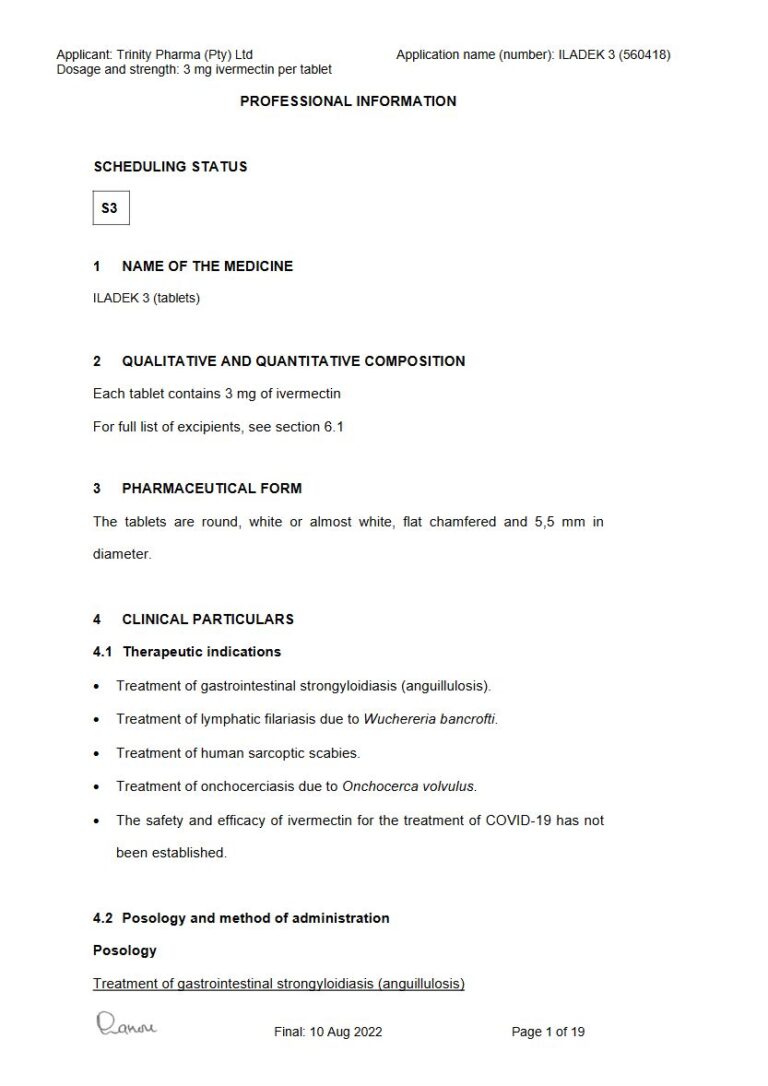
4.1 Therapeutic indications
- Treatment of gastrointestinal strongyloidiasis (anguillulosis).
- Treatment of lymphatic filariasis due to Wuchereria bancrofti.
- Treatment of human sarcoptic scabies.
- Treatment of onchocerciasis due to Onchocerca volvulus.
- The safety and efficacy of ivermectin for the treatment of COVID-19 has not been established.
4.2 Posology and method of administration
Posology
Treatment of gastrointestinal strongyloidiasis (anguillulosis) The recommended dosage is one single oral dose of 200 micrograms of ivermectin per kg body weight. For guidance, the dose, as determined by the patientu2019s weight, is as follows:
Treatment of microfilaraemia caused by Wuchereria bancrofti The recommended dosage for mass distribution for the treatment of microfilaraemia caused by Wuchereria bancrofti is a single oral dose once every 6 months designed to provide approximately 150 to 200 u03bcg/kg of body weight. In endemic areas where treatment can only be administered once every 12 months, the recommended dosage is 300 to 400 u03bcg/kg of body weight to maintain adequate suppression of microfilaraemia in treated patients. For guidance, the dose, as determined by the patientu2019s weight, is as follows:
BODY WEIGHT (kg) DOSE (number of 3 mg tablets)
15 to 24: one
25 to 35: two
36 to 50: three
51 to 65: four
66 to 79: five
u2265 80: six
BODY WEIGHT (kg) DOSE when given once every 6 months (number of 3 mg tablets) DOSE when given once every 12 months (number of 3 mg tablets)
15 to 25: one, two
26 to 44: two, four
45 to 64: three, six
65 to 84: four, eight
Alternatively and if no scales are available, the dose of ivermectin for use in mass chemotherapy campaigns may be determined by the patient's height as follows:
Treatment of human sarcoptic scabies Treatment is justified when the diagnosis of scabies has been established clinically and/or by parasitological examination. Without formal diagnosis treatment is not justified in case of pruritus. The recommended dosage is a single oral dose to provide ivermectin 200 u03bcg/kg body weight. Common scabies: Recovery will be considered as definite only after 4 weeks of the treatment. Persistence of pruritus or scraping lesions does not justify a second treatment before this date. Administration of a second dose within 2 weeks after the initial dose should only be considered: a) when new specific lesions occur, b) when the parasitologic examination is positive at this date. Profuse and crusting scabies: In these heavily infected forms, a second dose within 8 to 15 days of ivermectin and/or concomitant topical therapy may be necessary to obtain recovery.
HEIGHT (cm) DOSE when given once every 6 months (number of 3 mg tablets) DOSE when given once every 12 months (number of 3 mg tablets)
90 to 119: one, two
120 to 140: two, four
141 to 158: three, six
> 158: four, eight
Treatment of Onchocerciasis This indication is based on randomized, double-blind, placebo-controlled and comparative studies conducted in 1427 patients in onchocerciasis-endemic areas of West Africa. The comparative studies used diethylcarbamazine citrate (DEC -C). The recommended dosage for the treatment of onchocerciasis is a single oral dose designed to provide approximately 150 mcg of ivermectin per kg of body weight. See Table 2 for dosage guidelines. Patients should take tablets on an empty stomach with water. In mass distribution campaigns in international treatment programs, the most commonly used dose interval is 12 months. For the treatment of individual patients, retreatment may be considered at intervals as short as 3 months. NOTE: ILADEK 3 has no activity against adult Onchocerca volvulus parasites. The adult parasites reside in subcutaneous nodules which are infrequently palpable. Surgical excision of these nodules (nodulectomy) may be considered in the management of patients with onchocerciasis, since this procedure will eliminate the microfilariae-producing adult parasites.
Paediatric population For all indications, safety in paediatric patients weighing less than 15 kg of body weight has not been established.
BODY WEIGHT (kg) DOSE (number of 3 mg tablets)
15 to 25: one
26 to 44: two
45 to 64: three
65 to 84: four
u2265 85: 150 mcg/kg
Method of administration Oral route. In children less than 6 years of age, tablets should be crushed before swallowing. Treatment is one single oral dose taken with water in fasting patient. The dose may be taken at any time of the day, but no food should be taken within two hours before or after administration, as the influence of food on absorption is unknown.
4.3 Contraindications
Hypersensitivity to the ivermectin or to any of the excipients (see section 6.1).
4.4 Special warnings and precautions for use
Special warnings Efficacy and dosing regimen of ivermectin in immunocompromised patients being treated for intestinal strongyloidiasis have not been established by adequate clinical studies. There have been reported cases which show the persistence of infestation following a single dose of ivermectin, particularly in this type of patients. Ivermectin is not a prophylactic therapy of infection with filariae or anguillulosis; there are no data available demonstrating the efficacy of ivermectin, either for killing or preventing the maturation of infective larvae in humans. Ivermectin has not been shown to have any activity against the adult worm of any species of filariae. Ivermectin has not been shown to have any beneficial effect on tropical pulmonary eosinophilia syndrome, on lymphadenitis or lymphangitis observed in case of infection with filariae.
The intensity and severity of adverse experiences following administration of ivermectin are probably related to the pretreatment microfilarial density particularly in the blood. In patients co-infected with Loa loa, microfilarial density, particularly in the blood, is most often high which predisposes the treated patients to an increased risk in the occurrence of serious adverse experiences. CNS adverse experiences (encephalopathies) have been rarely reported in patients treated with ivermectin and co-infected by a high number of microfilariae of Loa loa. Consequently, in Loa loa endemic areas, special measures should be taken before any treatment with ivermectin (see section 4.8). Concomitant treatment with diethylcarbamazine citrate (DEC) and ivermectin in mass chemotherapy campaigns for filariasis caused by Wuchereria Bancrofti in Africa is not recommended. Co-infection with other microfilariae, such as Loa loa may result in high microfilaraemia in patients infected. Systemic exposure to DEC in such patients may result in the occurrence of serious side effects related to the rapid and effective microfilaricidal effects of this medicine. Following administration of drugs with a rapid microfilaricidal action such as DEC in patients with onchocerciasis, cutaneous and/or systemic reactions of varying severity (the Mazzotti reaction), and ophthalmological reactions have been reported. These reactions are probably due to inflammatory responses to degradation products released following the death of microfilariae. Patients treated with ivermectin for onchoceriasis may also experience these reactions when treated for the first time. After treatment with a microfilaricidal drug, patients with hyperreactive onchodermatitis or u201cSowdau201d (observed particularly in Yemen) may be more likely than others to experience severe cutaneous adverse reactions (oedema and aggravation of onchodermatitis).
Paediatric population Safety in paediatric patients weighing less than 15 kg of body weight has not been established.
4.5 Interaction with other medicines and other forms of interaction
No interaction studies have been performed.
4.6 Fertility, pregnancy and lactation
Pregnancy Safety in pregnancy has not been established. During mass treatment of onchocerciasis, data on a limited number (approximately 300) of pregnant women indicated no adverse effects such as congenital anomalies, spontaneous abortions, stillbirths and infant mortality which might be associated with ivermectin treatment during the first trimester of pregnancy. To date, no other epidemiological data are available. Animal studies have shown reproductive toxicity (see section 5.3); however, the predictive value of these observations has not been established.
Breastfeeding Safety of use has not been established in newborn infants. The treatment to breastfeeding mothers may be only given one week after the birth of the child.
4.7 Effects on ability to drive and use machines
The effect of this medicine on the ability to drive vehicles or operate machinery has not been studied. The possibility of side effects such as dizziness, drowsiness, vertigo and tremor in some patients that may affect the ability to drive or operate machinery cannot be ruled out (see section 4.8).
4.8 Undesirable effects
a. Summary of the safety profile Transient hypereosinophilia, liver dysfunction including acute hepatitis, increased liver enzymes, hyperbilirubinaemia and haematuria have been reported. Very rarely, toxic epidermal necrolysis and Stevens-Johnson syndrome have also been reported. Side effects are related to the parasite density and are mild and transient in the majority of cases, but their severity may be increased in patients infected with more than one parasite, particularly in the case of infestation with Loa loa. Rarely, severe and potentially fatal cases of encephalopathy have been described following administration of ivermectin, particularly in patients also heavily infected with Loa loa. In these patients, the following adverse reactions have also been reported: back or neck pain, ocular hyperaemia, subconjunctival haemorrhage, dyspnoea, urinary and/or faecal incontinence, difficulty in standing/walking, mental status changes, confusion, lethargy, stupor or coma (see section 4.4). In patients receiving ivermectin for the treatment of strongyloidiasis, the following adverse reactions have been reported: asthenia, abdominal pain, anorexia, constipation, diarrhoea, nausea, vomiting, dizziness, somnolence, vertigo, tremor, transient hypereosinophilia, leukopenia/anaemia and increase in ALAT/alkaline phosphatases. In the treatment of Wuchereria bancrofti filariasis, the intensity of undesirable effects does not seem to be dose-dependent but is related to the microfilarial density in blood. The following have been described: fever, headache, asthenia, feeling of weakness, myalgia, arthralgia, diffuse pain, digestive disorders such as anorexia, nausea, abdominal and epigastric pain, cough, feeling of respiratory discomfort, sore throat, orthostatic hypotension, chills, vertigo, profuse sweating, testicular pain or feeling of discomfort.
Following administration of ivermectin in patients infected with Onchocerca volvulus, the hypersensitivity reactions observed resulting from microfilarial death pertain to Mazzotti-type reactions: pruritus, urticarial rash, conjunctivitis, arthralgia, myalgia (including abdominal myalgia), fever, oedema, lymphadenitis, adenopathies, nausea, vomiting, diarrhoea, orthostatic hypotension, vertigo, tachycardia, asthenia, headache. Rarely, these symptoms have been severe. A few cases of asthma exacerbation have been described. In these patients, abnormal sensation in the eyes, eyelid oedema, anterior uveitis, conjunctivitis, limbitis, keratitis and chorioretinitis or choroiditis have also been described. These manifestations, which may be due to the disease itself, have also been described occasionally after treatment. They were rarely severe and generally resolved without corticosteroid treatment. Onset of conjunctival haemorrhage has been reported in patients with onchocerciasis. Observations of adult Ascaris expulsion have been described following ingestion of ivermectin. In patients with scabies, transient exacerbation of pruritus may be observed at the start of treatment.
b. Tabulated summary of adverse reactions MedDRA system organ class Frequency Adverse reactions Infections and infestations Less frequent Encephalitis Frequency Sore throat, lymphadenitis
4.9 Overdose
Cases of accidental overdose with ivermectin have been reported, but none have resulted in fatalities. In cases of accidental intoxication with unknown doses of products destined for veterinary use (oral use, as an injection, cutaneous use), the symptoms described were: rash, contact dermatitis, oedema, headache, vertigo, asthenia, nausea, vomiting, diarrhoea and abdominal pain. Other effects have also been observed, including: seizures, ataxia, dyspnoea, paraesthesia and urticaria. Management in case of accidental intoxication: u2022 symptomatic treatment and surveillance in a medical care setting with fluid replacement and hypertensive treatment, if necessary. Although there are no specific studies available, it is advisable to avoid combination of GABA agonists in the treatment of accidental intoxication due to ivermectin.
