
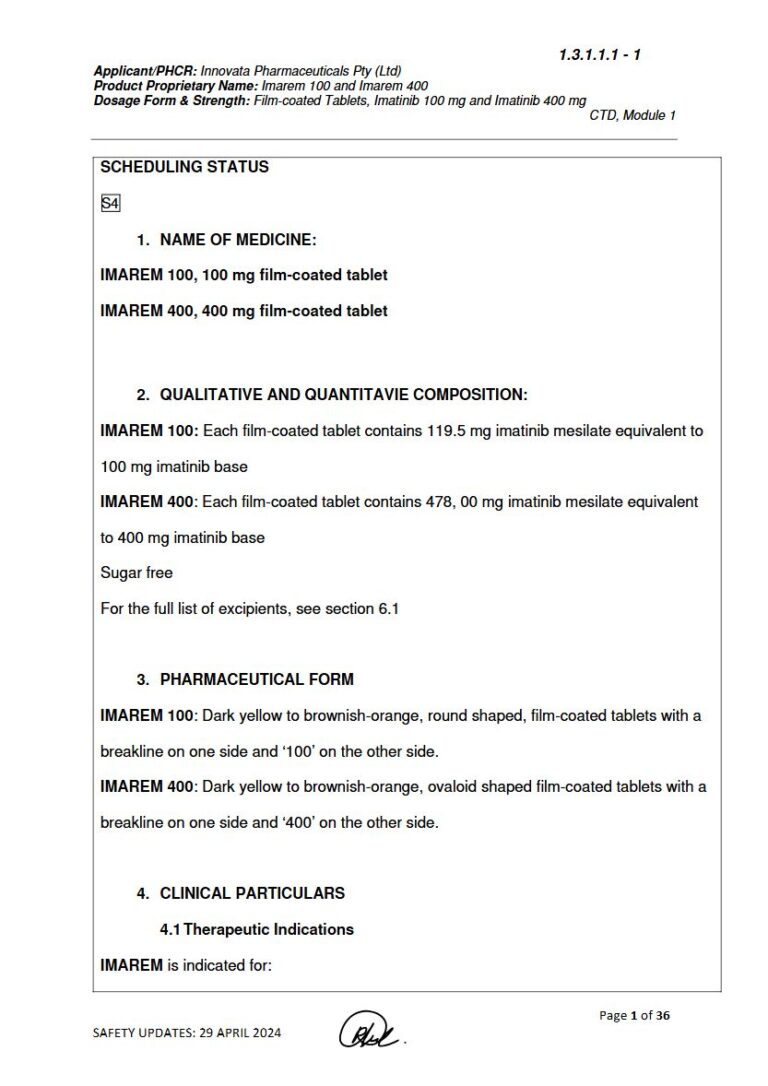
Imarem 100 mg/400 mg Film-Coated Tablets
PDF Leaflet Revision Date: 29 April 2024
Clinical Summary
Quick overview from the medicine insert
Indication
Treatment of various hematological malignancies including CML and Ph+ ALL.
Dosage (summary)
400 mg/day for chronic phase CML; 600 mg/day for accelerated phase or blast crisis; 800 mg/day for DFSP.
Special Populations
- Hepatic impairment
- Renal impairment
- Elderly
Pregnancy & Breastfeeding
Safety not established; avoid breastfeeding.
Key Drug Interactions
- CYP3A4 inhibitors increase imatinib levels
- CYP3A4 inducers decrease imatinib levels
Contraindications
- Hypersensitivity to imatinib
Common side effects
- Neutropenia
- Thrombocytopenia
- Nausea
- Vomiting
- Fluid retention
Counselling Points
- Take with food and water
- Monitor for signs of liver dysfunction
- Use contraception during treatment
Serious warnings
- Cerebrovascular events
- Hepatotoxicity
- Fluid retention
- Tumor lysis syndrome
Important Disclaimer
The Imarem 100 mg/400 mg Film-Coated Tablets professional information leaflet below is the property of Innovata Pharmaceuticals Pty (Ltd) and is provided on Medinsert exactly as issued, with no.. alterations or editorial changes. We make every effort to keep content current by updating documents as soon as new versions become available. Medinsert serves as a trusted access point for healthcare professionals, but does not replace official sources or clinical judgement. For more details, please read our full disclaimer. read more>>
 Healthcare Professionals Only
This content is for registered healthcare professionals
Sign in or create a free account to read the full package insert.
Free for HPCSA-registered professionals. Powered by Medinsert.
Clinical Particulars
Section 4 of the official insert — extracted exactly as issued, no alterations
4.1 Therapeutic Indications
IMAREM is indicated for:
- Treatment of adult and paediatric patients with newly diagnosed Philadelphia chromosome positive chronic myeloid leukaemia (CML) (for paediatric use, see sections 4.2)
- Treatment of adult and paediatric patients with CML in blast crisis, accelerated phase, or in chronic phase after failure of interferon-alpha therapy (for paediatric use, see sections 4.2)
- Treatment of adult patients with newly diagnosed Philadelphia chromosome positive acute lymphoblastic leukaemia (Ph+ ALL) integrated with chemotherapy.
- Treatment of adult patients with relapsed or refractory Ph+ ALL as monotherapy.
- Treatment of adult patients with myelodysplastic / myeloproliferative diseases (MDS/MPD) associated with platelet-derived growth factor receptor (PDGFR) gene re-arrangements.
- Treatment of adult patients with systemic mastocytosis (SM) without the D816V c-Kit mutation and eosinophilia.
- Treatment of adult patients with hypereosinophilic syndrome (HES) and/or chronic eosinophilic leukaemia (CEL) with FIP1L1 u2013 PDGFRu03b1 rearrangement.
- Treatment of adult patients with unresectable, recurrent and/or metastatic dermatofibrosarcoma protuberans (DFSP).
The effectiveness of IMAREM is based on overall haematological and cytogenetic response rates and progression-free survival in CML, on haematological and cytogenetic response rates in Ph+ ALL, MDS/MPD, on haematological response rates in SM, HES/CEL, and on objective response rates in DFSP (see section 5). Increased survival has been demonstrated only in newly diagnosed chronic phase CML.
4.2 Posology and method of administration
Therapy should be initiated by a medical practitioner experienced in the treatment of patients with malignancies. The prescribed dose should be administered orally with a meal and a large glass of water. Doses of 400 mg or 600 mg should be administered once daily, whereas a daily dose of 800 mg should be administered as 400 mg twice a day, in the morning and in the evening.
For patients unable to swallow the film-coated tablets, the tablets may be dispersed in a glass of water or apple juice. The required number of tablets should be placed in the appropriate volume of beverage (approximately 50 ml for a 100 mg tablet, and 200 ml for a 400 mg tablet) and stirred with a spoon. The suspension should be administered immediately after complete disintegration of the tablet(s).
Dosage in CML: The recommended dosage of IMAREM is 400 mg/day for patients in chronic phase CML and 600 mg/day for patients in accelerated phase or blast crisis. Treatment should be continued as long as the patient continues to benefit. Dose increase from 400 mg to 600 mg, or to 800 mg in patients with chronic phase disease, or from 600 mg to a maximum of 800 mg daily in patients in accelerated phase or blast crisis may be considered in the absence of severe adverse medicine reaction and severe non-leukaemia related neutropaenia or thrombocytopaenia in the following circumstances: disease progression (at any time); failure to achieve a satisfactory haematological response after at least 3 months of treatment; failure to achieve a cytogenic response after 12 months of treatment; or loss of a previously achieved haematological and/or cytogenic response.
Dosing in children should be on the basis of body surface area (mg/mu00b2). The dose of 340 mg/mu00b2 daily is recommended for children with chronic phase and advanced phase CML (not to exceed the total dose of 600mg daily. Treatment can be given as a once daily dose or alternatively the daily dose may be split into two administrations - one in the morning and one in the evening. There is no experience with the use of imatinib as in IMAREM in children under 2 years of age.
Dosage in Ph+ ALL: The recommended dose of IMAREM is 600 mg/day for patients with Ph+ ALL.
Dosage In MDS/MPD: The recommended dose of IMAREM is 400 mg/day for patients with MDS/MPD.
Dosage in SM: For patients with SM associated with eosinophilia, a clonal haematological disease related to the fusion kinase FIP1L1- PDGFRu03b1, a starting dose of 100 mg/day is recommended. A dose increase from 100 mg to 400 mg for these patients may be considered in the absence of adverse medicine reactions if assessments demonstrate an insufficient response to therapy.
Dosage in HES/CEL: For HES/CEL patients with demonstrated FIP1L1 - PDGFRu03b1 fusion kinase, a starting dose of 100 mg/day is recommended. A dose increase from 100 mg to 400 mg for these patients may be considered in the absence of adverse medicine reactions if assessments demonstrate an insufficient response to therapy.
Dosage in DFSP: The recommended dose of IMAREM is 800 mg/day for patients with DFSP.
Dose adjustments for adverse reactions: Non-haematological adverse reactions: If a severe non-haematological adverse reaction develops with IMAREM use, treatment must be withheld until the event has resolved. Thereafter, treatment can be resumed as appropriate depending on the initial severity of the event. If elevations in bilirubin > 3 x institutional upper limit of normal (IULN) or in liver transaminases > 5 x IULN occur, IMAREM should be withheld until bilirubin levels have returned to a < 1.5 x IULN and transaminase levels to < 2.5 x IULN. Treatment with IMAREM may then be continued at a reduced daily dose. In adults the dose should be reduced from 400 to 300 mg or from 600 to 400 mg or from 800 mg to 600 mg and in children from 340 to 260 mg/mu00b2/day.
Haematological adverse reactions: Dose reduction or treatment interruption for severe neutropaenia and thrombocytopaenia are recommended as indicated in the table below.
4.3 Contraindications
Hypersensitivity to the active ingredient, imatinib, or to any of the excipients of IMAREM listed in section 6.1. Safety in pregnancy and lactation has not been established. (see section 4.6)
4.4 Special warnings and precautions for use
Cerebrovascular adverse events identified as class related adverse events have occurred in patients treated with TKI containing medicines such as IMAREM. These adverse events include cerebrovascular accident (CA), transient ischaemic attack (TIA), ischaemic stroke (IS), and cerebral infarct (CI). These events may occur in patients on treatment, with or without risk factors and may occur at any time during treatment. Patients on treatment should be carefully monitored and relevant risk factors managed to reduce the risk of these cerebrovascular adverse events. Treatment with IMAREM should be discontinued, and alternative treatment options be considered in patients who develop these class related adverse events.
IMAREM should be taken with food and a large glass of water to minimise the risk of gastrointestinal disturbances.
When imatinib as in IMAREM is co-administered with other medications, there is a potential for medicine interactions (see section 4.5). Special caution should be exercised when using paracetamol, as it may increase the risk of liver damage. (see section 4.5).
Hypothyroidism: Hypothyroidism may occur in thyroidectomy patients undergoing levothyroxine replacement during treatment with imatinib as in IMAREM. Thyroid-stimulating hormone (TSH) levels should be closely monitored in such patients (see section 4.5).
Hepatotoxicity: Metabolism of IMAREM occurs mainly via the liver. Patients with hepatic dysfunction (mild, moderate, or severe) must have their peripheral blood counts and liver enzymes carefully monitored (see sections 4.2, 4.8 and 5.2). Cases of liver injury, including liver failure and liver necrosis, have been reported with imatinib as in IMAREM. It has been reported that when imatinib as in IMAREM is combined with high dose chemotherapy regimens, transient liver toxicity in the form of transaminase elevation and hyperbilirubinaemia has been observed. Additionally, there have been reports of acute liver failure. Monitoring of hepatic function is recommended in circumstances where imatinib as in IMAREM is combined with chemotherapy regimens also known to be associated with hepatic dysfunction (see section 4.8).
Fluid retention: Occurrences of severe fluid retention (pleural effusion, oedema, pulmonary oedema, ascites, and superficial oedema) have been reported in newly diagnosed CML patients taking imatinib as in IMAREM. Therefore, it is recommended that patients be weighed regularly. An unexpected rapid weight gain should be carefully investigated and if necessary appropriate supportive care and therapeutic measures should be undertaken. It has been reported that there was an increased incidence of these events in elderly patients and those with a prior history of cardiac disease.
Patients with cardiac disease: Patients with cardiac disease or risk factors for cardiac failure should be monitored carefully and any patient with signs or symptoms consistent with cardiac failure should be evaluated and treated. In patients with hypereosinophilic syndrome (HES) and cardiac involvement isolated cases of cardiogenic shock/left ventricular dysfunction have been associated with the initiation of imatinib as in IMAREM therapy. The condition was reported to be reversible with the administration of systemic steroids, circulatory support measures and temporarily withholding imatinib as in IMAREM.
Myelodysplastic/myeloproliferative diseases and systemic mastocytosis might be associated with high eosinophil levels. Performance of an echocardiogram and determination of serum troponin should therefore be considered in patients with HES/CEL, and in patients with MDS/MPD or SM associated with high eosinophil levels. If either is abnormal, the prophylactic use of systemic steroids (1-2 mg/kg) for one to two weeks concomitantly with imatinib as in IMAREM should be considered at the initiation of therapy.
Gastrointestinal haemorrhage: Gastric antral vascular ectasia (GAVE), a cause of gastrointestinal haemorrhage, has been reported in post-marketing experience in patients with CML, ALL and other diseases (see section 4.8). When needed, discontinuation of IMAREM treatment may be considered.
Laboratory tests: Complete blood counts must be performed regularly during therapy with IMAREM. Treatment of CML patients with IMAREM has been associated with neutropenia or thrombocytopenia. However, the occurrence of these cytopenias is likely to be related to the stage of the disease being treated and they were more frequent in patients with accelerated phase CML or blast crisis as compared to patients with chronic phase CML. Treatment with IMAREM may be interrupted or the dose may be reduced, as recommended in section 4.2.
Liver function (transaminases, bilirubin, alkaline phosphatase) should be monitored regularly in patients receiving IMAREM. These laboratory abnormalities should be managed with interruption and/or dose reduction of the treatment with imatinib as in IMAREM.
Imatinib as in IMAREM and its metabolites are excreted via the kidney to a significant extent. Creatinine clearance (CrCL) is known to decrease with age, and age did not significantly affect imatinib kinetics (see section 5).
Renal impairment: In patients with impaired renal function, imatinib plasma exposure seems to be higher than that in patients with normal renal function, probably due to an elevated plasma level of alpha-acid glycoprotein (AGP), an imatinib-binding protein, in these patients. Patients with renal impairment should be given the minimum starting dose. Patients with severe renal impairment should be treated with caution. The dose can be reduced if not tolerated (see section 4.2 and 5.2).
Long-term treatment with imatinib may be associated with a clinically significant decline in renal function. Renal function should, therefore, be evaluated prior to the start of imatinib therapy and closely monitored during therapy, with particular attention to those patients exhibiting risk factors for renal dysfunction.
Tumour lysis syndrome: Due to the possible occurrence of tumour lysis syndrome (TLS) with imatinib, correction of clinically significant dehydration and treatment of high uric acid levels are recommended prior to initiation of IMAREM (see section 4.8).
Hepatitis B reactivation: Reactivation of hepatitis B in patients who are chronic carriers of this virus has occurred after these patients received BCR-ABL tyrosine kinase inhibitors. Some cases resulted in acute hepatic failure or fulminant hepatitis leading to liver transplantation or a fatal outcome. An increase in the viral load or positive serology occurred upon HBV reactivation. Patients should be tested for HBV infection before initiating treatment with imatinib as in IMAREM. Patients already on treatment with IMAREM should be tested for hepatitis B infection in order to identify chronic carriers of the virus. Expert medical practitioners experienced in oncology and hepatology should be consulted before treatment is initiated in patients with positive hepatitis B serology (including those with active disease) and for patients who test positive for HBV infection during treatment.
Carriers of HBV who require treatment with IMAREM should be counselled and closely monitored for signs and symptoms of active HBV infection throughout therapy and for several months following termination of therapy (see section 4.8).
Phototoxicity: Exposure to direct sunlight should be avoided or minimised due to the risk of phototoxicity associated with imatinib as in IMAREM treatment. Patients should be instructed to use measures such as protective clothing and sunscreen with high sun protection factor (SPF).
Thrombotic microangiopathy: BCR-ABL tyrosine kinase inhibitors (TKIs) have been associated with thrombotic microangiopathy (TMA), including individual case reports for imatinib as in IMAREM (see section 4.8). If laboratory or clinical findings associated with TMA occur in a patient receiving IMAREM, treatment should be discontinued and thorough evaluation for TMA, including ADAMTS13 activity and anti-ADAMTS13-antibody determination, should be completed. If anti-ADAMTS13-antibody is elevated in conjunction with low ADAMTS13 activity, treatment with IMAREM should not be resumed.
Paediatric population: There have been case reports of growth retardation occurring in children and pre-adolescents receiving imatinib as in IMAREM. Close monitoring of growth in children under imatinib treatment is recommended (see section 4.8).
4.5 Interaction with other medicines and other forms of interaction
The following medicines may increase imatinib as in IMAREM plasma concentrations:
Medicines that inhibit the cytochrome P450 isoenzyme CYP3A4 activity (e.g. azole antifungals such as ketoconazole, itraconazole, macrolides such as erythromycin, clarithromycin and protease inhibitors such as indinavir, lopinavir/ritonavir, ritonavir, telaprevir, nelfinavir, boceprevir) could decrease metabolism and increase imatinib concentrations. Caution should be taken when administering IMAREM with inhibitors of the CYP3A4 family.
The following medicines that may decrease imatinib as in IMAREM plasma concentrations: Medicines that are inducers of CYP3A4 activity could increase metabolism and decrease imatinib plasma concentrations. Co-medications which induce CYP3A4 (e.g. dexamethasone, phenytoin, carbamazepine, rifampicin, phenobarbitone or hypericum perforatum (also known as St. John's Wort) may significantly reduce exposure to imatinib as in IMAREM. Patients with malignant gliomas treated with IMAREM while taking enzyme-inducing anti-epileptic drugs (EIAEDs) such as carbamazepine, oxcarbazepine, phenytoin, fosphenyloin, phenobarbital, and primidone may experience a decrease in concentration levels of imatinib as in IMAREM, compared to patients not on (EIAEDs). In patients where rifampin or other CYP3A4 inducers are indicated, alternative therapeutic agents with less enzyme induction potential should be considered.
Medicines that may have their plasma concentration altered by imatinib as in IMAREM: Imatinib as in IMAREM increases the mean Cmax and AUC of CYP3A4 substrates. Therefore, caution is recommended when administering imatinib as in IMAREM with CYP3A4 substrates with a narrow therapeutic window (e.g. ciclosporin, simvastatin or pimozide). Imatinib as in IMAREM may increase plasma concentration of other CYP3A4 metabolised medicines (e.g. triazolo-benzodiazepines, dihydropyridine calcium channel blockers, certain HMG-CoA reductase inhibitors, i.e. statins, etc.) Imatinib as in IMAREM also inhibits CYP2C9 and CYP2C19 activity in vitro. PT prolongation was observed following co-administration with warfarin. When giving coumarins, short-term PT monitoring is therefore necessary at the start and end of IMAREM therapy and when altering the dosage. Alternatively, the use of low-molecular weight heparin should be considered. In vitro, Imatinib as in IMAREM inhibits the cytochrome P450 isoenzyme CYP2D6 activity at concentrations similar to those that affect CYP3A4 activity. IMAREM at 400 mg twice daily had a weak inhibitory effect on CYP2D6-mediated metoprolol GI metabolism, with metoprolol Cmax and AUC being increased by approximately 23%. Co-administration of imatinib as in IMAREM with CYP2D6 substrates, such as metoprolol, does not seem to be a risk factor for drug-drug interactions and dose adjustment may not be necessary. In vitro, imatinib as in IMAREM inhibits paracetamol O-glucuronidation (Ki value of 58.5 micromol/I at therapeutic levels) see section 4.5.
Concomitant use of levothyroxine and IMAREM may result in plasma exposure to levothyroxine being decreased in thyroidectomy patients, therefore caution is recommended (see section 4.4).
4.6 Fertility, pregnancy, and lactation
Women of childbearing potential/Contraception in males and females: Women of child-bearing potential must be advised to use effective contraception during treatment. (see section 4.3). Contraceptive measures must be taken during treatment and for at least three months after cessation of IMAREM therapy for men and at least six months after cessation of IMAREM therapy for women.
Pregnancy: Safety in pregnancy has not been established (See Section 4.3). Studies in animals have shown reproductive toxicity.
Breastfeeding: Safety in lactation has not been established (See Section 4.6). Women taking IMAREM should not breastfeed.
Fertility: In non-clinical studies in rats, the fertility of male and female species was not affected (see section 5.3). Studies on patients receiving imatinib and its effect on fertility and gametogenesis have not been performed. Patients concerned about their fertility on IMAREM treatment should consult with their medical practitioner.
4.7 Effects on ability to drive and use machines
Patients should be advised that they may experience undesirable effects such as dizziness, somnolence, or blurred vision during treatment with IMAREM. Therefore, patients should not drive or operate machines, until they know how treatment with IMAREM affects them (see section 4.8).
4.8 Undesirable effects
a) CNS effects associated with tyrosine kinase inhibitors. Cerebrovascular adverse events identified as class related adverse events have occurred in patients treated with TKI containing medicines. These class related cerebrovascular adverse events, shared to a variable degree by all TKIs, are cerebrovascular accident (CA), transient ischaemic attack (TIA), ischaemic stroke (IS), and cerebral infarction (CI). These cerebrovascular events may occur in patients on treatment with TKIs with or without risk factors for these events and may occur at any time during treatment with TKIs.
Table 1: Ischaemic Central Nervous System Vascular Condition Associated with Imatinib- a tyrosine kinase inhibitor
| Drug | Period | Cases | Cerebrovascular accident | Transient ischaemic attack | Cerebral infarction | Ischaemic stroke |
|---|---|---|---|---|---|---|
| Imatinib | 2002 till 6/3/2020 | 464 | 277 | 44 | 71 | 18 |
Cerebrovascular adverse events (mentioned in table above) may occur in patients on treatment with TKI containing medicines with or without risk factors for these events and may occur at any time during treatment with TKIs. Patients on treatment with TKI containing medicine should be carefully monitored, and relevant risk factors managed to reduce the risk for these class related cerebrovascular adverse events. Treatment with TKI containing medicines should be discontinued, and alternative treatment options be considered in patients who develop these class related cerebrovascular adverse events.
Tabulated summary of Adverse reactions:
MedDRA System organ classification
| Frequent | Less Frequent |
|---|---|
| Infections and infestations: Sepsis, pneumonia, herpes simplex, herpes zoster, nasopharyngitis, upper respiratory tract infection, gastroenteritis, sinusitis, cellulitis influenza urinary tract infection, fungal infection | Neoplasm benign, malignant and unspecified (including cysts and polyps) |
| Blood and lymphatic system disorders: Neutropenia, thrombocytopaenia, anaemia, febrile neutropenia, pancytopenia | Thrombocythemia, lymphopenia, bone marrow depression, eosinophilia, lymphadenopathy, haemolytic anaemia, thrombotic microangiopathy |
| Metabolism and nutrition disorders: Anorexia | Dehydration, hyperuricaemia, hypokalaemia, increased appetite, decreased appetite, gout, hypophosphatemia, hypercalcaemia, hyperglycaemia, hyponatraemia, hyperkalaemia, hypomagnesaemia |
| Psychiatric disorders: Insomnia | Depression, anxiety, decreased libido, confusion |
| Nervous system disorders: Headache, dizziness, taste disturbances, paraesthesia, hypoaesthesia | Cerebral haemorrhage, syncope, peripheral neuropathy, somnolence, migraines, memory impairment, sciatica, restless leg syndrome, tremor, optic neuritis, increased intracranial pressure, convulsions |
| Eye disorders: Conjunctivitis, increased lacrimation, blurred vision, eyelid oedema, conjunctival haemorrhage, dry eye | Eye irritation, eye pain, orbital oedema, scleral haemorrhage, retinal haemorrhage, blepharitis, macular oedema, cataract, papilloedema, glaucoma |
| Ear and Labyrinth disorders: Vertigo, tinnitus, hearing loss | Cardiac disorders: Cardiac failure, congestive pulmonary oedema, palpitations, tachycardia, pericardial effusion, dysrhythmia, atrial fibrillation, cardiac arrest, myocardial infarction, angina pectoris |
| Vascular disorder: Flushing haemorrhage | Haematoma, subdural haematoma, hypertension, hypotension, peripheral coldness, Raynaudu2019s phenomenon. |
| Respiratory, thoracic and mediastinal disorders: Epistaxis, dyspnoea, cough | Pleural effusion, pharyngo-laryngeal pain, pharyngitis, pulmonary fibrosis, pleuritic pain, pulmonary hypertension, pulmonary haemorrhage |
| Gastrointestinal disorders: Nausea, vomiting, diarrhoea, dyspepsia, abdominal pain, abdominal distension, flatulence, constipation, gastro-oesophageal reflux, dry mouth, gastritis | Gastrointestinal haemorrhage, eructation, melaena, oesophagitis, ascites, gastric ulcer, mouth ulceration, stomatitis, haematemesis, cheilitis, dysphagia, pancreatitis, colitis, ileus, inflammatory bowel disease |
| Hepato-biliary disorders: Increased hepatic enzymes | Jaundice, hepatitis, hyperbilirubinemia, hepatic failure, hepatic necrosis. |
| Skin and subcutaneous tissue disorders: Periorbital oedema, dermatitis/eczema/rash, face oedema, pruritus, erythema, dry skin, alopecia, night sweats, photosensitivity reaction. | Rash pustular, petechiae, contusion, increased sweating, urticarial, ecchymosis, increased tendency to bruise, onychoclasis, folliculitis, purpura, hypotrichosis, skin hyperpigmentation, psoriasis, exfoliative dermatitis and bullous eruptions, nail discolouration, vesicular rash, Stevens-Johnson syndrome, acute febrile neutrophilic dermatosis (Sweets Syndrome), erythema multiforme, leucocytoclastic vasculitis, acute generalised exanthematous pustulosis (AGEP). |
| Musculoskeletal, connective tissue and bone disorders: Muscle spasm and cramps, musculoskeletal pain, including myalgia, joint and muscle stiffness, muscular weakness, arthritis. | Rhabdomyolysis/myopathy, arthralgia, bone pain, joint swelling. |
| Renal and urinary disorders: Renal failure, renal pain increased urinary frequency, haematuria | Reproductive system and breast disorders: Gynaecomastia, erectile dysfunction, breast enlargement, scrotal oedema, menorrhagia, menstruation irregular, nipple pain, sexual dysfunction, haemorrhagic corpus luteum/haemorrhagic ovarian cyst. |
| General Disorders and administration site conditions: Fluid retention and oedema, fatigue, pyrexia, weakness, rigors, anasarca, chills. | Malaise, chest pain. |
| Investigations: Increased weight, weight decreased. | Increased blood alkaline phosphatase, increased blood creatine, increased blood creatine phosphokinase, increased blood lactate dehydrogenase, blood amylase increased. |
Tabulated results from undesirable effects from post-marketing reports:
Infections and infestations: Hepatitis B reactivation
Neoplasm benign, malignant and unspecified (including cysts and polyps)
Tumour haemorrhage/tumour necrosis
Nervous system disorders: Cerebral oedema
Immune system disorders: anaphylactic shock
Eye disorders: Vitreous haemorrhage
Cardiac disorders: Pericarditis, cardiac tamponade
Vascular disorders: Thrombosis/embolism
Respiratory, thoracic and mediastinal disorders: Acute respiratory failure, interstitial lung disease.
Gastrointestinal disorders: Ileus/intestinal obstruction, tumour haemorrhage/tumour necrosis, gastrointestinal perforation, diverticulitis, gastric antral vascular ectasia (GAVE).
Musculoskeletal and connective tissue disorders: Avascular necrosis/hip osteonecrosis, growth retardation in children.
Renal and urinary disorders: Chronic renal failure.
Skin and subcutaneous tissue disorders: Lichenoid keratosis, lichen planus, toxic epidermal necrolysis, palmoplantar erythrodysesthesia syndrome, drug rash with eosinophilia and systemic symptoms (DRESS), pseudoporphyria.
4.9 Overdose
In the event of overdose, the patient should be observed, and appropriate symptomatic treatment given.
