
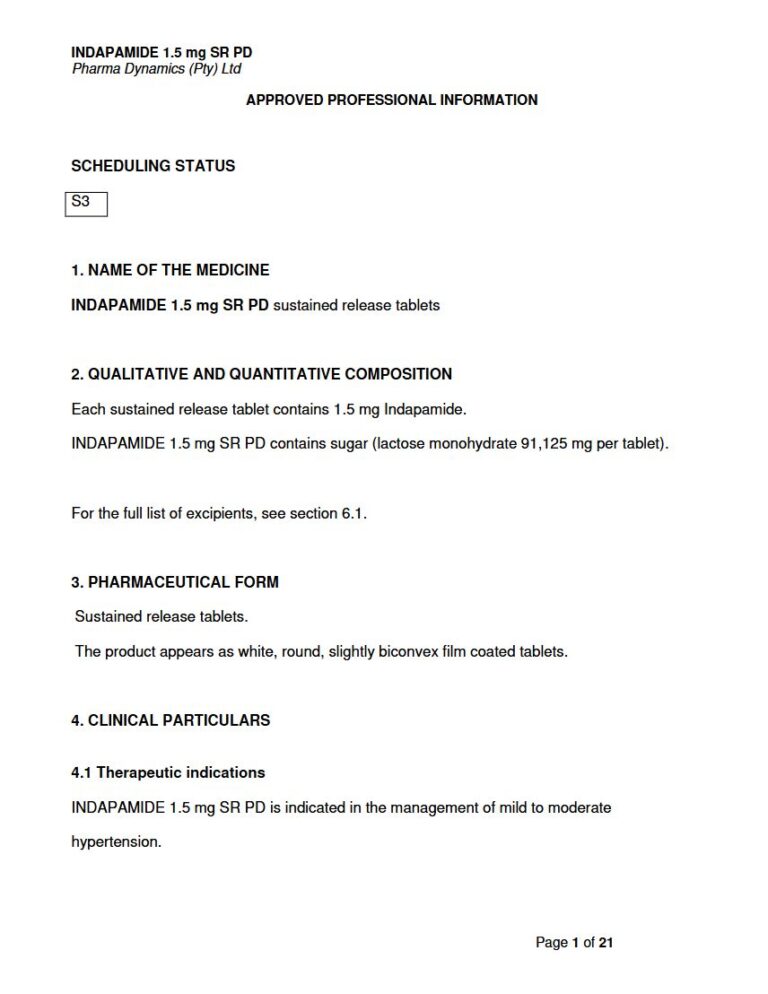
Indapamide 1.5 Mg Tablets
PDF Leaflet Revision Date: 28 January 2025
Clinical Summary
Quick overview from the medicine insert
Indication
Management of mild to moderate hypertension.
Dosage (summary)
One tablet daily, preferably in the morning.
Special Populations
- Renal impairment
- Hepatic impairment
- Elderly
Pregnancy & Breastfeeding
Avoid in pregnancy; not recommended during breastfeeding.
Key Drug Interactions
- Lithium
- NSAIDs
- ACE inhibitors
- Digoxin
Contraindications
- Hypersensitivity to indapamide
- Severe hepatic impairment
- Severe renal failure
- Hypokalaemia
Common side effects
- Hypokalaemia
- Dizziness
- Skin rash
Counselling Points
- Monitor blood pressure regularly.
- Stay hydrated.
- Report any signs of allergic reactions.
Serious warnings
- Risk of electrolyte imbalance
- Photosensitivity reactions
- Potential for torsades de pointes
Important Disclaimer
The Indapamide 1.5 Mg Tablets professional information leaflet below is the property of Pharma Dynamics and is provided on Medinsert exactly as issued, with no.. alterations or editorial changes. We make every effort to keep content current by updating documents as soon as new versions become available. Medinsert serves as a trusted access point for healthcare professionals, but does not replace official sources or clinical judgement. For more details, please read our full disclaimer. read more>>
 Healthcare Professionals Only
This content is for registered healthcare professionals
Sign in or create a free account to read the full package insert.
Free for HPCSA-registered professionals. Powered by Medinsert.
Clinical Particulars
Section 4 of the official insert — extracted exactly as issued, no alterations
4.1 Therapeutic indications
INDAPAMIDE 1.5 mg SR PD is indicated in the management of mild to moderate hypertension.
4.2 Posology and method of administration
Posology
Adults: One tablet daily, to be swallowed whole with water and not chewed, preferably taken on arising in the morning. INDAPAMIDE 1.5 mg SR PD (1.5 mg indapamide) can be combined with other categories of antihypertensive agents, in more severe cases. The antihypertensive action of indapamide is not enhanced at higher doses, but the saluretic effect is increased.
Special populations
Renal impairment
In severe renal failure (creatinine clearance below 30 mL/min), treatment is contraindicated (see section 4.3). Thiazide and related diuretics are fully effective only when renal function is normal or only minimally impaired (see section 4.4).
Hepatic impairment
In severe hepatic impairment, treatment is contraindicated (see sections 4.3 and 4.4).
Elderly
In the elderly, the plasma creatinine must be adjusted in relation to age, weight and gender. Elderly patients can be treated with INDAPAMIDE 1.5 mg SR PD when renal function is normal or only minimally impaired (see section 4.4).
Paediatric population
Safety and efficacy have not been established and INDAPAMIDE 1.5 mg SR PD is not recommended for use in children and adolescents under the age of 18 years as no data are available.
Method of administration
Oral use.
4.3 Contraindications
- hypersensitivity to indapamide, other sulphonamide type medications, or to any of the ingredients of INDAPAMIDE 1.5 mg SR PD
- hepatic encephalopathy or severe hepatic impairment
- in patients with severe renal failure
- in patients with hypokalaemia.
4.4 Special warnings and precautions for use
The elderly patient population may be more sensitive to the electrolyte and hypotensive effects of INDAPAMIDE 1.5 mg SR PD. In addition, elderly patients are more likely to have renal function impairment, which may require caution. The following medical conditions should be considered for risk-benefit when present in patients: severe renal impairment or anuria, history of gout, diabetes mellitus, hyperuricaemia, hepatic impairment and sympathectomy.
Hypersensitivity to other sulphonamide-type medicines may lead to allergic reaction when taking INDAPAMIDE 1.5 mg SR PD.
Laboratory test values that may be altered while taking INDAPAMIDE 1.5 mg SR PD include the following: calcium and protein-bound iodine (decreased); plasma renin activity (increased); potassium and sodium (decreased, but within normal limits); uric acid (increased, but within normal limits).
Special warnings
When liver function is impaired, thiazide-related diuretics may cause hepatic encephalopathy, particularly in case of electrolyte imbalance. Administration of the diuretic must be stopped immediately if this occurs.
Photosensitivity
Cases of photosensitivity reactions have been reported with thiazides and thiazide-related diuretics (see section 4.8). If photosensitivity reaction occurs during treatment, it is recommended to stop the treatment. If a re-administration of the diuretic is deemed necessary, it is recommended to protect exposed areas to the sun or to artificial UVA.
Special precautions for use
Water and electrolyte balance
Plasma sodium: This must be measured before starting treatment, then at regular intervals subsequently. The fall in plasma sodium may be asymptomatic initially and regular monitoring is therefore essential. Monitoring should be even more frequent in the elderly and cirrhotic patients (see sections 4.8 and 4.9). Any diuretic treatment may cause hyponatraemia, sometimes with very serious consequences.
Hyponatraemia with hypovolaemia may be responsible of dehydration and orthostatic hypotension. Concomitant loss of chloride ions may lead to secondary compensatory metabolic alkalosis: the incidence and degree of this effect are slight.
Plasma potassium: Potassium depletion with hypokalaemia is the major risk of thiazide and related diuretics. The risk of onset of hypokalaemia (< 3,4 mmol/L) must be prevented in certain high-risk populations, i.e. the elderly, malnourished and/or polymedicated, cirrhotic patients with oedema and ascites, coronary artery disease and cardiac failure patients. In this situation, hypokalaemia increases the cardiac toxicity of digitalis preparations and the risks of arrhythmias. Individuals with a long QT interval are also at risk, whether the origin is congenital or iatrogenic. Hypokalaemia, as well as bradycardia, is then a predisposing factor to the onset of severe arrhythmias, in particular, potentially fatal torsades de pointes. More frequent monitoring of plasma potassium is required in all the situations indicated above. The first measurement of plasma potassium should be obtained during the first week following the start of treatment. Detection of hypokalaemia requires its correction. In patients at risk of developing hypokalaemia, serum potassium should be monitored, and they may require potassium supplements or potassium-sparing diuretics. Co-administration of INDAPAMIDE 1.5 mg SR PD with other diuretics, which may cause hypokalaemia, is not recommended (see section 4.5).
Hypokalaemia found in association with low serum magnesium concentration can be refractory to treatment unless serum magnesium is corrected.
Plasma magnesium: Thiazides and related diuretics including indapamide have been shown to increase the urinary excretion of magnesium, which may result in hypomagnesaemia (see section 4.5 and 4.8).
Plasma calcium: Thiazide and related diuretics may decrease urinary calcium excretion and cause a slight and transitory rise in plasma calcium. Frankly, hypercalcaemia may be due to previously unrecognized hyperparathyroidism. Treatment should be withdrawn before the investigation of parathyroid function.
Uric acid: Concentrations of serum uric acid should be monitored particularly in patients with a history of gout, who should continue with appropriate treatment.
Mild to moderately impaired renal function: INDAPAMIDE 1.5 mg SR PD can be administered to hypertensive patients with mild to moderately impaired renal function. If azotaemia or oliguria occurs, the treatment should be discontinued.
Blood glucose: Monitoring of blood glucose is important in diabetics, in particular in the presence of hypokalaemia.
Renal function and diuretics: Thiazide and related diuretics are fully effective only when renal function is normal or only minimally impaired (plasma creatinine below levels of the order of 25 mg/L, i.e. 220 u03bcmol/L in an adult). In the elderly, this plasma creatinine must be adjusted in relation to age, weight and gender. Hypovolaemia, secondary to the loss of water and sodium induced by the diuretic at the start of treatment causes a reduction in glomerular filtration. This may lead to an increase in blood urea and plasma creatinine. This transitory functional renal insufficiency is of no consequence in individuals with normal renal function but may worsen pre-existing renal insufficiency.
Athletes: The attention of athletes is drawn to the fact that this medicinal product contains a drug substance, which may give a positive reaction in doping tests.
Choroidal effusion, acute myopia and secondary angle-closure glaucoma: Sulfonamide, or sulfonamide derivativemedicines, can cause an idiosyncratic reaction resulting in choroidal effusion with visual field defect, transient myopia and acute angle-closure glaucoma. Symptoms include acute onset of decreased visual acuity or ocular pain and typically occur within hours to weeks of drug initiation. Untreated acute angle-closure glaucoma can lead to permanent vision loss. The primary treatment is to discontinue medicine intake as rapidly as possible. Prompt medical or surgical treatments may need to be considered if the intraocular pressure remains uncontrolled. Risk factors for developing acute angle-closure glaucoma may include a history of sulfonamide or penicillin allergy.
Excipients: INDAPAMIDE 1.5 mg SR PD contains sugar (lactose monohydrate 91,125 mg per tablet). Patients with rare hereditary problems of galactose intolerance, the Lapp lactase deficiency or glucose-galactose malabsorption should not take this medicine. Patients with rare hereditary problems of galactose intolerance e.g. galactasaemia, Lapp lactase deficiency, or glucose-galactose malabsorption or fructose intolerance should not take INDAPAMIDE 1.5 mg SR PD. Lactose may have an effect on the glycaemic control of patients with diabetes mellitus.
4.5 Interaction with other medicines and other forms of interaction
Combinations that are not recommended:
- Lithium: Increased plasma lithium with signs of overdosage, as with a salt-free diet (decreased urinary lithium excretion). However, if the use of diuretics is necessary, careful monitoring of plasma lithium and dose adjustment are required.
Combinations requiring precautions for use:
- Torsades de pointes - inducing medicines
- class Ia antiarrhythmics (quinidine, hydroquinidine, disopyramide)
- class III antiarrhythmics (amiodarone, sotalol, dofetilide, ibutilide)
- some antipsychotics: phenothiazines (chlorpromazine, cyamemazine, levomepromazine, thioridazine, trifluoperazine), benzamides (amisulpride, sulpiride, sultopride, tiapride) and butyrophenones (droperidol, haloperidol)
- others: bepridil, cisapride, diphemanil, erythromycin IV, halofantrine, mizolastine, pentamidine, sparfloxacin, moxifloxacin, vincamine IV.
Increased risk of ventricular arrhythmias, particularly torsades de pointes (hypokalaemia is a risk factor). Monitor for hypokalaemia and correct, if required, before introducing this combination. Clinical, plasma electrolytes and ECG monitoring. Use substances which do not have the disadvantage of causing torsades de pointes in the presence of hypokalaemia.
N.S.A.I.Ds. (systemic route) including COX-2 selective inhibitors, high dose salicylic acid (u2265 3 g/day): Possible reduction in the antihypertensive effect of indapamide. Risk of acute renal failure in dehydrated patients (decreased glomerular filtration). Hydrate the patient; monitor renal function at the start of treatment.
Angiotensin converting enzyme (A.C.E) inhibitors: Risk of sudden hypotension and/or acute renal failure when treatment with an ACE inhibitor is initiated in the presence of pre-existing sodium depletion (particularly in patients with renal artery stenosis). In hypertension, when prior diuretic treatment may have caused sodium depletion, it is necessary:
- either to stop the diuretic 3 days before starting treatment with the ACE inhibitor, and restart with a hypokalaemic diuretic if necessary;
- or give a low initial dose of the ACE inhibitor and increase the dose gradually.
In congestive heart failure, start with a very low dose of ACE inhibitor, possibly after a reduction in the dose of the concomitant hypokalaemic diuretic.
In all cases, monitor renal function (plasma creatinine) during the first weeks of treatment with an ACE inhibitor.
Other compounds causing hypokalaemia: amphotericin B (IV), gluco- and mineralo- corticoids (systemic route), tetracosactide, stimulant laxatives: Increased risk of hypokalaemia (additive effect). Monitoring of plasma potassium and correction if required. Must be particularly borne in mind in the case of concomitant digoxin treatment and in the use of non-stimulant laxatives.
Baclofen: Increased antihypertensive effect. Hydrate the patient; monitor renal function at the start of treatment.
Digoxin: Hypokalaemia predisposing to the toxic effects of digoxin. Monitoring of plasma potassium and ECG and, if necessary, adjust the treatment.
Combinations requiring special care:
- Allopurinol: Concomitant treatment with indapamide may increase the incidence of hypersensitivity reactions to allopurinol.
Combinations to be taken into consideration:
- Potassium-sparing diuretics (amiloride, spironolactone, triamterene): Whilst rational combinations are useful in some patients, hypokalaemia or hyperkalaemia (particularly in patients with renal failure or diabetes) may still occur. Plasma potassium and ECG should be monitored and, if necessary, treatment reviewed.
- Metformin: Increased risk of metformin induced lactic acidosis due to the possibility of functional renal failure associated with diuretics and more particularly with loop diuretics. Do not use metformin when plasma creatinine exceeds 15 mg/L (135 u03bcmol/L) in men and 12 mg/L (110 u03bcmol/L) in women.
- Iodinated contrast media: In the presence of dehydration caused by diuretics, increased risk of acute renal failure, in particular when large doses of iodinated contrast media are used. Rehydration before administration of the iodinated compound.
- Imipramine-like antidepressants, neuroleptics: Antihypertensive effect and increased risk of orthostatic hypotension increased (additive effect).
- Calcium (salts): Risk of hypercalcaemia resulting from decreased urinary elimination of calcium.
- Ciclosporin, tacrolimus: Risk of increased plasma creatinine without any change in circulating cyclosporin levels, even in the absence of water/sodium depletion.
- Corticosteroids, tetracosactide (systemic route): Decreased antihypertensive effect (water/sodium retention due to corticosteroids).
4.6 Fertility, pregnancy and lactation
Women of childbearing potential / Contraception in males and females: Reproductive toxicity studies showed no effect on fertility in female and male rats (see section 5.3). No effects on human fertility are anticipated.
Pregnancy: INDAPAMIDE 1.5 mg SR PD should be avoided in pregnant women and should never be used to treat physiological oedema of pregnancy. Diuretics can cause foeto-placental ischaemia, with a risk of impaired foetal growth.
Breastfeeding: INDAPAMIDE 1.5 mg SR PD treatment is not recommended during breastfeeding. There is insufficient information on the excretion of indapamide/metabolites in human milk. Hypersensitivity to sulphonamide-derived medicines and hypokalaemia might occur. A risk to the newborns/infants cannot be excluded. Indapamide is closely related to thiazide diuretics which have been associated with decrease or even suppression of milk lactation, during breast-feeding.
Fertility: Reproductive toxicity studies showed no effect on fertility in female and male rats. No effects on human fertility are anticipated.
4.7 Effects on ability to drive and use machines
INDAPAMIDE 1.5 mg SR PD does not affect alertness but different reactions in relation to the decrease in blood pressure may occur in individual cases, especially at the start of the treatment or when another antihypertensive agent is added. As a result, the ability to drive vehicles or to operate machinery may be impaired.
4.8 Undesirable effects
a. Summary of the safety profile
The most commonly reported adverse reactions are hypersensitivity reactions, mainly dermatological, in subjects with a predisposition to allergic and asthmatic reactions and maculopapular rashes. During clinical trials, hypokalaemia (plasma potassium <3,4 mmol/L) was seen in 10 % of patients and < 3.2 mmol/L in 4 % of patients after 4 to 6 weeks treatment. After 12 weeks treatment, the mean fall in plasma potassium was 0,23 mmol/L. The majority of adverse reactions concerning clinical or laboratory parameters are dose-dependent.
b. Tabulated list of adverse effects
| System Organ Class | Frequency | Side effects |
|---|---|---|
| Blood and lymphatic system disorders | Less frequent | Thrombocytopaenia, granulocytopaenia, leucopaenia, aplastic anaemia, haemolytic anaemia, hypochloraemic alkalosis, hyponatraemia, hypokalaemia, hyperuricaemia |
| Immune system disorders | Less frequent | Skin rash, itching, pulmonary oedema, pneumonitis, cholestatic jaundice |
| Metabolism and nutrition disorders | Less frequent | Frequency unknown: Hypercalcaemia, Potassium depletion with hypokalaemia, particularly serious in certain high-risk populations (see section 4.4), hyponatraemia (see section 4.4) |
| Nervous system disorders | Less frequent | Frequency unknown: Headaches, postural hypotension (dizziness especially when standing up from lying or sitting position), fatigue, paraesthesia, Syncope |
| Eye disorders | Frequency unknown | Myopia, blurred vision, visual impairment, choroidal effusion |
| Cardiac disorders | Less frequent | Frequency unknown: Arrhythmia, Torsade de pointes (potentially fatal) (see sections 4.4 and 4.5) |
| Vascular disorders | Less frequent | Hypotension |
| Gastrointestinal disorders | Less frequent | Anorexia, gastric irritation, nausea, vomiting, constipation, diarrhoea, dry mouth, pancreatitis |
| Hepatobiliary disorders | Less frequent | Frequency unknown: Abnormal hepatic function, Possibility of onset of hepatic encephalopathy in case of hepatic insufficiency (see sections 4.3 and 4.4), hepatitis |
| Skin and subcutaneous tissue disorders | Frequent | Less frequent: Frequency unknown: Hypersensitivity reactions, maculopapular rashes, Purpura, angioedema, urticaria, Toxic epidermic necrolysis, Stevens-Johnson Syndrome, Possible worsening of pre-existing acute disseminated lupus erythematosus, photosensitivity reactions (see section 4.4) |
| Musculoskeletal, connective tissue and bone disorders | Frequency unknown | Muscle spasms, muscular weakness, myalgia, rhabdomyolysis |
| Renal and urinary disorders | Less frequent | Renal failure |
| Reproductive system and breast disorders | Less frequent | Erectile dysfunction |
| Investigations | Frequency unknown | Electrocardiogram QT prolonged (see sections 4.4 and 4.5), blood glucose increased (see section 4.4), blood uric acid increased (see section 4.4), elevated liver enzyme levels |
4.9 Overdose
Indapamide has been found free of toxicity at up to 40 mg. This is 27 times the therapeutic dose. Signs and symptoms: Signs of acute poisoning take the form above all of water/electrolyte disturbances (hyponatraemia, hypokalaemia). Clinically, possibility of nausea, vomiting, hypotension, cramps, vertigo, drowsiness, confusion, polyuria or oliguria possibly to the point of anuria (by hypovolaemia).
Management of overdose: INDAPAMIDE 1.5 mg SR PD Initial measures involve the rapid elimination of the ingested substance(s) by gastric wash-out and/or administration of activated charcoal, followed by restoration of water/electrolyte balance to normal in a specialised centre.
