
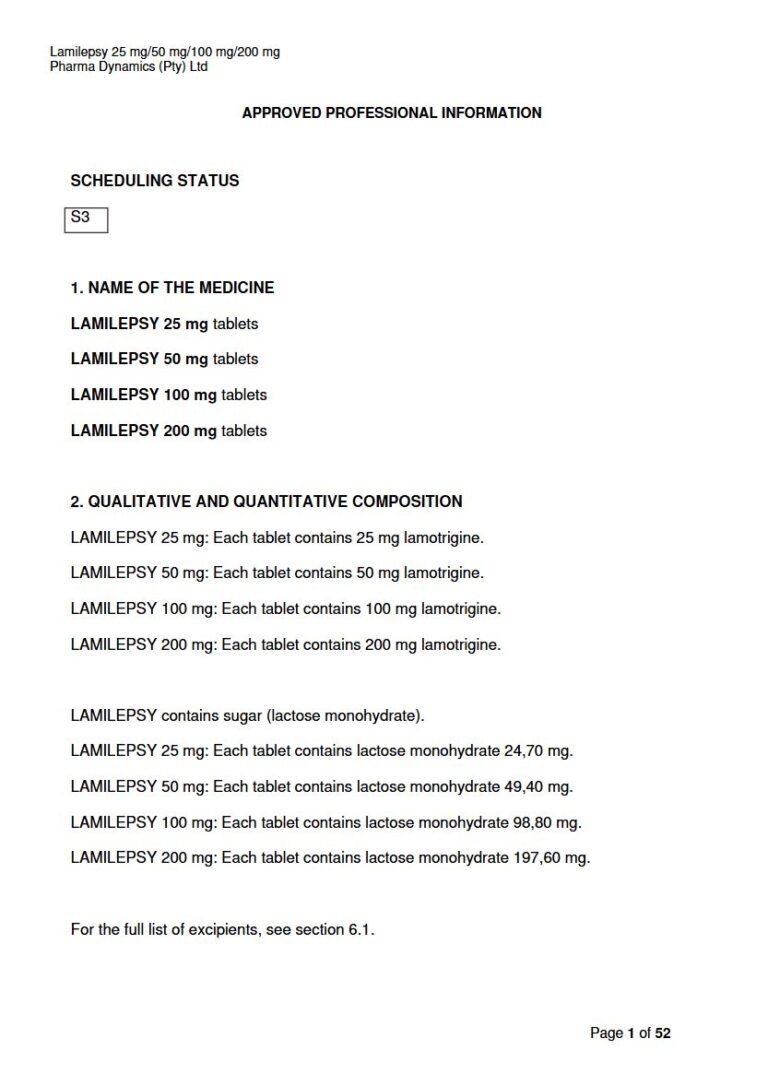
Lamilepsy 25 mg/50 mg/100 mg/200 mg Tablets.
PDF Leaflet Revision Date: 31 January 2025
Clinical Summary
Quick overview from the medicine insert
Indication
Monotherapy or add-on treatment for epilepsy and bipolar disorder.
Dosage (summary)
Adults: Start 25 mg daily, increase to 100-200 mg/day. Children: 0.6 mg/kg/day, max 400 mg.
Special Populations
- Elderly
- Hepatic impairment
- Renal impairment
Pregnancy & Breastfeeding
Use in pregnancy only if necessary; monitor levels. Caution in breastfeeding.
Key Drug Interactions
- Valproate increases lamotrigine levels
- Carbamazepine decreases lamotrigine levels
- Hormonal contraceptives may reduce efficacy
Contraindications
- Hypersensitivity to lamotrigine
Common side effects
- Rash
- Dizziness
- Nausea
- Headache
Counselling Points
- Monitor for rash and flu-like symptoms
- Do not abruptly discontinue
- Report any mood changes or suicidal thoughts
Serious warnings
- Risk of serious skin reactions
- Hemophagocytic lymphohistiocytosis (HLH)
- Suicidal ideation
Important Disclaimer
The Lamilepsy 25 mg/50 mg/100 mg/200 mg Tablets. professional information leaflet below is the property of Pharma Dynamics and is provided on Medinsert exactly as issued, with no.. alterations or editorial changes. We make every effort to keep content current by updating documents as soon as new versions become available. Medinsert serves as a trusted access point for healthcare professionals, but does not replace official sources or clinical judgement. For more details, please read our full disclaimer. read more>>
 Healthcare Professionals Only
This content is for registered healthcare professionals
Sign in or create a free account to read the full package insert.
Free for HPCSA-registered professionals. Powered by Medinsert.
Clinical Particulars
Section 4 of the official insert — extracted exactly as issued, no alterations
4.1 Therapeutic indications
Adults and children over 12 years
LAMILEPSY is indicated as monotherapy or add-on treatment of partial epilepsy with or without secondary generalised tonic-clonic seizures and in primary generalised tonic-clonic seizures.
Children 2 to 12 years
LAMILEPSY is indicated as add-on treatment of partial epilepsy with or without secondary generalised tonic-clonic seizures not satisfactorily controlled with other antiepileptic medicines. Monotherapy in children under 12 years of age is not recommended until such time as adequate information is made available from controlled trials in this particular target population.
Lennox-Gastaut Syndrome
LAMILEPSY is indicated as add-on treatment for seizures associated with Lennox-Gastaut Syndrome.
Bipolar disorder
Adults 18 years of age and over: LAMILEPSY is indicated for the prevention of mood episodes in patients with bipolar disorder, predominantly by preventing depressive episodes.
4.2 Posology and method of administration
Strictly adhere to the recommended dosages, especially in combination therapy with valproate where one-tenth to one-fifth of the normal LAMILEPSY dose is used. Do not exceed the maximum dosage (see section 4.4).
Epilepsy
When concomitant AEDs are withdrawn to achieve LAMILEPSY monotherapy or other AEDs/medicines are added-on to treatment regimens containing LAMILEPSY, consideration should be given to the effect this may have on lamotrigine pharmacokinetics (see section 4.5). To ensure a therapeutic dose is maintained, the weight of a child must be monitored and the dose reviewed if weight changes occur. If the doses calculated for children, according to bodyweight, do not equate to whole tablets, the dose to be administered is that equal to the lower number of whole tablets.
Dosage in epilepsy monotherapy
Adults and children over 12 years of age: Initial dose in monotherapy: 25 mg once daily for two weeks, followed by 50 mg once daily for two weeks. Thereafter, the dosage should be increased by a maximum of 50 mg u2013 100 mg every 1 u2013 2 weeks until the optimal response is achieved. Maintenance dose in monotherapy: The usual dose to achieve optimal response is 100 - 200 mg per day, given in one dose or two divided doses. Some patients have required 500 mg/day of LAMILEPSY to achieve the desired response.
Dosage in epilepsy add-on therapy
Adults and children over 12 years of age: In those patients taking concomitant AEDs or other medicines (see section 4.5) that induce lamotrigine glucuronidation with/without other AEDs (except valproate), the initial dose is 50 mg once a day for two weeks, then 100 mg a day, divided into two doses, for two weeks. The dosage may be increased by a maximum of 100 mg every 1 - 2 weeks until the optimal response is achieved. The usual maintenance dose is 200 - 400 mg/day given in two divided doses.
In those patients taking sodium valproate with/without any other AED, the initial LAMILEPSY dose is 25 mg once every other day for two weeks, then 25 mg once a day for two weeks. The dosage should be increased by a maximum of 25 - 50 mg a day every 1 to 2 weeks until the optimal response is achieved. The usual maintenance dose to achieve optimal response is 100 - 200 mg/day given once a day or in two divided doses.
In those patients taking oxcarbazepine 1 200 mg daily, without any other inducers or inhibitors of lamotrigine glucuronidation, the initial LAMILEPSY dose is 25 mg once a day for two weeks, followed by 50 mg once a day for two weeks. Thereafter, the dose should be increased by a maximum of 50 to 100 mg every one to two weeks until optimal response is achieved or a dose of 200 mg is reached. The usual maintenance dose to achieve an optimal response is 100 to 200 mg/day given once a day or as two divided doses.
Table 1: Recommended treatment regimen for adults over 12 years of age
Treatment regimen
- Monotherapy: 25 mg (once a day) for Weeks 1 + 2, 50 mg (once a day) for Weeks 3 + 4, Maintenance dose 100 - 200 mg (once a day or two divided doses).
- Add-on therapy with valproate: 12,5 mg (given as 25 mg on alternate days) for Weeks 1 + 2, 25 mg (once a day) for Weeks 3 + 4, Maintenance dose 100 - 200 mg (once a day or two divided doses).
- Add on therapy without valproate: 50 mg (once a day) for Weeks 1 + 2, 100 mg (two divided doses) for Weeks 3 + 4, Maintenance dose 200 - 400 mg (two divided doses).
Children aged 2 to 12 years: To ensure a therapeutic dose is maintained, the weight of a child must be monitored and the dose reviewed as weight changes occur. If the doses calculated for children, according to bodyweight, do not equate to whole tablets, the dose to be administered is that equal to the lower number of whole tablets.
In those patients taking concomitant AEDs or other medicines (see section 4.5) that induce lamotrigine glucuronidation with/without other AEDs (except valproate), the initial LAMILEPSY dose is 0,6 mg/kg body mass/day given in two divided doses for two weeks, followed by 1,2 mg/kg/day for two weeks. Thereafter, the dose should be increased by a maximum of 1,2 mg/kg every one to two weeks until the optimal response is achieved. The usual maintenance dose to achieve optimal response is 5 - 15 mg/kg/day given in two divided doses. A maximum daily dose of 400 mg must not be exceeded.
In those patients taking sodium valproate with/without any other AED, the initial LAMILEPSY dose is 0,15 mg/kg body mass/day given once a day for two weeks, followed by 0,3 mg/kg/day given once a day for two weeks. Thereafter, the dose should be increased by a maximum of 0,3 mg/kg every one to two weeks until the optimal response is achieved. The usual maintenance dose to achieve optimal response is 1 - 5 mg/kg/day given once a day or in two divided doses. A maximum daily dose of 200 mg must not be exceeded.
In patients taking oxcarbazepine without any inducers or inhibitors of lamotrigine glucuronidation, the initial LAMILEPSY dose is 0,3 mg/kg bodyweight/day given once a day or in two divided doses for two weeks, followed by 0,6 mg/kg/day given once a day or in two divided doses for two weeks. Thereafter, the dose should be increased by a maximum of 0,6 mg/kg every one to two weeks until an optimal response is achieved, or a dose of 200 mg is reached. The usual maintenance dose to achieve optimal response is 1 to 10 mg/kg/day given once a day or in two divided doses, with a maximum of 200 mg/day.
Table 2: Recommended treatment regimen for children aged 2 to 12 years (total daily dose in mg/kg bodyweight/day)**
Treatment regimen
- Add-on therapy with valproate: 0,15 mg/kg* (once a day) for Weeks 1 + 2, 0,3 mg/kg (once a day) for Weeks 3 + 4, 0,3 mg/kg increments every one to two weeks to achieve a maintenance dose of 1 - 5 mg/kg (once day or two divided doses) to a maximum of 200 mg/day.
- Add on therapy without valproate: 0,6 mg/kg (two divided doses) for Weeks 1 + 2, 1,2 mg/kg (two divided doses) for Weeks 3 + 4, 1,2 mg/kg increments every one to two weeks to achieve a maintenance dose of 5 - 15 mg/kg (once a day or two divided doses) to a maximum of 400 mg/day.
- With oxcarbazepine without inducers or inhibitors of lamotrigine glucuronidation: 0,3 mg/kg (once a day or two divided doses) for Weeks 1 + 2, 0,6 mg/kg (once a day or two divided doses) for Weeks 3 + 4, 0,6 mg/kg increments every one to two weeks to achieve a maintenance dose of 1 - 10 mg/kg (once a day or two divided doses) to a maximum of 200 mg/day.
Note: In patients taking AEDs where the pharmacokinetic interaction with lamotrigine is currently not known (see section 4.5), the treatment regimen as recommended for LAMILEPSY with concurrent valproate should be used. *If the calculated daily dose in patients taking valproate is 1 - 2 mg, then 2 mg LAMILEPSY may be taken on alternate days for the first two weeks. If the calculated daily dose is less than 1 mg, then LAMILEPSY should not be administered. **If the calculated dose of LAMILEPSY cannot be achieved using whole tablets, the dose should be rounded down to the nearest whole tablet. The recommended initial dose and subsequent dose escalation should not be exceeded to minimise the risk of skin rash (see section 4.4). Patients aged 2 - 6 years may require a maintenance dose at the higher end of the recommended range. Dosage in seizures associated with Lennox-Gastaut Syndrome: The dosing guidelines outlined above for both adults and children aged 2 - 12 years, apply for the treatment of seizures associated with Lennox-Gastaut Syndrome. Children aged less than 2 years: There is insufficient information on the use of LAMILEPSY in children aged less than two years. Therefore, LAMILEPSY is not recommended for use in children under the age of 2.
Bipolar disorder
Because of the risk of rash, the initial dose and subsequent dose escalation should not be exceeded (see section 4.4). LAMILEPSY is recommended for use in bipolar patients at risk for a future depressive episode. The following transition regimen should be followed to prevent recurrence of depressive episodes. The transition regimen involves escalating the dose of LAMILEPSY to a maintenance stabilisation dose over six weeks (see Table 3), after which other psychotropic and/or AEDs can be withdrawn, if clinically indicated (see Table 4).
4.3 Contraindications
LAMILEPSY is contraindicated in the following circumstances:
- Hypersensitivity to lamotrigine or to any of the excipients of LAMILEPSY (see section 6.1).
4.4 Special warnings and precautions for use
Hemophagocytic lymphohistiocytosis (HLH)
LAMILEPSY, containing lamotrigine, can cause a rare but very serious reaction called hemophagocytic lymphohistiocytosis (HLH) which can be life threatening. HLH excessively activates the bodyu2019s infection-fighting immune system and can cause severe inflammation throughout the body that may lead to hospitalisation and death. HLH typically presents as a persistent fever, usually greater than 38 u00b0C, and it can lead to severe problems with blood cells and organs throughout the body, such as the liver, kidneys, and lungs.
Symptoms occur generally within 4 weeks of treatment initiation. Early recognition and treatment are important for improving HLH outcomes and reducing mortality. Patients should be advised to seek medical attention if they experience symptoms of HLH. A diagnosis of HLH can be established if a patient presents with at least five of the following eight signs or symptoms: fever and rash, enlarged spleen, cytopenias, elevated levels of triglycerides or low blood levels of fibrinogen, high levels of blood ferritin, haemophagocytosis identified through bone marrow, spleen, or lymph node biopsy, decreased or absent Natural Killer (NK) cell activity and elevated blood levels of CD25 showing prolonged immune cell activation. LAMILEPSY should be discontinued unless an alternative aetiology can be established.
Cardiac Rhythm and Conduction Abnormalities
In vitro testing showed that lamotrigine, as in LAMILEPSY, exhibits Class IB antiarrhythmic activity at therapeutically relevant concentrations. It inhibits human cardiac sodium channels with rapid onset and offset kinetics and strong voltage dependence, consistent with other Class IB antiarrhythmic agents. Lamotrigine, as in LAMILEPSY, did not slow ventricular conduction (widen QRS) in healthy individuals in a thorough QT study; however, it could slow ventricular conduction and increase the risk of arrhythmia in people with structural heart disease or myocardial ischemia. Elevated heart rates could also increase the risk of ventricular conduction slowing with LAMILEPSY.
Based on this activity, lamotrigine, as in LAMILEPSY, could slow ventricular conduction (widen QRS) and induce proarrhythmia, including sudden death, in people with structural heart disease or myocardial ischemia. Therefore, avoid the use of LAMILEPSY in people who have cardiac conduction disorders (e.g., second- or third-degree heart block) ventricular arrhythmias, or cardiac disease or abnormality (e.g., myocardial ischemia, heart failure, structural heart disease, Brugada syndrome or other sodium channelopathies). Concomitant use of other sodium channel blockers may increase the risk of proarrhythmia.
Seizures
Severe convulsive seizures including status epilepticus may lead to rhabdomyolysis, multi-organ dysfunction and disseminated intravascular coagulation, usually with fatal outcome. Similar cases have occurred in association with the use of LAMILEPSY. Patients receiving LAMILEPSY should be closely monitored and changes in hepatic, renal and clotting parameters looked for. Patients should be warned to consult their doctor immediately if rashes or flu-like symptoms associated with hypersensitivity develop, especially within the first month of starting treatment with LAMILEPSY. Withdrawal of therapy should be considered if unexplained rashes, fever, flu-like symptoms, drowsiness or worsening of seizure control occur.
Dosage recommendations should not be exceeded to minimise the risk of developing rash, requiring withdrawal of therapy. Abrupt withdrawal of LAMILEPSY may provoke rebound seizures. The risk may be reduced by tapering off the withdrawal of LAMILEPSY over a period of two weeks.
Skin reactions
Adverse skin reactions have been reported, which have generally occurred within the first 8 weeks of starting LAMILEPSY. Although the majority of rashes usually resolve when LAMILEPSY is discontinued, irreversible scarring and cases of associated death have been reported. A mild rash may subside even with continuation of LAMILEPSY therapy, however, close monitoring is essential. Less frequently, serious and potentially life-threatening skin rashes including Stevens-Johnson syndrome, Drug Reaction with Eosinophilia and Systemic Symptoms (DRESS); also known as hypersensitivity syndrome (HSS) and toxic epidermal necrolysis have been reported, especially in children and in patients using valproate (see section 4.8). Isolated cases have been reported after prolonged treatment (6 months). The estimated incidence of serious skin rashes in adults is 1 in 1 000. The risk is higher in children than in adults. Some children may require hospitalisation because of the seriousness of skin rashes.
Clinical worsening and suicide risk
There is evidence that patients with bipolar disorder and with epilepsy, have an elevated risk for suicidality. This risk may continue during treatment. Suicidal ideation and behaviour have been reported in patients treated with anti-epileptic medicines (AEDs), including LAMILEPSY in several indications, including epilepsy and bipolar disorder. A meta-analysis of randomised placebo-controlled trials of AEDs (including LAMILEPSY) has also shown an increased risk of suicidal ideation and behaviour. The mechanism of this risk is not known. Patients should be monitored for signs of suicidal ideation and behaviours and appropriate treatment should be considered. Patients (and caregivers of patients) should be advised to seek medical advice should signs of suicidal ideation or behaviour emerge. The possibility of a suicide attempt is inherent in bipolar disorder, and close supervision of high-risk patients should accompany therapy with LAMILEPSY. Worsening of depressive symptoms and/or the emergence of suicidality may occur whether or not they are taking medicines for bipolar disorder, including lamotrigine. Therefore, patients taking LAMILEPSY for bipolar disorder should be closely monitored for clinical worsening (including development of new symptoms) and suicidality, especially at the beginning of a course of treatment, or at the time of dose changes. Certain patients, such as those with a history of suicidal behaviour or thoughts, young adults, and those patients exhibiting a significant degree of suicidal ideation prior to commencement of treatment, may be at a greater risk of suicidal thoughts or suicide attempts.
Patients (and caregivers of patients) should be alerted about the need to monitor for any worsening of their condition (including development of new symptoms) and/or the emergence of suicidal ideation/behaviour or thoughts of harming themselves and to seek medical advice immediately if these symptoms present. Consideration should be given to changing the therapeutic regimen, including possibly discontinuing LAMILEPSY, in patients who experience clinical worsening (including development of new symptoms) and/or the emergence of suicidal ideation/behaviour, especially if these symptoms are severe, abrupt in onset, or were not part of the patient's presenting symptoms.
4.5 Interactions with other medicines
Uridine 5u2019 -diphospho (UDP)-glucuronyl transferases (UGTs) have been identified as the enzymes responsible for metabolism of lamotrigine. Medicines that induce or inhibit glucuronidation may, therefore, affect the apparent clearance of lamotrigine. Strong or moderate inducers of the cytochrome P450 3A4 (CYP3A4) enzyme, which are also known to induce UGTs, may also enhance the metabolism of lamotrigine. There is no evidence that LAMILEPSY causes clinically significant induction or inhibition of hepatic oxidative drug-metabolising enzymes. LAMILEPSY may induce its own metabolism, but the effect is modest and unlikely to have significant clinical consequences.
Those medicines that have been demonstrated to have a clinically relevant impact on lamotrigine concentration are outlined in the table below. Specific dosing guidance for these medicines is provided in section 4.2. In addition, this table lists those medicines which have been shown to have little or no effect on the concentration of lamotrigine. Co-administration of such medicines would generally not be expected to result in any clinical impact. However, consideration should be given to patients whose epilepsy is especially sensitive to fluctuations in concentrations of lamotrigine.
Effects of medicines on the concentration of lamotrigine
Meds that increase the concentration of lamotrigine (doubling of lamotrigine half-life): Valproate
Meds that decrease the concentration of lamotrigine (halving lamotrigine half-life): Atazanavir/ritonavir*, Carbamazepine, Ethinyloestradiol/levonorgestrel combination **, Phenytoin, Phenobarbitone, Primidone, Rifampicin
Meds with little or no effect on the concentration of lamotrigine: Aripiprazole, Bupropion, Felbamate, Gabapentin, Oxcarbazepine, Lacosamide, Levetiracetam, Lithium, Olanzapine, Oxcarbazepine, Paracetamol, Perampanel, Topiramate, Pregabalin, Zonisamide
* For dosing guidance, refer to section 4.2 Special Populations
** Special Patient Populations, for women taking hormonal contraceptives also see section 4.4 u2013 Hormonal Contraceptives.
Interactions involving AEDs (see section 4.2)
Concomitant use of valproic acid significantly reduces the metabolism of lamotrigine and increases the half-life and plasma concentrations of lamotrigine, nearly two-fold, due to competition for hepatic glucuronidation. Plasma concentrations of valproic acid may decrease slightly when LAMILEPSY is added (see section 5.2).
Enzyme-inducing medicines (such as phenytoin, carbamazepine, phenobarbitone, primidone, rifampicin, lopinavir/ritonavir and atazanavir/ritonavir) significantly enhance the metabolism of LAMILEPSY leading to an increased clearance and subsequent reduction of the elimination half-life of lamotrigine, as in LAMILEPSY.
Central nervous system events including dizziness, ataxia, diplopia, blurred vision and nausea have been reported in patients taking carbamazepine following the introduction of lamotrigine, as in LAMILEPSY. On reduction of the dose of carbamazepine, these events usually resolve. Although a similar effect was observed during a study of lamotrigine and oxcarbazepine, dose reduction was not investigated.
Decreased lamotrigine levels have been reported when lamotrigine was given in combination with oxcarbazepine. However, in a prospective study in healthy adult volunteers using doses of 200 mg lamotrigine and 1200 mg oxcarbazepine, oxcarbazepine did not alter the metabolism of lamotrigine and lamotrigine did not alter the metabolism of oxcarbazepine. Therefore, the treatment regimen for lamotrigine adjunctive therapy without valproate and without inducers of lamotrigine glucuronidation should be used in patients receiving concomitant therapy with oxcarbazepine.
Co-administration of felbamate (1 200 mg twice daily) with lamotrigine (100 mg twice daily for 10 days) appeared to have no clinically relevant effects on the pharmacokinetics of lamotrigine in a study of healthy volunteers. Retrospective analysis of plasma levels in patients receiving lamotrigine both with and without gabapentin, indicates gabapentin does not appear to change the apparent clearance of lamotrigine. Evaluation of serum concentrations of both levetiracetam and lamotrigine, when taken concomitantly, indicate that lamotrigine does not influence the pharmacokinetics of levetiracetam and that levetiracetam does not influence the pharmacokinetics of lamotrigine. Steady-state trough plasma concentrations of lamotrigine were not affected by concomitant pregabalin (200 mg, 3 times daily) administration. There are no pharmacokinetic interactions between lamotrigine and pregabalin. Whilst topiramate resulted in no change in plasma concentrations of lamotrigine, administration of lamotrigine resulted in a 15 % increase in topiramate concentrations.
In a study of patients with epilepsy, co-administration of zonisamide (200 - 400 mg/day) with lamotrigine (150 - 500 mg/day) for 35 days had no significant effect on the pharmacokinetics of lamotrigine. Plasma concentrations of lamotrigine were not affected by concomitant lacosamide (200, 400, or 600 mg/day) in placebo-controlled clinical trials in patients with partial-onset seizures. In a pooled analysis of data from three placebo-controlled clinical trials investigating adjunctive perampanel in patients with partial-onset and primary generalised tonic-clonic seizures, the highest perampanel dose evaluated (12 mg/day) increased lamotrigine clearance by less than 10 %. An effect of this magnitude is not considered to be clinically relevant.
4.6 Fertility, pregnancy and lactation
The safety of LAMILEPSY in pregnancy and lactation has not been established.
Pregnancy
There is some evidence of an increased risk of oral cleft malformations following exposure to lamotrigine in pregnancy. The decision to use LAMILEPSY during pregnancy should be taken by the physician following assessment of the benefit / risk profile. A large amount of data on pregnant women exposed to lamotrigine monotherapy during the first trimester of pregnancy (more than 8700) do not suggest a substantial increase in the risk for major congenital malformations, including oral clefts. Animal studies have shown developmental toxicity.
If therapy with LAMILEPSY is considered necessary during pregnancy, the lowest possible therapeutic dose is recommended. Lamotrigine has a slight inhibitory effect on dihydrofolic acid reductase and could therefore theoretically lead to an increased risk of embryofoetal damage by reducing folic acid levels. Intake of folic acid when planning pregnancy and during early pregnancy may be considered.
Physiological changes during pregnancy may affect lamotrigine levels and/or therapeutic effect. There have been reports of decreased lamotrigine plasma levels during pregnancy with a potential risk of loss of seizure control. After birth, lamotrigine levels may increase rapidly with a risk of dose-related adverse events. Therefore, lamotrigine serum concentrations should be monitored before, during and after pregnancy, as well as shortly after birth. If necessary, the dose should be adapted to maintain the lamotrigine serum concentration at the same level as before pregnancy or adapted according to clinical response. In addition, dose-related undesirable effects should be monitored after birth.
Breastfeeding
The decision to breastfeed should be taken by the mother in consultation with the physician. The potential benefits of breast feeding should be weighed against the potential risk of adverse effects occurring in the infant. There is limited information on the use of LAMILEPSY in lactation. LAMILEPSY passes into breast milk in concentrations usually of the order of 40 % - 60 % of the serum concentration. In a small number of infants known to have been breastfed, the serum concentrations of lamotrigine reached levels at which pharmacological effects may occur.
4.7 Effects on ability to drive and use machines
LAMILEPSY may have a minor influence on the ability to perform tasks requiring concentration and coordination. LAMILEPSY has adverse events of a neurological character such as dizziness and diplopia. Therefore, patients should see how LAMILEPSY therapy affects them before driving or operating machinery.
4.8 Undesirable effects
Tabulated summary of adverse reactions
Epilepsy
System Organ Class
Frequency
Side effects
Blood and lymphatic system disorders
Less frequent
Frequency unknown
Blood dyscrasias including aplastic anaemia, eosinophilia, leucopenia, thrombocytopenia, agranulocytosis, neutropenia, red cell aplasia, pancytopenia
Bone marrow depression, septic shock, hemophagocytic lymphohistiocytosis (HLH)*, pseudolymphoma
Immune system disorders
Less frequent
Frequency unknown
Hypersensitivity syndrome, lymphadenopathy, disseminated intravascular coagulation, multi-organ failure
Hypogammaglobinaemia*
Psychiatric disorders
Frequent
Less frequent
Frequency unknown
Aggression, irritability
Hallucinations, tics, confusion
Nightmares*
Nervous system disorders
Frequent
Less frequent
Frequency unknown
Headache, insomnia, dizziness, drowsiness, tremor, coordination abnormalities, paraesthesia, vertigo
Ataxia
Anxiety, depression, amnesia, slurred speech, agitation, extrapyramidal effects, choreoathetosis, aseptic meningitis*, unsteadiness*, movement disorders*, worsening of the disease*, worsening of Parkinsonu2019s disease *, increase in seizure frequency in epilepsy only*
Eye disorders
Frequent
Less frequent
Frequency unknown
Vision abnormalities, blurred vision, diplopia
Nystagmus
Conjunctivitis*
Respiratory, thoracic and mediastinal disorders
Less frequent
Frequency unknown
Angioedema (trouble in breathing, swelling of face, mouth, hands or feet), rhinitis, apnoea, oesophagitis
Interstitial pneumonitis with pulmonary infiltrates
Gastrointestinal disorders
Frequent
Less frequent
Nausea, vomiting
Constipation, diarrhoea, dyspepsia
Hepatobiliary disorders
Less frequent
Increased liver function tests, hepatic failure, hepatic dysfunction
Skin and subcutaneous tissue disorders
Frequent
Less frequent
Frequency unknown
Severe skin rashes, skin rash
Stevens-Johnson syndrome, toxic epidermal necrolysis especially in children, erythema multiforme, Drug Reaction with Eosinophilia and Systemic Symptoms (DRESS)
Maculopapular skin rash, alopecia*
Musculoskeletal, connective tissue and bone disorders
Frequent
Less frequent
Frequency unknown
Arthralgia
Asthenia, pain, lupus-like reactions
Low bone mineral density and reduced bone formation, rhabdomyolysis, short-stature
Renal and urinary disorders
Frequency unknown
Tubulointerstitial nephritis*, tubulointerstitial nephritis and uveitis syndrome*
General disorders and administrative site conditions
Frequent
Less frequent
Unnatural weight loss, tiredness, back pain, dryness of the mouth
Fever, malaise, flu-like symptoms, photosensitivity
Bipolar disorder
The side effects below should be considered alongside those in epilepsy for an overall safety profile of LAMILEPSY.
System Organ Class
Frequency
Side effects
Nervous system disorders
Frequent
Headache, agitation, somnolence, dizziness
Skin and subcutaneous tissue disorders
Frequent
Skin rashes
Stevens-Johnson syndrome
Musculoskeletal, connective tissue and bone disorders
Frequent
Arthralgia
General disorders and administrative site conditions
Frequent
Pain, back pain
Reporting of suspected adverse reactions
Reporting suspected adverse reactions after authorisation of the medicine is important. It allows continued monitoring of the benefit/risk balance of the medicine. Healthcare professionals are asked to report any suspected adverse reactions to SAHPRA via the online service for adverse drug reaction reporting by following the link: https://www.sahpra.org.za/Publications/Index/8. An email can be sent directly to the company, [email protected], to ensure safety of the product.
4.9 Overdose
Signs and symptoms
Acute ingestion of doses in excess of 10 to 20 times the maximum therapeutic dose of LAMILEPSY has been reported, including fatal cases. Overdose has resulted in symptoms including nystagmus, ataxia, impaired consciousness, grand mal convulsion and coma. QRS broadening (intraventricular conduction delay) has also been observed in overdose patients. Broadening of QRS duration to more than 100 msec may be associated with more severe toxicity.
Management of overdose
In the event of overdosage, the patient should be admitted to hospital and given appropriate supportive therapy. Therapy aimed at decreasing absorption (activated charcoal) should be performed if indicated. Further management should be as clinically indicated. There is no experience with haemodialysis as treatment of overdose.
