
Levocetirizine 5 Mg Film-Coated Tablets
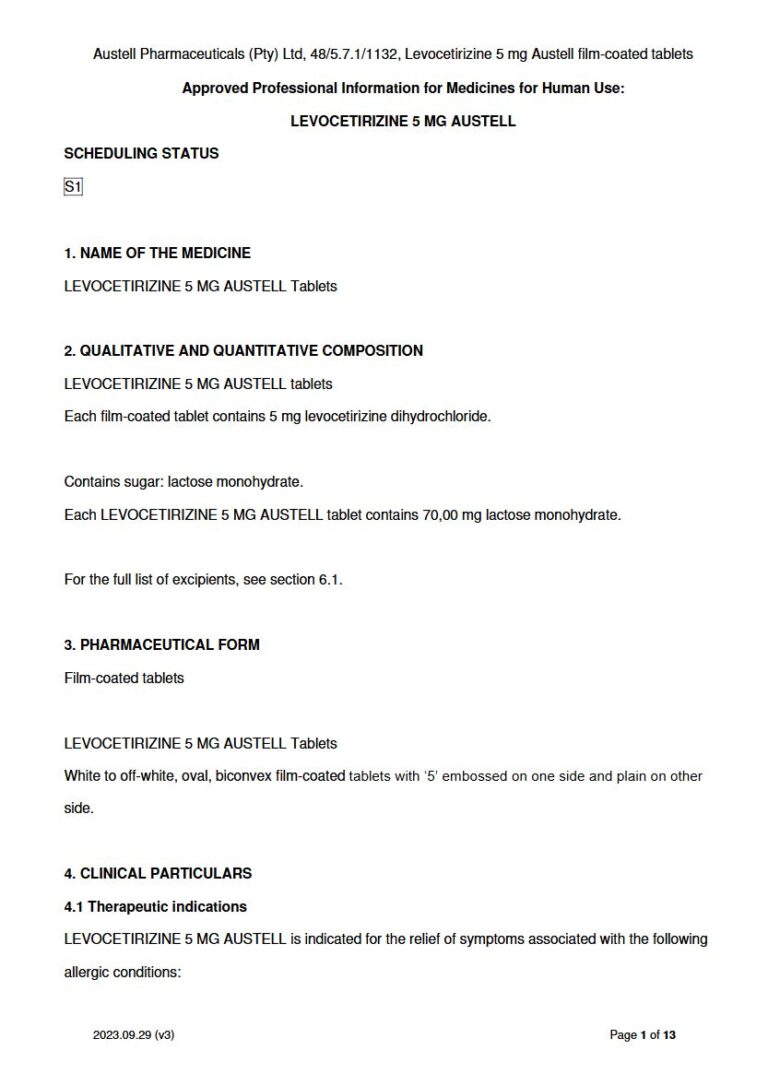
PDF Leaflet Revision Date: 29 September 2023
Clinical Summary
Quick overview from the medicine insert
Indication
Relief of symptoms associated with allergic rhinitis and chronic idiopathic urticaria.
Dosage (summary)
Adults and adolescents: 5 mg once daily. Adjust for renal impairment.
Onset of Action / Duration
Onset: 1 hour, Duration: 24 hours
Special Populations
- Elderly
- Renal impairment
- Hepatic impairment
Pregnancy & Breastfeeding
Contraindicated in pregnancy and breastfeeding.
Key Drug Interactions
- Alcohol
- CNS depressants
- Theophylline
- Ritonavir
Contraindications
- Hypersensitivity to levocetirizine
- Children < 2 years
- End-stage renal disease
Common side effects
- Somnolence
- Headache
- Dry mouth
- Pruritus
Counselling Points
- Take with or without food
- May cause drowsiness
- Avoid alcohol
Serious warnings
- Risk of urinary retention
- Caution in epilepsy
Important Disclaimer
The Levocetirizine 5 Mg Film-Coated Tablets professional information leaflet below is the property of Austell Pharmaceuticals and is provided on Medinsert exactly as issued, with no.. alterations or editorial changes. We make every effort to keep content current by updating documents as soon as new versions become available. Medinsert serves as a trusted access point for healthcare professionals, but does not replace official sources or clinical judgement. For more details, please read our full disclaimer. read more>>
 Healthcare Professionals Only
This content is for registered healthcare professionals
Sign in or create a free account to read the full package insert.
Free for HPCSA-registered professionals. Powered by Medinsert.
Clinical Particulars
Section 4 of the official insert — extracted exactly as issued, no alterations
4.1 Therapeutic indications
LEVOCETIRIZINE 5 MG AUSTELL is indicated for the relief of symptoms associated with the following allergic conditions:
- seasonal allergic rhinitis
- perennial allergic rhinitis
- chronic idiopathic urticaria.
4.2 Posology and method of administration
Posology
Adults and adolescents 12 years of age and older
The daily recommended dose is one 5 mg tablet.
Children
For children aged 2 - 6 years no adjusted dosage is possible with the film-coated tablet formulation.
Children aged 6 - 12 years: The daily recommended dose is one 5 mg tablet.
Special populations
Elderly
Adjustment of the dose is recommended in elderly patients with moderate to severe renal impairment (see u201cRenal impairmentu201d below).
Renal impairment
Adults with renal impairment: The dosing interval must be individualised according to renal function. Refer to the following table and adjust the dose as indicated. To use this dosing table, an estimate of the patient's creatinine clearance (Clcr) in mL/min is needed.
The Clcr (mL/min) may be estimated from serum creatinine (u03bcmol/L) determination using the following formula:
Clcr = [140 u2013 age (years)] x weight (kg) (x 0,85 for women)
Serum creatinine (u03bcmol/L)
Dosing adjustments for patients with impaired renal function:
| Group | Creatine clearance (mL/min) | Dosage and frequency |
|---|---|---|
| Normal | u2265 80 | 5 mg once daily |
| Mild | 50 u2013 79 | 5 mg once daily |
| Moderate | 30 u2013 49 | 5 mg once every 2 days |
| Severe | < 30 | 5 mg once every 3 days |
| End-stage renal disease u2013 patients undergoing dialysis | < 10 | Contraindicated |
Paediatric patients with renal impairment: The dose will have to be adjusted on an individual basis taking into account the renal clearance of the patient and his/her body weight. There are no specific data for children with renal impairment.
Hepatic impairment
No dose adjustment is needed in patients with solely hepatic impairment. In patients with hepatic impairment and renal impairment, adjustment of the dose is recommended (see u201cRenal impairmentu201d above)
Duration of use
Intermittent allergic rhinitis (symptoms 4 days/week or during more than 4 weeks), continuous therapy can be proposed to the patient during the period of exposure to allergens.
Method of administration
The film-coated tablet must be taken orally, swallowed with liquid and may be taken with or without food. It is recommended to take the daily dose in one single intake.
4.3 Contraindications
LEVOCETIRIZINE 5 MG AUSTELL is contraindicated:
- in hypersensitivity to levocetirizine, to any piperazine derivative or to any of the excipients listed in section 6.1.
- in infants and toddlers aged less than two years, as safety and efficacy have not been demonstrated
- during breastfeeding of infants and while pregnant (see section 4.6)
- in patients with end stage renal disease, at less than 10 mL/min creatinine clearance.
4.4 Special warnings and precautions for use
Alcohol
Precaution is recommended with concurrent intake of alcohol. LEVOCETIRIZINE 5 MG AUSTELL lacks significant sedative effects. Patients should, however, be warned that a small number of individuals may experience sedation. This effect may be compounded by the simultaneous intake of alcohol or other central nervous system depressants (see section 4.5).
Risk of urinary retention
Caution should be taken in patients with predisposing factors of urinary retention (e.g. spinal cord lesion, prostatic hyperplasia) as levocetirizine may increase the risk of urinary retention.
Epilepsy and convulsion risk patients
Caution should be taken in patients with epilepsy and patients at risk of convulsion as levocetirizine may cause seizure aggravation.
Allergy skin tests
Response to allergy skin tests are inhibited by antihistamines and a wash-out period (of 3 days) is required before performing them.
Pruritus
Pruritus may occur when levocetirizine is stopped even if those symptoms were not present before treatment initiation. The symptoms may resolve spontaneously. In some cases, the symptoms may be intense and may require treatment to be restarted. The symptoms should resolve when the treatment is restarted (see section 4.8).
Paediatric population
The use of the film-coated tablet formulation is not recommended in children aged less than 6 years since this formulation does not allow for appropriate dose adaptation. It is recommended to use a paediatric formulation of levocetirizine.
Excipients: lactose intolerance
This medicine contains lactose: Patients with rare hereditary problems of galactose intolerance, total lactase deficiency or glucose-galactose malabsorption should not take this medicine.
4.5 Interaction with other medicines and other forms of interaction
No interaction studies have been performed with levocetirizine (including no studies with CYP3A4 inducers); studies with the racemate compound cetirizine demonstrated that there were no clinically relevant adverse interactions (with antipyrine, azithromycin, cimetidine, diazepam, erythromycin, glipizide, ketoconazole and pseudoephedrine). A small decrease in the clearance of cetirizine (16 %) was observed in a multiple dose study with theophylline (400 mg once a day); while the disposition of theophylline was not altered by concomitant cetirizine administration.
In a multiple dose study of ritonavir (600 mg twice daily) and cetirizine (10 mg daily), the extent of exposure to cetirizine was increased by about 40 % while the disposition of ritonavir was slightly altered (-11 %) further to concomitant cetirizine administration.
The extent of absorption of levocetirizine is not reduced with food, although the rate of absorption is decreased. In sensitive patients, the concurrent administration of cetirizine or levocetirizine and alcohol or other CNS depressants may cause additional reductions in alertness and impairment of performance.
4.6 Fertility, pregnancy and lactation
Pregnancy
LEVOCETIRIZINE 5 MG AUSTELL is contraindicated in pregnancy as safety has not been demonstrated (see section 4.3).
Lactation
LEVOCETIRIZINE 5 MG AUSTELL is contraindicated in breastfeeding (see section 4.3). Levocetirizine is excreted in human milk.
Fertility
No clinical data are available.
4.7 Effects on ability to drive and use machines
Comparative clinical trials have revealed no evidence that levocetirizine at the recommended dose impairs mental alertness, reactivity or the ability to drive.
Nevertheless, some patients could experience somnolence, fatigue and asthenia under therapy with levocetirizine. Therefore, patients intending to drive, engage in potentially hazardous activities or operate machinery should take their response to the medicine into account.
4.8 Undesirable effects
a) Tabulated list of adverse reactions
The table below shows all adverse drug reactions (ADRs) observed during post-market spontaneous reports with Levocetirizine dihydrochloride.
| System Organ Class | Frequency | Frequent | Less Frequent | Not known |
|---|---|---|---|---|
| Immune system disorders | hypersensitivity including anaphylaxis, angioedema | |||
| Metabolism and nutrition disorders | increased appetite, increased weight | |||
| Psychiatric disorders | aggression, agitation, hallucination, depression, insomnia, suicidal ideation, nightmare | |||
| Nervous system disorders | headache, somnolence | convulsion, paraesthesia, dizziness, syncope, tremor, dysgeusia | ||
| Eye disorders | visual disturbances, blurred vision, oculogyration | |||
| Ear and labyrinth disorders | vertigo | |||
| Cardiac disorders | palpitations, tachycardia | |||
| Respiratory, thoracic and mediastinal disorders | dyspnoea | |||
| Gastrointestinal disorders | dry mouth | Gastrointestinal discomfort, abdominal pain | nausea, vomiting, diarrhoea | |
| Hepatobiliary disorders | hepatitis | |||
| Skin and subcutaneous tissue disorders | fixed drug eruption, pruritus, rash, urticaria | |||
| Musculoskeletal and connective tissue disorders | myalgia, arthralgia | |||
| Renal and urinary disorders | dysuria, urinary retention | |||
| General disorders and administration site conditions | oedema | |||
| Investigations | abnormal liver function tests. |
b) Description of selected adverse reactions
After levocetirizine discontinuation, pruritus has been reported (see section 4.4 above).
Reporting of suspected adverse reactions
Reporting suspected adverse reactions after authorisation of the medicine is important. It allows continued monitoring of the benefit/risk balance of the medicine. Health care providers are asked to report any suspected adverse reactions to SAHPRA via the u201c6.04 Adverse Drug Reaction Reporting Formu201d, found online under S AHPRAu2019s publications: https://www.sahpra.org.za/Publications/Index/8
4.9 Overdose
Symptoms
Symptoms of overdose may include drowsiness in adults. In children, agitation and restlessness may initially occur, followed by drowsiness.
Management of overdoses
There is no known specific antidote to LEVOCETIRIZINE 5 MG AUSTELL. Should overdose occur, symptomatic or supportive treatment is recommended. Levocetirizine is not effectively removed by haemodialysis.
