
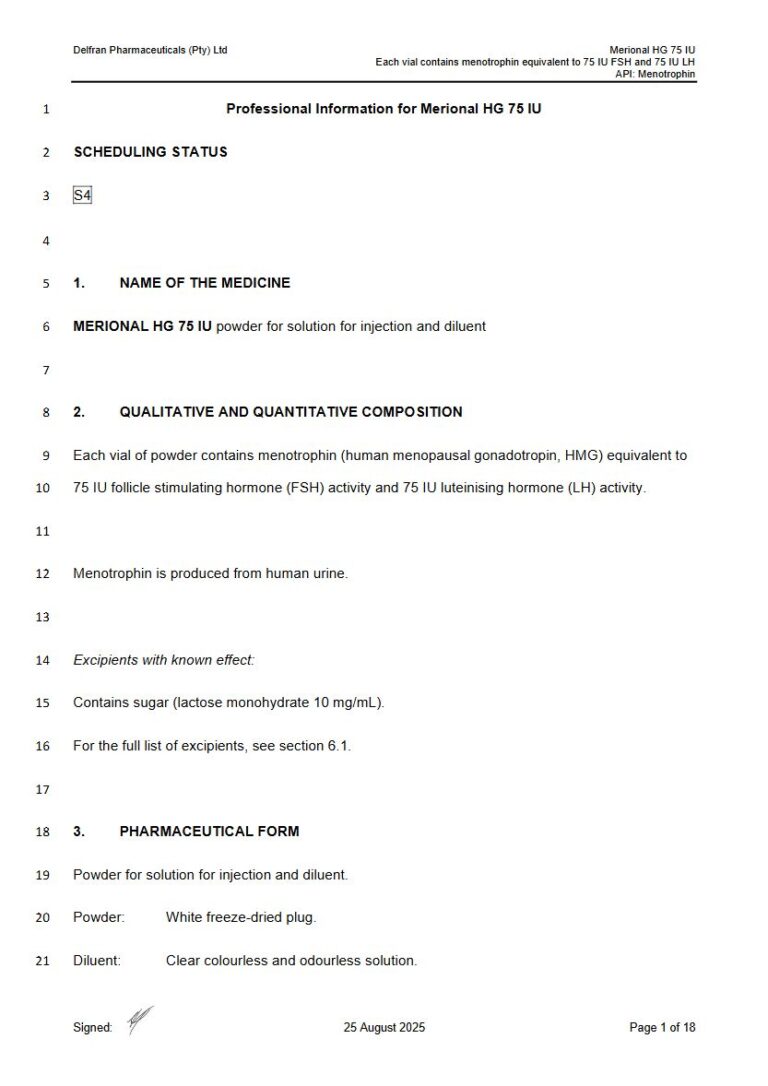
Merional Hg 75 IU Powder for solution for injection and diluent.
PDF Leaflet Revision Date: 25 August 2025
Clinical Summary
Quick overview from the medicine insert
Indication
Indicated for anovulation and stimulation of multifollicular development in assisted reproductive technologies.
Dosage (summary)
Start with 75-150 IU daily, max 225 IU; adjust based on response.
Special Populations
- Renal impairment
- Hepatic impairment
Pregnancy & Breastfeeding
Contraindicated in pregnancy and breastfeeding.
Key Drug Interactions
- Concomitant use with hCG or clomifene may potentiate response
- GnRH agonists may increase dosage needed
Contraindications
- Hypersensitivity to menotrophin
- Tumours of hypothalamus or pituitary
- Ovarian enlargement not due to PCOD
- Gynaecological haemorrhages of unknown cause
- Ovarian, uterine or mammary carcinoma
Common side effects
- Headache
- Abdominal pain
- Nausea
- Weight gain
- Ovarian cysts
Counselling Points
- Monitor for signs of OHSS
- Adhere to dosing regimen
- Discuss risks of multiple pregnancies
Serious warnings
- Risk of ovarian hyperstimulation syndrome (OHSS)
- Potential for multiple pregnancies
- Monitor for thromboembolic events
Important Disclaimer
The Merional Hg 75 IU Powder for solution for injection and diluent. professional information leaflet below is the property of Delfran Pharmaceuticals and is provided on Medinsert exactly as issued, with no.. alterations or editorial changes. We make every effort to keep content current by updating documents as soon as new versions become available. Medinsert serves as a trusted access point for healthcare professionals, but does not replace official sources or clinical judgement. For more details, please read our full disclaimer. read more>>
 Healthcare Professionals Only
This content is for registered healthcare professionals
Sign in or create a free account to read the full package insert.
Free for HPCSA-registered professionals. Powered by Medinsert.
Clinical Particulars
Section 4 of the official insert — extracted exactly as issued, no alterations
4.1 Therapeutic indications
MERIONAL HG is indicated for:
- Anovulation (including polycystic ovarian disease, PCOD) in women who have been unresponsive to treatment with clomifene citrate.
- Stimulation of multifollicular development in women undergoing assisted reproductive technologies (ART) such as in vitro fertilisation (IVF), gamete intrafallopian transfer (GIFT) and zygote intrafallopian transfer (ZIFT).
MERIONAL HG is indicated for use in adults only.
4.2 Posology and method of administration
Treatment with MERIONAL HG should be initiated under the supervision of a medical practitioner experienced in the treatment of fertility issues.
Posology
Women with anovulation (including PCOD):
The objective of treatment with MERIONAL HG is to develop a single mature Graafian follicle from which the ovum will be released after the administration of human chorionic gonadotrophin (hCG). MERIONAL HG may be given as a course of daily injections. In menstruating patients, treatment should be started within the first seven days of the menstrual cycle.
MERIONAL HG treatment should be adjusted to the individual patientu2019s response as assessed by measuring follicle size by ultrasound and/or oestrogen secretion. A commonly used regimen commences at 75 u2013 150 IU of MERIONAL HG and is increased according to the patientu2019s response. The maximum daily dose is usually not higher than 225 IU. If a patient fails to adequately respond after 4 weeks of treatment, the cycle should be abandoned and the patient should recommence at a higher initial dose than in the previous cycle.
When an ideal response is obtained a single injection of 5 000 u2013 10 000 IU of hCG should be administered 24 u2013 48 hours after the last MERIONAL HG injection. The patient should be recommended to have coitus on the hCG injection day and the following day. Alternatively, intrauterine insemination (IUI) may be performed. In the event of an excessive response treatment should be suspended and hCG withheld (see section 4.4). Treatment should recommence in the next cycle at a lower dose than in the previous cycle.
Women with anovulation resulting from severe LH and FSH deficiency:
In these women (hypogonadotrophic hypogonadism) the objective of treatment is to develop a single mature Graafian follicle from which the oocyte will be released following the administration of hCG. As these women are amenorrhoeic and have low endogenous oestrogen secretion, treatment may commence at any time.
The treatment should be adjusted to the individual patientu2019s response as assessed by measuring follicle size by ultrasound and/or oestrogen secretion. A commonly used regimen commences at 75 u2013 150 IU of MERIONAL HG and is increased according to the patientu2019s response. Should an increased dose of MERIONAL HG be deemed appropriate, dose adaptation should preferably be made after 7 u2013 14-day intervals and preferably by 150 IU increments. It may be acceptable to extend the duration of stimulation in any one cycle up to 5 weeks.
When an ideal response is obtained a single injection of 5 000 u2013 10 000 IU of hCG should be administered 24 u2013 48 hours after the last MERIONAL HG injection. The patient should be recommended to have coitus on the hCG injection day and the following day. Alternatively, IUI may be performed. Luteal support may be considered since lack of substances with luteotrophic activity (LH/hCG) after ovulation may lead to a premature loss of the corpus luteum.
In the event of an excessive response, treatment should be suspended and hCG withheld (see section 4.4). Treatment should recommence in the next cycle at a lower dose than in the previous cycle.
Women undergoing controlled ovarian stimulation for multiple follicular development prior to in vitro fertilisation or other assisted reproductive technologies:
A commonly used protocol for superovulation involves the administration of 150 u2013 225 IU of MERIONAL HG daily commencing on day 2 or 3 of the cycle and continued until sufficient follicular development has been achieved as assessed by monitoring serum oestrogen concentrations and/or ultrasound examination with the dose adjusted according to the patientu2019s response but usually not higher than 450 IU daily. Adequate follicular development is usually achieved by the tenth day of treatment (range 5 u2013 20 days).
A single injection of 5 000 u2013 10 000 IU of hCG should be administered 24 u2013 48 hours after the last MERIONAL HG injection to induce follicular maturation.
Pituitary down-regulation in order to suppress the endogenous LH surge and to control tonic levels of LH is now commonly achieved by administration of a gonadotrophin releasing hormone (GnRH) agonist. In a commonly used protocol, the administration of MERIONAL HG is started approximately two weeks after the start of agonist treatment, both being continued until adequate follicular development has been achieved. For example, following two weeks of pituitary down-regulation with an agonist, 150 u2013 225 IU. MERIONAL HG are administered for seven days; the dose is then adjusted according to the patientu2019s ovarian response.
Experience with ART indicates that in general the treatment success rate remains stable during the first four attempts and gradually declines thereafter.
Method of administration
MERIONAL HG can be administered either intramuscularly (IM) or subcutaneously (SC). MERIONAL HG should be inspected visually for particulate matter or discolouration prior to administration. MERIONAL HG powder should be reconstituted prior to use with the diluent provided and administered immediately after reconstitution (see section 6.6).
4.3 Contraindications
MERIONAL HG should not be administered to women who have:
- Hypersensitivity to menotrophin or to any of the excipients of MERIONAL HG (see section 6.1).
- Tumours of the hypothalamus or pituitary gland.
- Ovarian enlargement or a cyst not due to polycystic ovarian disease.
- Gynaecological haemorrhages of unknown cause.
- Ovarian, uterine or mammary carcinoma.
MERIONAL HG should not be used when an effective response cannot be achieved, such as:
- Primary ovarian failure.
- Malformation of sexual organs incompatible with pregnancy.
- Fibroid tumours of the uterus incompatible with pregnancy.
MERIONAL HG should not be used during pregnancy and lactation (see section 4.6). There is no relevant use of MERIONAL HG in the paediatric population, therefore MERIONAL HG should not be administered to children.
4.4 Special warnings and precautions for use
MERIONAL HG is a potent gonadotrophin capable of causing mild to severe adverse reactions and its use should only be supervised by medical practitioners who are thoroughly experienced with infertility problems and their management. To minimise the risks of ovarian hyperstimulation syndrome (OHSS) or of multiple pregnancies, ultrasound scans as well as oestradiol measurements are mandatory during treatment.
Gonadotrophin therapy requires a certain time commitment by medical practitioners and supportive health care providers, as well as the availability of appropriate monitoring facilities. Safe and effective use of MERIONAL HG calls for monitoring of ovarian response with ultrasound alone or preferably in combination with measurement of serum oestradiol levels on a regular basis. There is considerable interpatient variability in response to MERIONAL HG administration with a poor response in some cases. The lowest effective dose in relation to the treatment objective should be used.
Treatment:
Before starting treatment, the coupleu2019s infertility should be assessed as appropriate and putative contraindications for pregnancy evaluated. In particular, patients should be evaluated for hypothyroidism, adrenocortical deficiency, hyperprolactinaemia and pituitary or hypothalamic tumours, and appropriate specific treatment given.
Patients undergoing stimulation of follicular growth in ART procedures, may experience ovarian enlargement or develop hyperstimulation. Adherence to recommended dosage and regimen of MERIONAL HG administration and careful monitoring of therapy will minimise the incidence of such events. Accurate interpretation of the indices of follicular development and maturation requires a medical practitioner who is experienced in the interpretation of such data.
Ovarian hyperstimulation syndrome:
OHSS is a medical event distinct from uncomplicated ovarian enlargement. It is a syndrome that can manifest itself with increasing degrees of severity. It comprises marked ovarian enlargement, high serum sex steroids, and an increase in vascular permeability, pleural and rarely in pericardial cavities.
The following symptoms may be observed in severe cases of OHSS: abdominal pain, abdominal distension, severe ovarian enlargement, body mass gain, dyspnoea, oliguria and gastrointestinal symptoms including nausea, vomiting and diarrhoea. Clinical examination may reveal hypovolaemia, haemoconcentration, electrolyte imbalances, ascites, haemoperitoneum, pleural effusions, hydrothorax, acute pulmonary distress and thromboembolic events.
hCG used to trigger ovulation, may aggravate the ovarian hyperstimulation. Therefore, in cases of OHSS it is prudent to withhold hCG and to advise the patient to refrain from coitus or to use barrier methods for at least four days. OHSS may progress rapidly (within 24 hours to several days) to become a serious medical event, therefore patients should be followed for at least two weeks after hCG administration.
To minimise the risk of OHSS or of multiple pregnancy, ultrasound scans as well as oestradiol measurements are mandatory. In anovulation the risk of OHSS and multiple pregnancy is increased by a serum oestradiol > 900 pg/mL (3 300 pmol/L) and more than 3 follicles of 14 mm or more in diameter. In ART there is an increased risk of OHSS with a serum oestradiol > 3 000 pg/mL (11 000 pmol/L) and 20 or more follicles of 12 mm or more in diameter. When the oestradiol level is > 5 500 pg/mL (20 200 pmol/L) and where there are 40 or more follicles in total, it may be necessary to withhold hCG administration.
Adherence to recommended MERIONAL HG dosage, regimen of administration and careful monitoring of therapy will minimise the incidence of ovarian hyperstimulation and multiple pregnancy. In ART, aspiration of all follicles prior to ovulation may reduce the occurrence of hyperstimulation. OHSS may be more severe and more protracted if pregnancy occurs. Most often OHSS occurs after hormonal treatment has been discontinued and reaches its maximum at about 7 u2013 10 days following treatment. Usually, OHSS resolves spontaneously with the onset of menses.
If severe OHSS occurs, gonadotrophin treatment should be stopped if still ongoing, the patient hospitalised and specific therapy for OHSS started. This syndrome occurs with higher incidence in patients with polycystic ovarian disease.
Multiple pregnancy:
Multiple pregnancy, especially high order, carries an increased risk of adverse maternal and perinatal outcomes. In patients undergoing ovulation induction with MERIONAL HG the incidence of multiple pregnancies is increased as compared with natural conception. The majority of multiple conceptions are twins. To minimise the risk of multiple pregnancy, careful monitoring of ovarian response is recommended. In patients undergoing ART procedures the risk of multiple pregnancy is related mainly to the number of embryos replaced, their quality and the patientu2019s age. The patient should be advised of the potential risk of multiple births before starting treatment.
Pregnancy wastage:
The incidence of pregnancy wastage by miscarriage or abortion is higher in patients undergoing stimulation of follicular growth for ovulation induction or ART than in the normal population.
Ectopic pregnancy:
Women with a history of tubal disease are at risk of ectopic pregnancy. The prevalence of ectopic pregnancy after IVF is reported to be 2 u2013 5 % as compared to 1 u2013 1,5 % in the general population.
Neoplasms of the reproductive system:
There have been reports of ovarian and other reproductive system neoplasms, both benign and malignant in women who have undergone multiple medicine regimens for infertility treatment.
Congenital malformations:
The prevalence of congenital malformations after ART is higher than after spontaneous conceptions. This is thought to be due to differences in parental characteristics (e.g. maternal age, sperm characteristics) and multiple pregnancies.
Thromboembolic events:
In women with generally recognised risk factors for thromboembolic events, such as personal or family history or significant obesity, treatment with gonadotrophins may further increase the risk.
MERIONAL HG contains lactose monohydrate Patients with rare hereditary problems of galactose intolerance total lactase deficiency or glucose-galactose malabsorption should not use MERIONAL HG.
4.5 Interaction with other medicines and other forms of interaction
Concomitant use of MERIONAL HG with other medicines used to stimulate ovulation (e.g. hCG, clomifene citrate) may potentiate the follicular response.
Concurrent use of GnRH agonists to induce pituitary suppression may increase the dosage of MERIONAL HG needed to elicit an adequate ovarian response. MERIONAL HG should not be administered as a mixture with other medicines in the same injection (see section 6.4).
4.6 Fertility, pregnancy and lactation
Pregnancy
MERIONAL HG should not be administered during pregnancy (see section 4.3). In case of exposure during pregnancy clinical data are insufficient to exclude a teratogenic effect.
Breastfeeding
MERIONAL HG should not be used during breastfeeding (see section 4.3). During lactation the secretion of prolactin can entail a poor response to ovarian stimulation.
Fertility
MERIONAL HG is indicated for use in infertility (see section 4.1).
4.7 Effects on ability to drive and use machines
No studies on the effects on the ability to drive and use machines have been performed. However, MERIONAL HG may cause dizziness, and this may affect the patientu2019s ability to drive and use machines. Symptoms associated with OHSS may also impair the patientu2019s ability to drive or to use machines.
4.8 Undesirable effects
Immune system disorders:
Less frequent: Systemic allergic reactions including symptoms such as erythema, rash or facial swelling.
Nervous system disorders:
Frequent: Headache.
Less frequent: Dizziness.
Vascular disorders:
Less frequent: Thromboembolism.
Gastrointestinal disorders:
Frequent: Abdominal pain, nausea, vomiting, diarrhoea, abdominal cramps, bloating.
Skin and subcutaneous tissue disorders:
Frequent: Acne.
Reproductive system and breast disorders:
Frequent: Ovarian cysts, OHSS (for symptoms associated with OHSS see section 4.4 u2013 Ovarian hyperstimulation).
Less frequent: Ovarian torsion.
General disorders and administration site conditions:
Frequent: Weight gain and injection site reaction including symptoms such as pain, redness, bruising, swelling and/or irritation at the site of injection.
Reporting of suspected adverse reactions
Reporting suspected adverse reactions after authorisation of MERIONAL HG is important. It allows continued monitoring of the benefit/risk balance of the medicine. Health care providers are requested to report any suspected adverse drug reactions to SAHPRA via the Med Safety App (Medsafety X SAHPRA) and eReporting platform (who- umc.org) found on SAHPRAu2019s website.
4.9 Overdose
For symptoms associated with OHSS see section 4.4 u2013 Ovarian hyperstimulation.
