
Methylphenidate Biotech 10 10 mg Tablets.
PDF Leaflet Revision Date: 06 March 2025
Clinical Summary
Quick overview from the medicine insert
Indication
ADHD in children 6+ years and narcolepsy in adults.
Dosage (summary)
Start with 5 mg once or twice daily for ADHD; narcolepsy average 20-30 mg daily.
Special Populations
- Elderly
- Hepatic impairment
- Renal impairment
- Children under 6 years
Pregnancy & Breastfeeding
Contraindicated in pregnancy and lactation.
Key Drug Interactions
- MAO inhibitors
- Alcohol
- Serotonergic medicines
- Antihypertensives
Contraindications
- Hypersensitivity to methylphenidate
- Severe depression
- Cardiovascular disorders
- Psychotic disorders
- Bipolar disorder
Common side effects
- Insomnia
- Anorexia
- Headache
- Dizziness
- Hypertension
Counselling Points
- Monitor for cardiovascular symptoms
- Avoid alcohol
- Regularly assess growth in children
- Report any new psychiatric symptoms
Serious warnings
- Risk of sudden death in patients with cardiac abnormalities
- Potential for abuse and dependence
- Emergence of psychiatric symptoms
Important Disclaimer
The Methylphenidate Biotech 10 10 mg Tablets. professional information leaflet below is the property of Biotech Laboratories and is provided on Medinsert exactly as issued, with no.. alterations or editorial changes. We make every effort to keep content current by updating documents as soon as new versions become available. Medinsert serves as a trusted access point for healthcare professionals, but does not replace official sources or clinical judgement. For more details, please read our full disclaimer. read more>>
 Healthcare Professionals Only
This content is for registered healthcare professionals
Sign in or create a free account to read the full package insert.
Free for HPCSA-registered professionals. Powered by Medinsert.
Clinical Particulars
Section 4 of the official insert — extracted exactly as issued, no alterations
4.1 Therapeutic indications
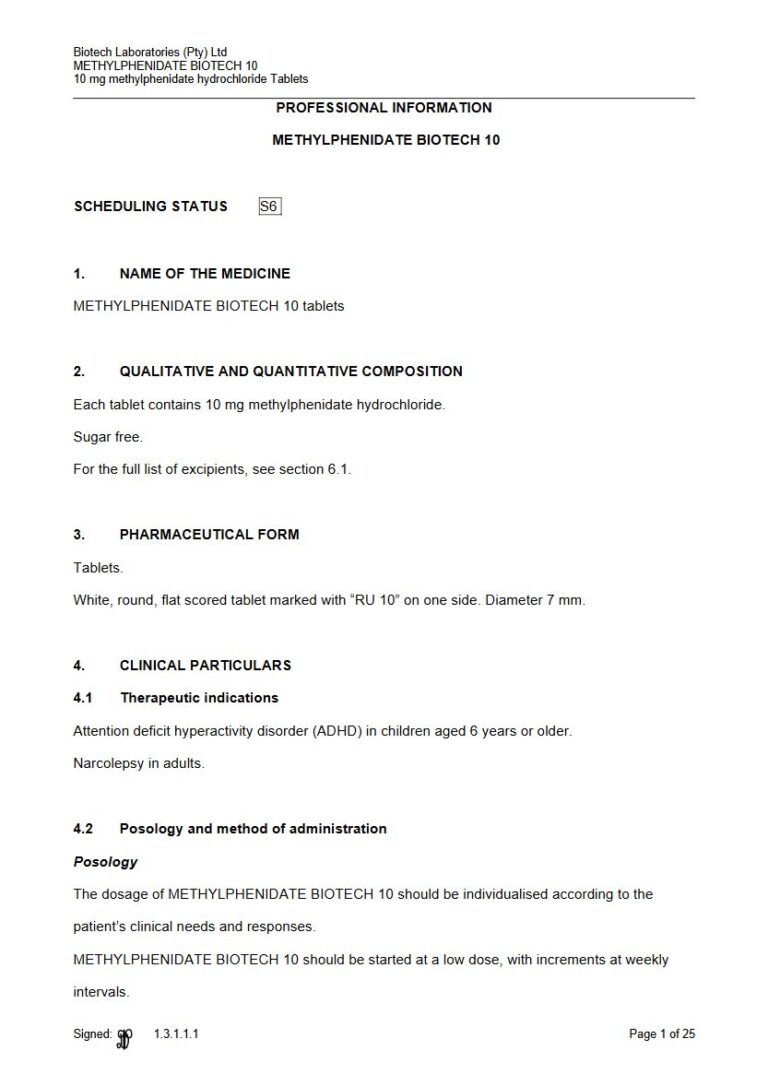
Attention deficit hyperactivity disorder (ADHD) in children aged 6 years or older. Narcolepsy in adults.
4.2 Posology and method of administration
Posology
The dosage of METHYLPHENIDATE BIOTECH 10 should be individualised according to the patientu2019s clinical needs and responses. METHYLPHENIDATE BIOTECH 10 should be started at a low dose, with increments at weekly intervals. Daily doses above 60 mg are not recommended for the treatment of narcolepsy in adults, or for the treatment of ADHD in children. Effective doses in adults may vary, and range from 40 mg u2013 80 mg per day. If improvement is not observed after appropriate dosage adjustment over a one-month period, METHYLPHENIDATE BIOTECH 10 should be discontinued. If paradoxical aggravation of symptoms or other adverse effects occur, METHYLPHENIDATE BIOTECH 10 should be discontinued.
Pre-treatment screening
Before initiating METHYLPHENIDATE BIOTECH 10 treatment, patients should be assessed for pre-existing cardiovascular and psychiatric disorders and a family history of sudden death, ventricular dysrhythmia and psychiatric disorders (see sections 4.3 and 4.4).
NARCOLEPSY: The average dosage is 20 to 30 mg daily, given in 2 to 3 divided doses. Some patients may require 40 to 60 mg daily. In others, 10 to 15 mg daily will be adequate. Patients who are unable to sleep if METHYLPHENIDATE BIOTECH 10 is taken late in the day should take the last dose before 6 p.m. (18:00). A total daily dose of 60 mg should not be exceeded.
Periodic assessment of the treatment in ADHD
Medicine treatment should not and need not be indefinite. METHYLPHENIDATE BIOTECH 10 should be periodically discontinued to assess the patientu2019s condition. Improvement may be sustained when the medicine is either temporarily or permanently discontinued. When used in children with ADHD, METHYLPHENIDATE BIOTECH 10 can usually be discontinued after puberty.
ADHD: Children and adolescents (6 years and older): Start with 5 mg once or twice daily (before breakfast and lunch) with gradual increments of 5 to 10 mg weekly. The total daily dose should be administered in divided doses. Daily dosage above 60 mg is not recommended.
Special populations
Elderly
Safety and efficacy have not been established in patients over 60 years of age.
Hepatic impairment
METHYLPHENIDATE BIOTECH 10 has not been studied in patients with hepatic impairment. Caution should be exercised in these patients.
Renal impairment
METHYLPHENIDATE BIOTECH 10 has not been studied in patients with renal impairment. Caution should be exercised in these patients.
Paediatric population
Children under 6 years of age
METHYLPHENIDATE BIOTECH 10 is not indicated in children less than six years of age.
Method of administration
METHYLPHENIDATE BIOTECH 10 is for oral administration and can be taken with or without food.
4.3 Contraindications
- Known hypersensitivity to methylphenidate or to any of the excipients of METHYLPHENIDATE BIOTECH 10 (see section 6.1).
- Anxiety, tension, agitation, a family history or diagnosis of Touretteu2019s syndrome, hyperthyroidism or thyrotoxicosis, glaucoma, phaeochromocytoma.
- Diagnosis or history of severe depression, anorexia nervosa/anorexic disorders, suicidal tendencies, psychotic symptoms, severe mood disorders, mania, schizophrenia, psychopathic/borderline personality disorder.
- Diagnosis or history of severe and episodic (Type 1) Bipolar (affective) disorder (that is not well controlled).
- Pre-existing cardiovascular disorders, including hypertension, angina, arterial occlusive disease; heart failure, haemodynamically significant congenital heart disease, cardiomyopathies, myocardial infarction, potentially life-threatening dysrhythmias, channelopathies (disorders caused by the dysfunction of ion channels) and QT prolongation either congenital, familial or caused by medicine (see section 4.4).
- During treatment with monoamine oxidase (MAO) inhibitors, or within a minimum of 2 weeks of discontinuing those medicines, due to risk of hypertensive crisis (see section 4.5).
- Pregnancy and lactation (see section 4.6).
- Pre-existing cerebrovascular disorders, cerebral aneurysm, vascular abnormalities including vasculitis or stroke or known risk factors for cerebrovascular disorders.
4.4 Special warnings and precautions for use
General
Methylphenidate treatment is not indicated in all children with ADHD and the decision to use METHYLPHENIDATE BIOTECH 10 must be based on a very thorough assessment of the severity and chronicity of the child's symptoms in relation to the child's age, and not simply on the presence of one or more abnormal behavioural characteristics. METHYLPHENIDATE BIOTECH 10 should not be used for the treatment of attention deficit or hyperactivity secondary to amenable causes, including acute stress reactions.
Long-term use (more than 12 months) in children and adolescents
The safety and efficacy of long-term use of methylphenidate, as contained in METHYLPHENIDATE BIOTECH 10, have not been systematically evaluated in controlled trials. METHYLPHENIDATE BIOTECH 10 treatment should not and need not be indefinite. Methylphenidate treatment is usually discontinued after puberty (see section 4.2). Patients on long-term therapy (i.e. over 12 months) must have careful ongoing monitoring according to the guidance in sections 4.2 and 4.4 for cardiovascular status, growth, appetite, development of de novo or worsening of pre-existing psychiatric disorders. Psychiatric disorders to monitor for are described below and include (but are not limited to) motor or vocal tics, aggressive or hostile behaviour, agitation, anxiety, depression, psychosis, mania, delusions, irritability, lack of spontaneity, withdrawal and excessive perseveration. The medical practitioner who elects to use methylphenidate as contained in METHYLPHENIDATE BIOTECH 10 for extended periods (over 12 months) in children and adolescents with ADHD should periodically re-evaluate the long term usefulness of the medicine for the individual patient with trial periods off the medicine to assess the patient's functioning without pharmacotherapy. It is recommended that methylphenidate is de-challenged at least once yearly to assess the child's condition (preferably during times of school holidays). Improvement may be sustained when the medicine is either temporarily or permanently discontinued.
Use in adults with ADHD
METHYLPHENIDATE BIOTECH 10 is not indicated for use in adults with ADHD. Safety and efficacy have not yet been established in this age group.
Use in the elderly
Methylphenidate should not be used in the elderly. Safety and efficacy have not been established in patients over 60 years of age.
Use in children under 6 years of age
METHYLPHENIDATE BIOTECH 10 is not indicated in children less than six years of age.
Cardiovascular conditions
METHYLPHENIDATE BIOTECH 10 is contraindicated in patients with hypertension. METHYLPHENIDATE BIOTECH 10 increases heart rate and systolic and diastolic blood pressure. Therefore, caution is indicated in treating patients whose underlying medical conditions might be compromised by increases in blood pressure or heart rate, e.g. those with pre-existing hypertension and severe cardiovascular disorders (see section 4.3). Blood pressure should be monitored at appropriate intervals in all patients taking METHYLPHENIDATE BIOTECH 10. Blood pressure and pulse should be recorded on a centile chart at each adjustment of dose and then at least every 6 months. Patients who develop symptoms such as palpitations, exertional chest pain, unexplained syncope, dyspnoea or other symptoms suggestive of cardiac disease during METHYLPHENIDATE BIOTECH 10 treatment should undergo a prompt cardiac evaluation.
Sudden death and pre-existing cardiac structural abnormalities or other serious cardiac disorders
Sudden death has been reported in association with the use of stimulants of the central nervous system at usual doses in children, some of whom had structural cardiac abnormalities or other serious heart problems. Although some serious heart problems alone may carry an increased risk of sudden death, METHYLPHENIDATE BIOTECH 10 is not recommended in patients with known cardiac structural abnormalities, cardiomyopathy, serious heart rhythm abnormalities, or other serious cardiac problems that may place them at increased vulnerability to the sympathomimetic effects of a stimulant medicine. Before initiating METHYLPHENIDATE BIOTECH 10 treatment, patients should have a careful history (including assessment for a family history of sudden cardiac or unexplained death or malignant dysrhythmia) and physical exam to assess for the presence of cardiac disease, and should receive further specialist cardiac evaluation if initial findings suggest such history or disease.
Misuse and cardiovascular events
Misuse of stimulants of the central nervous system, such as METHYLPHENIDATE BIOTECH 10, may be associated with sudden death and other serious cardiovascular adverse events.
Cerebrovascular disorders
Patients with pre-existing central nervous system (CNS) abnormalities, e.g. cerebral aneurysm and/or other vascular abnormalities such as vasculitis or pre-existing stroke should not be treated with METHYLPHENIDATE BIOTECH 10. Patients with additional risk factors (such as a history of cardiovascular disease, concomitant medicines that elevate blood pressure) should be assessed at every visit for neurological signs and symptoms after initiating treatment with METHYLPHENIDATE BIOTECH 10. Cerebral vasculitis appears to be a very rare idiosyncratic reaction to methylphenidate exposure. There is little evidence to suggest that patients at higher risk can be identified and the initial onset of symptoms may be the first indication of an underlying clinical problem. Early diagnosis, based on a high index of suspicion, may allow the prompt withdrawal of METHYLPHENIDATE BIOTECH 10 and early treatment. The diagnosis should therefore be considered in any patient who develops new neurological symptoms that are consistent with cerebral ischaemia during METHYLPHENIDATE BIOTECH 10 therapy. These symptoms could include severe headache, numbness, weakness, paralysis, and impairment of coordination, vision, speech, language or memory. Treatment with METHYLPHENIDATE BIOTECH 10 is not contraindicated in patients with hemiplegic cerebral palsy.
Psychiatric disorders
Co-morbidity of psychiatric disorders in ADHD is common and should be taken into account when prescribing METHYLPHENIDATE BIOTECH 10. Prior to initiating treatment with METHYLPHENIDATE BIOTECH 10, patients should be assessed for pre-existing psychiatric disorders and a family history of psychiatric disorders (see section 4.2). Treatment of ADHD with METHYLPHENIDATE BIOTECH 10 should not be initiated in patients with acute psychosis, acute mania or acute suicidality. These acute conditions should be treated and controlled before ADHD treatment is considered. In the case of emergent psychiatric symptoms or exacerbation of pre-existing psychiatric disorders, methylphenidate should not be given unless the benefits outweigh the risks to the patient. Development or worsening of psychiatric disorders should be monitored at every adjustment of dose, then at least every 6 months, and at every visit; discontinuation of treatment may be appropriate.
Exacerbation of pre-existing psychotic or manic symptoms
In psychotic patients, administration of METHYLPHENIDATE BIOTECH 10 may exacerbate symptoms of behavioural disturbance and thought disorder.
Emergence of new psychotic or manic symptoms
Treatment-emergent psychotic symptoms (visual/tactile/auditory hallucinations and delusions) or mania in patients without prior history of psychotic illness or mania can be caused by METHYLPHENIDATE BIOTECH 10 at usual doses. If manic or psychotic symptoms occur, consideration should be given to a possible causal role for methylphenidate and discontinuation of treatment may be appropriate.
Aggressive or hostile behaviour
The emergence or worsening of aggression or hostility can be caused by treatment with stimulants. Patients treated with METHYLPHENIDATE BIOTECH 10 should be closely monitored for the emergence or worsening of aggressive behaviour or hostility at treatment initiation, at every dose adjustment and then at least every 6 months or every visit. Medical practitioners should evaluate the need for adjustment of the treatment regimen in patients experiencing behavioural changes, bearing in mind that upwards or downwards titration may be appropriate. Treatment interruption can be considered.
Suicidal tendency
Patients with emergent suicidal ideation or behaviour during treatment for ADHD should be evaluated immediately by their medical practitioner. Consideration should be given to the exacerbation of an underlying psychiatric condition and to a possible causal role of METHYLPHENIDATE BIOTECH 10 treatment. Treatment of an underlying psychiatric condition may be necessary, and consideration should be given to a possible discontinuation of METHYLPHENIDATE BIOTECH 10.
Tics
Methylphenidate is associated with the onset or exacerbation of motor and verbal tics. Worsening of Tourette's syndrome has also been reported. Family history should be assessed and clinical evaluation for tics or Tourette's syndrome in children should precede use of METHYLPHENIDATE BIOTECH 10. Patients should be regularly monitored for the emergence or worsening of tics during treatment with METHYLPHENIDATE BIOTECH 10.
Anxiety, agitation or tension
METHYLPHENIDATE BIOTECH 10 is associated with the worsening of pre-existing anxiety, agitation or tension. METHYLPHENIDATE BIOTECH 10 is contraindicated in patients suffering from these conditions (see section 4.3).
4.5 Interaction with other medicines and other forms of interaction
It is not known how methylphenidate, as contained in METHYLPHENIDATE BIOTECH 10, may affect plasma concentrations of concomitantly administered medicines. Therefore, caution is recommended at combining METHYLPHENIDATE BIOTECH 10 with other medicines, especially those with a narrow therapeutic window.
Pharmacokinetic interactions
Methylphenidate is not metabolised by cytochrome P450 to a clinically relevant extent. Inducers or inhibitors of cytochrome P450 are not expected to have any relevant impact on methylphenidate pharmacokinetics. Conversely, the d- and I-enantiomers of methylphenidate do not relevantly inhibit cytochrome P450 1A2, 2C8, 2C9, 2C19, 2D6, 2E1 or 3A. However, there are reports indicating that methylphenidate, as contained in METHYLPHENIDATE BIOTECH 10, may inhibit the metabolism of coumarin anticoagulants, anticonvulsants (e.g. phenobarbital, phenytoin, primidone), and some antidepressants (tricyclic and selective serotonin reuptake inhibitors). When starting and stopping treatment with METHYLPHENIDATE BIOTECH 10, it may be necessary to adjust the dosage of these medicines that are already being taken and establish plasma concentrations (or for coumarin, coagulation times). METHYLPHENIDATE BIOTECH 10 coadministration did not increase plasma concentrations of the CYP2D6 substrate desipramine.
Pharmacodynamic interactions
Anti-hypertensive medicines
Methylphenidate may decrease the effectiveness of medicines used to treat hypertension.
Use with medicines that elevate blood pressure
Caution is advised in patients being treated with METHYLPHENIDATE BIOTECH 10 with other medicines that can also elevate blood pressure (see also sections on cardiovascular and cerebrovascular conditions in section 4.4). Because of possible hypertensive crisis, METHYLPHENIDATE BIOTECH 10 is contraindicated in patients being treated (currently or within the preceding 2 weeks) with MAO inhibitors (see section 4.3).
Use with alcohol
Alcohol may exacerbate the adverse CNS effects of psychoactive medicines, including METHYLPHENIDATE BIOTECH 10. It is therefore advisable for patients to abstain from alcohol during treatment.
Use with anaesthetics
There is a risk of sudden blood pressure and heart rate increase during surgery. If surgery is planned, treatment with METHYLPHENIDATE BIOTECH 10 should not be used on the day of surgery.
Use with centrally acting alpha-2 agonists (e.g. clonidine or dexmedetomidine)
Serious adverse events including sudden death may occur in concomitant use with clonidine or dexmedetomidine.
Use with dopaminergic medicines
Caution is recommended when administering METHYLPHENIDATE BIOTECH 10 with dopaminergic medicines, including antipsychotics. Because a predominant action of methylphenidate is to increase extracellular dopamine levels, METHYLPHENIDATE BIOTECH 10 may be associated with pharmacodynamic interactions when co-administered with direct and indirect dopamine agonists (including DOPA and tricyclic antidepressants) or with dopamine antagonists including antipsychotics.
4.6 Fertility, pregnancy and lactation
Pregnancy
METHYLPHENIDATE BIOTECH 10 is contraindicated during pregnancy (see section 4.3). There is a limited amount of data from the use of methylphenidate, as contained in METHYLPHENIDATE BIOTECH 10, in pregnant women.
Breastfeeding
METHYLPHENIDATE BIOTECH 10 is contraindicated during lactation as safety has not been demonstrated (see section 4.3). Mothers taking METHYLPHENIDATE BIOTECH 10 should not breastfeed their infants. Methylphenidate, as contained in METHYLPHENIDATE BIOTECH 10, has been found in breast milk of women treated with methylphenidate.
Fertility
No human data exists regarding the effect of methylphenidate on fertility. No clinically relevant effects on fertility have been observed in animal studies.
4.7 Effects on ability to drive and use machines
METHYLPHENIDATE BIOTECH 10 may cause dizziness, drowsiness and visual disturbances including difficulties with accommodation, diplopia and blurred vision (see section 4.8). It may have a moderate influence on the ability to drive and use machines. Patients should be warned of these possible effects and advised that if affected, they should avoid potentially hazardous activities such as driving a vehicle or operating machinery.
4.8 Undesirable effects
Infections and infestations
Frequent: nasopharyngitis
Less frequent: gastroenteritis
Blood and lymphatic disorders
Less frequent: anaemia, leucopenia, thrombocytopenia, thrombocytopenic purpura
Frequency unknown: pancytopenia
Immune system disorders
Less frequent: hypersensitivity reactions such as angioneurotic oedema, anaphylactic reactions, auricular swelling, bullous conditions, exfoliative conditions, urticaria, pruritis, rashes and eruptions
Metabolism and nutritional disorders*
Frequent: anorexia, decreased appetite, moderately reduced body mass and height gain during prolonged use in children
Psychiatric disorders*
Frequent: insomnia, nervousness, affect lability, aggression*, agitation*, anxiety*, depression*, irritability, abnormal behaviour, restlessness 1, sleep disorder 1, impaired libido 2, panic attacks 2, stress 2, bruxism 3
Less frequent: psychotic disorders *, auditory, visual, and tactile hallucinations *, anger, suicidal ideation *, mood altered, mood swings, tearfulness, tics *, worsening of pre-existing tics or Tourette's syndrome *, hypervigilance, mania *, disorientation, libido disorder, suicidal attempt (including completed suicide) *, transient depressed mood *, abnormal thinking , apathy, repetitive behaviours, over-focussing
Frequency unknown: delusions *, thought disturbances *, confusional state, dependence, logorrhoea. Cases of abuse and dependence have been described, more often with immediate release formulations (frequency not known).
Nervous system disorders
Frequent: headache, dizziness, dyskinesia, psychomotor hyperactivity, somnolence, tremors 1
Less frequent: sedation, convulsions, choreo-athetoid movements, reversible ischaemic neurological deficit, neuroleptic malignant syndrome (NMS) (reports were poorly documented and, in most cases, patients were also receiving other medicines, so the role of methylphenidate is unclear)
Frequency unknown: cerebrovascular disorders* (including vasculitis, cerebral haemorrhages, cerebrovascular incidents, cerebral arteritis, cerebral occlusion), grand mal convulsions*, migraine, dysphemia
Eye disorders
Less frequent: diplopia, blurred vision, difficulties in visual accommodation, mydriasis, visual disturbance
Cardiac disorders*
Frequent: dysrhythmia, tachycardia, palpitations
Less frequent: chest pain, angina pectoris, cardiac arrest, myocardial infarction, sudden cardiac death*
Frequency unknown: supraventricular tachycardia, bradycardia, ventricular extrasystoles, extrasystoles
Vascular disorders*
Frequent: hypertension, peripheral coldness 1
Less frequent: cerebral arteritis and/or occlusion, Raynaud's phenomenon
Respiratory, thoracic and mediastinal disorders
Frequent: cough, pharyngolaryngeal pain, dyspnoea 1
Frequency unknown: epistaxis
Gastrointestinal disorders
Frequent: abdominal pain, diarrhoea, nausea, stomach discomfort and vomiting (these usually occur at the beginning of treatment and may be alleviated by concomitant food intake), dry mouth
Less frequent: constipation
Hepatobiliary disorders
Less frequent: hepatic enzyme elevations, abnormal liver functions, including hepatic coma
Skin and subcutaneous tissue disorders
Frequent: alopecia, pruritis, rash, urticaria, hyperhidrosis 1
Less frequent: angioneurotic oedema, bullous conditions, exfoliate conditions, hyperhidrosis, macular rash, erythema, erythema multiforme, exfoliate dermatitis, fixed medicine eruption
Musculoskeletal, connective tissue and bone disorders
Frequent: arthralgia
Less frequent: myalgia, muscle twitching, muscle cramps, muscle tension 2
Frequency unknown: trismus 3
Renal and urinary disorders
Less frequent: haematuria
Frequency unknown: incontinence
Reproductive system and breast disorders
Less frequent: gynaecomastia
Frequency unknown: erectile dysfunction, priapism, increased erection and prolonged erection
General disorders and administration site conditions
Frequent: pyrexia, growth retardation during prolonged use in children*, fatigue, thirst
Frequency unknown: chest discomfort, hyperpyrexia
Investigations
Frequent: changes in blood pressure and heart rate (usually an increase)*, decreased body mass*
Less frequent: cardiac murmur*, increased hepatic enzyme, increased blood alkaline phosphatase, increased blood bilirubin, decreased platelet count, abnormal white blood count.
* See section 4.4 u201cSpecial warnings and precautions for useu201d.
4.9 Overdose
Signs and symptoms
Acute overdose, mainly due to overstimulation of the central and sympathetic nervous systems, may result in vomiting, agitation, tremors, hyperreflexia, muscle twitching, convulsions (may be followed by coma), euphoria, confusion, hallucinations, delirium, sweating, flushing, headache, hyperpyrexia, tachycardia, palpitations, cardiac dysrhythmias, hypertension, mydriasis, dryness of mucous membranes and rhabdomyolysis.
Treatment
There is no specific antidote to methylphenidate overdosage. Treatment consists of appropriate supportive measures and symptomatic treatment of life-threatening events e.g. hypertensive crisis, cardiac dysrhythmias, convulsions. For the most current guidance for treatment of symptoms of overdose, the medical practitioner should consult a certified poison centre or current toxicological publication. The patient must be protected against self-injury and against external stimuli that would aggravate over-stimulation already present. If the patient is conscious, administration of activated charcoal and a laxative is recommended. In the presence of severe intoxication, a carefully titrated dose of a benzodiazepine should be given. Intensive care must be provided to maintain adequate circulation and respiratory exchange; external cooling procedures may be required to reduce hyperpyrexia. Efficacy of peritoneal dialysis or extracorporeal haemodialysis for overdose of methylphenidate has not been established.
