
Metoclopramide 10 Oethmaan 10 mg Tablet
PDF Leaflet Revision Date: 13 August 2025
Clinical Summary
Quick overview from the medicine insert
Indication
Management of nausea, vomiting, and gastric stasis.
Dosage (summary)
Adults: 10 mg three times daily; Children 5-14 years: 5 mg three times daily.
Special Populations
- Renal impairment
- Hepatic impairment
Pregnancy & Breastfeeding
Unsafe in pregnancy; caution in breastfeeding.
Key Drug Interactions
- Phenothiazines
- Levodopa
- CNS depressants
- Alcohol
Contraindications
- Hypersensitivity
- Phaeochromocytoma
- Epilepsy
- Parkinson's disease
Common side effects
- Extrapyramidal symptoms
- Drowsiness
- Headache
- Constipation
Counselling Points
- Avoid driving if drowsy
- Monitor for extrapyramidal symptoms
- Do not exceed recommended duration
Serious warnings
- Risk of tardive dyskinesia
- Neuroleptic malignant syndrome
Important Disclaimer
The Metoclopramide 10 Oethmaan 10 mg Tablet professional information leaflet below is the property of Oethmaan Biosims and is provided on Medinsert exactly as issued, with no.. alterations or editorial changes. We make every effort to keep content current by updating documents as soon as new versions become available. Medinsert serves as a trusted access point for healthcare professionals, but does not replace official sources or clinical judgement. For more details, please read our full disclaimer. read more>>
 Healthcare Professionals Only
This content is for registered healthcare professionals
Sign in or create a free account to read the full package insert.
Free for HPCSA-registered professionals. Powered by Medinsert.
Clinical Particulars
Section 4 of the official insert — extracted exactly as issued, no alterations
4.1 Therapeutic indications
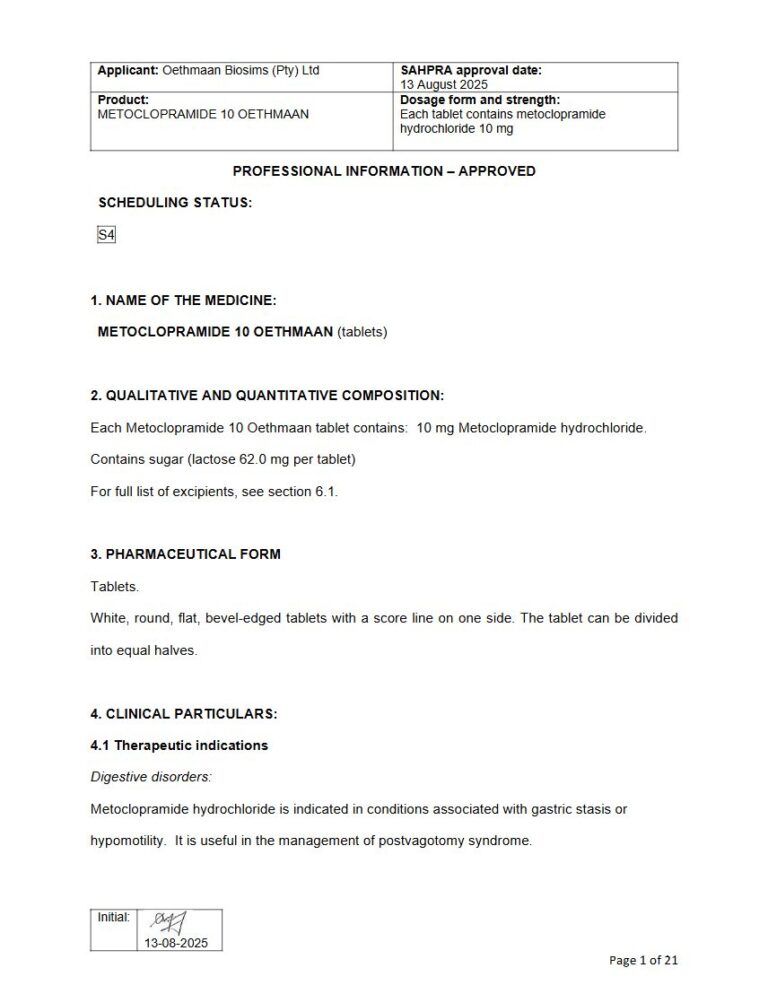
Digestive disorders: Metoclopramide hydrochloride is indicated in conditions associated with gastric stasis or hypomotility. It is useful in the management of postvagotomy syndrome.
Nausea and vomiting: Metoclopramide hydrochloride is indicated for the control of nausea and vomiting associated with the following conditions: medicine-induced nausea and vomiting, uraemic conditions, malignant disease, gastrointestinal disorders and post-anaesthetic vomiting.
Diagnostic radiology: Metoclopramide hydrochloride speeds gastric emptying and dilates the duodenal bulb. It is therefore useful in the following situations:
- Where barium meal studies are delayed by spasm of the duodenal cap making examination for the presence of an ulcer difficult.
- To facilitate examination of the hypotonic stomach with delayed emptying (gastric stasis and pyloric canal syndrome).
- To control or prevent nausea and vomiting of barium which occurs in a small minority of patients undergoing barium meal examination.
Duodenal intubation: Metoclopramide hydrochloride is a useful aid to gastrointestinal intubation procedures.
Young Adults and Children: The use of METOCLOPRAMIDE 10 OETHMAAN in patients under 20 years should be restricted to the following:
- Severe intractable vomiting of known cause.
- As an aid to gastro-intestinal intubation and diagnostic radiology.
4.2 Posology and method of administration
Posology: See section 4.4.
Adults and children over 14 years: 10 mg (1 x 10 mg tablet) three times daily.
Paediatric population: Children 5 to 14 years: 5 mg three times daily.
Special populations: Patients with renal impairment and hepatic impairment: Total clearance of metoclopramide is significantly reduced in patients with renal impairment and hence dosage reduction of at least 50 % have been recommended in patients with moderate to severe renal impairment.
Method of administration: For oral use only.
4.3 Contraindications
- Hypersensitivity to metoclopramide or to any excipients listed in section 6.1.
- Cases of hypertensive crises have reportedly been associated with metoclopramide hydrochloride after administration to patients with phaeochromocytoma. Until further evaluation, metoclopramide hydrochloride should not be given to patients with suspected or confirmed phaeochromocytoma.
- Patients being treated with phenothiazines.
- METOCLOPRAMIDE 20 OETHMAAN should not be used when stimulation of muscular contractions might adversely affect gastro-intestinal conditions as in gastro-intestinal haemorrhage, obstruction, perforation, or immediately after surgery.
- History of neuroleptic or metoclopramide-induced tardive dyskinesia.
- METOCLOPRAMIDE 10 OETHMAAN should not be used in patients with epilepsy due to risk of increased frequency and severity of seizures.
- Parkinsonu2019s disease.
- Combination with levodopa or dopaminergic agonists (see section 4.5).
- Known history of methaemoglobinaemia with metoclopramide or of NADH cytochrome- b5 deficiency.
- Use in children less than 1 year of age due to an increased risk of extrapyramidal disorders (see section 4.4).
- METOCLOPRAMIDE 10 OETHMAAN should not be used during the first three to four days following operations such as pyloroplasty or gut anastomosis as vigorous muscular contractions may not help healing.
- Safety in pregnant and lactating mothers has not been established.
- Patients with convulsive disorders.
- Porphyria.
4.4 Special warnings and precautions for use
WARNING: TARDIVE DYSKINESIA
Chronic treatment with METOCLOPRAMIDE 10 OETHMAAN can cause tardive dyskinesia, a serious movement disorder that is often irreversible. The risk of developing tardive dyskinesia increases with the duration of treatment and the total cumulative dose. The elderly, especially elderly women, are most likely to develop this condition.
METOCLOPRAMIDE 10 OETHMAAN therapy should routinely be discontinued in patients who develop signs or symptoms of tardive dyskinesia. There is no known treatment for tardive dyskinesia; however, in some patients symptoms may lessen or resolve after METOCLOPRAMIDE 10 OETHMAAN treatment is stopped.
Prolonged treatment (greater than 12 weeks) with METOCLOPRAMIDE 10 OETHMAAN should be avoided in all but rare cases where therapeutic benefit is thought to outweigh the risks to the patient of developing tardive dyskinesia.
Care should be exercised in patients with underlying neurological conditions and in patients treated with other centrally active medicines (see section 4.3) e.g. epilepsy.
In patients with clinically significant degrees of renal or hepatic impairment, therapy should be at a reduced dosage.
There should be at least a 6 hour time interval between each METOCLOPRAMIDE 10 OETHMAAN administration, even in case of vomiting and rejection of the dose, in order to avoid overdose. If vomiting persists the patient should be re-assessed to exclude the possibility of an underlying disorder, e.g. cerebral irritation.
Neurological disorders: Extrapyramidal disorders may occur, particularly in children and young adults, and/or when high doses are used. These reactions occur usually at the beginning of the treatment and can occur after a single administration. Metoclopramide should be discontinued immediately in the event of extrapyramidal symptoms. These effects are generally completely reversible after treatment discontinuation but may require a symptomatic treatment (benzodiazepines in children and/or anticholinergic anti-Parkinsonian medicinal products in adults).
Caution is advised in patients with a history of mental depression. Prolonged treatment with metoclopramide may cause tardive dyskinesia, potentially irreversible, especially in the elderly. Treatment should not exceed 3 months because of the risk of tardive dyskinesia (see section 4.8). Treatment must be discontinued if clinical signs of tardive dyskinesia appear. Patients on prolonged therapy should be reviewed regularly. It is recommended that METOCLOPRAMIDE 10 OETHMAAN should not be prescribed for the long-term treatment of minor symptoms, especially in elderly patients.
4.5 Interaction with other medicines and other forms of interaction
METOCLOPRAMIDE 10 OETHMAAN may affect the absorption of other medicines. It may either diminish absorption from the stomach (as with digoxin) or enhance absorption from small intestine (for example, with alcohol, cyclosporine, levodopa, aspirin or paracetamol). It inhibits serum cholinesterase and may prolong neuromuscular blockade produced by suxamethonium and mivacurium.
Since METOCLOPRAMIDE 10 OETHMAAN increase prolactin blood concentrations, it may interfere with medicines which have a hypoprolactinaemic effect such as bromocriptine. It should not be given to patients being treated with phenothiazines as extrapyramidal reactions may be precipitated.
Increased toxicity may occur if METOCLOPRAMIDE 10 OETHMAAN is given to patients receiving lithium. Caution is advisable with other centrally acting medicines such as antiepileptics, antidepressants and sympathomimetics. Giving METOCLOPRAMIDE 10 OETHMAAN with Central Nervous System medicines can lead to increased sedative effects. Opioids and antimuscarinics antagonize the gastrointestinal effects of METOCLOPRAMIDE 10 OETHMAAN. Levodopa or dopaminergic agonists and metoclopramide have a mutual antagonism (see section 4.3). Alcohol potentiates the sedative effect of metoclopramide.
Serotonergic medicines: The use of metoclopramide with serotonergic medicines such as SSRIs may increase the risk of serotonin syndrome.
Digoxin: Metoclopramide may decrease digoxin bioavailability. Careful monitoring of digoxin plasma concentration is required.
Cyclospirone: Metoclopramide increases cyclosporine bioavailability (C max by 46 % and exposure by 22 %). Careful monitoring of cyclosporine plasma concentration is required. The clinical consequence is uncertain.
Strong CYP2D6 inhibitors: Metoclopramide exposure levels are increased when co-administered with strong CYP2D6 inhibitors such as fluoxetine and paroxetine. Although the clinical significance is uncertain, patients should be monitored for adverse reactions.
Atovaquone: Metoclopramide injection may reduce plasma concentrations of atovaquone.
4.6 Fertility, pregnancy and lactation
Pregnancy: Safety in pregnancy has not been established (see section 4.3). The use of METOCLOPRAMIDE 10 OETHMAAN during pregnancy is considered unsafe as teratogenicity has been demonstrated in animal studies.
Breastfeeding: METOCLOPRAMIDE 10 OETHMAAN is excreted in breast milk at low levels. Adverse reactions in the breastfed baby cannot be excluded. Discontinuation of METOCLOPRAMIDE 10 OETHMAAN in breastfeeding women should be considered.
Fertility: There are no fertility data.
4.7 Effects on ability to drive and use machines
METOCLOPRAMIDE 10 OETHMAAN may cause drowsiness or impaired reactions, so affected patients should not drive or operate machinery.
4.8 Undesirable effects
a. Summary of the safety profile: METOCLOPRAMIDE 10 OETHMAAN is a dopamine antagonist and may cause extrapyramidal symptoms which usually occur as acute dystonia reactions, especially in young female patients. Parkinsonism and tardive dyskinesia have occasionally occurred, usually during prolonged treatment in elderly patients.
b. Tabulated list of adverse reactions:
System Organ Class Adverse reaction Frequency
Blood and lymphatic system disorders Agranulocytosis, Methaemoglobinaemia 1 , sulfhaemoglobinaemia 1 Frequency unknown
Immune system disorders Hypersensitivity reactions Less frequent Anaphylactic reaction (including anaphylactic shock) particularly with intravenous formulation. Severe allergic reactions such as oedema of the tongue, peri-orbital oedema may occur. Frequency unknown
Endocrine disorders 2 Amenorrhoea, hyperprolactinaemia, galactorrhoea Less frequent
Gynaecomastia Frequency unknown
Psychiatric disorders Depression Frequent Hallucination, confusional state Less frequent
Nervous system disorders Somnolence, restlessness, drowsiness, dizziness, headache, extrapyramidal disorders 3 , parkinsonism, akathisia. Frequent Anxiety and agitation, Parkinsonism and Tardive dyskinesia have occasionally occurred, usually during prolonged treatment in the elderly. Dystonia (including visual disturbances and oculogyric crisis), dyskinesia, depressed level of consciousness. Convulsion especially in epileptic patients. Less frequent Tardive dyskinesia 4 , neuroleptic malignant syndrome 5 Frequency unknown
Cardiac disorders Bradycardia Less frequent
Cardiac arrest 6 , atrioventricular block, sinus arrest, electrocardiogram QT prolonged, Torsade de Pointes Frequency unknown
Vascular disorders Hypotension Frequent Shock, syncope after injectable use. Acute hypertension in patients with phaeochromocytoma (see section 4.3). Transient increase in blood pressure Frequency unknown
Gastrointestinal disorders Constipation, diarrhoea Frequent
Skin and subcutaneous tissue disorders Skin reactions such as rash, pruritus, angioedema and urticaria Frequency unknown
Renal and urinary disorders Urinary incontinence Frequency unknown
General disorders and administration site conditions Asthenia Frequent
1 Methaemoglobinaemia, which could be related to NADH cytochrome b5 reductase deficiency, particularly in neonates (see section 4.4). Sulfhaemoglobinaemia, mainly with concomitant administration of high doses of sulphur- releasing medicines.
2 Endocrine disorders during prolonged treatment in relation with hyperprolactinaemia (amenorrhoea, galactorrhoea, gynaecomastia).
3 METOCLOPRAMIDE 10 OETHMAAN may cause extrapyramidal symptoms, which usually occur as acute dystonic reactions, including spasm of the facial and/or extra ocular muscles, trismus, a bulbar type of speech and unnatural positioning of the head and shoulders. There may be a general increase in muscle tone. These are common in young patients especially if female. Tardive dyskinesia has been reported (see section 4.4).
4 Tardive dyskinesia which may be persistent, during or after prolonged treatment, particularly in elderly patients (see section 4.4).
5 Neuroleptic malignant syndrome, Neuroleptic malignant syndromes have been reported. This syndrome is potentially fatal and comprises hyperpyrexia, altered consciousness, muscle rigidity, autonomic instability and elevated levels of creatinine phosphokinase and must be treated urgently (recognised treatments include dantrolene and bromocriptine). METOCLOPRAMIDE 10 OETHMAAN should be stopped immediately if this syndrome occurs.
6 Cardiac arrest, occurring shortly after injectable use, and which can be subsequent to bradycardia (see section 4.4).
c. Description of selected adverse reactions: The following reactions, sometimes associated, occur more frequently when high doses are used:
- Extrapyramidal symptoms: acute dystonia and dyskinesia, parkinsonian syndrome, akathisia, even following administration of a single dose of METOCLOPRAMIDE 10 OETHMAAN, particularly in children and young adults (see section 4.4).
- Drowsiness, decreased level of consciousness, confusion, hallucination.
4.9 Overdose
Overdosage with metoclopramide hydrochloride could give rise to dyskinetic reactions manifested as motor restlessness, agitation, irritability, spasm of facial and neck muscles and the muscles of the tongue. In severe cases opisthotonos can result. Anti-parkinson medicines, e.g. procyclidine will usually control these reactions. Treatment is symptomatic and supportive.
