
Muscuron 4 mg/vial Injection
PDF Leaflet Revision Date: 03 January 2024
Clinical Summary
Quick overview from the medicine insert
Indication
Adjunct to general anaesthesia for intubation and muscle relaxation.
Dosage (summary)
Intubating dose: 0.08-0.10 mg/kg IV; Maintenance: 0.03-0.05 mg/kg.
Onset of Action / Duration
Onset: 90-120 secs, Duration: 24-60 mins.
Special Populations
- Hepatic impairment
- Renal failure
- Severe obesity
- Neuromuscular disease
Pregnancy & Breastfeeding
Safety in pregnancy and lactation not established.
Key Drug Interactions
- Anaesthetics (e.g., isoflurane, halothane)
- Aminoglycosides
- Corticosteroids
- Magnesium salts
Contraindications
- Hypersensitivity to vecuronium or excipients
- Children under 3 months
- Pregnancy and lactation
Common side effects
- Hypersensitivity reactions
- Flaccid paralysis
- Respiratory insufficiency
- Hypotension
Counselling Points
- Monitor respiratory function during recovery.
- Avoid use in patients with known hypersensitivity.
- Ventilatory support mandatory until recovery.
Serious warnings
- Respiratory paralysis possible
- Anaphylactic reactions may occur
- Residual neuromuscular blockade
Important Disclaimer
The Muscuron 4 mg/vial Injection professional information leaflet below is the property of Ranbaxy Pharmaceuticals and is provided on Medinsert exactly as issued, with no.. alterations or editorial changes. We make every effort to keep content current by updating documents as soon as new versions become available. Medinsert serves as a trusted access point for healthcare professionals, but does not replace official sources or clinical judgement. For more details, please read our full disclaimer. read more>>
 Healthcare Professionals Only
This content is for registered healthcare professionals
Sign in or create a free account to read the full package insert.
Free for HPCSA-registered professionals. Powered by Medinsert.
Clinical Particulars
Section 4 of the official insert — extracted exactly as issued, no alterations
4.1 Therapeutic indications
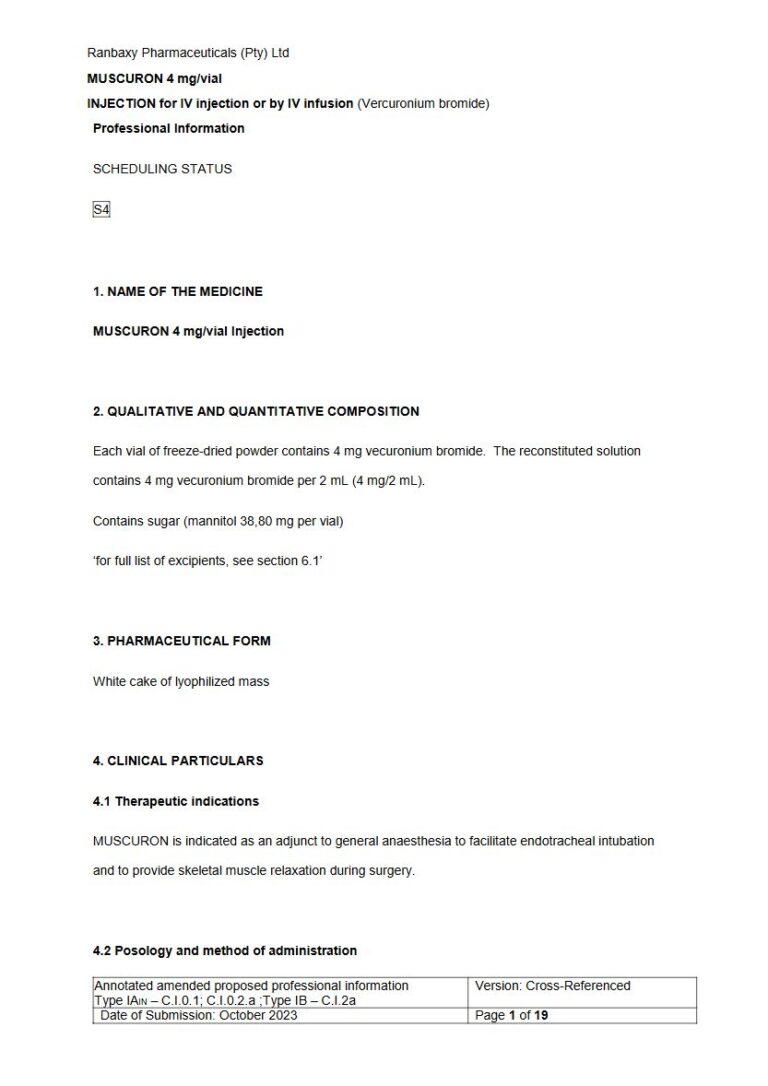
MUSCURON is indicated as an adjunct to general anaesthesia to facilitate endotracheal intubation and to provide skeletal muscle relaxation during surgery.
4.2 Posology and method of administration
The dosage of MUSCURON should be individualised according to individual requirement and response.
Adults
Intubating dose: The usual initial dose is 0,08 to 0,10 mg/kg body mass by IV injection. Under neurolept anaesthesia, conditions for intubation occur within 90 to 120 seconds, and within 3 to 4 minutes following administration of these dosages general muscle paralysis adequate for surgery is established.
Dosages of MUSCURON for surgical procedures after intubation with suxamethonium: 0,03 to 0,05 mg per kg body mass. If suxamethonium is used for intubation, the administration of MUSCURON should be delayed until the patient has clinically recovered from the neuromuscular block induced by suxamethonium.
Maintenance dose: 0,03 to 0,05 mg per kg body mass. These maintenance doses should best be given when twitch height has recovered to 25 % of control twitch height. Should there be reason for selection of larger doses in individual patients, initial doses ranging from 0,15 mg up to 0,30 mg per kg body mass may be administered as long as ventilation is properly maintained. The use of these high dosages of MUSCURON pharmacodynamically decreases the onset time and increases the duration of action.
Dose requirements for administration by continuous infusion: For prolonged surgical procedures MUSCURON may be given by continuous IV infusion, by further diluting the reconstituted injection to the desired concentration (0,1 to 0,2 mg/mL) in a compatible IV infusion such as 5 % dextrose and 0,9 % sodium chloride. A precise control of the flow rate during continuous infusion is required.
If MUSCURON is administered by continuous infusion, it is recommended to give a bolus dose first (ED 90 or 2 times ED 90 dose) and, when neuromuscular block starts to recover, to start administration of MUSCURON by infusion. The infusion rate should be adjusted to maintain twitch response at 10 % of control twitch height. In adults, the infusion rate required to maintain neuromuscular block at this level ranges from 0,8 to 1,4 u03bcg vecuronium bromide/kg/minute. Repeated monitoring of neuromuscular block is essential since infusion rate requirements vary from patient to patient and with the anaesthetic method used.
Caesarean section: In caesarean section the dose should not exceed 0,1 mg/kg body weight.
Paediatric population
Children: The duration of action is, in general, shorter in children older than one year of age than in adults. Since the onset time of MUSCURON in children is considerably shorter, the use of high intubation doses is in general not required for early development of good intubation conditions. Maintenance doses are required more frequently in children, since the duration of action and recovery time with MUSCURON is approximately 30 % shorter in children than in adults.
Children under one year of age: Because of the possible variation of the sensitivity of the neuromuscular junction, it is recommended that an initial test dose of 0,01 to 0,02 mg per kg body mass followed by incremental doses until 90 to 95 % depression of twitch response is achieved, is given. The duration of muscle paralysis will be prolonged in these children, up to double that seen in children.
Method of administration: MUSCURON is administered by slow IV injection or by IV infusion. MUSCURON should not be administered by IM injection. The reconstituted solution is clear and colourless.
4.3 Contra-indications
- Hypersensitivity to the vecuronium, to bromide ion or any of the excipients listed in section 6.1.
- Safety in children 3 months or younger has not been established.
- Pregnancy and lactation as safety has not been established.
4.4 Special warnings and precautions for use
Safety and efficacy of MUSCURON in children 3 months or younger have not been established. Monitoring respiratory function during recovery. The usual precautions of neuromuscular blocking medicine administration should be observed. MUSCURON can cause respiratory paralysis. MUSCURON should be used only by individuals who are experienced in the use of neuromuscular blocking medicines. Ventilatory support is mandatory for patients treated with this medicine until adequate spontaneous respiration is restored.
Vagal reactions: Since MUSCURON exhibits minimal effects on heart rate at the recommended doses, the medicine will not counteract the bradycardia induced when used concomitantly during anaesthesia with medicines that may cause bradycardia. Therefore, reassessment of the use and/or dosage of vagolytic medicines such as atropine for premedication or at induction of anaesthesia, may be of value for surgical procedures during which vagal reactions are more likely to occur (e.g. surgical procedures where anaesthetic medicines with known vagal stimulatory effects are used, ophthalmic, abdominal or anorectal surgery, etc.).
Medicine hypersensitivity reactions: Anaphylactic reactions to neuromuscular blocking medicines in general have been reported and precautions for treating such reactions if they would occur should always be taken. Allergic cross-reactivity between neuromuscular blocking medicines has been reported and special caution should be taken in the case of former anaphylactic reactions to neuromuscular-blocking medicines. MUSCURON should only be used when absolutely essential in susceptible patients. Patients who experience a hypersensitivity reaction under general anaesthesia should be tested subsequently for hypersensitivity to other neuromuscular blockers.
Use in the intensive care unit (ICU): Presently there are insufficient data to give recommendations for the use of MUSCURON in the Intensive Care Unit. As with other muscle relaxants prolonged neuromuscular block following long term use of vecuronium bromide in seriously ill patients in the Intensive Care Unit prolonged paralysis and/or skeletal muscle weakness has been reported. It is essential that during continuous neuromuscular block, patients receive adequate analgesia and sedation and that neuromuscular transmission is monitored throughout. Furthermore, muscle relaxants should be administered in carefully adjusted doses sufficient for the maintenance of less than complete block by or under the supervision of experienced clinicians who are familiar with its actions and with appropriate neuromuscular monitoring techniques.
Myopathy after long term administration of non-depolarising neuromuscular blocking medicines in the ICU in combination with corticosteroid therapy has been reported frequently. Therefore, for patients receiving both neuromuscular blocking medicines and corticosteroids, the period of use of the neuromuscular blocking medicine should be limited as much as possible.
Residual neuromuscular blockade: As with other neuromuscular blocking medicines, residual neuromuscular blockade has been reported for MUSCURON. In order to prevent complications resulting from residual neuromuscular blockade, it is recommended to extubate only after the patient has recovered sufficiently from neuromuscular block. Other factors which could cause residual neuromuscular blockade after extubation in the post-operative phase (such as medicine interactions or patient condition) should also be considered. If not used as part of standard clinical practice, the use of a reversal medicine should be considered, especially in those cases where residual neuromuscular blockade is more likely to occur.
The following disease states may influence the pharmacokinetics and/or pharmacodynamics action of MUSCURON: Hepatic and/or biliary tract disease. Caution should be exercised when MUSCURON is administered to patients with hepatic dysfunction, since recovery from neuromuscular blockade may be prolonged in these patients. As MUSCURON is excreted mainly via the bile and in urine, moderate changes in the course of neuromuscular block induced by MUSCURON are found in patients with hepatic and /or biliary tract diseases. In these patient groups prolongation of action has been observed, especially when high doses of vecuronium (200 micrograms/kg bodyweight) were administered in patients with hepatic disease.
Renal failure: Since the neuromuscular blockade induced by the medicine may be prolonged in patients with severe renal failure (i.e. creatinine clearance less than 10 mL/minute) a lower than usual initial dose of MUSCURON should be considered in these patients.
Prolonged circulation time: Conditions associated with prolonged circulation time such as cardiovascular disease, old age, oedematous state resulting in an increased volume of distribution, may contribute to an increase in the onset time of neuromuscular block. The duration of action may also be prolonged due to a reduced plasma clearance.
Severe obesity or neuromuscular disease: MUSCURON should be administered with caution in severely obese patients since maintenance of an adequate airway and ventilation support prior to, during and following administration of neuromuscular blocking medicines may require particular care in these patients. As with other neuromuscular blocking medicines, MUSCURON should be used with extreme caution in cases of neuromuscular disease or after poliomyelitis since the response to neuromuscular blocking medicines may be considerably altered in these patients. The magnitude and direction of this alteration may vary widely. In patients with myasthenia gravisor the myasthenic (Eaton Lambert) syndrome, small doses of vecuronium may have profound effects and vecuronium should be titrated to the response.
Hypothermia: In operations under hypothermia, the neuromuscular blocking effect of MUSCURON is increased and the duration is prolonged.
Other conditions which may increase the effects of MUSCURON are: Hypokalaemia (e.g. after severe vomiting, diarrhoea and diuretic therapy), hypermagnesaemia, hypocalcaemia (after massive transfusion), hypoproteinaemia, dehydration, acidosis, hypercapnioea, cachexia. Severe electrolyte disturbances, altered blood pH or dehydration should therefore be corrected when possible. Because malignant hyperthermia can occur even in the absence of a recognised precipitating factor, clinicians should be vigilant for its possible development and prepared for its management in any patient undergoing general anaesthesia.
Based on preclinical findings, vecuronium may cause a reduction in the partial thromboplastin time and the prothrombintime, like pancuronium bromide, d-tubocurarine or other non-depolarising neuromuscular blocking medicines.
Burns: Resistance to MUSCURON can develop in burn patients. The degree of resistance depends on the extent of thermal injury and elapsed time since the burn. Therefore, the possible need for substantially increased doses of MUSCURON in burn patients should be considered.
4.5 Interaction with other medicines and other forms of interaction
It has been shown that the following medicines can have an increased effect on the magnitude and/or duration of action of non-depolarising neuromuscular blocking medicines:
- Anaesthetics: ether, isoflurane, methoxyflurane, cyclopropane, halothane and enflurane potentiate the duration and intensity of the effect of MUSCURON. High doses of thiopentone, methohexitone, ketamine, fentanyl, gamma-hydroxybutyrate, etomidate.
- Other medicines: other non-depolarising muscle relaxants, prior administration of suxamethonium, aminoglycoside and polypeptide antibiotics, acylamino penicillin antibiotics, lincosamides antibiotics, diuretics, beta-adrenergic blocking medicines, lithium salts, quinidine, lidocaine, calcium-channel blockers, protamine, alpha-adrenergic blocking medicines, imidazole, high doses of metronidazole, thiamine, cimetidine, MAO inhibiting medicines, magnesium salts and acute administration of phenytoin.
A decreased effect on the magnitude and/or duration of action of non-depolarising neuromuscular blocking medicines has been shown with the following medicines:
- Neostigmine, edrophonium, pyridostigmine, aminopyridine derivatives, corticosteroids, prior chronic administration of phenytoin, carbamazepine, noradrenaline, azathioprine, theophylline, KCl, NaCl, CaCl2.
Variable effects have been shown with the following medicines:
- Depolarising muscle relaxants, e.g. suxamethonium given before or after the administration of MUSCURON may produce potentiation or attenuation of the neuromuscular blocking effect of MUSCURON.
Effect of vecuronium on other medicines: Effect of vecuronium on lidocaine: MUSCURON combined with lidocaine may result in a quicker onset of action of lidocaine.
4.6 Fertility, pregnancy and lactation
Pregnancy: There are insufficient data on the use of vecuronium during animal or human pregnancy to assess potential harm to the foetus.
Note: Reversal of MUSCURON-induced neuromuscular block may be inhibited or unsatisfactory in patients receiving magnesium sulphate for toxaemia of pregnancy because magnesium salts enhance neuromuscular block. Therefore, in patients receiving magnesium sulphate, the dosage of MUSCURON should be reduced and be carefully titrated to twitch response.
Breastfeeding: The excretion of vecuronium bromide in milk has not been studied in animals.
Fertility: Animal studies do not indicate an effect on fertility.
4.7 Effects on ability to drive and use machines
It is not recommended to use potentially dangerous machinery or drive a car within 24 hours after the full recovery from the neuromuscular blocking action of MUSCURON.
4.8 Undesirable effects
MedDRA System organ class Frequency Adverse reactions
Immune system disorders Less frequent Hypersensitivity, anaphylactic reaction, anaphylactoid reaction, anaphylactic shock, anaphylactoid shock
Nervous system disorders Less frequent Flaccid paralysis
Cardiac disorders Less frequent Tachycardia
Vascular disorders Less frequent Hypotension, circulatory collapse and shock, flushing
Respiratory, thoracic and mediastinal disorders Less frequent Respiratory insufficiency or apnoea has been reported, bronchospasm.
Skin and subcutaneous tissue disorders Less frequent Angioneurotic oedema, urticaria, rash, erythematous rash
Musculoskeletal and connective tissue disorders Less frequent Skeletal muscle weakness or paralysis has been reported, steroid myopathy.
General disorders and administration site conditions Less frequent Face oedema, injection site pain, injection site reaction, medicine ineffective, decreased medicine effect/therapeutic response, increased medicine effect/therapeutic response
Injury, poisoning and procedural complications Less frequent Prolonged neuromuscular block, delayed recovery from anaesthesia, airway complication of anaesthesia
Description of selected adverse reactions: Prolonged Neuromuscular block: The most frequent adverse reaction to non-depolarising blocking medicines as a class consists of an extension of the medicine's pharmacological action beyond the time period needed. This may vary from skeletal muscle weakness to profound and prolonged skeletal muscle paralysis resulting in respiratory insufficiency or apnoea. A few cases of myopathy have been reported after vecuronium was used in the ICU in combination with corticosteroids (see section 4.4).
Anaphylactic reactions: Although very rare, severe anaphylactic reactions to neuromuscular blocking medicines, including vecuronium, have been reported. Anaphylactic/anaphylactoid reactions usually comprise of several signs or symptoms e.g. bronchospasm, cardiovascular changes (e.g. hypotension, tachycardia, circulatory collapse u2013 shock), and cutaneous changes (e.g. angioedema, urticaria). These reactions have, in some cases, been fatal. Due to the possible severity of these reactions, one should always assume they may occur and take the necessary precautions.
Histamine release and histaminoid reactions: Since neuromuscular blocking medicines are known to be capable of inducing histamine release both locally at the site of injection and systemically, the possible occurrence of itching and erythematous reactions at the site of injection and/or generalised histaminoid (anaphylactoid) reactions (see also under anaphylactic reactions above) should always be taken into consideration when administering these medicines. Experimental studies with intradermal injection of vecuronium have demonstrated that this medicine has only a weak capacity for inducing local histamine release. Controlled studies in man failed to demonstrate any significant rise in plasma histamine levels after intravenous administration of vecuronium. Nevertheless, such cases have rarely been reported during large scale use of vecuronium.
4.9 Overdose
In the event of overdosage and prolonged neuromuscular block, the patient should continue to receive ventilator support and sedation. In this situation there are two options for the reversal of neuromuscular block: (1) sugammadex can be used for reversal of intense (profound) and deep block. The dose of sugammadex to be administered depends on the level of neuromuscular block. The use of sugammadex for the purposes of reversal of vecuronium-induced blockade is recommended for use only in the adult population. (2) An acetylcholinesterase inhibitor (e.g. neostigmine, edrophonium, pyridostigmine) can be used once spontaneous recovery starts and should be administered in adequate doses. When administration of a cholinesterase inhibiting medicine fails to reverse the neuromuscular effects of vecuronium, ventilation must be continued until spontaneous breathing is restored. Repeated dosage of a cholinesterase inhibitor can be dangerous.
