
Myorythm 100 mg & 200 mg Tablets.
PDF Leaflet Revision Date: 14 November 2023
Clinical Summary
Quick overview from the medicine insert
Indication
Prevention of tachydysrhythmias.
Dosage (summary)
Initial: 200 mg TID for 1 week, then 200 mg BID for 1 week, followed by 200 mg daily.
Onset of Action / Duration
Onset: 1 week, Duration: variable.
Special Populations
- Elderly
- Paediatric patients
Pregnancy & Breastfeeding
Contraindicated in pregnancy and breastfeeding.
Key Drug Interactions
- Beta-blockers
- Calcium channel inhibitors
- Sofosbuvir
Contraindications
- Hypersensitivity to amiodarone
- Sinus bradycardia
- Thyroid dysfunction
- Pregnancy
- Lactation
Common side effects
- Bradycardia
- QT prolongation
- Pulmonary toxicity
- Hepatic injury
Counselling Points
- Monitor for bradycardia
- Avoid sun exposure
- Regular liver function tests
Serious warnings
- Serious adverse reactions possible
- Pro-dysrhythmic effects
- Monitor thyroid function
Important Disclaimer
The Myorythm 100 mg & 200 mg Tablets. professional information leaflet below is the property of Ipharma and is provided on Medinsert exactly as issued, with no.. alterations or editorial changes. We make every effort to keep content current by updating documents as soon as new versions become available. Medinsert serves as a trusted access point for healthcare professionals, but does not replace official sources or clinical judgement. For more details, please read our full disclaimer. read more>>
 Healthcare Professionals Only
This content is for registered healthcare professionals
Sign in or create a free account to read the full package insert.
Free for HPCSA-registered professionals. Powered by Medinsert.
Clinical Particulars
Section 4 of the official insert — extracted exactly as issued, no alterations
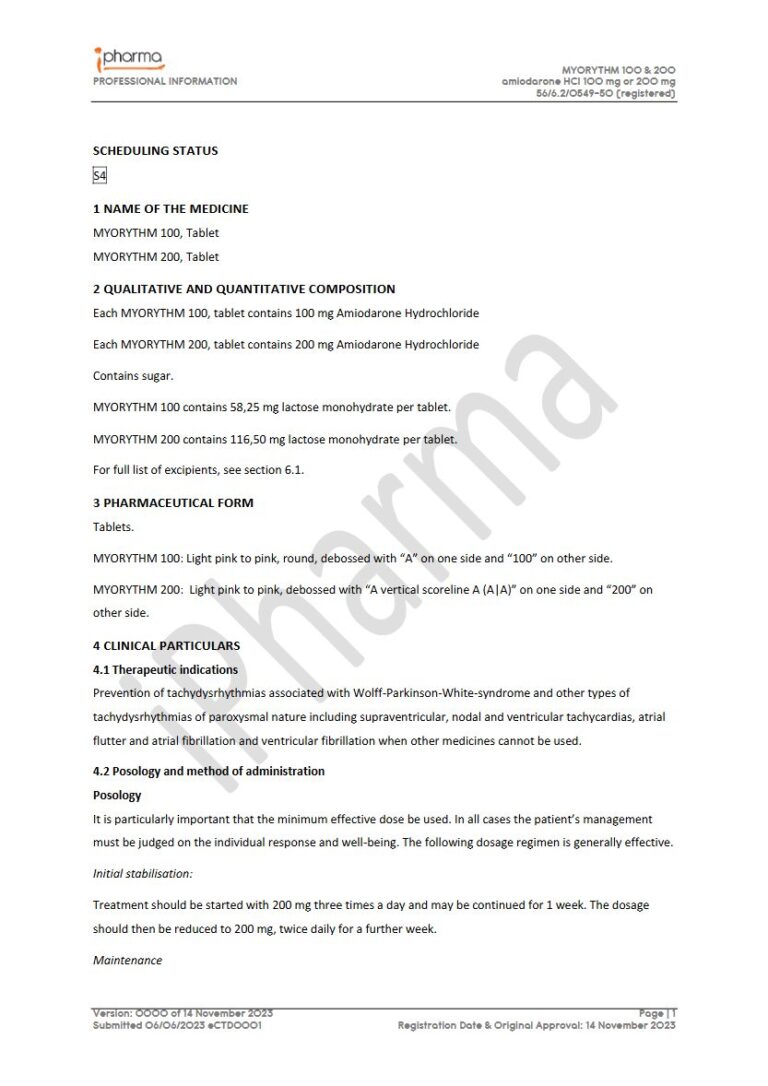
4.1 Therapeutic indications
Prevention of tachydysrhythmias associated with Wolff-Parkinson-White-syndrome and other types of tachydysrhythmias of paroxysmal nature including supraventricular, nodal and ventricular tachycardias, atrial flutter and atrial fibrillation and ventricular fibrillation when other medicines cannot be used.
4.2 Posology and method of administration
Posology
It is particularly important that the minimum effective dose be used. In all cases the patientu2019s management must be judged on the individual response and well-being. The following dosage regimen is generally effective.
Initial stabilisation:
Treatment should be started with 200 mg three times a day and may be continued for 1 week. The dosage should then be reduced to 200 mg, twice daily for a further week.
Maintenance
After the initial period the dosage should be reduced to 200 mg daily, or less if appropriate. Rarely, the patient may require a higher maintenance dose. The 100 mg tablet should be used to titrate the minimum dosage required to maintain control of the dysrhythmia. The maintenance dose should be regularly reviewed, especially where this exceeds 200 mg daily.
Changeover from intravenous to oral therapy
Oral therapy should be initiated concomitantly at the usual loading dose i.e.: 200 mg three times a day, as soon as possible after an adequate response has been obtained using Amiodarone HCl intravenous injection, which should then be phased out gradually.
General considerations
The high initial dose is necessary because of the slow onset of action whilst the necessary tissue levels of amiodarone are achieved. Amiodarone as contained in MYORYTHM has a low acute toxicity and in this initial treatment period serious problems have not been reported. However, excessive dosage during maintenance therapy can cause side effects, which are believed to be related to excessive tissue retention of amiodarone and/or its metabolites. Side effects slowly disappear as the tissue levels fall after the dosage is reduced or treatment withdrawn. If MYORYTHM treatment is withdrawn, residual tissue-bound amiodarone may protect the patient for up to one month, but the likelihood of recurrence of cardiac dysrhythmias during this period should be a consideration. The important factor is that the patient requires monitoring regularly to ensure that clinical features of excessive dosage are detected, and the dosage adjusted accordingly. It is particularly important that the minimum effective dose be used, and that the patient is monitored regularly to detect the clinical features of excess amiodarone dosage. Therapy may then be adjusted accordingly.
Special populations
Use in the elderly
It is important that the minimum effective dose is used. Whilst there is no evidence that dosage requirements are different for this group of patients, they may be more susceptible to bradycardia and conduction defects if too high a dose is employed. Particular attention should be paid to monitoring of thyroid function (see section 4.3 and section 4.4).
Paediatric population
The safety and efficacy of amiodarone in children has not been established (see section 4.3).
Method of administration
Oral use.
4.3 Contraindications
MYORYTHM is contraindicated in:
- Hypersensitivity to the active substance, amiodarone, or to iodine or to any of the excipients (see section 6.1). (One tablet of MYORYTHM 100 contains 37,5 mg iodine and one tablet of MYORYTHM 200 contains 75 mg iodine);
- sinus bradycardia, sino-atrial heart block. In patients with sick sinus syndrome (risk of sinus arrest), severe atrioventricular conduction disorders (high grade AV block, bifascicular or trifascicular block) or sinus node disease, unless a pacemaker is fitted;
- thyroid dysfunction (see section 4.4). Thyroid function tests should be performed in all patients prior to therapy;
- pregnancy and lactation (see section 4.6);
- combined therapy with medicines which may induce Torsades de Pointes (see section 4.5); or
- Paediatric Patients: The safety and efficacy of MYORYTHM in paediatric patients have not been established. Therefore, its use in paediatric patients is not recommended.
4.4 Special warnings and precautions for use
Amiodarone can cause serious adverse reactions affecting the eyes, heart, lung, liver, thyroid gland, skin and peripheral nervous system (see section 4.8). Because these reactions may be delayed, patients on long-term treatment should be carefully supervised. As undesirable effects are usually dose-related, the minimum effective maintenance dose should be given.
Before surgery, the anaesthetist should be informed that the patient is taking MYORYTHM (see sections 4.5 and 4.8).
MYORYTHM should be avoided in patients with porphyria as it may precipitate an attack.
Cardiac disorders (see section 4.8):
Too high a dosage may lead to severe bradycardia and to conduction disturbances with the appearance of an idioventricular rhythm, particularly in elderly patients or during digitalis therapy. In these circumstances, MYORYTHM treatment should be withdrawn. If necessary, beta-adrenostimulants or glucagon may be given. Because of the long half-life of amiodarone, if bradycardia is severe and symptomatic the insertion of a pacemaker should be considered.
MYORYTHM is not contraindicated in patients with latent or manifest heart failure but caution should be exercised as, occasionally, existing heart failure may be worsened. In such cases, MYORYTHM may be used with other appropriate therapies.
The pharmacological action of amiodarone induces ECG changes: QT prolongation (related to prolonged repolarisation) with the possible development of U-waves and deformed T-waves; these changes do not reflect toxicity.
In the elderly, heart rate may decrease markedly. Treatment should be discontinued in case of onset of 2nd or 3rd degree A-V block, sino-atrial block, or bifascicular block.
Amiodarone has a low pro-dysrhythmic effect. Onsets of new dysrhythmias or worsening of treated dysrhythmias, sometimes fatal, have been reported. It is important, but difficult, to differentiate a lack of efficacy of the medicine from a pro-dysrhythmic effect, whether or not this is associated with a worsening of the cardiac condition. Pro-dysrhythmic effects generally occur in the context of QT prolonging factors such as medicine interactions and/or electrolytic disorders (see sections 4.5. and 4.8). Despite QT interval prolongation, amiodarone exhibits a low torsadogenic activity.
Before starting MYORYTHM treatment, it is recommended to perform an ECG and serum potassium measurement. Monitoring of ECG is recommended during treatment.
MYORYTHM may increase the defibrillation threshold and/or pacing threshold in patients with an implantable cardioverter defibrillator or a pacemaker, which may adversely affect the efficacy of the device. Regular tests are recommended to ensure the proper function of the device after initiation of treatment or change in posology.
Severe bradycardia and heart block (see section 4.5):
Life-threatening cases of bradycardia and heart block have been observed when sofosbuvir-containing regimens are used in combination with amiodarone (e.g., MYORYTHM.) Bradycardia has generally occurred within hours to days, but later cases have been mostly observed up to 2 weeks after initiating HCV treatment.
MYORYTHM should only be used in patients on sofosbuvir- containing regimen when other alternative anti- dysrhythmic treatments are not tolerated or are contraindicated. Should concomitant use of MYORYTHM be considered necessary, it is recommended that patients undergo cardiac monitoring in an in-patient setting for the first 48 hours of coadministration, after which outpatient or self-monitoring of the heart rate should occur on a daily basis through at least the first 2 weeks of treatment. Due to the long half-life of MYORYTHM, cardiac monitoring as outlined above should also be carried out for patients who have discontinued amiodarone within the past few months and are to be initiated on sofosbuvir- containing regimen.
4.5 Interactions with other medicines
Pharmacodynamic interactions
Medicine inducing Torsade de Pointes or prolonging QT
Medicine inducing Torsade de Pointes: Combined therapy with the following medicine which prolong the QT interval is contraindicated (see section 4.3) due to the increased risk of Torsades de Pointes; for example:
- Class Ia anti-dysrhythmic medicine e.g., quinidine, disopyramide, procainamide;
- class III anti-dysrhythmic medicine e.g., sotalol, bretylium;
- intravenous erythromycin, co-trimoxazole or pentamidine injection;
- some anti-psychotics e.g., chlorpromazine, thioridazine, fluphenazine, pimozide, haloperidol, amisulpiride and sertindole;
- lithium and tricyclic anti-depressants e.g., doxepin, maprotiline, amitriptyline;
- certain antihistamines e.g., terfenadine, astemizole, mizolastine;
- non-antidysrhythmic medicines such as vincamine, some neuroleptic medicines, cisapride;
- anti-malarial e.g., quinine, mefloquine, chloroquine, halofantrine; or
- moxifloxacin.
Medicines prolonging QT interval:
Co-administration of MYORYTHM with medicine known to prolong the QT interval (such as clarithromycin) must be based on a careful assessment of the potential risks and benefits for each patient since the risk of Torsade de Pointes may increase and patients should be monitored for QT prolongation.
Concomitant use of MYORYTHM with fluoroquinolones should be avoided (concomitant use with moxifloxacin is contraindicated). There have been reports of QTc interval prolongation, with or without Torsades de Pointes, in patients taking MYORYTHM with fluoroquinolones (see section 4.3).
Medicine lowering heart rate or causing automaticity or conduction disorders
Combined therapy with the following medicine is not recommended: Beta blockers and heart rate lowering calcium channel inhibitors (diltiazem, verapamil); potentiation of negative chronotropic properties and conduction slowing effects may occur.
Medicine which may induce hypokalaemia
Combined therapy with the following medicine is not recommended: Stimulant laxatives, which may cause hypokalaemia thus increasing the risk of Torsades de Pointes; other types of laxatives should be used. Caution should be exercised over combined therapy with the following medicine which may also cause hypokalaemia and/or hypomagnesaemia, e.g., diuretics, systemic corticosteroids (gluco-, mineralo-), intravenous amphotericin. In cases of hypokalaemia, corrective action should be taken and QT interval monitored. In case of Torsades de Pointes anti-dysrhythmic medicines should not be given; pacing may be instituted, and IV magnesium may be used.
General anaesthesia
Caution is advised in patients undergoing general anaesthesia, or receiving high dose oxygen therapy. Potentially severe complications have been reported in patients taking MYORYTHM undergoing general anaesthesia: bradycardia unresponsive to atropine, hypotension, disturbances of conduction, decreased cardiac output. A few cases of adult respiratory distress syndrome, sometimes fatal most often in the period immediately after surgery, have been observed. A possible interaction with a high oxygen concentration may be implicated.
Effect of MYORYTHM on other medicines
MYORYTHM and/or its metabolite, desethylamiodarone, inhibit CYP1A1, CYP1A2, CYP3A4, CYP2C9, CYP2D6 and P-glycoprotein may increase exposure of their substrates.
Due to the long half-life of amiodarone, interactions may be observed for several months after discontinuation of amiodarone.
- PgP substrates
MYORYTHM is a P-gp inhibitor. Co administration with P-gp substrates is expected to result in an increase of their exposure:
- Digitalis: administration of MYORYTHM to a patient already receiving digoxin will bring about an increase in the plasma digoxin concentration and thus precipitate symptoms and signs associated with high digoxin levels. Clinical, ECG and biological monitoring is recommended and digoxin dosage should be halved. A synergistic effect on heart rate and atrioventricular conduction is also possible.
- Dabigatran: caution should be exercised when MYORYTHM is co administered with dabigatran due to the risk of bleeding. It may be necessary to adjust the dosage of dabigatran as per its label.
- CYP 2C9 substrates
MYORYTHM raises the plasma concentrations of oral anticoagulants (warfarin) and phenytoin by inhibition of CYP 2C9. - Warfarin: the dose of warfarin should be reduced accordingly. More frequent monitoring of prothrombin time both during and after amiodarone treatment is recommended.
- Phenytoin: phenytoin dosage should be reduced if signs of overdosage appear (resulting in neurological signs), and plasma levels may be measured.
- CYP P450 3A4 substrates
When such medicine is co-administered with MYORYTHM, an inhibitor of CYP 3A4, this may result in a higher level of their plasma concentrations, which may lead to a possible increase in their toxicity: - Ciclosporin: plasma levels of ciclosporin may increase as much as 2-fold when used in combination. A reduction in the dose of ciclosporin may be necessary to maintain the plasma concentration within the therapeutic range.
- Statins: the risk of muscular toxicity (e.g. rhabdomyolysis) is increased by concomitant administration of MYORYTHM with statins metabolised by CYP 3A4 such as simvastatin, atorvastatin and lovastatin. It is recommended to use a statin not metabolised by CYP 3A4 when given with MYORYTHM.
- Other medicine metabolised by cytochrome P450 3A4: examples of such medicine are lidocaine, tacrolimus, sildenafil, fentanyl, midazolam, triazolam, dihydroergotamine, ergotamine and colchicine. Medicine metabolised by CYP 3A4 increases the risk of muscular toxicity.
- CYP 2D6 substrates: Flecainide: given that flecainide is mainly metabolised by CYP 2D6, by inhibiting this isoenzyme, amiodarone may increase flecainide plasma levels; it is advised to reduce the flecainide dose by 50% and to monitor the patient closely for adverse effects. Monitoring of flecainide plasma levels is strongly recommended in such circumstances.
Effect of other substances on MYORYTHM
CYP3A4 inhibitors and CYP2C8 inhibitors may have a potential to inhibit MYORYTHM metabolism and to increase its exposure. It is recommended to avoid CYP 3A4 inhibitors during treatment with MYORYTHM. Grapefruit juice inhibits cytochrome P450 3A4 and may increase the plasma concentration of MYORYTHM. Grapefruit juice should be avoided during treatment with oral amiodarone.
Other medicine interactions with MYORYTHM (see section 4.4) Coadministration of MYORYTHM with sofosbuvir-containing regimens may lead to serious symptomatic bradycardia. If coadministration cannot be avoided, cardiac monitoring is recommended.
4.6 Fertility, pregnancy and lactation
Pregnancy
In view of its effect on the foetal thyroid gland, MYORYTHM is contraindicated during pregnancy. MYORYTHM should only be considered in pregnancy if no alternate therapy is available and dysrhythmias are life threatening. Under these circumstances the mother/parent(s) should be counselled regarding harmful effects of MYORYTHM on the foetus, and written consent given thereto (see section 4.3).
Breastfeeding
Amiodarone is excreted into the breast milk in significant quantities and breastfeeding is contraindicated (see section 4.3).
Fertility
There are no data on fertility.
4.8 Undesirable effects
System organ class Frequency Adverse Reaction
Blood and lymphatic system disorders Less frequent Haemolytic anaemia, aplastic anaemia, thrombocytopenia In patients taking amiodarone there have been incidental findings of bone marrow granulomas. The clinical significance of this is unknown Immune system disorders Frequency unknown Angioedema (Quincke's Oedema), anaphylactic shock/ anaphylactoid reaction including shock Endocrine disorders (see section 4.4) Frequent Hypothyroidism, hyperthyroidism, sometimes fatal Less frequent Syndrome of inappropriate antidiuretic hormone secretion (SIADH) Metabolism and nutrition disorders Less frequent Decreased appetite Psychiatric disorders Frequency unknown Confusional state/delirium Nervous system disorders Frequent Extrapyramidal tremor, for which regression usually occurs after reduction of dose or withdrawal; nightmares, sleep disorders Less frequent Peripheral sensorimotor neuropathy and/or myopathy, usually reversible on withdrawal of the medicine; cerebellar ataxia, for which regression usually occurs after reduction of dose or withdrawal; benign intracranial hypertension (pseudo-tumor cerebri); headache; vertigo, ataxia, fatigue Frequency unknown Parkinsonism, parosmia Eye disorders Frequent Corneal microdeposits usually limited to the area under the pupil, which are usually only discernable by slit-lamp examinations. They may be associated with coloured halos in dazzling light or blurred vision. Corneal micro-deposits consist of complex lipid deposits and are reversible following discontinuation of treatment. The deposits are considered essentially benign and do not require discontinuation of amiodarone. Less frequent Optic neuropathy/ neuritis that may progress to blindness (see section 4.4). Papilloedema, corneal degeneration, photosensitivity, eye discomfort, scotoma, lens opacities and macular degeneration have also been reported. Cardiac disorders Frequent Bradycardia, generally moderate and dose-related ECG changes, i.e., QT interval lengthening corresponding to prolonged repolarisation; U-waves and deformed T-waves may occur. Less frequent Onset or worsening of dysrhythmia, sometimes followed by cardiac arrest; conduction disturbances (sinoatrial block, AV block of various degrees); marked bradycardia or sinus arrest in patients with sinus node dysfunction and/or in elderly patients. Frequency unknown Torsade de pointes Vascular disorders Less frequent Vasculitis Respiratory, thoracic and mediastinal disorders Frequent Pulmonary toxicity [hypersensitivity pneumonitis, alveolar/interstitial pneumonitis or fibrosis, pleuritis, bronchiolitis obliterans organising pneumonia (BOOP)], sometimes fatal Less frequent Bronchospasm in patients with severe respiratory failure and especially in asthmatic patients; surgery (possible interaction with a high oxygen concentration) Frequency unknown Pulmonary haemorrhage (there have been some reports of pulmonary haemorrhage, although exact frequencies are not known) Gastrointestinal disorders Frequent Benign gastrointestinal disorders (nausea, vomiting, dysgeusia) usually occurring with loading dosage and resolving with dose reduction; constipation Less frequent Dry mouth Frequency unknown Pancreatitis/acute pancreatitis Hepato-biliary disorders (see section 4.4) Frequent Isolated increase in serum transaminases, which is usually moderate (1.5 to 3 times normal range), occurring at the beginning of therapy. It may return to normal with dose reduction or even spontaneously; acute liver disorders with high serum transaminases and/or jaundice, including hepatic failure, which are sometimes fatal Less frequent Chronic liver disease (pseudo alcoholic hepatitis, cirrhosis), sometimes fatal. Skin and subcutaneous tissue disorders Frequent Photosensitivity; slate grey or bluish pigmentations of light- exposed skin, particularly the face, in case of prolonged treatment with high daily dosages; such pigmentations slowly disappear following treatment discontinuation; eczema Less frequent Erythema during the course of radiotherapy; skin rashes, usually non- specific; exfoliative dermatitis; alopecia Frequency unknown Urticaria; severe skin reactions sometimes fatal including toxic epidermal necrolysis/Stevens-Johnson syndrome; bullous dermatitis and drug reaction with eosinophilia and systematic symptoms Musculoskeletal and connective tissue disorders Frequency unknown Lupus like syndrome Reproductive system and breast disorders Less frequent Epididymo-orchitis; impotence General disorders and administration site disorders Frequency unknown Granuloma, including bone marrow granuloma Investigations Less frequent Increase in blood / serum creatinine
4.9 Overdose
Overdosage may lead to sinus bradycardia, heart block, attacks of ventricular tachycardia, Torsades de Pointes, circulatory failure, hepatic injury and conduction disturbances with the appearance of an idioventricular rhythm, particularly in the elderly patients or during digitalis therapy. In these circumstances MYORYTHM treatment should be withdrawn. In the event of overdose treatment should be symptomatic, in addition to general supportive measures. The patient should be monitored and if bradycardia occurs beta-adrenostimulants or glucagon may be given. Spontaneously resolving attacks of ventricular tachycardia may also occur. Due to the pharmacokinetics of amiodarone, adequate and prolonged surveillance of the patient, particularly cardiac status, is recommended. Neither amiodarone nor its metabolites are dialysable.
