
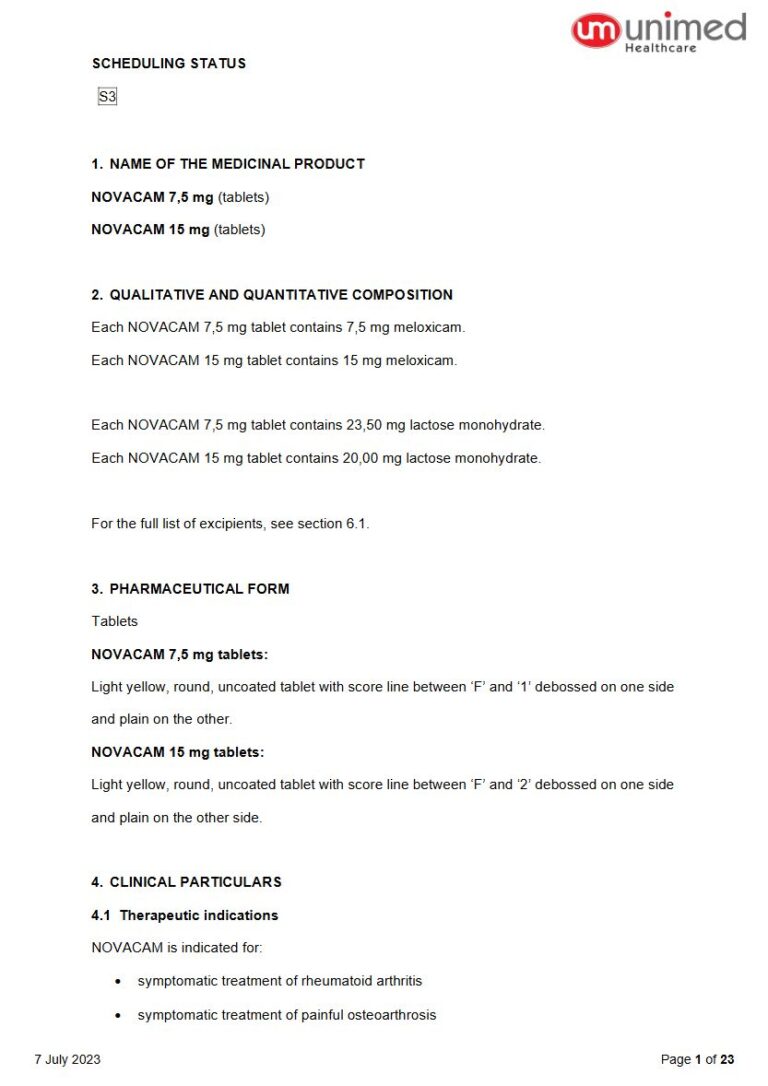
Novacam 7,5 mg/ 15 mg Tablets
PDF Leaflet Revision Date: 7 July 2023
Clinical Summary
Quick overview from the medicine insert
Indication
Symptomatic treatment of rheumatoid arthritis, osteoarthrosis, ankylosing spondylitis, and acute sciatica.
Dosage (summary)
15 mg/day for rheumatoid arthritis and ankylosing spondylitis; 7.5 mg/day for osteoarthrosis and acute sciatica.
Special Populations
- Elderly
- Hepatic impairment
- Renal impairment
Pregnancy & Breastfeeding
Contraindicated in pregnancy and breastfeeding.
Key Drug Interactions
- Other NSAIDs
- Anticoagulants
- Corticosteroids
- Lithium
- Methotrexate
Contraindications
- Hypersensitivity to meloxicam
- Severe hepatic failure
- Severe renal failure
- Severe heart failure
- Gastrointestinal bleeding
- Active inflammatory bowel disease
- Children under 12 years
Common side effects
- Gastrointestinal disorders
- Hypertension
- Oedema
- Headache
- Dizziness
Counselling Points
- Take with food
- Monitor for gastrointestinal symptoms
- Avoid alcohol
- Report any skin reactions
Serious warnings
- Gastrointestinal bleeding risk
- Cardiovascular events risk
- Serious skin reactions
Important Disclaimer
The Novacam 7,5 mg/ 15 mg Tablets professional information leaflet below is the property of Unimed Healthcare and is provided on Medinsert exactly as issued, with no.. alterations or editorial changes. We make every effort to keep content current by updating documents as soon as new versions become available. Medinsert serves as a trusted access point for healthcare professionals, but does not replace official sources or clinical judgement. For more details, please read our full disclaimer. read more>>
 Healthcare Professionals Only
This content is for registered healthcare professionals
Sign in or create a free account to read the full package insert.
Free for HPCSA-registered professionals. Powered by Medinsert.
Clinical Particulars
Section 4 of the official insert — extracted exactly as issued, no alterations
4.1 Therapeutic indications
NOVACAM is indicated for:
- symptomatic treatment of rheumatoid arthritis
- symptomatic treatment of painful osteoarthrosis
- symptomatic treatment of ankylosing spondylitis
- symptomatic treatment of episodes of acute sciatica.
4.2 Posology and method of administration
Posology
As the potential for adverse reactions increases with dose and duration of exposure, the shortest duration possible and the lowest effective daily dose should be used. (see section 4.4).
The maximum recommended daily dose is 15 mg per day.
Rheumatoid arthritis: 15 mg/day (see also u201cspecial populationsu201d). According to the therapeutic response, the dose may be reduced to 7,5 mg/day.
Ankylosing spondylitis: 15 mg/day (see also u201cspecial populationsu201d). According to the therapeutic response, the dose may be reduced to 7,5 mg/day.
Osteoarthrosis: 7,5 mg/day. If necessary, the dose may be increased to 15 mg/day.
Episodes of acute sciatica: 7,5 mg/day. If necessary, in the absence of improvement, the dose may be increased to 15 mg/day.
Combined administration: The total daily dosage of meloxicam administered as tablets, suppositories and injections should not exceed 15 mg.
Special Populations
Elderly patients and patients with increased risks for adverse reaction (see section 5.2): In patients with increased risks for adverse reactions (e.g. the elderly) start treatment at the dose of 7,5 mg per day (see section 4.4).
Hepatic/Renal impairment (see section 5.2): Mild or moderate hepatic insufficiency and mild or moderate renal insufficiency do not have a substantial effect on meloxicam pharmacokinetics. In dialysis patients with severe renal failure, the dose should not exceed 7,5 mg per day.
Paediatric population: As a dosage for use in children has yet to be established, NOVACAM should not be used in children aged less than 12 years. (see section 4.3).
Method of administration
For oral administration
NOVACAM should be swallowed, with water or other liquid, in conjunction with a food.
4.3 Contraindications
NOVACAM is contraindicated in the following:
- known hypersensitivity to meloxicam or any excipient of NOVACAM, or hypersensitivity to substances with a similar action, e.g. aspirin. and other non-steroidal anti-inflammatory drugs (NSAIDs).
- patients who have developed signs of asthma, nasal polyps, angioneurotic oedema or urticaria following the administration of acetylsalicylic acid or other NSAIDs.
- severe hepatic failure
- non-dialysed severe renal failure
- severe heart failure
- gastrointestinal bleeding, history of cerebrovascular bleeding or other bleeding disorders
- history of gastro-intestinal bleeding or perforation, related to previous NSAIDs therapy
- active, or history of recurrent peptic ulcer/haemorrhage (two or more distinct episodes of proven ulceration or bleeding)
- active inflammatory bowel disease (Crohnu2019s disease or ulcerative colitis)
- children under 12 years
- pregnancy and breastfeeding (See section 4.6)
- for the treatment of peri-operative pain in the setting of coronary artery bypass graft (CABG) surgery.
- In case of rare hereditary conditions that may be incompatible with an excipient of the product (see section 4.4)
4.4 Special warnings and precautions for use
Undesirable effects may be minimised by using the lowest effective dose for the shortest duration necessary to control symptoms (see section 4.2 and GI and cardiovascular risks below). The recommended maximum daily dose should not be exceeded in case of insufficient therapeutic effect, nor should an additional NSAID be added to the therapy because this may increase the toxicity while therapeutic advantage has not been proven. In the absence of improvement after several days, the clinical benefit of the treatment should be reassessed.
The use of NOVACAM, with concomitant NSAIDs including cyclooxygenase-2 selective inhibitors should be avoided.
Any history of oesophagitis, gastritis and/or peptic ulcer must be sought in order to ensure their total cure before starting treatment with NOVACAM. Attention should routinely be paid to the possible onset of a recurrence in patients treated with NOVACAM and with a past history of this type.
NOVACAM is not appropriate for the treatment of patients requiring relief from acute pain.
Gastrointestinal Effects
Gastrointestinal bleeding, ulceration or perforation, which can be fatal, has been reported with at any time during treatment, with or without warning symptoms or a previous history of serious gastrointestinal events. The risk of gastrointestinal bleeding, ulceration or perforation is higher with increasing NSAID doses, in patients with a history of ulcer, particularly if complicated with haemorrhage or perforations (see section 4.3), and in the elderly. Patients with a history of gastrointestinal toxicity, particularly when elderly, should report any unusual abdominal symptoms (especially gastrointestinal bleeding).
Caution should be advised in patients receiving concomitant medicines which could increase the risk of ulceration or bleeding, such as heparin as curative treatment or given in geriatrics, oral corticosteroids, anticoagulants such as warfarin, selective serotonin-reuptake inhibitors or anti-platelet agents such as aspirin or other non-steroidal anti-inflammatory drugs, including acetylsalicylic acid given at anti-inflammatory doses (u2265 1 g as single intake or u2265 3 g as total daily amount) (see section 4.5).
When gastrointestinal bleeding or ulceration occurs in patients receiving NOVACAM the treatment should be withdrawn. NOVACAM should be given with care to patients with a history of gastrointestinal disease (ulcerative colitis, Crohnu2019s disease, hiatus hernia, gastro-oesophageal reflux disease, angiodysplasia) as these conditions may be exacerbated (see section 4.8).
Cardiovascular and cerebrovascular effects
Appropriate monitoring and advice are required for patients with a history of hypertension and/or mild to moderate congestive heart failure as fluid retention and oedema have been reported in association with meloxicam as in NOVACAM therapy. Clinical monitoring of blood pressure for patients at risk is recommended at baseline and especially during treatment initiation with NOVACAM.
The use of NOVACAM (particularly at high doses and in long term treatment) may increase the risk of arterial thrombotic events (for example myocardial infarction or stroke) which can be fatal. Patients with cardiovascular disease or risk factors for cardiovascular disease may be at greater risk. Patients with uncontrolled hypertension, congestive heart failure, established ischaemic heart disease, peripheral arterial disease, and/or cerebrovascular disease should only be treated with NOVACAM after careful consideration. Similar consideration should be made before initiating longer-term treatment of patients with risk factors for cardiovascular disease (e.g. hypertension, hyperlipidaemia, diabetes mellitus, smoking).
Skin reactions
Serious skin reactions, some of them fatal, including exfoliative dermatitis, Stevens-Johnson syndrome (SJS), and toxic epidermal necrolysis (TEN), have been reported in association with the use of meloxicam as in NOVACAM (see section 4.8). Patients appear to be at highest risk of these reactions early in the course of therapy, the onset of the reaction occurring in the majority of cases within the first month of treatment. Patients should be monitored closely for skin reactions. NOVACAM should be discontinued at the first appearance of skin rash, mucosal lesions, or any other sign of hypersensitivity. If the patient has developed SJS or TEN with the use of NOVACAM, it must not be re-started in this patient at any time.
Parameters of liver and renal function
As with most NSAIDs, occasional increases in serum transaminase levels, increases in serum bilirubin or other liver function parameters, as well as increases in serum creatinine and blood urea nitrogen and other laboratory disturbances, have been reported with meloxicam as in NOVACAM. The majority of these instances involved transitory and slight abnormalities. Should any such abnormality prove significant or persistent, the administration of NOVACAM should be stopped and appropriate investigations undertaken.
No dose reduction is required in patients with clinically stable liver cirrhosis.
Functional renal failure
NOVACAM, by inhibiting the vasodilating effect of renal prostaglandins, may induce a functional renal failure by reduction of glomerular filtration. This adverse event is dose-dependent. At the beginning of the treatment, or after dose increase, careful monitoring of diuresis and renal function is recommended in patients with the following risk factors:
- elderly
- concomitant treatments such as ACE inhibitors, angiotensin-II antagonists, sartans, and diuretics (see section 4.5.)
- hypovolaemia (whatever the cause)
- congestive heart failure
- renal failure
- nephrotic syndrome
- lupus nephropathy
- severe hepatic dysfunction (serum albumin < 25 g/l or Child-Pugh score u2265 10)
Meloxicam as in NOVACAM may be the cause of interstitial nephritis, glomerulo-nephritis, renal medullary necrosis or nephrotic syndrome.
Renal Tubular Acidosis
Severe hypokalaemia and renal tubular acidosis have been reported due to prolonged use of NSAIDs at higher than recommended doses. Presenting signs and symptoms included generalised weakness. NSAID induced renal tubular acidosis should be considered in patients with unexplained hypokalaemia and metabolic acidosis.
Sodium, potassium and water retention
Induction of sodium, potassium and water retention and interference with the natriuretic effects of diuretics may occur with meloxicam as in NOVACAM. Furthermore, a decrease of the antihypertensive effect of antihypertensive medicines can occur (see section 4.5). Consequently, oedema, cardiac failure or hypertension may be precipitated or exacerbated in susceptible patients as a result. Clinical monitoring is therefore necessary for patients at risk (see section 4.2 and 4.3).
Hyperkalaemia
Hyperkalaemia can be favoured by diabetes or concomitant treatment known to increase hyperkalaemia (see section 4.5). Regular monitoring of potassium values should be performed in such cases.
Other warnings and precautions
Adverse reactions are often less well tolerated in elderly, fragile or weakened individuals, who therefore require careful monitoring. As with other NSAIDs, Particular caution is required in the elderly, in whom renal, hepatic and cardiac functions are frequently impaired. The elderly have an increased frequency of adverse events to NSAIDs especially gastrointestinal bleeding and perforation which may be fatal (see section 4.2).
Meloxicam as in NOVACAM, as any other NSAID may mask symptoms of an underlying infectious disease.
The use of NOVACAM may inhibit cyclooxygenase/prostaglandin syntheses and may impair fertility and is not recommended in women attempting to conceive. In women who have difficulties conceiving, or who are undergoing investigation of infertility, withdrawal of NOVACAM should be considered. (see section 4.6)
4.5 Interactions with other medicines
Interaction studies have only been performed in adults.
Pharmacodynamic Interactions:
Other non-steroidal anti-inflammatory drugs (NSAIDs) and salicylates (acetylsalicyclic acid u2265 3 g/d): Combination (see section 4.4) with other NSAIDs, including acetylsalicylic acid given at anti-inflammatory doses (u2265 1 g as single intake or u2265 3 g as total daily amount) is not recommended. Administration of several NSAIDs together may increase the risk of gastrointestinal ulcers and bleeding, via a synergistic effect.
Corticosteroids (e.g. Glucocorticoids): The concomitant use with corticosteroids requests caution because of an increased risk gastrointestinal perforation, ulceration or of bleeding (PUBs).
Anticoagulants or heparin administered in geriatrics or at curative doses: Considerably increased risk of bleeding, via inhibition of platelet function and damage to the gastroduodenal mucosa. Meloxicam as in NOVACAM may enhance the effects of anticoagulants, such as warfarin (see section 4.4).
The concomitant use of NOVACAM and anticoagulants or heparin administered in geriatrics or at curative dose is not recommended (see section 4.4). In remaining cases of heparin use caution is necessary due to an increased bleeding risk. Careful monitoring of the INR is required if it proves impossible to avoid such combination.
Thrombolytics and antiplatelet medicines: Increased risk of bleeding, via inhibition of platelet function and damage to the gastroduodenal mucosa.
Selective serotonin reuptake inhibitors (SSRIs): Increased risk of gastrointestinal bleeding, via inhibition of platelet function.
Diuretics, ACE inhibitors and Angiotensin-II Antagonists: Meloxicam as in NOVACAM may reduce the effect of diuretics and other antihypertensive medicines. In some patients with compromised renal function (e.g. dehydrated patients or elderly patients with compromised renal function) the co-administration of an ACE inhibitor or Angiotensin-II receptor antagonists and medicines that inhibit cyclo-oxygenase may result in further deterioration of renal function, including possible acute renal failure, which is usually reversible. Therefore, the combination should be administered with caution, especially in the elderly. Patients should be adequately hydrated and consideration should be given to monitoring of renal function prior and after initiation of concomitant therapy, and periodically thereafter (see also section 4.4).
Other antihypertensive medicines (e.g. Beta-blockers): As for the latter, a decrease of the antihypertensive effect of beta-blockers (due to inhibition of prostaglandins with vasodilatory effect) can occur.
Calcineurin inhibitors (e.g. ciclosporin, tacrolimus): Nephrotoxicity of ciclosporin may be enhanced by meloxicam as in NOVACAM via renal prostaglandin mediated effects. During combined treatment renal function is to be measured. A careful monitoring of the renal function is recommended, especially in the elderly. Tacrolimus should not be combined with NOVACAM.
Pemetrexed: For the concomitant use of NOVACAM with pemetrexed in patients with creatinine clearance from 45 to 79 mL/min, the administration of NOVACAM should be paused for 5 days before, on the day of, and 5 days following pemetrexed administration. If a combination of NOVACAM with pemetrexed is necessary, patients should be closely monitored, especially for myelosuppression and gastrointestinal adverse reactions. In patients with creatinine clearance below 45 mL/min the concomitant administration of NOVACAM with pemetrexed is not recommended.
Intrauterine devices: Meloxicam as in NOVACAM has been reported to decrease the efficacy of intrauterine devices.
Pharmacokinetic Interactions
Lithium: Meloxicam as in NOVACAM has been reported to increase blood lithium levels (via decreased renal excretion of lithium), which may reach toxic values. The concomitant use of lithium and meloxicam as in NOVACAM is not recommended (see section 4.4). If this combination appears necessary, lithium plasma concentrations should be monitored carefully during the initiation, adjustment and withdrawal of NOVACAM treatment.
Methotrexate: Meloxicam as in NOVACAM can reduce the tubular secretion of methotrexate thereby increasing the plasma concentrations of methotrexate. For this reason, for patients on high dosages of methotrexate (more than 15 mg/week) the concomitant use of meloxicam as in NOVACAM is not recommended (see section 4.4). The risk of an interaction between meloxicam as in NOVACAM and methotrexate, should be considered also in patients on low dosage of methotrexate, especially in patients with impaired renal function. In case combination treatment is necessary blood cell count and the renal function should be monitored. Caution should be taken in case both meloxicam as in NOVACAM and methotrexate are given within 3 days, in which case the plasma level of methotrexate may increase and cause increased toxicity. Although the pharmacokinetics of methotrexate (15 mg/week) were not relevantly affected by concomitant meloxicam as in NOVACAM treatment, it should be considered that the haematological toxicity of methotrexate can be amplified by treatment with NOVACAM (see above). (see section 4.8).
Cholestyramine: Cholestyramine accelerates the elimination of meloxicam as in NOVACAM by interrupting the enterohepatic circulation so that clearance for meloxicam as in NOVACAM increases by 50 % and the half-life decreases to 13 u00b1 3 hrs. This interaction is of clinical significance. NOVACAM is eliminated almost entirely by hepatic metabolism, of which approximately 200 two thirds are mediated by cytochrome (CYP) P450 enzymes (CYP 2C9 major pathway and CYP 3A4 minor pathway) and one third by other pathways, such as peroxidase oxidation. The potential for a pharmacokinetic interaction should be taken into account when NOVACAM and medicines known to inhibit, or to be metabolised by CYP 2C9 and/or CYP 3A4 are administered concurrently. No clinically relevant pharmacokinetic medicines interactions were detected with respect to the concomitant administration of antacids, cimetidine and digoxin and furosemide.
Interactions with oral anti-diabetics cannot be excluded. Concomitant treatment with probenecid leads to reduced excretion and thereby increased effects of meloxicam as in NOVACAM. Simultaneous administration of alcohol and NOVACAM increases the risk of bleeding.
4.6 Fertility, pregnancy and lactation
Pregnancy
NOVACAM is contraindicated during pregnancy. Inhibition of prostaglandin synthesis may adversely affect the pregnancy and/or the embryo/foetal development. Data from epidemiological studies suggest an increased risk of miscarriage and of cardiac malformation and gastroschisis after use of a prostaglandin synthesis inhibitor in early pregnancy. During the third trimester of pregnancy, all prostaglandin synthesis inhibitors may expose the foetus to:
- cardiopulmonary toxicity (with premature closure of the ductus arteriosus and pulmonary hypertension);
- renal dysfunction, which may progress to renal failure with oligo-hydroamniosis;
- The mother and the neonate, at the end of pregnancy, to possible prolongation of bleeding time, an anti-aggregating effect which may occur even at very low doses.
- inhibition of uterine contractions resulting in delayed or prolonged labour.
Breastfeeding
While no specific experience exists for meloxicam as in NOVACAM, NSAIDs are known to pass into motheru2019s milk. Administration therefore is not recommended in women who are breastfeeding.
Fertility
The use of meloxicam as in NOVACAM may impair fertility and is not recommended in women attempting to conceive. Therefore, in women who have difficulties conceiving, or who are undergoing investigation of infertility, withdrawal of NOVACAM should be considered.
4.7 Effects on ability to drive and use machines
There are no specific studies on the ability to drive and use machinery. However, when visual disturbances or drowsiness, vertigo or other central nervous system disturbances occur, it is advisable to refrain from driving and operating machinery.
4.8 Undesirable effects
a) Summary of the safety profile
NOVACAM tablets have side effects. Oedema, hypertension, and cardiac failure have been reported in association with NOVACAM treatment. Use of some NSAIDs (particularly at high doses and in long term treatment) may be associated with a small increased risk of arterial thrombotic events (for example myocardial infarction or stroke) (see section 4.4). The most commonly observed adverse events are gastrointestinal in nature. Peptic ulcers, perforation or GI bleeding, sometimes fatal, particularly in the elderly, may occur (see section 4.4). Nausea, vomiting, diarrhoea, flatulence, constipation, dyspepsia, abdominal pain, melaena, haematemesis, ulcerative stomatitis, exacerbation of colitis and Crohnu2019s disease (see section 4.4 - Special warnings and precautions for use) have been reported following administration. Less frequently, gastritis has been observed. Severe cutaneous adverse reactions (SCARs): Stevens-Johnson syndrome (SJS) and toxic epidermal necrolysis (TEN) have been reported (see section 4.4).
b) Tabulated summary of the adverse effects
MedDRA System Organ Classification (SOC) according to the sequence:
Adverse Reaction Frequency
Blood and lymphatic system disorders. anaemia less frequent blood count abnormal (including differential white cell count), leukopenia, thrombocytopenia less frequent cases of agranulocytosis have been reported (see section c) less frequent
Immune system disorders. allergic reactions other than anaphylactic or anaphylactoid reactions less frequent anaphylactic reaction, anaphylactoid reactions frequency not known
Metabolism and Nutrition Disorders hyperkalaemia, (see sections 4.4 and 4.5) less frequent hypokalaemia** frequency not known
Psychiatric disorders. mood altered, nightmares less frequent confusional state, disorientation frequency not known
Nervous system disorders. headache frequent dizziness, somnolence less frequent insomnia, nightmares frequency not known
Eye disorders. visual disturbance including blurred vision, conjunctivitis less frequent
Ear and labyrinth disorders. vertigo less frequent tinnitus less frequent
Cardiac disorders: palpitations, risk of arterial thrombotic events (for example, myocardial infarction or stroke) Bradycardia less frequent cardiac failure has been reported in association with NSAID treatment frequency not known
Vascular disorders: blood pressure increased (see section 4.4), flushing less frequent
Respiratory, thoracic and mediastinal disorders. asthma in individuals allergic to aspirin or other NSAIDs less frequent
Gastrointestinal disorders. gastrointestinal disorders such as dyspepsia, nausea, vomiting, abdominal pain, constipation, flatulence, diarrhoea frequent occult or macroscopic gastrointestinal haemorrhage*, ulcerative stomatitis, gastritis, eructation less frequent colitis, gastroduodenal ulcer, oesophagitis less frequent gastrointestinal perforation less frequent Perforation, peptic ulcers, melaena, haematemesis, exacerbation of Crohnu2019s disease, pancreatitis frequency not known
Hepatobiliary disorders. liver function disorder (e.g. raised transaminases or bilirubin) less frequent hepatitis less frequent
Skin and subcutaneous tissue disorders. angioedema, pruritus, rash less frequent Stevens-Johnson syndrome, toxic epidermal necrolysis, urticaria less frequent dermatitis bullous, erythema multiforme less frequent photosensitivity reaction frequency not known
Renal and urinary disorders. acute urinary retention sodium and water retention, renal function test abnormal (increased serum creatinine and/or serum urea), micturation disorders, less frequent Acute functional renal failure in patients with risk factors (see section 4.4) less frequent Renal tubular acidosis** frequency not known
General disorders and administration site conditions. Oedema including oedema of the lower limbs less frequent
*Gastrointestinal haemorrhage, ulceration or perforation may sometimes be severe and potentially fatal, especially in elderly (see section 4.4).
**Renal tubular acidosis and hypokalaemia have been reported in the post-marketing setting typically following prolonged use of higher than recommended doses.
c) Description of selected adverse reactions
Cases of agranulocytosis have been reported in patients treated with meloxicam as in NOVACAM and other potentially myelotoxic medicine (see section 4.5).
d) Adverse reactions which have not been observed yet in relation to the product, but which are generally accepted as being attributable to other compounds in the class Organic renal injury probably resulting in acute renal failure: cases of interstitial nephritis, acute tubular necrosis, nephrotic syndrome, and papillary necrosis have been reported (see section 4.4).
Reporting of suspected adverse reactions
Reporting suspected adverse reactions after authorisation of NOVACAM is important. It allows continued monitoring of the benefit/ Risk balance of NOVACAM. Healthcare professionals are asked to report any suspected adverse reactions via the u201c6.04 Adverse Drug Reaction Reporting Formu201d, found online under SAHPRAu2019s publications: https://www.sahpra.org.za/Publications/Index/8
4.9 Overdose
Symptoms
Symptoms following acute meloxicam as in NOVACAM overdose are usually limited to lethargy, drowsiness, nausea, vomiting and epigastric pain, which are generally reversible with supportive care. Gastrointestinal bleeding can occur. Severe poisoning may result in hypertension, acute renal failure, hepatic dysfunction, respiratory depression, coma, convulsions, cardiovascular collapse and cardiac arrest. Anaphylactoid reactions have been reported with therapeutic ingestion of meloxicam as in NOVACAM and may occur following an overdose. Prolonged use at higher than recommended doses may result in severe hypokalaemia and renal tubular acidosis. Symptoms may include generalised weakness (see section 4.4 and 4.8).
Treatment
Patients should be managed with symptomatic and supportive care following a meloxicam overdose. Accelerated elimination of meloxicam oral doses of cholestyramine was demonstrated in a clinical trial.
