
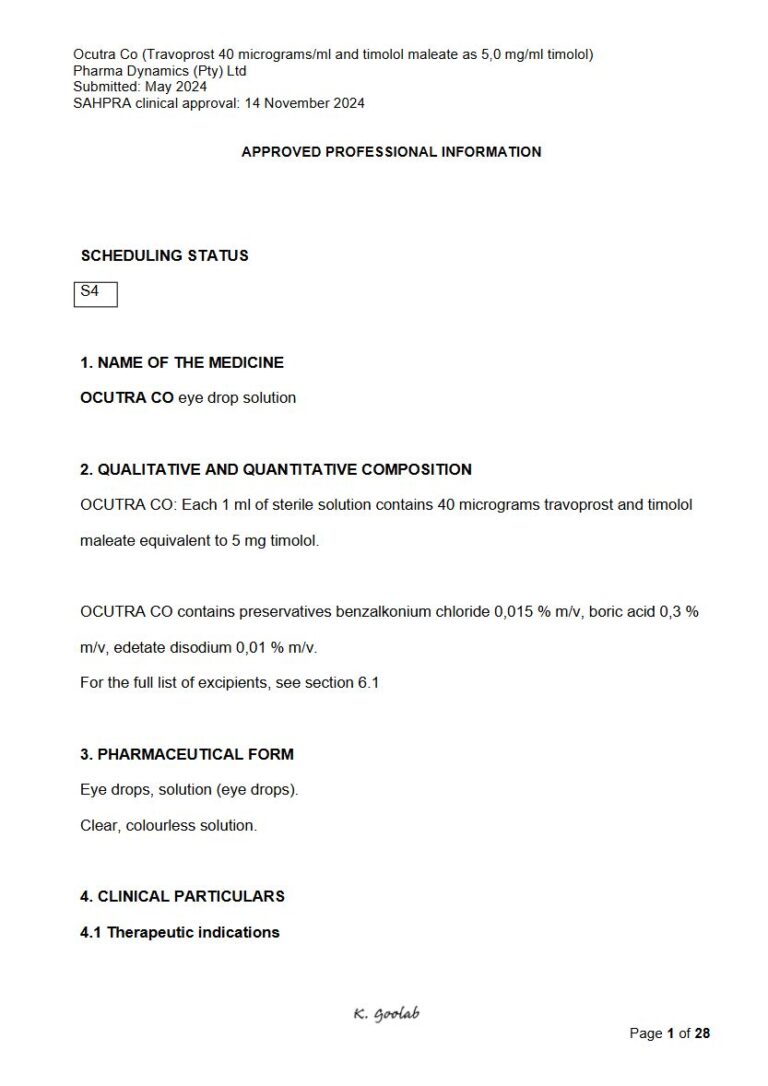
Ocutra Co 5 mg Eye drops, solution
PDF Leaflet Revision Date: 14 November 2024
Clinical Summary
Quick overview from the medicine insert
Indication
Decrease elevated intraocular pressure in ocular hypertension or open-angle glaucoma.
Dosage (summary)
One drop in the affected eye(s) once daily.
Onset of Action / Duration
Onset: 2 hours, Duration: >24 hours
Special Populations
- Hepatic impairment
- Renal impairment
Pregnancy & Breastfeeding
Not recommended in pregnancy; caution in breastfeeding.
Key Drug Interactions
- Oral beta-blockers
- Calcium channel blockers
- Digoxin
Contraindications
- Hypersensitivity to components
- Bronchial asthma
- Severe COPD
- Cardiac failure
Common side effects
- Ocular hyperemia
- Dry eye
- Blurred vision
- Headache
Counselling Points
- Avoid contact with eyelids
- Wait 15 mins before reinserting contact lenses
- Monitor for vision changes
Serious warnings
- Cardiac reactions
- Respiratory reactions
- Anaphylactic reactions
Important Disclaimer
The Ocutra Co 5 mg Eye drops, solution professional information leaflet below is the property of Pharma Dynamics and is provided on Medinsert exactly as issued, with no.. alterations or editorial changes. We make every effort to keep content current by updating documents as soon as new versions become available. Medinsert serves as a trusted access point for healthcare professionals, but does not replace official sources or clinical judgement. For more details, please read our full disclaimer. read more>>
 Healthcare Professionals Only
This content is for registered healthcare professionals
Sign in or create a free account to read the full package insert.
Free for HPCSA-registered professionals. Powered by Medinsert.
Clinical Particulars
Section 4 of the official insert — extracted exactly as issued, no alterations
4.1 Therapeutic indications
Decrease of elevated intraocular pressure (IOP) in patients with ocular hypertension or open-angle glaucoma for whom treatment with either travoprost or timolol given alone provides insufficient IOP reduction.
4.2 Posology and method of administration
For ocular use.
Posology
Use in adults, including the elderly: The dose is one drop of OCUTRA CO in the conjunctival sac of the affected eye(s) once daily, in the morning or evening. OCUTRA CO should be used at the same time each day.
Special populations
Use in hepatic and renal impairment: No studies have been conducted with OCUTRA CO in patients with hepatic or renal impairment. Travoprost, as in OCUTRA CO, has been studied in patients with mild to severe hepatic impairment and in patients with mild to severe renal impairment (creatinine clearance as low as 14 ml/min). No dosage adjustment was necessary in these patients.
Paediatric population
The efficacy and safety of OCUTRA CO in patients below the age of 18 years have not been established and its use is not recommended in these patients until further data become available.
Method of administration
The patient should remove the protective overwrap immediately prior to initial use. To prevent contamination of the dropper tip and solution, care must be taken not to touch the eyelids, surrounding areas or other surfaces with the dropper tip of the bottle. Nasolacrimal occlusion or gently closing the eyelid after administration of OCUTRA CO is recommended. This may reduce the systemic absorption of OCUTRA CO administered via the ocular route and result in a decrease in systemic side effects. If more than one topical ophthalmic medicine is being used, the medicines must be administered at least 5 minutes apart (see section 4.5). When substituting another ophthalmic anti-glaucoma medicine with OCUTRA CO, discontinue the other medicine after proper dosing on one day and start the following day with OCUTRA CO.
4.3 Contraindications
- hypersensitivity to travoprost, timolol or to any of the ingredients of OCUTRA CO
- bronchial asthma or a history of bronchial asthma, or severe chronic obstructive pulmonary disease
- sinus bradycardia, second or third degree atrioventricular block, overt cardiac failure or cardiogenic shock
- pregnancy and lactation (see section 4.6).
4.4 Special warnings and precautions for use
Children and adolescents under the age of 18 years: The efficacy and safety of OCUTRA CO in patients below the age of 18 years have not been established and its use is not recommended in these patients until further data becomes available.
Cardiac disorders: Coronary heart disease, Prinzmetalu2019s angina, cardiac failure and hypotension should be adequately controlled before beginning therapy with OCUTRA CO. Patients with cardiovascular diseases should be observed for signs of deterioration and have their pulse rates checked. Cardiac reactions and, in some cases, death in association with cardiac failure, have occurred following administration of OCUTRA CO. Due to its negative effect on conduction time, OCUTRA CO should be given with caution to patients with first degree heart block.
Respiratory disorders: Respiratory reactions, including death due to bronchospasm in patients with asthma, have occurred following administration of OCUTRA CO (see section 4.3). OCUTRA CO should be used with caution in patients with mild/moderate chronic obstructive pulmonary disease (COPD).
Vascular disorders: Patients with severe peripheral circulatory disturbance/disorders (i.e. severe forms of Raynaud's disease or Raynaud's syndrome) should be given OCUTRA CO with caution.
Hypoglycaemia/diabetes: OCUTRA CO should be administered with caution in patients subject to spontaneous hypoglycaemia or to diabetic patients (especially those with labile diabetes) as timolol, as in OCUTRA CO, may mask the signs and symptoms of, and the response to, hypoglycaemia.
Anaphylactic reactions: While taking OCUTRA CO, patients with a history of atopy or a history of severe anaphylactic reaction to a variety of allergens may be unresponsive to the usual doses of epinephrine (adrenaline) used to treat anaphylactic reactions.
Systemic effects: OCUTRA CO is absorbed systemically. Timolol is a beta-blocker, therefore the same types of adverse reactions found with systemic administration of beta-blockers may occur with OCUTRA CO. After topical ophthalmic administration, the incidence of systemic adverse reactions is lower than for systemic administration. For information on how to reduce systemic absorption, see section 4.2.
Muscle weakness: OCUTRA CO can potentiate muscle weakness consistent with certain myasthenic symptoms (e.g. diplopia, ptosis and generalised weakness).
Corneal diseases: Ophthalmic timolol, as in OCUTRA CO, may induce dryness of eyes. Patients with corneal diseases should be treated with caution.
Choroidal detachment: Choroidal detachment has been reported with administration of aqueous suppressant therapy, such as OCUTRA CO, after filtration procedures.
Ocular effects: Travoprost may gradually change the eye colour by increasing the number of melanosomes (pigment granules) in melanocytes. Before treatment with OCUTRA CO is commenced, patients must be informed of the possibility of a permanent change in eye colour. Unilateral treatment can result in permanent heterochromia. The long term effects on the melanocytes and any consequences thereof are currently unknown. The change in iris colour occurs slowly and may not be noticeable for months to years. The change in eye colour has predominantly been seen in patients with mixed coloured irides, i.e., blue-brown, grey-brown, yellow-brown and green-brown; however, it has also been observed in patients with brown eyes. Typically, the brown pigmentation around the pupil spreads concentrically towards the periphery in affected eyes, but the entire iris or parts of it may become more brownish. After discontinuation of therapy with OCUTRA CO, no further increase in brown iris pigment has been observed.
Periorbital and/or eyelid skin darkening in association with the use of OCUTRA CO has also been reported. Periorbital and lid changes, including deepening of the eyelid sulcus, have been observed with prostaglandin analogues. Travoprost may gradually change eyelashes in the treated eye(s); these changes include increased length, thickness, pigmentation, and/or number of lashes. The mechanism of eyelash changes and their long term consequences are unknown.
There is no experience of OCUTRA CO in inflammatory ocular conditions; nor in neovascular, angle-closure, narrow-angle or congenital glaucoma and only limited experience in thyroid eye disease, in open-angle glaucoma of pseudophakic patients and in pigmentary or pseudoexfoliative glaucoma. Caution is recommended when using OCUTRA CO in aphakic patients, pseudophakic patients with a torn posterior lens capsule or anterior chamber lenses, or in patients with known risk factors for cystoid macular oedema, as macular oedema has been reported during treatment with prostaglandin F2u03b1 analogues. In patients with known predisposing risk factors for iritis/uveitis, OCUTRA CO can be used with caution.
Skin contact: Travoprost, as in OCUTRA CO, is a biologically active substance that may be absorbed through the skin. Women who are pregnant or attempting to become pregnant should exercise appropriate precautions to avoid direct exposure to the contents of OCUTRA CO. In the unlikely event of coming into contact with a substantial portion of the contents of the OCUTRA CO bottle, thoroughly cleanse the exposed area immediately.
Hyperthyroidism: OCUTRA CO may also mask the signs of hyperthyroidism. Abrupt withdrawal of OCUTRA CO therapy may precipitate a worsening of symptoms.
Concomitant therapy: OCUTRA CO may interact with other medicines. The effect on intra-ocular pressure or the known effects of systemic beta-blockade may be potentiated when OCUTRA CO is given to patients already receiving an oral beta-blocking medicine. The response of these patients should be closely observed. The use of two local beta-adrenergic blocking medicines or two local prostaglandins is not recommended. Patients with phaeochromocytoma should not be given OCUTRA CO without alpha-adrenoceptor blocking therapy as well.
Surgery anaesthesia: OCUTRA CO may block systemic beta-agonist effects e.g. of epinephrine (adrenaline). The anaesthesiologist should be informed when the patient is receiving OCUTRA CO.
Information on excipients of OCUTRA CO: Benzalkonium chloride, used as a preservative in OCUTRA CO, may cause punctate keratopathy and/or toxic ulcerative keratopathy. Close monitoring is required with frequent or prolonged use of OCUTRA CO in dry eye patients, or in conditions where the cornea is compromised. Benzalkonium chloride may cause irritation and is known to discolour soft contact lenses. Therefore, patients must remove contact lenses prior to application of OCUTRA CO and should be instructed to wait 15 minutes after instillation of OCUTRA CO before inserting contact lenses. As the possibility of adverse effects on the corneal permeability, and the danger of disruption of the corneal epithelium with prolonged or repeated usage of benzalkonium chloride preservative cannot be excluded, regular ophthalmological examination is required. Caution should be exercised in the use of OCUTRA CO over an extended period in patients with extensive ocular surface disease.
4.5 Interaction with other medicines and other forms of interaction
No specific interaction studies have been conducted with travoprost or timolol, as in OCUTRA CO. There is a potential for additive effect results in hypotension and/or marked bradycardia when OCUTRA CO is administered concomitantly with oral calcium channel blockers, beta-blocking medicines, anti-dysrhythmics (including amiodarone), digoxin, guanethidine or parasympathomimetics. The hypertensive reaction to sudden withdrawal of clonidine can be potentiated when using timolol, as in OCUTRA CO. Potentiated systemic beta-blockade (e.g. decreased heart rate, depression) has occurred during combined treatment with CYP2D6 inhibitors (e.g. quinidine, selective serotonin re-uptake inhibitors) and timolol contained in OCUTRA CO. Mydriasis resulting from concomitant use of timolol, as in OCUTRA CO, and epinephrine (adrenaline) may occur. Timolol, as in OCUTRA CO, may increase the hypoglycaemic effect of antidiabetic medicines. OCUTRA CO can mask the signs and symptoms of hypoglycaemia (see section 4.4).
4.6 Fertility, pregnancy and lactation
Women of childbearing potential: OCUTRA CO should not be used in women who may become pregnant unless adequate contraceptive measures are in place.
Pregnancy: There are no adequate data from the use of OCUTRA CO in pregnant women. Animal studies with travoprost, as in OCUTRA CO, have shown reproductive toxicity. OCUTRA CO should not be used during pregnancy (see section 4.3). Travoprost has harmful pharmacological effects on pregnancy and/or the foetus/newborn child. Epidemiological studies have not revealed malformative effects but show a risk for intrauterine growth retardation when beta blockers are administered by the oral route. In addition, signs and symptoms of beta blockade (e.g. bradycardia, hypotension, respiratory distress and hypoglycaemia) have been observed in the neonate when beta blockers have been administered until delivery.
Breastfeeding: Timolol, as in OCUTRA CO, is excreted in breast milk and has the potential to cause serious adverse reactions in the breast-fed infant. However, at therapeutic doses of timolol in eye drops it is unlikely that sufficient amounts would be present in breast milk to produce clinical symptoms of beta blockade in the infant. For information on how to reduce systemic absorption, see section 4.2. Therefore, mothers breastfeeding their babies should not be treated with OCUTRA CO (see section 4.3). It is unknown whether travoprost from eye drops is excreted in human breast milk, however, animal studies have shown excretion of travoprost and metabolites in breast milk.
Fertility: There are no data on the effects of OCUTRA CO on human fertility.
4.7 Effects on ability to drive and use machines
OCUTRA CO has minor influence on the ability to drive and use machines. OCUTRA CO may cause temporary blurred vision or other visual disturbances which could affect the ability to drive and use machines. Patients should be advised to wait until their vision clears before driving or operating machinery.
4.8 Undesirable effects
Summary of the safety profile
Study data indicates the most frequently reported treatment-related adverse reaction is ocular hyperemia.
Tabulated list of adverse effects u2013 OCUTRA CO
System Organ Class Frequency Side effects
Blood and lymphatic system disorders Frequency unknown Agranulocytosis, increase in antinuclear antibodies, transient eosinophilia, non-thrombocytopenic purpura, thrombocytopenia
Immune system disorders Less frequent Hypersensitivity
Psychiatric disorders Less frequent Frequency unknown Nervousness, Depression
Nervous system disorders Less frequent Frequency unknown Dizziness, headache, Cerebrovascular accident, syncope, paraesthesia
Eye disorders Frequent Less frequent Frequency unknown Abnormal sensation in eye, dry eye, growth of eyelashes, ocular hyperaemia, eye irritation, punctate keratitis, eye pain, photophobia, eye pruritus, visual disturbance, blurred vision, Eye allergy, anterior chamber cells, anterior chamber flare, asthenopia, blepharitis, allergic conjunctivitis, conjunctival haemorrhage, conjunctival oedema, distichiasis, eyelid margin crusting, dermatitis of eyelid, corneal erosion, erythema of eyelid, eyelid irritation, iritis, keratitis, increased lacrimation, meibomianitis, eyelid oedema, eyelid pain, periorbital disorder, ocular discomfort, photophobia, eyelids pruritus, corneal staining, eye swelling, trichiasis, reduced visual acuity, visual disturbance, xerophthalmia, Corneal disorder, macular oedema, eyelid ptosis
Cardiac disorders Less frequent Frequency unknown Bradycardia, dysrhythmia, irregular heart rate, Cardiac failure, chest pain, palpitations, tachycardia
Vascular disorders Less frequent Frequency unknown Hypertension, hypotension, Peripheral oedema
Respiratory, thoracic and mediastinal disorders Less frequent Frequency unknown Bronchospasm, cough, nasal discomfort, dysphonia, dyspnoea, postnasal drip, throat irritation, oropharyngeal pain, Asthma
Gastrointestinal disorders Frequency unknown Dysgeusia
Hepatobiliary disorders Less frequent Increased alanine aminotransferase, increased aspartate aminotransferase
Skin and subcutaneous tissue disorders Less frequent Frequency unknown Alopecia, contact dermatitis, skin discolouration, skin hyperpigmentation, hypertrichosis, urticaria, Rash
Musculoskeletal, connective tissue and bone disorders Less frequent Pain in extremity
Renal and urinary disorders Less frequent Chromaturia
General disorders and administrative site conditions Less frequent Thirst, fatigue
Investigations Less frequent Frequency unknown Increased blood pressure, increased/decreased diastolic blood pressure, decreased heart rate, irregular heart rate, decreased intraocular pressure, Changes in blood concentrations of triglycerides and cholesterol, raised liver enzymes
Additional adverse reactions that have been seen with one of the active substances and may potentially occur with OCUTRA CO. as individually indicated below.
Tabulated list of adverse effects u2013 TRAVOPROST
System Organ Class Frequency Side effects
Immune system disorders Frequency unknown Seasonal allergy
Psychiatric disorders Frequency unknown Anxiety, insomnia
Nervous system disorders Frequency unknown Dizziness, headache
Eye disorders Frequency unknown Conjunctival disorder, darkening, thickening and lengthening of eye lashes, darkening of palpebral skin, conjunctival follicles, conjunctival hyperaemia, transient punctuate, epithelial erosions, iris hyperpigmentation, severe iritis, ocular irritation, corneal, macular and eyelid oedema, uveitis, eye discharge, eyelids pruritus, ectropion, cataract, ophthalmic herpes simplex, photopsia, eczema eyelids, halo vision, hypoaesthesia eye, anterior chamber pigmentation, mydriasis, visual field defect
Ear and labyrinth disorders Frequency unknown Vertigo, tinnitus
Vascular disorders Frequency unknown Blood pressure diastolic decreased, blood pressure systolic increased
Respiratory, thoracic and mediastinal disorders Frequency unknown Asthma aggravated, rhinitis allergic, epistaxis, respiratory disorder, nasal congestion, nasal dryness
Gastrointestinal disorders Frequency unknown Peptic ulcer reactivated, gastrointestinal disorder, diarrhoea, constipation, dry mouth, abdominal pain, nausea, vomiting
Skin and subcutaneous tissue disorders Frequency unknown Skin exfoliation, hair texture abnormal, dermatitis allergic, hair colour changes, madarosis, pruritus, hair growth abnormal, erythema
Musculoskeletal, connective tissue and bone disorders Frequency unknown Arthralgia, myalgia
Renal and urinary disorders Frequency unknown Dysuria, urinary incontinence
General disorders and administrative site conditions Frequency unknown Asthenia
Investigations Frequency unknown Prostatic specific antigen increased
Tabulated list of adverse effects u2013 TIMOLOL
System Organ Class Frequency Side effects
Immune system disorders Frequency unknown Systemic allergic reactions including anaphylaxis, angioedema, pruritus, localised and generalised rash, systemic lupus erythematosus, urticaria
Metabolism and nutrition disorders Frequency unknown Hypoglycaemia, hyperglycaemia
Psychiatric disorders Frequency unknown Confusion, depression, hallucinations, insomnia, memory loss, nightmares
Nervous system disorders Frequency unknown Headache, cerebral ischaemia, dizziness, increase in signs and symptoms of myasthenia gravis
Eye disorders Frequent Less frequent Frequency unknown Choroidal detachment (following filtration surgery), conjunctivitis, decreased corneal sensitivity, diplopia, signs and symptoms of ocular irritation (e.g. burning, stinging, itching, tearing, redness), decreased tear production, sore eyes, blurred vision diplopia
Cardiac disorders Frequency unknown Bradycardia, cardiac arrest, chest pains, congestive heart failure, heart block, palpitations, oedema, atrioventricular block
Vascular disorders Frequency unknown Hypotension, Raynaudu2019s phenomenon, cold hands and feet
Respiratory, thoracic and mediastinal disorders Frequency unknown Bronchospasm, dyspnoea, shortness of breath, pneumonitis, pulmonary fibrosis, pleurisy
Gastrointestinal disorders Frequency unknown Abdominal cramps and pain, constipation, diarrhoea, dry mouth, dysgeusia, dyspepsia, retroperitoneal fibrosis, nausea, sclerosing peritonitis, vomiting
Skin and subcutaneous tissue disorders Frequency unknown Reversible alopecia, pruritus, psoriasiform, rash or exacerbation of psoriasis, excess sweating
Musculoskeletal, connective tissue and bone disorders Frequency unknown Arthralgia and myopathies including muscle cramps, myalgia
Reproductive system and breast disorders Frequency unknown Sexual dysfunction, decreased libido, male impotence
General disorders and administrative site conditions Frequency unknown Asthenia
4.9 Overdose
Signs and symptoms: In case of accidental ingestion with OCUTRA CO, symptoms may include hypotension, bradycardia, bronchospasm, heart failure, convulsions and coma.
Management of overdose: If overdosage with OCUTRA CO occurs, treatment should be symptomatic and supportive. Timolol, as in OCUTRA CO, does not dialyse readily.
