
Oftapat 1,0 mg EYE DROPS SOLUTION
PDF Leaflet Revision Date: 25 October 2022
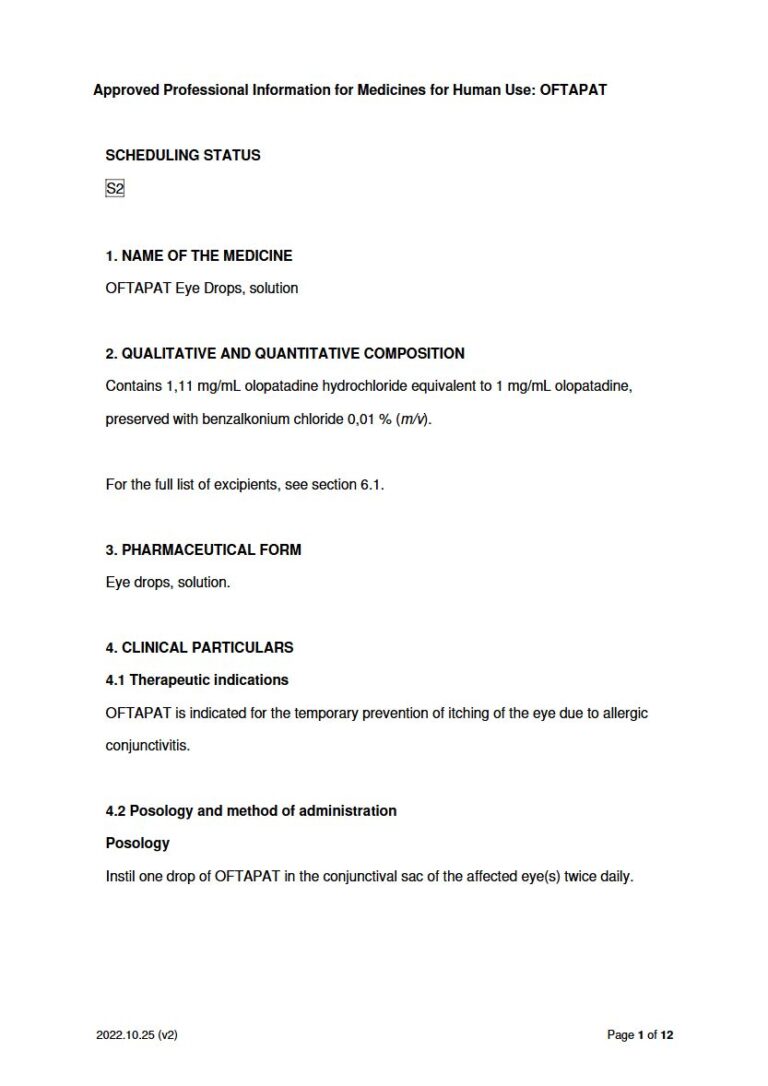
Clinical Summary
Quick overview from the medicine insert
Indication
Temporary prevention of itching of the eye due to allergic conjunctivitis.
Dosage (summary)
Instil one drop in the affected eye(s) twice daily.
Special Populations
- Elderly population
- Paediatric population
- Renal impairment
- Hepatic impairment
Pregnancy & Breastfeeding
Not recommended during pregnancy or breastfeeding.
Contraindications
- Hypersensitivity to olopatadine or excipients
Common side effects
- Eye pain
- Eye irritation
- Dry eye
Counselling Points
- Remove contact lenses before use
- Wait 10 minutes before reinserting contact lenses
- Monitor for eye irritation
Serious warnings
- Serious hypersensitivity reactions
- Eye irritation from benzalkonium chloride
- Risk of keratopathy
Important Disclaimer
The Oftapat 1,0 mg EYE DROPS SOLUTION professional information leaflet below is the property of Austell Pharmaceuticals and is provided on Medinsert exactly as issued, with no.. alterations or editorial changes. We make every effort to keep content current by updating documents as soon as new versions become available. Medinsert serves as a trusted access point for healthcare professionals, but does not replace official sources or clinical judgement. For more details, please read our full disclaimer. read more>>
 Healthcare Professionals Only
This content is for registered healthcare professionals
Sign in or create a free account to read the full package insert.
Free for HPCSA-registered professionals. Powered by Medinsert.
Clinical Particulars
Section 4 of the official insert — extracted exactly as issued, no alterations
4.1 Therapeutic indications
OFTAPAT is indicated for the temporary prevention of itching of the eye due to allergic conjunctivitis.
4.2 Posology and method of administration
Posology
Instil one drop of OFTAPAT in the conjunctival sac of the affected eye(s) twice daily.
Special populations
Elderly population
No dosage alteration in elderly patients is necessary.
Paediatric population
OFTAPAT may be used in paediatric patients (3 years of age and older) at the same posology as in adults.
Use in hepatic and renal impairment
OFTAPAT eye drops has not been studied in patients with renal or hepatic disease. However, a renal impairment study after oral dosing of olopatadine in patients with severe renal impairment indicates that a higher plasma concentration can be expected with olopatadine eye drops in this population. However, because of the low plasma exposure following topical ocular administration, no dose adjustment is necessary. Hepatic metabolism represents a small fraction of olopatadine elimination. Therefore, hepatic impairment is not expected to alter the pharmacokinetics of olopatadine and no dose adjustment is necessary.
Method of administration
OFTAPAT is for ocular use only. After the bottle cap is removed, if the tamper evident snap collar is loose, remove before using the product. To prevent contamination of the dropper tip and solution, care must be taken not to touch the eyelids, surrounding areas, or other surfaces with the dropper tip of the bottle. Keep the bottle tightly closed when not in use. In case of concomitant therapy with other topical ocular medicines, an interval of five minutes should be allowed between successive applications. Eye ointments should be administered last.
4.3 Contraindications
- Hypersensitivity to the active substance or to any of the excipients listed in section 6.1.
4.4 Special warnings and precautions for use
Hypersensitivity
OFTAPAT is an antiallergic/antihistaminic medicine and, although administered topically, is absorbed systemically. If signs of serious reactions or hypersensitivity occur, discontinue the use of this treatment.
Eye irritation
OFTAPAT contains benzalkonium chloride which may cause eye irritation.
Keratopathy
Benzalkonium chloride has also been reported to cause punctate keratopathy and/or toxic ulcerative keratopathy. Close monitoring is required with frequent or prolonged use in dry eye patients, or in conditions where the cornea is compromised.
Contact lenses
Benzalkonium is known to discolour soft contact lenses. To avoid contact with soft contact lenses, OFTAPAT should not be administered while wearing contact lenses. Patients should be instructed to remove contact lenses prior to administration of the eye drop and wait at least 10 minutes after instillation before re-inserting contact lenses.
Excipient: benzalkonium chloride OFTAPAT contains 0,1 mg benzalkonium chloride (a preservative) in each millilitre eye drop solution which is equivalent to 0,01 % (m/v). As the possibility of adverse effects on the corneal permeability, and the danger of disruption of the corneal epithelium with prolonged or repeated usage of benzalkonium chloride preserved ophthalmological preparations, cannot be excluded, regular ophthalmological examination is required. Caution should be exercised in the use of benzalkonium chloride preserved topical medication over an extended period in patients with extensive ocular surface disease. From the limited data available, there is no difference in the adverse event profile in children compared to adults. Generally, however, eyes in children show a stronger reaction for a given stimulus than the adult eye. Irritation may have an effect on treatment adherence in children.
4.5 Interaction with other medicines and other forms of interaction
No interaction studies with other medicines have been performed. In vitro studies with olopatadine eye drops have shown that olopatadine did not inhibit metabolic reactions which involve cytochrome P-450 isozymes 1A2, 2C8, 2C9, 2C19, 2D6, 2E1 and 3A4. These results indicate that olopatadine is unlikely to result in metabolic interactions with other concomitantly administered active substances.
4.6 Fertility, pregnancy and lactation
Pregnancy
There are no or limited amount of data from the use of ophthalmic olopatadine in pregnant women. Studies in animals have shown reproductive toxicity following systemic administration. Olopatadine is not recommended during pregnancy and in women of childbearing potential not using contraception.
Breastfeeding
It is not known whether topical administration to humans could result in sufficient systemic absorption to produce detectable quantities in human breast milk. OFTAPAT is not recommended for breastfeeding mothers.
Fertility
Studies have not been performed to evaluate the effect of topical ocular administration of olopatadine on human fertility.
4.7 Effects on ability to drive and use machines
OFTAPAT has no or negligible influence on the ability to drive and use machines. Temporary blurred vision or other visual disturbances may affect the ability to drive or use machines. If blurred vision occurs at instillation, the patient must wait until the vision clears before driving or using machinery.
4.8 Undesirable effects
a) Summary of the safety profile
The most frequent treatment-related adverse reaction was eye pain, reported at an overall incidence of 0,7 %. b) Tabulated list of adverse reactions
The table below shows all adverse drug reactions (ADRs) observed during clinical trials and postmarket spontaneous reports with olopatadine.
System Organ Class Frequency Frequent Less Frequent Not known Infections and infestations rhinitis Immune system disorders hypersensitivity, swelling face Nervous system disorders headache, dysgeusia dizziness, hypoaesthesia somnolence Eye disorders eye pain, eye irritation, dry eye, abnormal sensation in eyes corneal erosion, corneal epithelium defect, corneal epithelium disorder, punctate keratitis, keratitis, corneal staining, eye discharge, photophobia, vision blurred, visual acuity reduced, blepharospasm, ocular discomfort, eye pruritus, conjunctival follicles, conjunctival disorder, foreign body sensation in eyes, lacrimation increased, corneal oedema, eye oedema, eye swelling, conjunctivitis, mydriasis, visual disturbance, eyelid margin crusting erythema of eyelid, eyelid oedema, eyelid disorder, ocular hyperaemia Respiratory, thoracic and mediastinal disorders nasal dryness dyspnoea, sinusitis Gastrointestinal disorders nausea, vomiting Skin and subcutaneous tissue disorders contact dermatitis, skin burning sensation, dry skin dermatitis, erythema General disorders and administration site conditions fatigue asthenia, malaise Cases of corneal calcification have been reported less frequently in association with the use of phosphate containing eye drops in some patients with significantly damaged corneas.
Reporting of suspected adverse reactions
Reporting suspected adverse reactions after authorisation of the medicine is important. It allows continued monitoring of the benefit/risk balance of the medicine. Healthcare professionals are asked to report any suspected adverse reactions to SAHPRA via the u201c6.04 Adverse Drug Reaction Reporting Formu201d, found online under SAHPRAu2019s publications: https://www.sahpra.org.za/Publications/Index/8
4.9 Overdose
In the case of overdose, appropriate monitoring and management of the patient should be implemented.
