
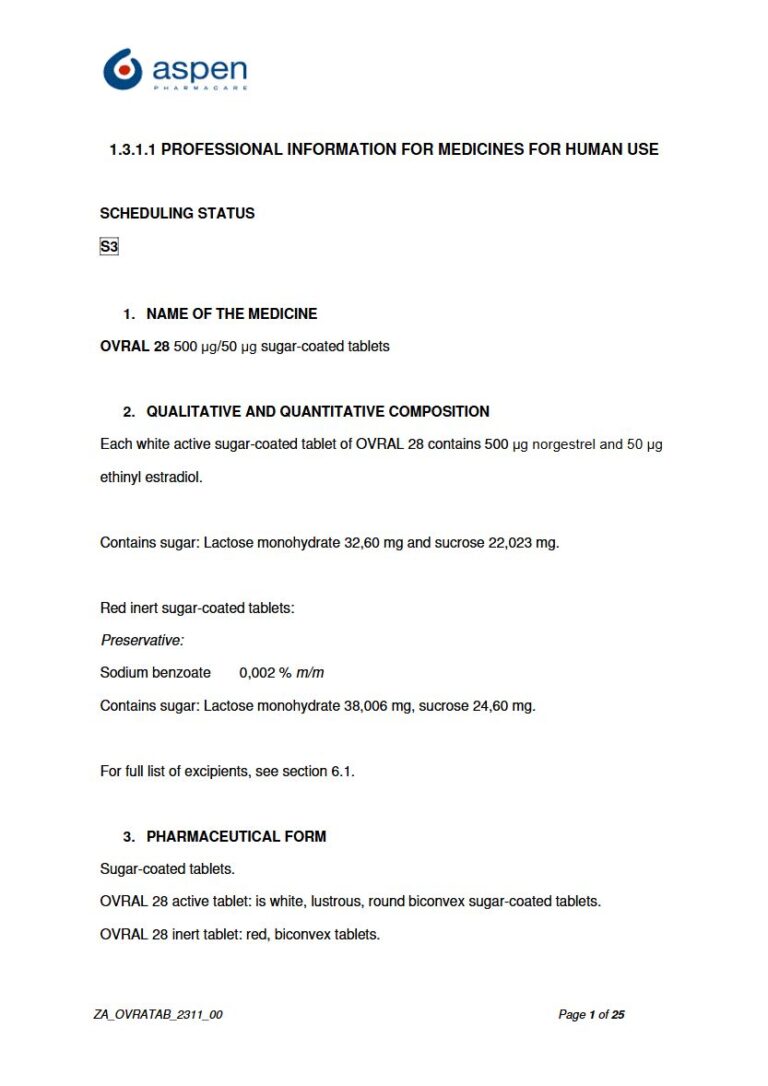
Ovral 28 500 _g / 50 _g Tablet
PDF Leaflet Revision Date: 21 November 2023
Clinical Summary
Quick overview from the medicine insert
Indication
Fertility control and management of menstrual irregularities.
Dosage (summary)
One white tablet daily for 21 days, followed by one red tablet daily until finished.
Special Populations
- Caution in smokers over 35
- History of thromboembolic disorders
- Liver disease
Pregnancy & Breastfeeding
Contraindicated in pregnancy; may reduce milk production in lactating women.
Key Drug Interactions
- Antibiotics
- CYP3A4 inducers
- HCV treatments with ombitasvir/paritaprevir/ritonavir
Contraindications
- Hypersensitivity
- Thromboembolic disorders
- Uncontrolled hypertension
- Liver tumors
- Pregnancy
Common side effects
- Breakthrough bleeding
- Nausea
- Headache
- Breast tenderness
Counselling Points
- Take at the same time daily
- Use backup contraception if missed doses
- Report severe headaches or vision changes
Serious warnings
- Increased risk of thromboembolic events
- Serious cardiovascular risks in smokers
- Monitor for depression
Important Disclaimer
The Ovral 28 500 _g / 50 _g Tablet professional information leaflet below is the property of Pharmacare and is provided on Medinsert exactly as issued, with no.. alterations or editorial changes. We make every effort to keep content current by updating documents as soon as new versions become available. Medinsert serves as a trusted access point for healthcare professionals, but does not replace official sources or clinical judgement. For more details, please read our full disclaimer. read more>>
 Healthcare Professionals Only
This content is for registered healthcare professionals
Sign in or create a free account to read the full package insert.
Free for HPCSA-registered professionals. Powered by Medinsert.
Clinical Particulars
Section 4 of the official insert — extracted exactly as issued, no alterations
4.1. Therapeutic indications
OVRAL 28 is indicated for:
- Fertility control in women.
- Control of certain menstrual irregularities.
4.2. Posology and method of administration
Posology
Adults
FOR CONTRACEPTION
- The patient should start by taking the white tablet in the circle on the package on the first day of her menstrual cycle (i.e. the day bleeding commences).
- One white tablet should be taken each day, immediately after the evening meal or at bedtime, as nearly as possible at the same time each day for 21 days, following the arrows until all 21 white tablets are finished.
- Then the patient should start taking one red coloured tablet each day (again following the arrows) until all the red tablets are finished.
- On the following day, the patient should start a new package taking the first white tablet in the circle to commence the next course.
NOTE: There must be no interval between finishing one course and starting the next.
The changes the patient can expect:
The patient will probably have a menstrual period two or three days after taking the last white tablet in each package.
The blood now may be slightly less or more than the patient had before she started taking OVRAL 28.
Caution:
Omitted tablets: OVRAL 28 is designed to prevent pregnancy. OVRAL 28 will do this as long as the patient follows the schedule carefully. However, should the patient forget to take one or more tablets, contraceptive failure may take place. In such cases, the patient should use an additional birth control method (other than OVRAL 28).
If the patient misses taking 1 tablet, the patient should take it in the morning as soon as possible, then take the next tablet at the usual time and continue the course as before. The patient should remember to use an additional contraceptive method until she finishes the package.
If the patient forgets to take 2 tablets in a row; the patient should take the 2 missed tablets when she remembers, and the tablet for that day should be taken at the regular time. In this case the patient will take 3 tablets on the day she remembers. The patient should continue her schedule until the package is finished. An additional contraceptive method is necessary until she finishes the package.
If the patient forgets 3 or more tablets in a row, she should NOT take them when she remembers and she should NOT finish the package. The patient should wait 4 more days. This makes 1 week without tablets. The patient should then begin a new package on DAY 8, even if she is still bleeding. During the 7 days without tablets, and until the patients has taken a tablet daily for seven days from the new OVRAL 28 package, the patient should use an additional birth control method.
If she omits any of the tablets in a package and does not menstruate when she expected to, she should be advised to see her doctor or healthcare provider. She should not take any more tablets until the doctor says that she can.
Advice in case of gastrointestinal disturbances
If, while on OVRAL 28 the patient develops severe vomiting and diarrhoea, the absorption of OVRAL 28 may be diminished and women should be advised to use additional methods of contraception at a time of such disorders. If vomiting or diarrhoea occurs within 3 to 4 hours after taking an active tablet of OVRAL 28, handle this as a missed tablet.
Method of administration
For oral administration.
4.3. Contraindications
OVRAL 28 is contraindicated in:
- Patients with hypersensitivity to norgestrel, ethinyl estradiol or to any of the excipients listed (see section 6.1).
- Patients with previous or active thromboembolic disorders or those with a high risk of arterial of venous thrombotic diseases (see section 4.4). This includes:
- Patients who smoke and are over the age of 35 years.
- Patients who have a history of, or current deep vein thrombosis (DVT), pulmonary embolism or inherited thrombophilia.
- Patients who have inherited or acquired hypercoagulopathies.
- Patients who have cerebrovascular insufficiency or cerebrovascular disease.
- Patients with coronary artery disease. OVRAL 28 should be discontinued immediately if there is an onset of unexplained chest pain.
- Patients with thrombogenic valvular or thrombogenic rhythm diseases of the heart (e.g. subacute bacterial endocarditis with valvular disease, or atrial fibrillation).
- Patients with uncontrolled hypertension.
- Patients with diabetes mellitus with vascular disease.
- Patients with headaches with focal neurological symptoms or patients who have migraine headaches with an aura. OVRAL 28 should be discontinued immediately if migraine becomes focal, or if there is a loss of vision.
- Patients over the age of 35 with any migraine headaches.
- Patients with liver tumours (benign or malignant), liver disease, recurrent cholestatic jaundice, or markedly impaired liver function.
- Patients with a history of or current hormone dependent (estrogen or progestin sensitive) neoplasms, or carcinoma of the breast.
- Patients with undiagnosed, abnormal vaginal bleeding.
- Concomitant administration of hepatitis C medicine combinations containing ombitasvir/paritaprevir/ritonavir with or without dasabuvir, due to the potential for ALT elevations.
- Depression not well controlled with treatment.
- A history of depression with the use of hormonal contraceptives.
- Patients known with inherited genetic mutations: BRCA 1 and BRCA 2 genes.
- Early menstrual periods (before the age of 12 years).
- History of non-cancerous breast diseases (atypical hyperplasia or lobular carcinoma in situ).
- Previous treatment using radiation therapy to the chest or breast.
- Previous exposure to diethylstilbestrol (DES).
- Pregnancy and lactation.
4.4. Special warnings and precautions for use
CIGARETTE SMOKING INCREASES THE RISK OF SERIOUS CARDIOVASCULAR SIDE EFFECTS FROM THE USE OF OVRAL 28. THE RISK INCREASES WITH AGE AND WITH HEAVY SMOKING (15 OR MORE CIGARETTES PER DAY) AND IS MARKED IN WOMEN OVER 35 YEARS OF AGE. WOMEN WHO USE ORAL CONTRACEPTIVES SUCH AS OVRAL 28 SHOULD BE STRONGLY ADVISED NOT TO SMOKE.
Stopping OVRAL 28
Under no circumstances should OVRAL 28 be stopped without having adopted a satisfactory alternative method of contraception.
Caution for use
OVRAL 28 should be used with caution in patients with a history of epilepsy, asthma, or states in which fluid retention occur.
Antibiotic therapy
Oral contraceptive failure may occur with some concomitant antibiotic therapy, which may impair the contraceptive efficacy and/or lead to breakthrough bleeding and/or contraceptive failure. Women on treatment with any of these medicines should temporarily use a barrier contraceptive method or another method of contraception in addition to OVRAL 28.
With liver enzyme inducing medicines, the barrier contraceptive method must be used during the whole time of the concomitant medicines therapy and for 28 days after its discontinuation (refer to section 4.5).
Thrombotic disorders and other vascular problems
The incidence of diseases of the circulatory system in women using COCs, such as OVRAL 28, is significantly greater than those of controls and the mortality is slightly increased. OVRAL 28 should be stopped if an arterial thrombotic event or venous thromboembolic (VTE) event occurs. OVRAL 28 should be stopped if there is unexplained loss of vision, proptosis, diplopia or papilledema. Evaluate for retinal vein thrombosis immediately (see section 4.8).
Surgery or prolonged periods of immobilisation are more likely to be associated with an increased incidence of thrombotic side effects. OVRAL 28 should be discontinued four weeks prior to elective surgery or during periods of immobilisation and 2 weeks after major surgery or other surgeries known to have an elevated risk of VTE.
OVRAL 28 should not be started earlier than 4 weeks after delivery in women who are not breastfeeding. The risk of postpartum VTE decreases after the third postpartum week, whereas the risk of ovulation increases after the third postpartum week.
The use of COCs, such as OVRAL 28, increases the risk of VTE. However, pregnancy increases the risk of VTE as much or more than the use of COCs, such as OVRAL 28. The risk of VTE in women using COCs, such as OVRAL 28, is 3 to 9 cases per 10 000 woman-years. The risk of VTE is highest during the first year of use of OVRAL 28 and when restarting oral contraception, such as OVRAL 28, after a break of 4 weeks or longer. The risk of thromboembolic disease due to COCs, such as OVRAL 28, gradually disappears after OVRAL 28 use is discontinued. Use of COCs, such as OVRAL 28, also increases the risk of arterial thromboses that result in strokes and myocardial infarctions, especially in women with other risk factors for these events. COCs, such as OVRAL 28, have been shown to increase both the relative and attributable risks of cerebrovascular events (thrombotic and haemorrhagic strokes). This risk increases with age, particularly in women over 35 years of age who smoke. COCs should be used with caution in women with cardiovascular disease risk factors.
Coronary thrombosis, cerebrovascular accidents, myocardial infarction and venous thrombosis are more likely to occur in smokers over the age of 35 years and non-smokers over the age of 40, particularly if they have used a contraceptive for longer than 5 years, if they are obese or if they are hypertensive (see section 4.3).
Additional risk factors are diabetes, hypercholesterolemia and familial hyperlipoprotelinaemia. However, with the exception of women 35 years and older who smoke and non-smokers 40 and older, the risk of mortality associated with all methods of birth control is less than that associated with childbirth. Since cigarette smoking increases the risk of serious side effects, women who use oral contraceptives should be strongly advised not to smoke (see section 4.3).
Impaired liver function
OVRAL 28 should not be prescribed to women with liver disease, such as acute viral hepatitis or severe (decompensated) cirrhosis of liver (see section 4.3). Acute or chronic disturbances of liver function may necessitate the discontinuation of OVRAL 28 use until markers of liver function return to normal and OVRAL 28 causation has been excluded. Discontinue OVRAL 28 if jaundice develops.
Hepatic tumours
OVRAL 28 is contraindicated in women with benign and malignant liver tumours (see section 4.3). Hepatic adenomas are associated with COC, such as OVRAL 28, use. Rupture of hepatic adenomas may cause death through intra-abdominal haemorrhage. There is an increased risk of developing hepatocellular carcinoma in long-term (> 8 years) COC, such as OVRAL 28, users. OVRAL 28 should be discontinued if persistent upper abdominal pain develops.
Risk of liver enzyme elevations with concomitant hepatitis C treatment
It has been found that in patients on hepatitis C combination medicine regimen that contains ombitasvir/paritaprevir/ritonavir, with or without dasabuvir, ALT elevations greater than 5 times the upper limit of normal (ULN), including some cases greater than 20 times the ULN, were significantly more frequent in patients using ethinyl estradiol-containing medicines such as OVRAL 28. OVRAL 28 should be discontinued prior to starting therapy with the combination medicine regimen ombitasvir/paritaprevir/ritonavir, with or without dasabuvir (see section 4.3). OVRAL 28 can be restarted approximately 2 weeks following completion of treatment with the combination medicine regimen.
Hypertension
OVRAL 28 is contraindicated in women with uncontrolled hypertension or hypertension with vascular disease (see section 4.3). Hypertension may occur in association with the use of OVRAL 28. Regular blood pressure checks, including a pre-treatment level, are advisable. For women with well-controlled hypertension, monitor blood pressure and stop OVRAL 28 if blood pressure rises significantly. An increase in blood pressure has been reported in women taking COCs, such as OVRAL 28, and this increase is more likely in older women with extended duration of use. The incidence of hypertension increases with increasing concentrations of progestin.
Gallbladder disease
There is a small increased risk of developing gallbladder disease among COC, such as OVRAL 28, users. Use of OVRAL 28 may worsen existing gallbladder disease. A past history of cholestasis related to COC, such as OVRAL 28, use predicts an increased risk with subsequent COC, such as OVRAL 28, use. Women with a history of pregnancy-related cholestasis may be at an increased risk for COC, such as OVRAL 28, related cholestasis.
Carbohydrate and lipid metabolic effect
Decreased glucose tolerance and increase in triglycerides and total phospholipids have been observed in patients on COCs, such as OVRAL 28. Diabetic and prediabetic patients should be monitored closely. Consider alternative contraception for women with uncontrolled dyslipidaemias. A small proportion of women will have adverse lipid changes while on COCs, such as OVRAL 28. Women with hypertriglyceridemia, or a family history thereof, may be at an increased risk of pancreatitis when using OVRAL 28.
Headache
If a woman taking OVRAL 28 develops new headaches that are recurrent, persistent, or severe, evaluate the cause and discontinue OVRAL 28 if indicated. Consider discontinuation of OVRAL 28 in the case of increased frequency or severity of migraine during OVRAL 28 use (which may be prodromal of a cerebrovascular event).
Unscheduled bleeding and spotting
Unscheduled (breakthrough or intracyclic) bleeding and spotting sometimes occur in patients on COCs, such as OVRAL 28, especially during the first three months of use. If bleeding persists or occurs after previously regular cycles, check for causes such as pregnancy or malignancy. If pathology and pregnancy are excluded, bleeding irregularities may resolve over time or with a change to a different contraceptive medicine.
Amenorrhoea and oligomenorrhoea
Prolonged amenorrhoea following the use of oral contraceptives, such as OVRAL 28, may occur. Women who use OVRAL 28 may experience amenorrhoea, absence of withdrawal bleeding, even if they are not pregnant. The incidence is in the order of 1 % of users. Caution is advised where oligomenorrhoea or amenorrhoea have occurred in the past. Some women may experience amenorrhea or oligomenorrhoea after discontinuation of OVRAL 28, especially when such a condition was pre-existent. If scheduled (withdrawal) bleeding does not occur, consider the possibility of pregnancy. If the patient has not adhered to the prescribed dosing schedule (missed one or more active tablets or started taking them on a day later than she should have), consider the possibility of pregnancy at the time of the first missed period and take appropriate diagnostic measures. If the patient has adhered to the prescribed regimen and misses two consecutive periods, rule out pregnancy.
Depression
Carefully observe women with a history of depression and discontinue OVRAL 28 if depression recurs to a serious degree. Mood changes and depression are side effects reported with the use of hormonal contraceptives including OVRAL 28. There is some evidence that hormonal contraceptive use may be associated with severe depression and a higher risk of suicidal thoughts/behaviour (e.g. talking about suicide, withdrawing from social contact, having mood swings, being preoccupied with death or violence, feeling hopeless about a situation, increasing use of alcohol/drugs, doing self-destructive things, personality changes) and suicide. Prescribers should inform their patients to contact their doctor for advice if they experience mood changes and depression whilst on treatment with OVRAL 28.
Carcinoma of the breast
OVRAL 28 contains estrogen and progestogen which, on prolonged use, may increase the risk of developing breast cancer. A meta-analysis of prospective epidemiological studies from 1992 to 2018 reported a significant increase in the risk of developing breast cancer in 55 575 women 40 to 59 years of age who used menopausal hormone therapy (MHT). The risk increased steadily with duration of use and was slightly greater for estrogen-progestogen than estrogen only preparations and the risk persisted for more than 10 years after stopping the treatment. The relative risk (RR) to develop breast cancer for estrogen-progestogen preparations was 1,60 at 1 to 4 years and RR=2,08 at 5 to 14 years, while that for estrogen only preparations was 1,17 at 1 to 4 years and 1,33 at 5 to 14 years. There was no risk of to develop breast cancer in women who started MHT at 60 years of age. All women on OVRAL 28 should receive yearly breast examinations by a healthcare provider and perform monthly breast self-examinations. Mammography evaluations should be done based on patient age, risk factors, and prior mammogram results.
Cervical cancer
Some data suggests that COCs, such as OVRAL 28, are associated with an increase in the risk of cervical cancer or intraepithelial neoplasia.
Effect on binding globulins
The estrogen component of COCs, such as OVRAL 28, may raise the serum concentrations of thyroxine-binding globulin, sex hormone-binding globulin, and cortisol-binding globulin. The dose of replacement thyroid hormone or cortisol therapy may need to be increased (see section 4.5).
Hereditary angioedema
In women with hereditary angioedema, exogenous estrogens as in OVRAL 28 may induce or exacerbate symptoms of angioedema.
Chloasma
Chloasma may occasionally occur, especially in women with a history of chloasma gravidarum. Women with a tendency to chloasma should avoid exposure to the sun or ultraviolet radiation while taking OVRAL 28.
Body mass index
The safety and efficacy of OVRAL 28 in women with a body mass index (BMI) of more than 35 kg/m2 has not been evaluated.
Geriatric use
OVRAL 28 has not been studied in postmenopausal women and is not indicated in this population.
Paediatric use
Not applicable.
Porphyria
OVRAL 28 should be used with caution in patients with porphyria. OVRAL 28 is probably porphyrinogenic. OVRAL should be prescribed only for compelling reasons and precautions should be considered in all patients.
Excipients
OVRAL 28 contains lactose and sucrose which may have an effect on the glycaemic control of patients with diabetes mellitus. Patients with the rare hereditary conditions of galactose intolerance e.g. galactosaemia, Lapp lactase deficiency, glucose-galactose malabsorption, fructose intolerance or sucrase-isomaltase insufficiency should not take OVRAL 28.
4.5. Interaction with other medicines and other forms of interaction
Medicines decreasing the plasma concentrations of OVRAL 28 and potentially diminishing the efficacy of OVRAL 28
Medicines and herbal medicines that induce certain enzymes, including cytochrome P450 3A4 (CYP3A4), may decrease the plasma concentrations of OVRAL 28 and potentially diminish the effectiveness of OVRAL 28 or increase breakthrough bleeding. The efficacy of OVRAL 28 may be decreased when it is administered concomitantly with other medicines such as phenytoin, barbiturates such as phenobarbitone, carbamazepine, bosentan, felbamate, griseofulvin, oxcarbazepine, topiramate, rufinamide, aprepitant, St. Johnu2019s wort, rifabutin, rifampicin, phenylbutazone and ampicillin. Interactions between OVRAL 28 and other medicines may lead to breakthrough bleeding and/or contraceptive failure. Counsel women to use an alternative non-hormonal method of contraception or a back-up method when enzyme inducers are used with OVRAL 28, and to continue back-up non-hormonal contraception for 28 days after discontinuing the enzyme inducer to ensure contraceptive reliability. Spotting and breakthrough bleeding are possible signs of diminished contraceptive effectiveness.
Colesevelam
Colesevelam, a bile acid sequestrant, given together with a COC, such as OVRAL 28, has been shown to significantly decrease the AUC of ethinyl estradiol (EE), as in OVRAL 28. The interaction can be decreased if the two medicines are given 4 hours apart.
Medicines increasing the plasma concentrations of OVRAL 28
Co-administration of atorvastatin or rosuvastatin and certain COCs containing ethinyl estradiol (EE), such as OVRAL 28, increase AUC values for EE by approximately 20 % to 25 %. Ascorbic acid and paracetamol may increase plasma EE concentrations, possibly by inhibition of conjugation. Concomitant administration of CYP3A4 inhibitors such as itraconazole, voriconazole, fluconazole, grapefruit juice, or ketoconazole may increase plasma hormone concentrations.
Human immunodeficiency virus (HIV)/Hepatitis C virus (HCV) protease inhibitors and non-nucleoside reverse transcriptase inhibitors
Significant changes (increase or decrease) in the plasma concentrations of estrogen and/or progestin may be noted in some cases of co-administration with HIV protease inhibitors, HCV protease inhibitors or non-nucleoside reverse transcriptase inhibitors. These changes may be clinically relevant in some cases. HIV protease inhibitors e.g. nelfinavir, ritonavir, darunavir/ritonavir, fosamprenavir/ritonavir, lopinavir/ritonavir, tipranavir/ritonavir and non-nucleoside reverse transcriptase inhibitors e.g., nevirapine and efavirenz, decrease plasma concentrations of estrogen and/or progestin. Indinavir, atazanavir/ritonavir (HIV protease inhibitors) and etravirine (non-nucleoside reverse transcriptase inhibitor) increase plasma concentrations of estrogen and/or progestin.
Concomitant use with HCV combination therapy u2013 Liver enzyme elevation
Coadministration of OVRAL 28 with HCV medicine combinations containing ombitasvir/paritaprevir/ritonavir, with or without dasabuvir, is contraindicated due to potential for ALT elevations (see section 4.3 and section 4.4).
Effects of OVRAL 28 on other medicines
OVRAL 28 may inhibit the metabolism of other medicines (e.g., ciclosporin, prednisolone, theophylline, tizanidine, and voriconazole) and increase their plasma concentrations. COCs, such as OVRAL 28, have been shown to decrease plasma concentrations of paracetamol, clofibric acid, morphine, salicylic acid, and temazepam. A significant decrease in plasma concentration of lamotrigine has been shown, likely due to induction of lamotrigine glucuronidation. This may reduce seizure control; therefore, dosage adjustments of lamotrigine may be necessary. Women on thyroid hormone replacement therapy may need increased doses of thyroid hormone because the serum concentration of thyroid-binding globulin increases with use of OVRAL 28 (see section 4.4).
Effects on laboratory tests
OVRAL 28 may interfere with the result of some laboratory tests in particular hormones, glucose tolerance, thyroid function, binding proteins, blood coagulation factors, serum triglycerides and liver function tests.
4.6. Fertility, pregnancy and lactation
OVRAL 28 is contraindicated in pregnancy (see section 4.3).
Pregnancy
There is little or no increased risk of birth defects in the children of females who inadvertently used COCs during early pregnancy. OVRAL 28 should be discontinued if pregnancy is confirmed. OVRAL 28 should not be administered to induce withdrawal bleeding as a test for pregnancy. Do not use OVRAL 28 during pregnancy to treat threatened or habitual abortion.
Lactation
OVRAL 28 and/or metabolites are present in human milk in small amounts. The effects of OVRAL 28 on the breastfed child is unknown. OVRAL 28 can reduce milk production in lactating women. Advise the nursing mother to use non-hormonal contraception, when possible, until she has weaned her child. This is less likely to occur once breastfeeding is well-established; however, it can occur at any time in some women. The developmental and health benefits of breastfeeding should be considered along with the motheru2019s clinical need for OVRAL 28 and any potential adverse effects on the breast-fed child from OVRAL 28 or from the underlying maternal condition.
Fertility
Administration of norgestrel/ethinyl estradiol in mice and rats to suppress fertility was followed by a recovery of reproductive function and fertility.
4.7. Effects on ability to drive and use machines
OVRAL 28 has no influence on the ability to drive and use machines, however patients should not drive, use machinery or perform any tasks that require concentration until they are certain that OVRAL 28 does not adversely affect their ability to do so safely (see section 4.8).
4.8. Undesirable effects
a) Summary of the safety profile
During the first few months treatment, breakthrough bleeding, spotting and breast tenderness or enlargement can occur. These are usually temporary and normally disappear after continued treatment.
b) Tabulated list of adverse reactions
System organ class
Frequent
Frequency unknown
Neoplasm benign, malignant and unspecified (incl. cysts and polyps)
Carcinoma of the reproductive organs and breasts, hepatic neoplasia (including hepatic adenomas, or benign hepatic tumours)
Immune system disorders
Anaphylactic/ anaphylactoid reactions including urticarial, angioedema and severe reactions with respiratory and circulatory symptoms
Endocrine disorders
Hirsutism
Metabolism and nutrition disorders
Increased appetite
Fluid retention, decreased appetite, carbohydrate and lipid effects, porphyria, exacerbation of porphyria
decreased glucose tolerance, increase in triglycerides and total phospholipids
Psychiatric disorders
Severe depression, nervousness
Mood changes, mood swings
Nervous system disorders
Headache
Migraine, cerebral haemorrhage, cerebral thrombosis
Eye disorders
Ocular lesions, retinal vein/vascular thrombosis, change in corneal curvature (steepening), optic neuritis (which may lead to partial or complete loss of vision), intolerance to contact lenses
Cardiac disorders
Myocardial infarction
Vascular disorders
Exacerbation of varicose veins
Hypertension, arterial thromboembolism, venous thrombosis
Respiratory, thoracic and mediastinal disorders
Pulmonary embolism
Gastrointestinal disorders
Nausea, gastrointestinal symptoms, abdominal pain, cramps and bloating
Gastrointestinal irritation, pancreatitis, mesenteric thrombosis, colitis
Hepato-biliary disorders
Gall bladder disease, jaundice, cholestatic jaundice, Budd-Chiari syndrome
Skin and subcutaneous tissue disorders
Acne, chloasma/melasma
Skin pigmentation, erythema multiforme, erythema nodosum, haemorrhagic skin eruption
Musculoskeletal, connective tissue and bone disorders
Backache
Reproductive system and breast disorders
Vaginal infection, vaginal discharge, dysmenorrhoea, breast discomfort, change in menstrual flow, cervical erosion
Unscheduled bleeding (breakthrough bleeding, spotting), amenorrhoea, breast changes (tenderness, pain, enlargement and secretion), premenstrual syndrome, temporary infertility after discontinuation of treatment, vaginal candidiasis, changes in libido
General disorders and administrative site conditions
Fatigue
Investigations
Mass gain, change in weight
c) Description of selected adverse reactions
The following side effects have been reported with the post marketing use of hormonal contraceptives: Severe depression with a higher risk of suicidal thoughts/behaviour and suicide.
Reporting of suspected adverse reactions
Reporting suspected adverse reactions after authorisation of the medicine is important. It allows continued monitoring of the benefit/risk balance of the medicine. Healthcare providers are asked to report any suspected adverse reactions to: SAHPRA: https://www.sahpra.org.za/Publications/Index/8 Aspen Pharmacare: E-mail: [email protected] Tel: 0800 118 088
4.9. Overdose
Symptoms
Nausea may occur and withdrawal bleeding may occur in females.
Treatment
Treatment of overdosage is symptomatic and supportive.
