
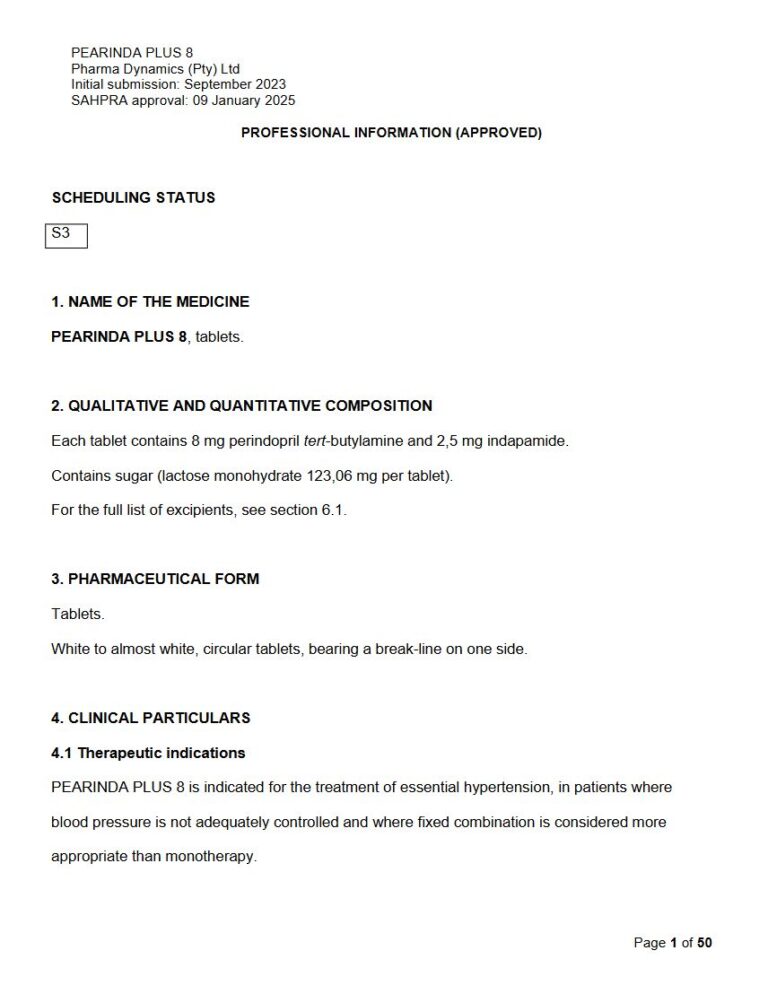
Pearinda Plus 8 8 mg Tablets.
PDF Leaflet Revision Date: 09 January 2025
Clinical Summary
Quick overview from the medicine insert
Indication
Treatment of essential hypertension.
Dosage (summary)
One tablet daily, preferably in the morning before a meal.
Onset of Action / Duration
Onset: 4-6 hours, Duration: 24 hours
Special Populations
- Elderly: start with one constituent
- Renal impairment: contraindicated if creatinine clearance <30 mL/min
- Hepatic impairment: contraindicated in severe cases
Pregnancy & Breastfeeding
Contraindicated in pregnancy and breastfeeding.
Key Drug Interactions
- Lithium: increased toxicity risk
- Aliskiren: contraindicated in renal impairment
- Potassium-sparing diuretics: risk of hyperkalaemia
Contraindications
- Hypersensitivity to perindopril or indapamide
- Severe renal impairment
- Pregnancy and lactation
Common side effects
- Dizziness
- Hypotension
- Cough
- Hypokalaemia
Counselling Points
- Take in the morning before meals
- Do not double dose if missed
- Report signs of infection or allergic reactions
Serious warnings
- Risk of angioedema
- Monitor renal function and potassium levels
- Caution in patients with renal artery stenosis
Important Disclaimer
The Pearinda Plus 8 8 mg Tablets. professional information leaflet below is the property of Pharma Dynamics and is provided on Medinsert exactly as issued, with no.. alterations or editorial changes. We make every effort to keep content current by updating documents as soon as new versions become available. Medinsert serves as a trusted access point for healthcare professionals, but does not replace official sources or clinical judgement. For more details, please read our full disclaimer. read more>>
 Healthcare Professionals Only
This content is for registered healthcare professionals
Sign in or create a free account to read the full package insert.
Free for HPCSA-registered professionals. Powered by Medinsert.
Clinical Particulars
Section 4 of the official insert — extracted exactly as issued, no alterations
4.1 Therapeutic indications
PEARINDA PLUS 8 is indicated for the treatment of essential hypertension, in patients where blood pressure is not adequately controlled and where fixed combination is considered more appropriate than monotherapy.
4.2 Posology and method of administration
Posology
One PEARINDA PLUS 8 tablet per day as a single dose, preferably to be taken in the morning, before a meal.
Special populations
Elderly: It is recommended to start the treatment with only one of the constituents. Patients with renal impairment: In cases of severe renal impairment (creatinine clearance below 30 mL/min), treatment is contraindicated (see section 4.3). In patients with a creatinine clearance greater than or equal to 30 mL/min and less than 60 mL/min, it is recommended to start the treatment with only one of the constituents. It is not necessary to change the dose when the creatinine clearance is greater than 60 mL/min. Usual medical follow-up will include frequent monitoring of creatinine and potassium. Patients with hepatic impairment: In severe hepatic impairment, treatment is contraindicated (see section 4.3). In patients with moderate hepatic impairment, no dose modification is required. Paediatric population
PEARINDA PLUS 8 should not be administered to children and adolescents as the efficacy and safety of perindopril (as contained in PEARINDA PLUS 8), either alone or in combination in this patient population, have not been established. Missed dose
Doctors should advise patients who forget to take PEARINDA PLUS 8 to take the next dose at the normal time. Patients should not take a double dose to compensate for the missed dose.
Method of administration
For oral use
PEARINDA PLUS 8 should be taken in the morning, before a meal.
4.3 Contraindications
Linked to perindopril :
u2022 hypersensitivity to perindopril tert-butylamine, or to any other ACE inhibitor
u2022 patients with a history of angioedema related to previous ACE inhibitor therapy, angiotensin receptor blockers (ARBs) or renin inhibitors: these patients should never again be given these medicines (see section 4.4)
u2022 hereditary or idiopathic angioedema
u2022 concomitant use of fluoroquinolones with ACE inhibitors/angiotensin receptor blockers is contraindicated in patients with moderate to severe renal function impairment (creatinine clearance less than 30 mL/min) and in the elderly
u2022 hypertrophic obstructive cardiomyopathy (HOCM)
u2022 severe renal impairment (creatinine clearance less than 30 mL/min), or anuria
u2022 bilateral renal artery stenosis
u2022 renal artery stenosis in patients with a single kidney
u2022 aortic stenosis (see section 4.4)
u2022 concomitant therapy with potassium sparing diuretics (such as spironolactone, triamterene, amiloride), potassium supplements or potassium-containing salt substitutes (see section 4.4)
u2022 porphyria
u2022 lithium: concomitant administration with PEARINDA PLUS 8 may lead to toxic blood concentrations of lithium (see section 4.5)
u2022 the concomitant use of PEARINDA PLUS 8 with aliskiren-containing products in patients with diabetes or renal impairment (GFR < 60 mL/min/1,73 m2) is contraindicated (see section 4.4)
u2022 concomitant use with sacubitril/valsartan (see section 4.4 and 4.5)
u2022 extracorporeal treatments leading to contact of blood with negatively charged surfaces (see section 4.5)
u2022 pregnancy and lactation.
Linked to indapamide:
u2022 hypersensitivity to indapamide or any other sulphonamides
u2022 severe renal impairment (creatinine clearance below 30 mL/min)
u2022 hepatic encephalopathy
u2022 severe hepatic impairment
u2022 hypokalaemia
u2022 concomitant use with non-antidysrhythmic medicines causing torsades de pointes (see section 4.5)
u2022 lactation.
Linked to PEARINDA PLUS 8:
u2022 hypersensitivity to any of the excipients listed in section 6.1
u2022 dialysis patients
u2022 patients with untreated decompensated heart failure
u2022 PEARINDA PLUS 8, should not be given to patients with Addisonu2019s disease.
4.4 Special warnings and precautions for use
Common to perindopril and indapamide:
Lithium
The combination of lithium with the combination of perindopril and indapamide is contraindicated (see section 4.5).
Linked to perindopril:
Should a woman become pregnant while receiving PEARINDA PLUS 8, the treatment should be stopped promptly and switched to a different class of antihypertensive medicine (see sections 4.3 and 4.6).
Dual blockade of the renin - angiotensin - aldosterone system (RAAS)
There is evidence that the concomitant use of ACE inhibitors, angiotensin II receptor blockers (ARBs) or renin inhibitors such as aliskiren may increase the risk of hypotension, hyperkalaemia and decreases renal function (including acute renal failure). Dual blockade of RAAS through the combined use of PEARINDA PLUS 8 and aliskiren is therefore contraindicated (see section 4.3).
ACE inhibitors and angiotensin II receptor blockers should not be used concomitantly in patients with diabetic nephropathy.
Potassium - sparing medicines, potassium supplements or potassium - containing salt substitutes
The combination of PEARINDA PLUS 8 and potassium-sparing diuretics (such as spironolactone, triamterene and amiloride), potassium supplements or potassium-containing salt substitutes may lead to hyperkalaemia, which may be severe and lead to cardiac conduction abnormalities, dysrhythmias, and cardiac arrest (see sections 4.3 and 4.5) and is therefore contraindicated.
Neutropenia/agranulocytosis/thrombocytopenia/anaemia
Neutropenia/agranulocytosis, thrombocytopenia and anaemia have been reported in patients receiving ACE inhibitors such as in PEARINDA PLUS 8. PEARINDA PLUS 8 may cause bone marrow depression, and therefore an increased risk of agranulocytosis and neutropenia. In patients with normal renal function and no other complicating factors, neutropenia may occur. PEARINDA PLUS 8 should be used with caution in patients with collagen vascular disease, immunosuppressant therapy, treatment with allopurinol or procainamide, or a combination of these complicating factors, especially if there is pre-existing impaired renal function. Some of these patients developed serious infections which did not respond to intensive antibiotic therapy. If PEARINDA PLUS 8 is used in such patients, periodical monitoring of white blood cell counts is advised and patients should be instructed to report any sign of infection (e.g., sore throat, fever) (see section 4.8). Autoimmune disease, especially systemic lupus erythematosus, other collagen vascular disease or scleroderma, increase the risk for development of neutropenia or agranulocytosis.
Renovascular hypertension
There is an increased risk of hypotension and renal insufficiency when patients with bilateral renal artery stenosis or stenosis of the artery to a single functioning kidney are treated with ACE- inhibitors (see section 4.3). Treatment with diuretics may be a contributory factor. Loss of renal function may occur with only minor changes in serum creatinine even in patients with unilateral renal artery stenosis.
Hypersensitivity/angioedema
Angioedema of the face, extremities, lips, tongue, glottis and/or larynx has been reported in patients treated with angiotensin converting enzyme inhibitors, including perindopril (see section 4.8). This may occur at any time during treatment. In such cases PEARINDA PLUS 8 should be discontinued promptly. These patients should be monitored to ensure complete resolution of symptoms (see section 4.3). Angioedema associated with laryngeal oedema may be fatal. Where there is involvement of the tongue, glottis, or larynx, likely to cause airway obstruction, appropriate emergency therapy should be administered. This may include the administration of a subcutaneous injection of epinephrine (adrenaline) at 1:1000 (0,3 mL to 0,5 mL) and/or the maintenance of a patent airway. The patient should be under close medical supervision until complete and sustained resolution of symptoms has occurred. These patients should never receive any PEARINDA PLUS 8, ACE inhibitors or angiotensin receptor blockers again (see section 4.3). Black patients receiving ACE inhibitors have been reported to have higher incidence of angioedema compared to non-blacks. Patients with a history of angioedema unrelated to ACE inhibitor therapy may be at increased risk of angioedema while receiving PEARINDA PLUS 8 (see section 4.3). Intestinal angioedema has been reported in patients treated with ACE inhibitors such as PEARINDA PLUS 8. These patients presented with abdominal pain (with or without nausea or vomiting), in some cases there was no prior facial angioedema and C-1 esterase levels were normal. The angioedema was diagnosed by procedures including abdominal CT scan, or ultrasound or at surgery and symptoms resolved after stopping the ACE inhibitor. Intestinal angioedema should be included in the differential diagnosis of patients on PEARINDA PLUS 8 presenting with abdominal pain.
Concomitant use of mTOR inhibitors (e.g., sirolimus, everolimus, temsirolimus)
Patients concomitantly taking mTOR inhibitors (e.g., sirolimus, everolimus, temsirolimus) therapy may be at an increased risk for angioedema (e.g., swelling of the airways or tongue, with or without respiratory impairment) (see section 4.5).
Sacubitril/valsartan
The combination of perindopril with sacubitril/valsartan is contraindicated due to the increased risk of angioedema (see section 4.3). Sacubitril/valsartan must not be initiated until 36 hours after taking the last dose of perindopril therapy. If treatment with sacubitril/valsartan is stopped, perindopril therapy must not be initiated until 36 hours after the last dose of sacubitril/valsartan (see section 4.3 and 4.5).
Concomitant use of other neutral endopeptidase (NEP) inhibitors (e.g., racecadotril) and ACE- inhibitors may also increase the risk of angioedema (see section 4.5). Hence, a careful benefit-risk assessment is needed before initiating treatment with NEP inhibitors (e.g., racecadotril) in patients on perindopril.
Anaphylactic reactions during low - density lipoproteins (LDL) apheresis
Patients receiving PEARINDA PLUS 8 during low density lipoprotein (LDL)-apheresis with dextran sulphate have experienced life-threatening anaphylactoid reactions. PEARINDA PLUS 8 should be avoided in such patients. These reactions were avoided by temporarily withholding ACE inhibitors, such as PEARINDA PLUS 8 therapy, for at least 24 hours prior to each apheresis for patients who require both ACE inhibitors and LDL apheresis.
Anaphylactic reactions during desensitisation
Life-threatening anaphylactoid reactions have occurred in patients using ACE inhibitors, including PEARINDA PLUS 8, during desensitising protocols involving, for example, hymenoptera (bees, wasps) venom. PEARINDA PLUS 8 should be used with caution in allergic patients treated with desensitisation and avoided in those undergoing venom immunotherapy. These reactions were, however, avoided when the ACE inhibitors were temporarily withheld for at least 24 hours before treatment in patients who require both ACE-inhibitors and desensitisation.
Haemodialysis patients
Anaphylactic reactions have been reported in patients dialysed with high flux membranes (e.g., AN 69u00ae), and treated concomitantly with an ACE inhibitor, such as in PEARINDA PLUS 8. In these patients, consideration should be given to using a different type of dialysis membrane or a different class of antihypertensive medicine.
Anaemia has been observed in patients who have had a kidney transplant or have been undergoing dialysis. The reduction in haemoglobin levels is more apparent if initial values were high. This reduction is slight, occurs within 1 to 6 months, and then remains stable. It is reversible when the treatment is stopped.
Primary aldosteronism
Patients with primary hyperaldosteronism generally will not respond to anti-hypertensive medication acting through inhibition of the renin-angiotensin system. Therefore, the use PEARINDA PLUS 8 is not recommended.
Linked to indapamide:
Hepatic encephalopathy
When liver function is impaired, thiazide diuretics and thiazide-related diuretics such as indapamide (contained in PEARINDA PLUS 8) may cause hepatic encephalopathy. Administration of PEARINDA PLUS 8 should be stopped immediately if this occurs.
Photosensitivity
Cases of photosensitivity reactions have been reported with thiazides and related thiazide diuretics such as indapamide (contained in PEARINDA PLUS 8), (see section 4.8). If a photosensitivity reaction occurs during treatment, it is recommended treatment be stopped. If a re-administration of the diuretic is necessary, it is recommended that areas of skin exposed to sun or artificial UVA, be protected.
Special precautions linked to perindopril and indapamide combination :
Renal impairment
In certain hypertensive patients without pre-existing apparent renal lesions and for whom renal blood tests show functional renal insufficiency, treatment should be stopped and possibly restarted with one active ingredient only. In these patients, usual medical follow up will include frequent monitoring of potassium and creatinine, after two weeks of treatment and then every two months during therapeutic stability period. Renal failure has been reported mainly in patients with severe heart failure or underlying renal failure including renal artery stenosis (see section 4.3). PEARINDA PLUS 8 should not be used in case of bilateral renal artery stenosis or a single functioning kidney (see section 4.3).
Hypotension and water depletion
There is a risk of sudden hypotension in the presence of pre-existing sodium depletion (in particular in individuals with renal artery stenosis). Therefore, systematic testing should be carried out for clinical signs of water and electrolyte depletion, which may occur with an inter-current episode of diarrhoea or vomiting. Regular monitoring of plasma electrolytes should be carried out in such patients.
Marked hypotension may require the implementation of an intravenous infusion of isotonic saline. Transient hypotension is not a contraindication to continuation of treatment. After re-establishment of a satisfactory blood volume and blood pressure, treatment can be started again with only one of the constituents.
Potassium levels
The combination of perindopril and indapamide does not prevent the onset of hypokalaemia particularly in diabetic patients or in patients with renal failure. Regular monitoring of plasma potassium levels should be carried out.
4.5 Interactions with other medicines
Concomitant use of PEARINDA PLUS 8 is contraindicated:
Linked to perindopril:
Fluoroquinolones
Concomitant use of fluoroquinolones and ACE inhibitors/angiotensin receptor blockers may precipitate acute kidney injury. The mechanism of the possible interaction between the different classes of medicines, over and above different mechanisms of kidney damage, is unknown (see section 4.3).
Lithium
Reversible increases in serum lithium concentrations and toxicity have been reported during concomitant administration of lithium with ACE inhibitors. The concomitant use of PEARINDA PLUS 8 with lithium is contraindicated (see section 4.3).
Aliskiren
In patients other than diabetic or impaired renal patients, risk of hyperkalaemia, worsening of renal function and cardiovascular morbidity and mortality increase (see section 4.4).
Extracorporeal treatments
Extracorporeal treatments leading to contact of blood with negatively charged surfaces such as dialysis or haemofiltration with certain high-flux membranes (e.g., polyacrylonitril membranes) and low density lipoprotein apheresis with dextran sulphate due to increased risk of severe anaphylactoid reactions (see section 4.3). If such treatment is required, consideration should be given to using a different type of dialysis membrane or a different class of antihypertensive medicine.
Sacubitril/valsartan
The concomitant use of perindopril with sacubitril/valsartan is contraindicated as the concomitant inhibition of neprilysin and ACE may increase the risk of angioedema. Sacubitril/valsartan must not be started until 36 hours after taking the last dose of perindopril therapy. Perindopril therapy must not be started until 36 hours after the last dose of sacubitril/valsartan (see sections 4.3 and 4.4).
Concomitant use not recommended:
Linked to perindopril:
Concomitant therapy with ACE inhibitor and angiotensin - receptor blocker
In patients with established atherosclerotic disease, heart failure, or with diabetes with end organ damage, concomitant therapy with an ACE inhibitor and angiotensin-receptor blocker is associated with a higher frequency of hypotension, syncope, hyperkalaemia, and worsening renal function (including acute renal failure) as compared to use of a single renin-angiotensin-aldosterone system agent. Dual blockade (e.g., by combining an ACE inhibitor with an angiotensin II receptor antagonist) should be limited to individually defined cases with close monitoring of renal function, potassium levels, and blood pressure (see section 4.4).
Estramustine
Risk of increased adverse effects such as angioneurotic oedema (angioedema).
Co - trimoxazole (trimethoprim/sulfamethoxazole)
Patients concomitantly taking co-trimoxazole may be at increased risk for hyperkalaemia (see section 4.4).
Concomitant use which requires special care:
Linked to the combination of perindopril and indapamide:
Baclofen
The antihypertensive effect may be potentiated. Monitor blood pressure and adapt antihypertensive dose if necessary.
Linked to perindopril:
Medicines inducing hyperkalaemia
Some medicines or therapeutic classes may increase the occurrence of hyperkalaemia; aliskiren, potassium salts, potassium-sparing diuretics, ACE inhibitors, angiotensin-II receptor antagonists, NSAIDs, heparins, immunosuppressant medicines such as ciclosporin or tacrolimus and trimethoprim (see section 4.3). The combination of these medicines increases the risk of hyperkalaemia.
Non - steroidal anti - inflammatory medicines (NSAIDs) (including aspirin u2265 3 g/day)
Non-steroidal anti-inflammatory medicines (including acetylsalicylic acid at high doses): When ACE inhibitors (as in PEARINDA PLUS 8) are administered simultaneously with NSAIDs (i.e., acetylsalicylic acid at anti-inflammatory dosage regimens, COX -2 inhibitors and non-selective NSAIDs), attenuation of the antihypertensive effect may occur. Concomitant use of ACE inhibitors and NSAIDs may lead to an increased risk of worsening of renal function, including possible acute renal failure and an increase in serum potassium, especially in patients with poor pre-existing renal function. The combination should be administered with caution, especially in the elderly. Patients should be adequately hydrated, and consideration should be given to monitoring renal function after initiation of concomitant therapy, and periodically thereafter.
Antidiabetic medicines (insulin, oral hypoglycaemic medicines)
The use of ACE inhibitors (such as PEARINDA PLUS 8) and anti-diabetic medicines (insulins, hypoglycaemic medicines) may cause an increased blood-glucose lowering effect with a risk of hypoglycaemia. This appears to be more likely to occur during the first weeks of treatment and in patients with renal impairment.
Non potassium - sparing diuretics
Patients taking diuretics, as well as those who are volume and/or salt depleted, may experience excessive reduction in blood pressure after initiation of therapy with an ACE inhibitor. The possibility of hypotensive effects can be reduced by discontinuation of the diuretic, or by increasing volume or salt intake prior to the initiation of treatment. In arterial hypertension, where previous diuretic treatment has caused salt/volume depletion, the diuretic must be discontinued prior to initiation of treatment with the ACE inhibitor. In diuretic-treated congestive heart failure, an ACE- inhibitor should be initiated at a very low dose, possibly after reducing the dose of the associated non-potassium sparing diuretic. In all cases, renal function (creatinine levels) must be monitored during the first few weeks of ACE inhibitor therapy.
Potassium - sparing diuretics (eplerenone, spironolactone)
With eplerenone or spironolactone at doses between 12,5 mg to 50 mg per day and with low doses of ACE inhibitors: Concomitant use of potassium-sparing diuretics in patients with class II-IV heart failure (NYHA) with ejection fraction < 40 %, and who have previously been treated with ACE inhibitors and loop diuretics have a high risk of hyperkalaemia, which may be fatal. Before initiating the combination, the absence of hyperkalaemia and renal impairment needs to be confirmed. Close monitoring of potassium and creatinine is recommended in the first month of treatment, once a week initially, and monthly thereafter.
Racecadotril
ACE inhibitors (e.g., perindopril) are known to cause angioedema. This risk may be elevated when used concomitantly with racecadotril (a product used against acute diarrhoea).
mTOR inhibitors (e.g., sirolimus, everolimus, temsirolimus)
Patients concomitantly taking mTOR inhibitors therapy may be at an increased risk for angioedema (see section 4.4).
Linked to indapamide:
Torsades de pointes inducing medicines
Due to the risk of hypokalaemia, indapamide (as in PEARINDA PLUS 8), should be administered with caution when associated with medicines known to induce torsade de pointes such as class IA antidysrhythmic medicines (quinidine, hydroquinidine, disopyramide), class III antidysrhythmic medicines (amiodarone, dofetilide, ibutilide, bretylium, sotalol), some neuroleptics (chlorpromazine, cyamemazine, levomepromazine, thioridazine, trifluoperazine), benzamides (amisulpride, sulpiride, sultopride, tiapride), butyrophenones (droperidol, haloperidol), other neuroleptics (pimozide), other medicines such as bepridil, cisapride, diphemanil, IV erythromycin, halofantrine, mizolastine, moxifloxacin, pentamidine, IV vincamine, astemizole, terfenadine and methadone. Prevention of low potassium levels and correction if necessary: monitoring of the QT interval.
Other potassium - lowering medicines causing hypokalaemia:
Amphotericin B (IV), gluco - and mineralo - corticoids (systemic route), tetracosactide, stimulant laxatives
Increased risk of hypokalaemia (additive effect). Potassium levels should be monitored, and corrected, if necessary, particular consideration is required in patients treated with cardiac glycosides. Non stimulant laxatives should be used.
Digoxin
Low potassium levels and/or hypomagnesaemia favour the toxic effects of digoxin. Potassium levels, magnesium levels and EGC should be monitored, and treatment reconsidered if necessary.
Allopurinol
Concomitant treatment with indapamide (as in PEARINDA PLUS 8) may increase the incidence of hypersensitivity reactions to allopurinol.
Concomitant use which requires some care:
Linked to the combination of perindopril and indapamide:
Imipramine - like antidepressants (tricyclics), neuroleptics
Increased antihypertensive effect and increased risk of orthostatic hypotension (additive effect).
Linked to perindopril:
Dual blockade of the RAAS with ARBs, ACE inhibitors, or aliskiren
Clinical trial data have shown that dual blockade of the renin-angiotensin-aldosterone system (RAAS) through the combined use of ACE inhibitors, angiotensin II receptor blockers or aliskiren is associated with a higher frequency of adverse events such as hypotension, hyperkalaemia and decreased renal function (see sections 4.3 and 4.4).
4.6 Fertility, pregnancy and lactation
Pregnancy
The use of PEARINDA PLUS 8 is contraindicated during pregnancy. Pregnant women should be informed of the potential hazards to the foetus and must not take PEARINDA PLUS 8 during pregnancy (see section 4.3). Patients planning pregnancy should be changed to alternative antihypertensive treatments which have an established safety profile for use in pregnancy. When pregnancy is diagnosed, treatment with PEARINDA PLUS 8 should be stopped immediately and if appropriate, alternative therapy should be started. Foetal exposure to ACE inhibitors during the first trimester of pregnancy has been reported to be associated with an increased risk of malformations of the cardiovascular (atrial and/or ventricular septal defect, pulmonic stenosis, patent ductus arteriosus) and central nervous system (microcephaly spina bifida) and of kidney malformations. PEARINDA PLUS 8 passes through the placenta and can be presumed to cause disturbance in foetal blood pressure regulatory mechanisms. Oligohydramnios as well as hypotension, oliguria, and anuria in newborns, have been reported after administration of ACE inhibitors during the second and third trimester. Cases of defective skull ossification have been observed. Prematurity and low birth mass can occur (see section 4.3). Should exposure to ACE inhibitor have occurred from the second trimester of pregnancy, ultrasound check of renal function and skull is recommended. Infants whose mothers have taken ACE inhibitors should be closely observed for hypotension.
Breastfeeding
The use of PEARINDA PLUS 8 is contraindicated during breastfeeding (see section 4.3). It is unknown whether perindopril passes into breastmilk, therefore perindopril is not recommended and alternative treatments with better established safety profiles during breastfeeding are preferable, especially while nursing a newborn or preterm infant. There is insufficient information on the excretion of indapamide/metabolites in human breast milk. Indapamide is closely related to thiazide diuretics which have been associated with a decrease or suppression of milk lactation during breastfeeding. Hypersensitivity to sulphonamide-derived medicines and hypokalaemia might occur. Indapamide is contraindicated during breastfeeding.
Fertility
Reproductive toxicity studies showed no effect on fertility in female and male rats. No effects on human fertility are anticipated.
4.7 Effects on ability to drive and use machines
Perindopril and indapamide individually, or in combination do not affect alertness but individual reactions related to low blood pressure may occur in some patients, particularly at the start of treatment or in combination with another antihypertensive medicine. PEARINDA PLUS 8 can cause side effects such as dizziness, visual disturbances and visual impairment. Caution is advised when driving or performing tasks requiring alertness until the patient knows how PEARINDA PLUS 8 affects them.
4.8 Undesirable effects
Summary of the safety profile
The administration of perindopril inhibits the renin-angiotensin-aldosterone axis and tends to reduce the potassium loss caused by indapamide. The most commonly reported adverse reactions with perindopril and indapamide given separately are decreased appetite, dizziness, headaches, paraesthesia, vertigo, dysgeusia, visual impairment, tinnitus, hypotension, cough, dyspnoea, abdominal pain, constipation, epigastric pain, diarrhoea, dyspepsia, nausea, vomiting, dry mouth, pruritus, rash, maculopapular rash, muscle cramps and asthenia.
Tabulated list of adverse effects
Side effects for PEARINDA PLUS 8:
System Organ Class
Frequency
Side effects
Infections and Infestations
Less frequent
Rhinitis
Blood and lymphatic system disorders
Less frequent
Leukopenia, decrease in haemoglobin and haematocrit, bone marrow depression, neutropenia, anaemia, aplastic anaemia, thrombocytopenia, agranulocytosis, haemolytic anaemia, pancytopenia
Immune system disorders
Less frequent
Frequency unknown
Hypersensitivity/angioedema reactions, anaphylaxis
Intestinal angioedema, a symptom complex has been reported which may include fever, vasculitis, myalgia, arthritis/arthralgia, a positive antinuclear antibodies (ANA), elevated erythrocyte sedimentation rate, eosinophilia, and leucocytosis
4.9 Overdose
Signs and symptoms:
The most likely adverse reaction in cases of overdose is hypotension, sometimes associated with nausea, vomiting, cramps, dizziness, sleepiness, mental confusion, oliguria which may progress to anuria (due to hypovolaemia). Other symptoms associated with overdosage of ACE inhibitors may include circulatory shock, electrolyte disturbances, renal failure, hyperventilation, tachycardia, palpitations, bradycardia, dizziness, anxiety, and cough. Salt and water disturbances (low sodium levels, low potassium levels) may occur.
Management of overdose:
The first measures to be taken consist of rapidly eliminating the product(s) ingested by administration of activated charcoal, then restoring fluid and electrolyte balance in a specialised centre until they return to normal. If marked hypotension occurs, this can be treated by placing the patient in supine position with the head lowered. If necessary, an intravenous infusion may be used. Perindoprilat, the active form of perindopril, can be dialysed.
