
Pethidine 50 Mg/100 Mg Injection
PDF Leaflet Revision Date: 22 August 2025
Clinical Summary
Quick overview from the medicine insert
Indication
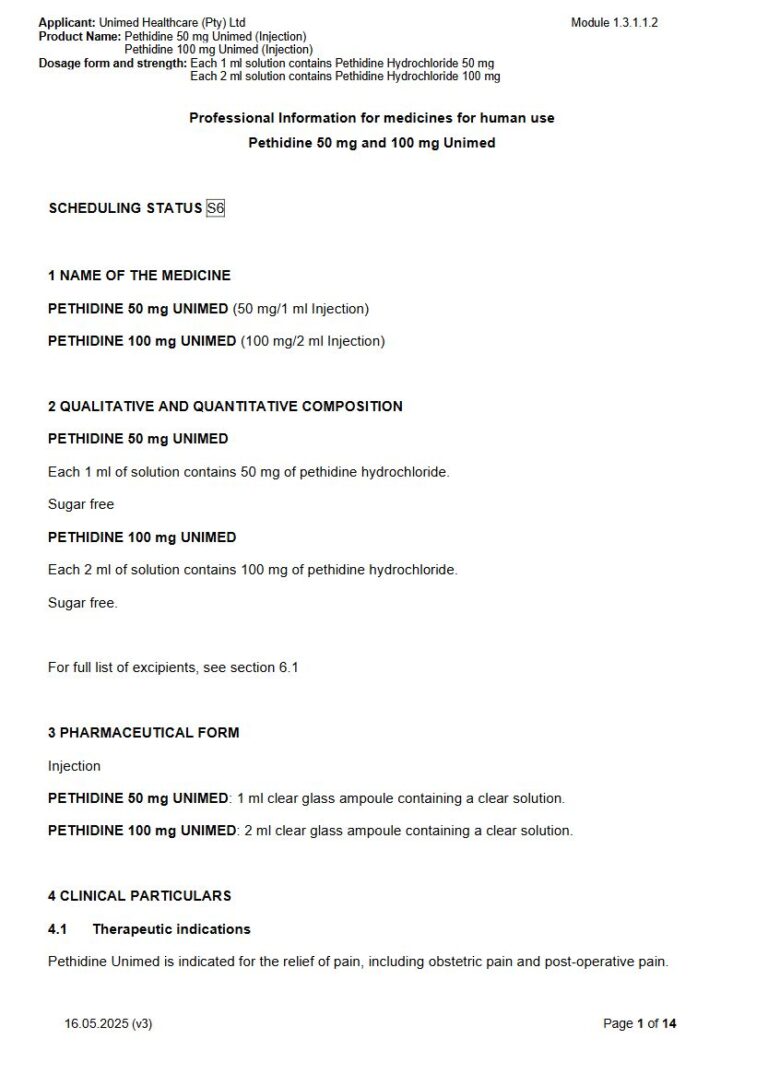
Relief of pain, including obstetric and post-operative pain.
Dosage (summary)
Adults: 50-100 mg IM/SC/IV every 4 hours as needed; during labor: 50-100 mg IM every 1-3 hours.
Onset of Action / Duration
Onset: 10 mins, Duration: 3-5 hours
Special Populations
- Elderly
- Debilitated patients
- Renal impairment
- Hepatic impairment
- Neonates
Pregnancy & Breastfeeding
Crosses placenta; may cause respiratory depression in newborns. Discontinue breastfeeding during treatment.
Key Drug Interactions
- MAOIs
- CNS depressants
- SSRIs
- Ritonavir
- Phenothiazines
Contraindications
- Hypersensitivity to pethidine
- Respiratory depression
- Acute alcoholism
- Convulsive disorders
- Head injuries
- Bronchial asthma
- Heart failure
- Severe renal impairment
- Severe hepatic impairment
Common side effects
- Drowsiness
- Nausea
- Respiratory depression
- Hypotension
- Dependence
Counselling Points
- Avoid driving or operating machinery
- Monitor for signs of respiratory depression
- Inform about potential for dependence
Serious warnings
- Risk of dependence
- Respiratory depression in newborns
- Caution in patients with airflow obstruction
Important Disclaimer
The Pethidine 50 Mg/100 Mg Injection professional information leaflet below is the property of Unimed Healthcare and is provided on Medinsert exactly as issued, with no.. alterations or editorial changes. We make every effort to keep content current by updating documents as soon as new versions become available. Medinsert serves as a trusted access point for healthcare professionals, but does not replace official sources or clinical judgement. For more details, please read our full disclaimer. read more>>
 Healthcare Professionals Only
This content is for registered healthcare professionals
Sign in or create a free account to read the full package insert.
Free for HPCSA-registered professionals. Powered by Medinsert.
Clinical Particulars
Section 4 of the official insert — extracted exactly as issued, no alterations
4.1 Therapeutic indications
Pethidine Unimed is indicated for the relief of pain, including obstetric pain and post-operative pain.
4.2 Posology and method of administration
Posology
Adults: For pain relief: 50-100 mg intramuscularly or subcutaneously or very slowly intravenously in doses of 25 to 50 mg every four hours as required.
Obstetric analgesia
Note: The lowest effective doses are recommended, particularly during labour.
During Labour: 50-100 mg intramuscularly every 1-3 hours as required.
Elderly or debilitated patients
The dosage should be reduced in elderly and debilitated patients.
Paediatric population
For pain relief: 0,5 to 2 mg per kg body mass intramuscularly.
Method of administration
Intramuscular, intravenous or subcutaneous injection.
4.3 Contraindications
- Hypersensitivity (allergy) to pethidine or to any of the excipients of Pethidine Unimed listed in section 6.1.
- Pethidine Unimed is generally contraindicated in respiratory depression especially in the presence of cyanosis and excessive bronchial secretion.
- It is also contraindicated in the presence of acute alcoholism, convulsive disorder, head injuries, and conditions in which intracranial pressure is raised. They should not be given to comatose patients.
- It should not be given during an attack of bronchial asthma or in heart failure secondary to chronic lung disease.
- Pethidine Unimed is contraindicated in patients who are being treated with monoamine oxidase Inhibitors (including moclobemide and selegiline), or within 2 weeks of the discontinuation of such treatment) (see section 4.5).
- Concomitant use with SSRIs, tramadol, St John's wort and triptans.
- Use of Pethidine should be avoided in patients with supraventricular tachycardia.
- Pethidine Unimed should not be administered to patients receiving ritonavir.
- Use of Pethidine Unimed in patients with phaechromocytoma may result in hypertensive crisis.
- In patients with a risk of paralytic ileus.
- Pethidine Unimed should not be administered to patients with severe renal impairment or severe hepatic impairment.
- Use of Pethidine Unimed should be avoided in patients with diabetic acidosis where there is danger of coma.
4.4 Special warnings and precautions for use
Dependence: Prolonged use of Pethidine Unimed may lead to dependence of the morphine type. Doses as large as 3 or 4 grams daily has been taken by addicts. As tolerance to the central nervous system stimulant and anticholinergic effects is not complete with these very large doses, muscle twitching, tremor, mental confusion, dilated pupils, and sometimes convulsions may be present. The euphoric activity of pethidine and related medicines has led to their abuse. Larger doses produce respiratory depression and hypotension, with circulatory failure and deepening coma. Convulsion may occur in infants and children. Death may occur from respiratory failure. Toxic doses vary considerably with the individual, with regular users tolerating large doses.
Local reactions often follow injection of pethidine due to the histamine-releasing effect. Intravenous injection may produce vasodilation and hypotension. Contact dermatitis has been reported and pain and irritation may occur on injection.
Pethidine Unimed should be given with caution or in reduced doses in patients with myasthenia gravis. Pethidine should be used with caution in patients with acute or chronic airflow obstruction including asthma. It should be given with caution or in reduced doses to patients with hypothyroidism, adrenocortical insufficiency, history of convulsive disorder, impaired kidney or liver function, prostatic hypertrophy or shock and biliary tract disorders including those with pain secondary to gallbladder pathology. Although less spasmogenic than morphine, pethidine may precipitate spasm of the ureter or Sphincter of Oddi. Subsequently it should be used with caution in patients with prostatic hypertrophy and biliary tract disorders including those with pain secondary to gallbladder pathology. Renal impairment may result in accumulation of the potentially toxic metabolite norpethidine, particularly with repeat dosing. All of these patient groups may experience increased or prolonged effects of the product. It should be used in caution in patients with obstructive bowel disorders due to its effects on the gastrointestinal tract where it may precipitate toxic megacolon. Pethidine Unimed has a slower elimination rate and a larger inter-subject variability in neonates and young infants compared to older children and adults, which may lead to dose related reactions such as respiratory depression. If pethidine use is contemplated in neonates or young infants (up to 12 months), any potential benefits of the drug need to be weighed against the relative risk to the patient. Pethidine Unimed should be given with caution and in reduced doses, patients who are elderly or debilitated.
Pethidine Unimed should be used with caution in patients with existing hypotension as it may reduce the blood pressure further.
Risk from concomitant use of sedative medicines such as benzodiazepines or related medicines: Concomitant use of pethidine and sedative medicines such as benzodiazepines or related medicines may result in sedation, respiratory depression, coma and death. Because of these risks, concomitant prescribing with these sedative medicines should be reserved for patients for whom alternative treatment options are not possible. If a decision is made to prescribe Pethidine Unimed concomitantly with sedative medicines, the lowest effective dose should be used, and the duration of treatment should be as short as possible. The patients should be followed closely for signs and symptoms of respiratory depression and sedation. In this respect, it is strongly recommended to inform patients and their caregivers to be aware of these symptoms (see section 4.5)
The administration of pethidine during labour may cause respiratory depression in the new born infant.
Mental health disorders
Pethidine Unimed should be used with particular care in patients with a personal or family history of substance abuse or mental health disorders including, but not limited to major depression, anxiety and alcohol and drug abuse.
Paediatric population
Pethidine is not usually given pre-operatively to children under 1 year of age, and it should be given with extreme caution to newborn or premature infants for other conditions.
4.5 Interaction with other medicines and other forms of interaction
Antipsychotics
Concurrent administration of pethidine and phenothiazines produced severe hypotensive episodes and may prolong the respiratory depression due to pethidine.
Monoamine Oxidase Inhibitors
The concurrent use of MAOIs (including moclobemide) is contraindicated (see section 4.3) as they may result in CNS excitation or depression. Very severe reactions, including coma, severe respiratory depression, cyanosis and hypotension have occurred in patients receiving monoamine oxidase inhibitors and given pethidine. There are also reports of hyperexcitability, convulsions, tachycardia, hyperpyrexia and hypotension (see section 4.3).
CNS depressants
The depressant effects pethidine are enhanced by depressants of the central nervous system such as alcohol, anaesthetics, hypnotics and sedatives, barbiturates, tricyclic antidepressants and phenothiazines.
Opioid agonists
Additive effects on CNS depression, respiratory depression and hypotension can occur with concomitant use of opioid agonist analgesics.
MAO-B inhibitors
Concomitant use of MAO-B inhibitors such as selegiline or rasagiline is contraindicated (see section 4.3) as this may lead to hyperpyrexia and CNS toxicity. Rasagiline should not be given with pethidine as there is risk of CNS toxicity, its use should be avoided for two weeks after taking rasagiline.
Anticonvulsants
Administration of phenytoin may cause an increase in hepatic metabolism of pethidine and subsequently increased levels of norpethidine (a toxic metabolite).
Anti-virals
Plasma concentrations of pethidine may be decreased by concomitant administration of ritonavir, however levels of norpethidine (a toxic metabolite) may rise. Concomitant administration of ritonavir and pethidine should be avoided (see section 4.3).
Histamine H2 antagonists
Cimetidine can reduce the metabolism of pethidine resulting in increased plasma concentration. Cyclizine may counteract the haemodynamic benefits of opioids.
Effects of pethidine on other medicines
Pethidine Unimed may have an effect on the activities of other drugs, for example domperidone, as a consequence of reduced gastro-intestinal motility. The plasma levels of ciprofloxacin may be reduced in the presence of opiate premedicants. Plasma levels of mexiletine may also be reduced in the presence of opioid analgesics. Possible increased serotonergic effects when pethidine is given with SSRI's. Sedative medicines such as benzodiazepines or related medicines: The concomitant use of opioids with sedative medicines such as benzodiazepines or related drugs increases the risk of sedation, respiratory depression, coma and death because of additive CNS depressant effect. The dose and duration of concomitant use should be limited (see section 4.4).
4.6 Fertility, pregnancy and lactation
Pregnancy
Signs of respiratory depression in new-borns are apparent when delivery occurs within 1 to 3 hours after pethidine administration.
Lactation
Pethidine Unimed crosses the placenta and appears in milk. Patients should be advised to discontinue breastfeeding during treatment with Pethidine Unimed.
Fertility
There is no fertility data.
4.7 Effects on ability to drive and use machines
Pethidine Unimed may cause drowsiness that may affect the ability to perform skilled tasks; those affected should not drive or operate machinery.
4.8 Undesirable effects
The frequency of adverse reactions reported with Pethidine Unimed are summarised in Table 1 as per the MedDRA system organ classification (SOC).
Table 1: Tabulated list of adverse reactions
System Organ Class Frequency Adverse effect
Immune system disorders Frequency not known General hypersensitivity reactions
Psychiatric disorders Frequency not known Dependence, confusion, changes of mood, mild euphoria, hallucinations, dysphoria
Nervous system disorders Frequency not known Drowsiness dizziness, tremor, convulsions, headache, fainting, CNS excitation
Eye disorders Frequency not known Dry eye, miosis, corneal reflex decreased
Ear and labyrinth disorders Frequency not known Vertigo
Cardiac disorders Frequency not known Tachycardia, bradycardia, palpitations
Vascular disorders Frequency not known Orthostatic hypotension, flushing, hypotension, hypertension, vasodilation
Respiratory, thoracic and mediastinal disorders Frequency not known Respiratory depression
Gastrointestinal disorders Frequency not known Nausea, vomiting, constipation, dry mouth
Hepatobiliary disorders Frequency not known Ureteric or biliary spasm
Skin and subcutaneous tissue disorders Frequency not known Sweating, rash, urticaria, pruritus
Musculoskeletal and connective tissue disorders Frequency not known Muscle twitching
Renal and urinary disorders Frequency not known Difficulty in micturition, renal colic
Reproductive system and breast disorders Frequency not known Sexual dysfunction
General disorders and administration site conditions Frequency not known Hypothermia, weakness, injection site reactions including induration and irritation.
Post marketing experience Increased risk of abdominal pain, including pancreatitis has been reported as a rare side effect.
Reporting of suspected adverse reactions
Reporting suspected adverse reactions after authorisation of the medicine is important. It allows continued monitoring of the benefit/risk balance of the medicine. Health care providers are asked to report any suspected adverse reactions to SAHPRA via the Med Safety APP (Medsafety X SAHPRA) and eReporting platform (who-umc.org) found on SAHPRA website.
4.9 Overdose
Symptoms and signs
Respiratory depression, CNS depression with extreme somnolence progressing to incoordination, stupor or coma, convulsions, CNS stimulation, cyanosis, miosis, skeletal muscle flaccidity or tremors, cold, clammy skin, hypothermia, bradycardia and hypotension. In severe overdosage, apnoea, circulatory collapse, pulmonary oedema, mydriasis, cardiac arrest and death may occur. After overdosage, symptoms are generally similar to those of morphine poisoning, however, stimulation of the central nervous system and convulsions may also occur, especially in tolerant individuals or following toxic doses by mouth.
Management of overdose
Intensive supportive therapy may be required to correct respiratory failure and shock. A patent airway must be established with assisted or controlled ventilation. If signs of CNS toxicity are exhibited the use of pethidine should be discontinued. In addition, the specific antagonist naloxone hydrochloride is used to counteract rapidly the severe respiratory depression and coma produced by excessive doses of pethidine.
A dose of 0,4 to 2 mg is given intravenously, repeated at intervals of 2 to 3 minutes if necessary, up to 10 mg. Naloxone may also be given by subcutaneous or intramuscular injection. The effects of naloxone may be of shorter duration than that of the opioid analgesic and additional doses may be required to prevent relapses. Children: 10 u03bcg per kg body mass intravenously initially. If necessary, followed by a larger dose of 100 u03bcg per kg. The use of opioid antagonists such as naloxone, nalorphine, and levallorphan in persons physically dependant on pethidine or related agents may induce withdrawal symptoms. Anti-convulsive therapy, oxygen, intravenous fluids, vasopressors and other supportive measures should be employed.
