
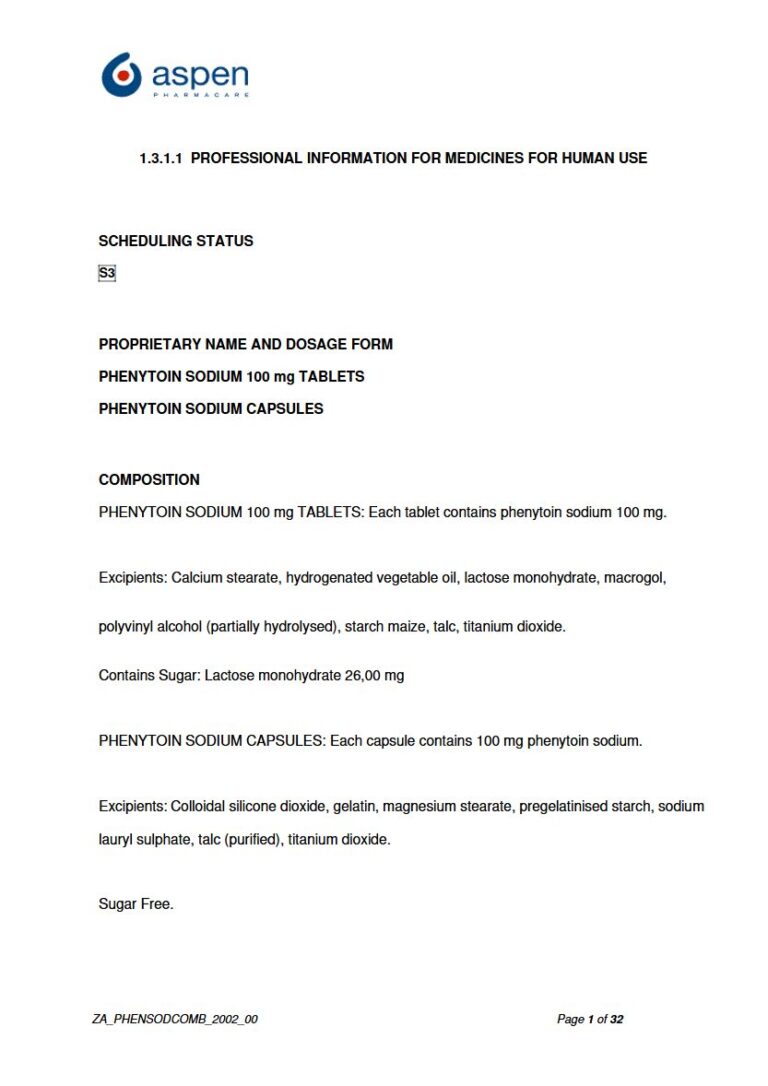
Phenytoin Sodium 100 Mg Tablets
PDF Leaflet Revision Date: 03 February 2020
Clinical Summary
Quick overview from the medicine insert
Indication
Control of generalized tonic-clonic and complex partial seizures.
Dosage (summary)
Adults: 100 mg three times daily, maintenance 300-400 mg daily, max 600 mg.
Onset of Action / Duration
Onset: 7-10 days for therapeutic levels.
Special Populations
- Renal impairment
- Hepatic impairment
Pregnancy & Breastfeeding
Not recommended during pregnancy; may cause congenital abnormalities. Avoid breastfeeding.
Key Drug Interactions
- St. John's Wort
- Alcohol
- CYP2C9/10 inducers
Contraindications
- Hypersensitivity
- Cardiac function impairment
- Porphyria
Common side effects
- Gingival hyperplasia
- Dizziness
- Nystagmus
Counselling Points
- Take with water after meals
- Monitor for skin reactions
- Avoid alcohol and St. John's Wort
Serious warnings
- Risk of SJS/TEN
- Suicidal ideation
- Abrupt withdrawal may precipitate status epilepticus
Important Disclaimer
The Phenytoin Sodium 100 Mg Tablets professional information leaflet below is the property of Pharmacare and is provided on Medinsert exactly as issued, with no.. alterations or editorial changes. We make every effort to keep content current by updating documents as soon as new versions become available. Medinsert serves as a trusted access point for healthcare professionals, but does not replace official sources or clinical judgement. For more details, please read our full disclaimer. read more>>
 Healthcare Professionals Only
This content is for registered healthcare professionals
Sign in or create a free account to read the full package insert.
Free for HPCSA-registered professionals. Powered by Medinsert.
Clinical Particulars
Section 4 of the official insert — extracted exactly as issued, no alterations
4.1 Therapeutic indications
PHENYTOIN SODIUM is indicated for the control of generalised tonic-clonic (grand mal) and complex partial psychomotor, temporal lobe seizures.
4.2 Posology and method of administration
To be taken with half a glassful of water after meals. Dosage should be individualised to provide maximum benefit. In some cases, serum level determinations may be necessary for optimal dosage adjustments, the clinically effective serum level is usually 40 to 80 u03bcmol/l (10 to 20 u03bcg/mi). With recommended dosage, a period of 7 to 10 days may be required to achieve therapeutic blood levels with PHENYTOIN SODIUM.
The dosages below are approximate guides only. Individual requirements vary in different patients, and the dosage should be increased gradually until a therapeutic blood level is reached.
Adult dosage: Divided daily dose: Patients who have received no previous treatment may be started on 100 mg three times daily, and the dosage is then adjusted to suit individual requirements. For most adults, the satisfactory maintenance dosage will be 300 to 400 mg daily, with a maximum daily dose of 600 mg.
Loading dose: Non-emergency oral loading dose in adult patients: An oral loading dose of PHENYTOIN SODIUM may be used for non-emergency initiation of therapy in adults who require rapid steady state serum levels, and for whom intravenous administration is not desirable. This dosing regimen should be reserved for patients in a clinical or hospital setting where PHENYTOIN SODIUM can be closely monitored. Patients with a history of renal or liver disease should not receive the oral loading regimen. The recommended oral loading dose is one gram divided into three equal doses (400 mg, 300 mg, 300 mg) administered at two-hour intervals. Normal maintenance dosage is then instituted 24 hours after the loading dose, with frequent serum levels determinations.
Paediatric and children dosage: Initially, 5 mg/kg/day in two or three equally divided doses, with subsequent dosage individualized to a maximum of 300 mg daily. A recommended daily maintenance dosage is usually in the range of 4 to 8 mg/kg. Children over 6 years old may require the minimal adult dosage (300 mg/day). If the daily dosage cannot be divided equally, the larger dose should be given at bedtime. Alternate dosage: Once-a-day dosage for adults may be considered if seizure control is established with divided doses. Once-a-day dosage offers a convenience to the patient and is intended to be used only for patients who demonstrate adequate control on a once-a-day dosage. Patients should be cautioned not to miss a dose.
4.3 Contraindications
PHENYTOIN SODIUM is contraindicated in:
- Patients with hypersensitivity to the active ingredient or to any of the excipients in PHENYTOIN SODIUM (see COMPOSITION) and in those patients with a history of hypersensitivity to hydantoin products.
- Cardiac function impairment, such as Adams Stokes syndrome, sinoatrial block and sinus bradycardia.
- Co-administration with delavirdine due to the potential for loss of virologic response and possible resistance to delavirdine or to the class of non-nucleoside reverse transcriptase inhibitors.
- Porphyria
4.4 Special warnings and precautions for use
General
PHENYTOIN SODIUM tablets contain lactose which may have an effect on the glycaemic control of patients with diabetes mellitus. PHENYTOIN SODIUM is not effective for absence (petit mal) seizures. If tonic-clonic (grand mal) and absence seizures are present together, combined medicine therapy is needed. PHENYTOIN SODIUM is not indicated for seizures due to hypoglycaemia or other metabolic causes. Abrupt withdrawal of phenytoin, as contained in PHENYTOIN SODIUM, in epileptic patients may precipitate status epilepticus. When, in the judgement of the clinician, the need for dosage reduction, discontinuation, or substitution of alternative anti-epileptic medication arises, this should be done gradually. However, in the event of an allergic or hypersensitivity reaction, rapid substitution of alternative therapy may be necessary. In this case, alternative therapy should be an anti-epileptic medicine not belonging to the hydantoin chemical class. Phenytoin sodium may precipitate or aggravate absence seizures and myoclonic seizures.
Herbal preparations containing St. John's Wort (Hypericum perforatum) should not be used while taking PHENYTOIN SODIUM due to the risk of decreased plasma concentrations and reduced clinical effects of phenytoin, contained in PHENYTOIN SODIUM (see INTERACTIONS). A small percentage of individuals who have been treated with PHENYTOIN SODIUM have been shown to metabolise the medicine slowly. Slow metabolism may be due to limited enzyme availability and lack of induction; it appears to be genetically determined. Hyperglycaemia may be potentialted in patients with diabetes mellitus. PHENYTOIN SODIUM should be administered with caution to patients receiving thyroid replacement therapy. It is suggested that caution be exercised in its use during early pregnancy, and during breastfeeding (see PREGNANCY AND LACTATION).
PHENYTOIN SODIUM should be prescribed with caution where ulcers or lesions of the gastrointestinal tract exist.
Alcohol
Acute alcohol intake may increase PHENYTOIN SODIUM serum levels while chronic alcoholism may decrease serum levels.
Suicide
Suicidal ideation and behaviour have been reported in patients treated with anti-epileptic medicines. Therefore patients should be monitored for signs of suicidal ideation and behaviours and appropriate treatment should be considered. Patients (and caregivers of patients) should be advised to seek medical advice should signs of suicidal ideation or behaviour emerge.
Anticonvulsant Hypersensitivity Syndrome (AHS)
Anticonvulsant Hypersensitivity Syndrome (AHS) is a rare medicine-induced, multiorgan syndrome which is potentially fatal and occurs in some patients taking anticonvulsant medication such as PHENYTOIN SODIUM. It is characterized by fever, rash, lymphadenopathy, and other multi-organ pathologies, often hepatic. The mechanism is unknown. The interval between first medicine exposure and symptoms is usually 2 to 4 weeks but has been reported in individuals receiving anticonvulsants for three or more months. Although up to 1 in 5 patients may develop cutaneous eruptions, only a small proportion will progress to AHS.
Patients at higher risk for developing AHS include black patients, patients who have a family history of or who have experienced this syndrome in the past, and immuno-suppressed patients. The syndrome is more severe in previously sensitised individuals. If a patient is diagnosed with AHS, discontinue the PHENYTOIN SODIUM and provide appropriate supportive measures.
Hypersensitivity Syndrome (HSS) or Drug Reaction with Eosinophilia and Systemic Symptoms (DRESS)
Patients at higher risk for developing HSS/DRESS include black patients, patients who have experienced this syndrome in the past (with phenytoin, as contained in PHENYTOIN SODIUM or other anticonvulsant medicines), patients who have a family history of this syndrome and immuno-suppressed patients. The syndrome is more severe in previously sensitised individuals.
Serious skin reactions
Life-threatening cutaneous reactions Stevens-Johnson syndrome (SJS) and toxic epidermal necrolysis (TEN) have been reported with the use of phenytoin, as contained in PHENYTOIN SODIUM. Although serious skin reactions may occur without warning, patients should be advised of the signs and symptoms of HSS/DRESS i.e. occurrence of rash and should be monitored closely for skin reactions. Patients should seek medical advice from their medical practitioner immediately when observing any indicative signs or symptoms. The highest risk for occurrence of SJS or TEN is within the first weeks of treatment. If symptoms or signs of SJS or TEN (e.g. progressive skin rash often with blisters or mucosal lesions) are present, PHENYTOIN SODIUM treatment should be discontinued. The best results in managing SJS and TEN come from early diagnosis and immediate discontinuation of any suspect medicines. Early withdrawal is associated with a better prognosis. If the patient has developed SJS or TEN with the use of PHENYTOIN SODIUM, PHENYTOIN SODIUM must not be re-started in this patient at any time. If the rash is of a milder type (measles-like or scarlatiniform), therapy may be resumed after the rash has completely disappeared. If the rash recurs upon reinstitution of therapy, further phenytoin medication is contraindicated. The risk of serious skin reactions and other hypersensitivity reactions to phenytoin, as contained in PHENYTOIN SODIUM, may be higher in black patients. Data suggests that HLA-B*1502 may be a risk factor for the development of SJS/TEN in patients of Asian ancestry taking medicines associated with SJS/TEN, including phenytoin, as contained in PHENYTOIN SODIUM. Consideration should be given to avoiding use of medicines associated with SJS/TEN, including phenytoin, in HLA-B*1502 positive patients when alternative therapies are otherwise equally available. HLA-B*1502 may be associated with an increased risk of developing Stevens Johnson Syndrome (SJS) in individuals of Thai and Han Chinese Origin when treated with phenytoin, as contained in PHENYTOIN SODIUM. If these patients are known to be positive for HLA-B*1502, the use of PHENYTOIN SODIUM should only be considered if the benefits are thought to exceed risks.
Hepatic Injury
Phenytoin is highly protein bound and extensively metabolised by the liver. Reduced dosage to prevent accumulation and toxicity may therefore be required in patients with impaired liver function. Where protein binding is reduced, as in uraemia, total serum phenytoin levels will be reduced accordingly. However, the pharmacologically active free medicine concentration is unlikely to be altered. Therefore, under these circumstances therapeutic control may be achieved with total phenytoin levels below the normal range of 10 to 20 mg/l (40 to 80 micromoles/l). Cases of acute hepatotoxicity, including infrequent cases of acute hepatic failure, have been reported with phenytoin, as contained in PHENYTOIN SODIUM. These incidents usually occur within the first 2 months of treatment and may be associated with HSS/DRESS. Patients with impaired liver function, older patients or those who are gravely ill may show early signs of toxicity. The risk of hepatotoxicity and other hypersensitivity reactions to phenytoin, as contained in PHENYTOIN SODIUM may be higher in black patients.
Haematopoietic system
Haematopoietic complications, some fatal, have occasionally been reported in association with administration of phenytoin, as contained in PHENYTOIN SODIUM. These have included thrombocytopenia, leucopenia, granulocytopenia, agranulocytosis, and pancytopenia with or without bone marrow suppression. There have been a number of reports suggesting a relationship between phenytoin and the development of lymphadenopathy (local and generalised) including benign lymph node hyperplasia, pseudo lymphoma, lymphoma, and Hodgkin's Disease. Although a cause and effect relationship has not been established, the occurrence of lymphadenopathy indicates the need to differentiate such a condition from other types of lymph node pathology. Lymph node involvement may occur with or without symptoms and signs resembling HSS/DRESS. In all cases of lymphadenopathy, follow-up observation for an extended period is indicated and every effort should be made to achieve seizure control using alternative antiepileptic medicines.
Central Nervous System Effect
Serum levels of phenytoin, as contained in PHENYTOIN SODIUM, sustained above the optimal range may produce confusional states referred to as u201cdeliriumu201d, u201cpsychosisu201d, or u201cencephalopathyu201d, or rarely irreversible cerebellar dysfunction (see SIDE EFFECTS). Accordingly, at the first sign of acute toxicity, serum medicine level determinations are recommended. Dose reduction of PHENYTOIN SODIUM therapy is indicated if serum levels are excessive; if symptoms persist, termination of therapy with PHENYTOIN SODIUM is recommended.
Musculoskeletal Effect
Phenytoin, as contained in PHENYTOIN SODIUM, and other anticonvulsants that have been shown to induce the CYP450 enzyme are thought to affect bone mineral metabolism indirectly by increasing the metabolism of Vitamin D3. This may lead to Vitamin D deficiency and heightened risk of osteomalacia, bone fractures, osteoporosis, hypocalcemia, and hypophosphatemia in chronically treated epileptic patients. It is suggested that patients on long-term treatment receive not less than 100 u03bcg of vitamin D as calciferol per week.
Metabolic Effect
In view of reports associating phenytoin with exacerbation of porphyria, caution should be exercised in using PHENYTOIN SODIUM in patients suffering from this disease (see CONTRAINDICATIONS). Phenytoin, as contained in PHENYTOIN SODIUM, may affect glucose metabolism and inhibit insulin release. Hyperglycaemia has been reported in association with toxic levels.
Effects on the endocrine system and metabolism
Although it may be difficult to separate from the effects of the disease itself, there is some evidence that antiepileptics, like PHENYTOIN SODIUM, can diminish sexual potency and fertility in male epileptics. Phenytoin is excreted in human semen in small quantities and might affect sperm morphology and motility. Reduced plasma concentrations of free testosterone have been detected in male epileptic patients receiving phenytoin as contained in PHENYTOIN SODIUM.
AIDS associations
Renal abnormalities or hypalbuminaemia associated with AIDS may increase the risk of elevated free phenytoin concentrations and subsequent toxicity.
Effects on ability to drive and use machines
Since adverse reactions such as headache, dizziness and visual disturbances have been reported in patients taking PHENYTOIN SODIUM, patients should not drive, use machinery or perform any tasks that require concentration, until they are certain that PHENYTOIN SODIUM does not adversely affect their ability to do so (see SIDE EFFECTS).
4.5 Interactions with other medicines
Medicines that may increase PHENYTOIN SODIUM serum levels include but are not limited to:
MEDICINE CLASSES Medicine in each class (such as)
- Alcohol (acute intake)
- Analgesic/Anti-inflammatory medicines azapropazone phenylbutazone salicylates
- Anaesthetics halothane
- Antibacterial medicines chloramphenicol erythromycin isoniazid sulfadiazine sulfamethizole sulfamethoxazole-trimethoprim sulfaphenazole sulfisoxazole sulfonamides
- Anticonvulsants felbamate oxcarbazepine sodium valproate succinimides topiramate
- Antifungal medicines amphotericin B fluconazole itraconazole ketoconazole miconazole voriconazole
- Antineoplastic medicines capecitabine fluorouracil
- Benzodiazepines/psychotropic medicines chlordiazepoxide diazepam disulfiram methylphenidate trazodone viloxazine phenothiazine
- Calcium channel blockers/Cardiovascular medicines amiodarone diltiazem nifedipine ticlopidine
- H2-antagonists cimetidine ranitidine
- HMG-CoA reductase inhibitors fluvastatin
- Hormones oestrogens
- Immunosuppressant medicines tacrolimus
- Oral hypoglycemic medicines tolbutamide
- Proton pump inhibitors omeprazole
- Serotonin re-uptake inhibitors fluoxetine fluvoxamine sertraline imipramine others
- Phenyramidol
- Sulthiame
- Clofibrate
- Thyroid preparations
Medicines that may decrease PHENYTOIN SODIUM serum levels include:
- Ingestion times of PHENYTOIN SODIUM and antacid preparations containing calcium should be staggered to prevent absorption problems.
MEDICINE CLASSES MEDICINE in each class (such as)
- Alcohol (chronic intake)
- Antibacterial medicines ciprofloxacin rifampicin
- Anticonvulsants vigabatrin
- Antineoplastic medicines bleomycin carboplatin cisplatin doxorubicin methotrexate
- Antiulcer medicines sucralfate
- Antiretrovirals fosamprenavir nelfinavir ritonavir
- Bronchodilators theophylline
- Cardiovascular medicines reserpine
- Folic acid folic acid
- Hyperglycemic medicines diazoxide
- St. John's Wort St. John's Wort
Serum levels of phenytoin, as contained in PHENYTOIN SODIUM, can be reduced by concomitant use of the herbal preparations containing St. John's Wort (Hypericum perforatum). This is due to induction of medicines metabolising enzymes by St. John's Wort. Herbal preparations containing St. John's Wort should therefore not be combined with PHENYTOIN SODIUM. The inducing effect may persist for at least 2 weeks after cessation of treatment with St, John's Wort. If a patient is already taking St. John's Wort check the anticonvulsant levels and stop St. John's Wort. Anticonvulsant levels may increase on stopping St. John's Wort. The dose of PHENYTOIN SODIUM may need adjusting.
Medicines that may either increase or decrease PHENYTOIN SODIUM serum levels include:
The effect of PHENYTOIN SODIUM on phenobarbitone, valproic acid and sodium valproate serum levels is unpredictable. Serum level determinations may be helpful when such interactions are suspected.
Medicine Classes Medicines in each Class (such as)
- Antibacterial medicines ciprofloxacin
- Anticonvulsants carbamazepine phenobarbital sodium valproate valproic acid
- Antineoplastic medicines Antineoplastic medicines
- Psychotropic medicines chlordiazepoxide diazepam phenothiazines
Medicines of which the efficacy may be enhanced by PHENYTOIN SODIUM include:
Warfarin, dicoumarol, alcohol and other central nervous system depressants. PHENYTOIN SODIUM may increase lithium levels and may produce toxicity. PHENYTOIN SODIUM may destabilise thyroxine therapy due to displacement from its protein binding sites.
Medicines of which the efficacy is impaired by PHENYTOIN SODIUM include:
Antifungal medicines, antineoplastic medicines, clozapine, corticosteroids, coumarin anticoagulants, oral contraceptives, quinidine, vitamin D, doxycycline, theophylline, oestrogens, furosemide, tricyclic antidepressants, rifampicin, paroxetine.
Tricyclic antidepressants may precipitate seizures in susceptible patients and PHENYTOIN SODIUM dosage may need to be adjusted.
Medicines whose serum levels and/or effects may be altered by PHENYTOIN SODIUM include:
Antibacterial medicines doxycycline rifampicin tetracycline
Anticonvulsants carbamazepine lamotrigine phenobarbital sodium valproate valproic acid
Antifungal medicines azoles posaconazole voriconazole
Antihelmintics albendazole praziquantel
Antineoplastic medicines teniposide
Antiretrovirals delavirdine efavirenz fosamprenavir indinavir lopinavir/ritonavir nelfinavir ritonavir saquinavir
Bronchodilators theophylline
Calcium channel blockers/Cardiovascular medicines digitoxin digoxin mexiletine nicardipine nimodipine nisoldipine quinidine verapamil
Corticosteroids
Coumarin anticoagulants warfarin
Cyclosporine
Diuretics furosemide
HMG-CoA reductase inhibitors atorvastatin fluvastatin simvastatin
Hormones oestrogens oral contraceptives
Hyperglycemic medicines diazoxide
Immunosuppressant medicines
Neuromuscular blocking medicines alcuronium cisatracurium pancuronium rocuronium vecuronium
Opioid analgesics methadone
Oral hypoglycemic medicines chlorpropamide glyburide tolbutamide
Psychotropic medicines/Antidepressants clozapine paroxetine quetiapine sertraline
Vitamin D vitamin D
Laboratory test Interactions: Phenytoin, as contained in PHENYTOIN SODIUM, may cause a slight decrease in serum levels of total and free thyroxine, possibly as a result of enhanced peripheral metabolism. These changes do not lead to clinical hypothyroidism and do not affect the levels of circulating TSH. The latter can therefore be used for diagnosing hypothyroidism in the patient on PHENYTOIN SODIUM. Phenytoin, as contained in PHENYTOIN SODIUM does not interfere with uptake and suppression tests used in the diagnosis of hypothyroidism. It may, however, produce lower than normal values for dexamethasone or metapyrone tests. PHENYTOIN SODIUM may cause raised serum levels of glucose, alkaline phosphatase, and gamma glutamyl transpeptidase and lowered serum levels of calcium and folic acid. It is recommended that serum folate concentrations be measured at least once every 6 months, and folic acid supplements given if necessary. PHENYTOIN SODIUM may affect blood sugar metabolism tests.
4.6 Fertility, pregnancy and lactation
Safety and efficacy in pregnancy and lactation has not been established.
Pregnancy
PHENYTOIN SODIUM should not be taken by pregnant women. There are intrinsic methodologic problems in obtaining adequate data on medicine teratogenicity in humans. Genetic factors or the epileptic condition itself may be more important than medicine therapy in leading to birth defects. The great majority of mothers on anticonvulsant medication deliver normal infants. It is important to note that anticonvulsant medicines should not be discontinued in patients in whom the medicines is administered to prevent major seizures because of the strong possibility of precipitating status epilepticus with attendant hypoxia and threat to life. In individual cases where the severity and frequency of the seizure disorder are such that the removal of medication does not pose a serious threat to the patient, discontinuation of the medicine may be considered prior to and during pregnancy although it cannot be said with any confidence that even minor seizures do not pose some hazard to the developing embryo or foetus. Anticonvulsants including PHENYTOIN SODIUM may produce congenital abnormalities in the offspring of a small number of epileptic patients. The exact role of medicine therapy in these abnormalities is unclear and genetic factors have also been shown to be important. PHENYTOIN SODIUM should only be used during pregnancy, especially early pregnancy, if in the judgement of the physician the potential benefits clearly outweigh the risk. In addition to the reports of increased incidence of congenital malformations, such as cleft lip/palate and heart malformations in children of women receiving phenytoin, as contained in PHENYTOIN SODIUM, there have more recently been reports of a foetal hydantoin syndrome. This consists of prenatal growth deficiency, micro-encephaly and mental deficiency in children born to mothers who have received phenytoin. However, these features are all interrelated and are frequently associated with intrauterine growth retardation from other causes. There have been isolated reports of malignancies, including neuroblastoma, in children whose mothers received phenytoin during pregnancy. An increase in seizure frequency during pregnancy occurs in a proportion of patients, and this may be due to altered phenytoin, as contained in PHENYTOIN SODIUM, absorption or metabolism. Periodic measurement of serum phenytoin levels is particularly valuable in the management of a pregnant epileptic patient as a guide to an appropriate adjustment of dosage. However, postpartum restoration of the original dosage will probably be indicated. Neonatal coagulation defects have been reported within the first 24 hours in babies born to epileptic mothers receiving phenytoin, as contained in PHENYTOIN SODIUM. Vitamin K1 has been shown to prevent or correct this defect and may be given to the mother before delivery and to the neonate after birth.
Lactation
Infant breastfeeding is not recommended for women taking phenytoin because phenytoin appears to be secreted in low concentrations in human milk (see SIDE EFFECTS and WARNINGS AND SPECIAL PRECAUTIONS).
Women of childbearing potential
Fertility
Decrease or diminish sexual potency and fertility in male epileptics (see SIDE EFFECTS and WARNINGS AND SPECIAL PRECAUTIONS).
4.8 Undesirable effects
Neoplasms benign and malignant (including cysts and polyps) Frequency unknown: Pseudolymphoma mimicking cutaneous T-cell lymphoma.
Blood and the lymphatic system disorders
Less frequent: Lymphadenopathy, polyarteritis nodosa, Frequency unknown: Leucopenia, granulocytopenia, agranulocytosis, pancytopenia with or without bone marrow suppression, aplastic anaemia, macrocytosis and megaloblastic anaemia, development of lymphadenopathy (local and generalised) including benign lymph node hyperplasia, pseudolymphoma, lymphoma, and Hodgkin's disease, polyarthropathy, eosinophilia, thrombocytopenia.
Immune system disorders
Frequency unknown: Hypersensitivity syndrome/Drug reaction with eosinophilia and systemic symptoms (HSS/DRESS) may in rare cases be fatal (the syndrome may include, but is not limited to, symptoms such as arthralgias, eosinophilia, fever, liver dysfunction, lymphadenopathy or rash), systemic lupus erythematosus, polyarteritis nodosa, and immunoglobulin abnormalities may occur. (Several individual case reports have suggested incidence of hypersensitivity reactions, including skin rash and hepatotoxicity, in black patients) and lymphocytosis with interstitial nephritis, interstitial pulmonary infiltrates, myopathy, diffuse intravascular coagulation.
Metabolism and nutrition disorders
Frequency unknown: Hyperglycaemia, interferes with vitamin D and folate metabolism, hypocalcaemia and elevated alkaline phosphatase.
Psychiatric disorders
Frequent: Hallucinations.
Nervous system disorders
Less frequent: Irreversible cerebellar dysfunction associated with severe phenytoin overdosage Frequency unknown: exacerbations of seizure frequency, ataxia, slurred speech, decreased coordination, mental confusion, paraesthesia, somnolence, drowsiness vertigo, dizziness, insomnia, transient nervousness, motor twitchings, taste perversion, headaches, phenytoin induced dyskinesias, including chorea, dystonia, tremor and asterixis, sensory peripheral polyneuropathy.
Eye disorders
Less frequent: Nystagmus, blurred vision or diplopia.
Cardiac disorders
Frequency unknown: Cardiac dysrhythmias, impaired cardiac conduction.
Vascular disorders
Frequency unknown: Hypotension.
Respiratory, thoracic and mediastinal disorders
Frequency unknown: Respiratory depression.
Less frequent: Pneumonitis.
Gastrointestinal disorders
Frequent: Lack of appetite, tenderness of the gums Frequency unknown: Nausea, vomiting, constipation, gingival hyperplasia of the gums.
Hepato-biliary disorders
Frequency unknown: Acute hepatic failure, toxic hepatitis, liver damage.
Skin and subcutaneous tissue disorders
Frequent: Acne, skin rashes, morbilliform skin rashes, Less frequent: Hirsutism, bullous, exfoliative, dermatitis or purpuric rashes may be symptoms of lupus erythematosus, erythema multiforme, Stevens-Johnson syndrome (SJS) or toxic epidermal necrolysis(TEN).
Musculoskeletal, connective tissue and bone disorders
Less frequent: Rickets, osteomalacia, coarsening of the facial features, enlargement of the lips, hirsutism, hypertrichosis, Peyronie's Disease and Dupuytren's contracture may occur Frequency unknown: Bone mineral density, osteopenia, osteoporosis, fractures, bone mineral metabolism may be affected indirectly by increasing the metabolism of Vitamin D3. This may lead to Vitamin D deficiency and heightened risk of osteomalacia, bone fractures, osteoporosis, hypocalcemia, and hypophosphatemia in chronically treated epileptic patients.
Pregnancy, puerperium and perinatal conditions
Frequent: Increased risk of neural tube defects, syndromes (foetal hydantoin syndrome) such as craniofacial and digital abnormalities (see PREGNANCY AND LACTATION).
Less frequent: Cleft lip and palate, neonatal bleeding (see PREGNANCY AND LACTATION).
Reproductive system and breast disorders
Frequency unknown: Decrease in sexual potency and fertility in male epileptics, gynaecomastia.
Investigations
Frequent: Decreased serum levels of protein bound iodine (PBI), lower than normal values for dexamethasone or metyrapone tests, raised serum levels of glucose, alkaline phosphatase, and gamma glutamyl transpeptidase (GGT) (see INTERACTIONS).
Less frequent: Immunoglobulin abnormalities.
4.9 Overdose
Symptoms
The lethal dose in children is not known. The mean lethal dose in adults is estimated to be 2 to 5 grams. The initial symptoms are nystagmus, ataxia and dysarthria. Other signs include tremor, hypereflexia, lethargy, slurred speech, nausea and vomiting. The patient then becomes comatose, the pupils are unresponsive and hypotension occurs. This may be followed by respiratory depression and apnoea. Death is due to respiratory and circulatory depression.
There are marked variations among individuals with respect to phenytoin serum levels where toxicity may occur. Nystagmus on lateral gaze usually appears at 20 mg/l, and ataxia at 30 mg/l, dysarthria and lethargy appear when the serum concentration is greater than 40 mg/l, but a concentration as high as 50 mg/l has been reported without evidence of toxicity. As much as 25 times therapeutic dose has been taken to result in serum concentration over 100 mg/l (400 micromoles/l) with complete recovery.
Treatment
Treatment is non-specific since there is no known antidote. If ingested within the previous 4 hours the stomach should be emptied. If the gag reflex is absent, the airway should be supported. Oxygen and assisted ventilation may be necessary for central nervous system, respiratory and cardiovascular depression. Haemodialysis can be considered since phenytoin is not completely bound to plasma proteins. Total exchange transfusion has been utilised in the treatment of severe intoxication in children. In acute overdosage the possibility of the presence of other CNS depressants, including alcohol, should be borne in mind.
