
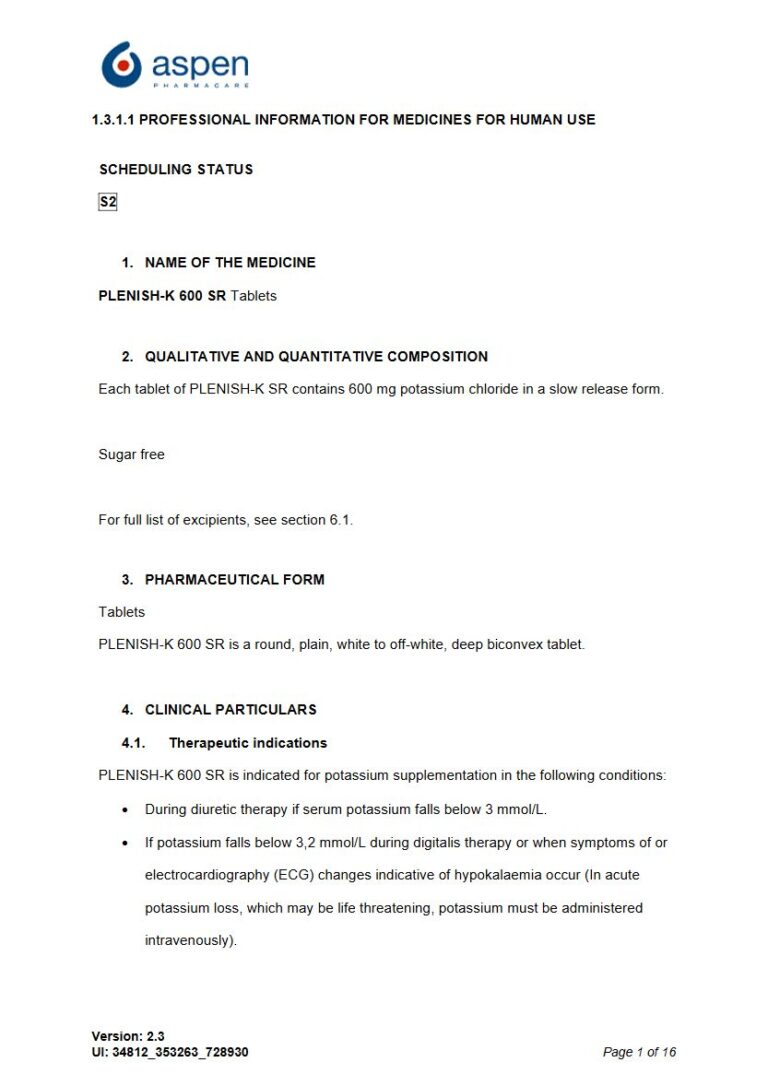
Plenish-K 600 Sr 600 mg Tablet
PDF Leaflet Revision Date: 19 February 2026
Clinical Summary
Quick overview from the medicine insert
Indication
Potassium supplementation for hypokalaemia.
Dosage (summary)
Adults: 6-12 tablets daily in divided doses; max 2 tablets per dose.
Special Populations
- Elderly
- Cirrhotics
- Renal impairment
Pregnancy & Breastfeeding
Use only if clearly needed; safety not established.
Key Drug Interactions
- Potassium-sparing diuretics
- ACE inhibitors
- NSAIDs
Contraindications
- Hypersensitivity to potassium chloride
- Hyperkalaemia
- Renal failure
- Gastrointestinal obstruction
Common side effects
- Nausea
- Vomiting
- Flatulence
- Abdominal pain
- Diarrhoea
Counselling Points
- Take with fluid during meals
- Monitor potassium levels
- Report gastrointestinal symptoms immediately
Serious warnings
- Risk of hyperkalaemia
- Monitor renal function
- Gastrointestinal ulceration risk
Important Disclaimer
The Plenish-K 600 Sr 600 mg Tablet professional information leaflet below is the property of Pharmacare and is provided on Medinsert exactly as issued, with no.. alterations or editorial changes. We make every effort to keep content current by updating documents as soon as new versions become available. Medinsert serves as a trusted access point for healthcare professionals, but does not replace official sources or clinical judgement. For more details, please read our full disclaimer. read more>>
 Healthcare Professionals Only
This content is for registered healthcare professionals
Sign in or create a free account to read the full package insert.
Free for HPCSA-registered professionals. Powered by Medinsert.
Clinical Particulars
Section 4 of the official insert — extracted exactly as issued, no alterations
4.1. Therapeutic indications
PLENISH-K 600 SR is indicated for potassium supplementation in the following conditions:
- During diuretic therapy if serum potassium falls below 3 mmol/L.
- If potassium falls below 3,2 mmol/L during digitalis therapy or when symptoms of or electrocardiography (ECG) changes indicative of hypokalaemia occur (In acute potassium loss, which may be life threatening, potassium must be administered intravenously).
4.2. Posology and method of administration
Posology
The dosage should be adapted to the cause and degree of the manifest hypokalaemic state. Provided no signs of intolerance occur, the medicine should be continued until the hypokalaemia has been corrected.
Adults
Depending on the patientu2019s individual requirements, a daily dosage of 6 to 12 tablets, in several divided doses should be given. Not more than 2 tablets should be given in a single dose. The tablets should be swallowed whole with fluid during meals while the patient is in an upright position. Adequate fluid intake during treatment with PLENISH-K 600 SR is essential. The adequacy of PLENISH-K 600 SR as an oral potassium replacement in hypokalaemia states, must be assessed by periodic monitoring of serum potassium levels.
Paediatric population
The safety and efficacy of PLENISH-K 600 SR in children has not been established. PLENISH-K 600 SR is therefore not recommended for paediatric use.
Method of administration
For oral administration.
4.3. Contraindications
PLENISH-K 600 SR is contraindicated in:
- Patients with hypersensitivity to potassium chloride or potassium administration, as found, for example in adynamia episodica hereditaria, hyperkalaemic periodic paralysis or congenital paramyotonia or to any of the excipients in PLENISH-K 600 SR (see sections 2 and 6.1).
- All forms of hyperkalaemia as encountered in renal failure, in conditions involving extensive cell destruction (e.g. severe burns, crush syndrome, massive haemolysis, rhabdomyolysis, tumour lysis), untreated Addisonu2019s disease, hyporeninaemic hypoaldosteronism as well as in metabolic acidosis and acute dehydration.
- Ulceration of the bowel.
- Renal failure and oliguria or kidney disease where GFR < 20 mL/min (even when not yet associated with manifest hyperkalaemia).
- All states in which passage through the digestive tract is retarded or obstructed (e.g. owing to diverticula or compression of the oesophagus by an enlarged atrium, to stenosis or atony in various gastrointestinal segments).
- Concomitant treatment with potassium sparing diuretics (e.g. triamterene, amiloride or angiotensin-converting-enzyme inhibitors (ACE inhibitors) and aldosterone antagonists (e.g. spironolactone and eplerenone) due to the possible risk of hyperkalaemia occurring (see section 4.5).
- Concomitant administration with intravenous potassium.
4.4. Special warnings and precautions for use
Hyperkalaemia
In patients with impaired mechanisms for excreting potassium, the administration of potassium salts can produce hyperkalaemia and cardiac arrest. This arises most commonly in patients given potassium by the intravenous route, but it may also occur in patients receiving potassium orally. Potentially fatal hyperkalaemia can develop rapidly and may be asymptomatic. Hyperkalaemia may develop in patients having difficulty with either renal potassium excretion or potassium metabolism (see section 4.8).
The use of potassium salts in patients with chronic renal disease, or any other condition which impairs potassium excretion, requires particularly careful monitoring of the serum potassium concentration and appropriate dosage adjustments. PLENISH-K 600 SR should be used with caution in patients receiving any medicine known to cause hyperkalaemia, i.e. other potassium chloride supplements, potassium sparing diuretics, nonsteroidal anti-inflammatory drugs (NSAIDs) (e.g. indomethacin), ACE inhibitors, angiotensin-II-receptor antagonists, lithium, beta-blockers, heparin, digoxin and cyclosporine (see section 4.5).
Caution should be observed in treating patients with renal or adrenal insufficiency, acute dehydration or heat cramp. In the presence of reduced renal function hyperkalaemia may be produced.
Gastrointestinal disorders
If a patient under treatment with PLENISH-K 600 SR develops severe vomiting, severe abdominal pains or flatulence, diarrhoea or gastrointestinal haemorrhage, PLENISH-K 600 SR should be withdrawn at once, because these signs and symptoms may point to the presence of ulceration or perforation in the gastrointestinal tract (see section 4.8). Such risks may be increased in patients with oesophageal stasis, known peptic and/or gastric ulcers, delayed intestinal transit, or intestinal ischaemia due to generalised atherosclerotic vascular disease.
Since anticholinergic medicines may reduce gastrointestinal motility, they should be prescribed with great care when given concomitantly with PLENISH-K 600 SR, particularly in high doses (see section 4.5). Patients with ostomies or other conditions which alter intestinal transit times are better treated with other forms of potassium salts.
Metabolic acidosis
Hypokalaemia in patients with metabolic acidosis should be managed not with potassium chloride, but with an alkalinising potassium salt, such as potassium bicarbonate, potassium citrate or potassium acetate.
Treatment monitoring
Periodic serum potassium determinations are recommended during long-term potassium supplementation, especially in clinical conditions, which carry a risk of hyperkalaemia (e.g. impairment of renal function, elderly individuals, heart disease) (see section 4.5). In addition, careful attention should be paid to the acid-base balance, to other serum electrolyte levels (e.g. magnesium), to the ECG, and to the clinical status of the patient. When blood samples are taken for analysis of plasma potassium, it is important to bear in mind that artificial elevations can occur after an improper venipuncture technique or as a result of in-vitro haemolysis of the sample.
Careful attention should be paid to any pointers to gastrointestinal intolerance when prescribing PLENISH-K 600 SR. Thus, for example, before administering the tablets one should preclude the possibility that the patient may be suffering from active ulceration in the gastrointestinal tract or from a condition in which passage through the tract may be obstructed to such an extent as to compromise the transit of substances given by the oral route. PLENISH-K 600 SR should be prescribed with particular caution in patients with a history of peptic ulcer because of the possibility of their causing gastrointestinal ulceration.
Other
In some patients, diuretic-induced magnesium deficiency will prevent the restoration of intracellular deficits of potassium, so that hypomagnesaemia should be corrected at the same time as hypokalaemia.
Special populations
Elderly
Dose selection for an elderly patient should be cautious, usually starting at the low end of the dosing range, reflecting the greater frequency of decreased hepatic, renal or cardiac function, and of concomitant disease or other concomitant therapy. PLENISH-K 600 SR is known to be substantially excreted by the kidney, and the risk of toxic reactions to this medicine may be greater in patients with impaired renal function. Because elderly patients are more likely to have decreased renal function, care should be taken in dose selection, and it may be useful to monitor renal function.
Cirrhotics
Patients with cirrhosis should usually be started at the low end of the dosing range, and the serum potassium level should be monitored frequently.
Renal Impairment
Patients with renal impairment have reduced urinary excretion of potassium and are at substantially increased risk of hyperkalemia. The serum potassium level should be monitored frequently. Renal function should be assessed periodically. PLENISH-K 600 SR should not be taken on an empty stomach because of its potential for gastric irritation (see section 4.2).
4.5. Interaction with other medicines and other forms of interaction
Concomitant treatment with potassium-sparing diuretics (e.g. triamterene and amiloride), ACE inhibitors and aldosterone antagonists (e.g. spironolactone and eplerenone) is contraindicated (see section 4.3). Medicines which interfere with potassium excretion may promote hyperkalaemia when given together with PLENISH-K 600 SR. Combined treatment with the following medicines increase the risk of hyperkalaemia: Angiotensin-II-receptor antagonists, ciclosporin, NSAIDs (e.g. indomethacin), beta-blockers, heparin, digoxin, direct renin inhibitors (e.g. aliskerin), medicines that contain potassium such as potassium salts of penicillin and ciclosporin and proton pump inhibitors (see section 4.4). Thus, caution should be exercised in their concomitant use and potassium levels should be closely monitored. Similarly, the concomitant use of potassium containing salt substitutes for flavouring food should be avoided.
Caution should be exercised when prescribing PLENISH-K 600 SR, particularly in high dosage, in patients concurrently receiving anticholinergics, because of their potential to slow gastrointestinal motility (see section 4.4).
4.6. Fertility, pregnancy and lactation
The safety of PLENISH-K 600 SR in pregnancy and lactation has not been established.
Pregnancy
No clinical data on potassium chloride exposed pregnancies are available. There is no indication in pre-clinical studies of direct or indirect harmful effects with respect to pregnancy, embryonal/foetal development, parturition or postnatal development. Pregnancy is associated with gastrointestinal hypomotility. In pregnant women, therefore, solid forms of oral potassium preparations, such as PLENISH-K 600 SR should be given to pregnant women only if clearly needed.
Breastfeeding
The excretion of potassium in milk has not been studied in animals or humans. The normal potassium (K + ) content of human milk is about 13 mmol/litre. Since oral potassium, such as PLENISH-K 600 SR, becomes part of the body's potassium pool, provided this is not excessive, PLENISH-K 600 SR can be expected to have little or no effect on the potassium level in human milk. PLENISH-K 600 SR should only be given during breastfeeding when the expected benefit to the mother outweighs the potential risk to the baby.
Fertility
No data is available.
4.7. Effects on ability to drive and use machines
Patients should not drive, use machinery or perform any tasks that require concentration until they are certain that PLENISH-K 600 SR does not adversely affect their ability to do so safely (see section 4.8).
4.8. Undesirable effects
a) Summary of the safety profile
The most common undesirable effects reported on PLENISH-K 600 SR is nausea, vomiting, flatulence, abdominal pain/discomfort, and diarrhoea.
b) Tabulated list of adverse reactions
System organ class
Frequent
Frequency unknown (cannot be estimated from the available data)
Metabolism and nutrition disorders
Hyperkalaemia
Gastrointestinal disorders
Gastrointestinal disturbances (nausea, flatulence, vomiting, abdominal pains and cramps, diarrhoea)
Gastrointestinal obstruction, gastrointestinal haemorrhage, gastrointestinal ulcer, with or without perforation of the upper or lower GIT
Skin and subcutaneous tissue disorders
Urticaria, skin rash, pruritus
usually associated with other factors known to predispose a patient to these effects (e.g. delayed GIT transit time, obstruction of GIT).
necessitating either a reduction in dosage or withdrawal of medicine (see section 4.4).
4.9. Overdose
Symptoms
The clinical picture of acute overdosage (intoxication) with potassium is characterised chiefly by hyperkalaemia together with cardiovascular and neuromuscular disturbances which, in the presence of renal impairment, may already develop following relatively low doses of PLENISH-K 600 SR.
General features:
Nausea, vomiting and abdominal pain. Patients may deteriorate rapidly. Gastritis and gastric/ small bowel ulceration may occur.
Cardiac effects:
Ventricular dysrhythmias, bundle-branch block and ventricular fibrillation, accompanied by hypotension and shock, possibly leading to cardiac arrest. Cardiac conduction abnormalities and dysrhythmias are the major hazards, particularly ventricular tachycardia and fibrillation. Besides elevation of the serum potassium concentration, typical ECG changes are also encountered (increased amplitude of peaking of T wave, disappearance of P wave, widening of QRS complex and ST segment depression).
Neuromuscular effects:
Paraesthesiae, convulsions, areflexia, flaccid paralysis of striated muscle leading possibly to respiratory paralysis and respiratory arrest.
Treatment
In cases of acute poisoning, remove and/or inactivate excess potassium by:
- Induction of vomiting.
- NOTE: Activated charcoal does not adsorb potassium.
- In all cases of suspected ingestion, measure U&Es (Urea and Electrolytes) and creatinine urgently. Monitor cardiac rhythm. In all patients the potassium concentration should be repeated at regular intervals after an acute overdose (i.e. 2 to 3 hourly if elevated). Intravenous fluids should be administered to all patients.
- Perform a 12 lead ECG and examine carefully for potassium-induced toxicity (PR and QRS prolongation, peaked T waves, disappearance of P waves). Manage QRS prolongation conventionally.
- All patients should be observed for at least 12 hours after ingestion.
- Administration of cation exchange resin by mouth or gastric instillation (e.g. 20 g sodium polystyrene sulfonate with 20 ml 70 % sorbitol solution three to four times per day).
In moderately severe hyperkalaemia (plasma potassium between 6,5 and 8 mmol/L, as well as T wave peaking as the only ECG abnormality):
- Promote transcellular shift of potassium by administering i.v. 300 to 500 ml/hour of 10 % dextrose solution containing 10 to 20 units of insulin per 1000 ml.
Correct acidosis, if present, with i.v. sodium bicarbonate (44 to 132 mmol/L of glucose solution).
Correct hyponatraemia and hypovolaemia, if present.
In severe hyperkalaemia (plasma potassium exceeding 8 mmol/L or ECG abnormalities including absence of P wave, presence of widened QRS complex, disappearance of T wave, or ventricular dysrhythmia):
- Infuse glucose (with insulin) and/or bicarbonate i.v. as described above.
- Administer 10 to 30 ml 10 % calcium gluconate i.v. over 1 to 5 minutes under continuous ECG monitoring; administer cation exchange resin by high retention enema as follows: 30 to 50 g sodium polystyrene sulfonate suspended in 100 ml warm aqueous sorbitol solution should be kept in the sigmoid colon for several hours, if possible. The colon is then irrigated with a non-sodium-containing solution to remove the resin. Repeated enemas can be administered, or the resin given repeatedly by mouth, in order to maintain a physiological potassium concentration.
- Haemodialysis or peritoneal dialysis may be of use, particularly in patients with renal failure.
When treating hyperkalaemia, it should be borne in mind that, in patients who have been stabilised on digitalis, lowering the serum potassium concentration too rapidly can produce digitalis toxicity.
