
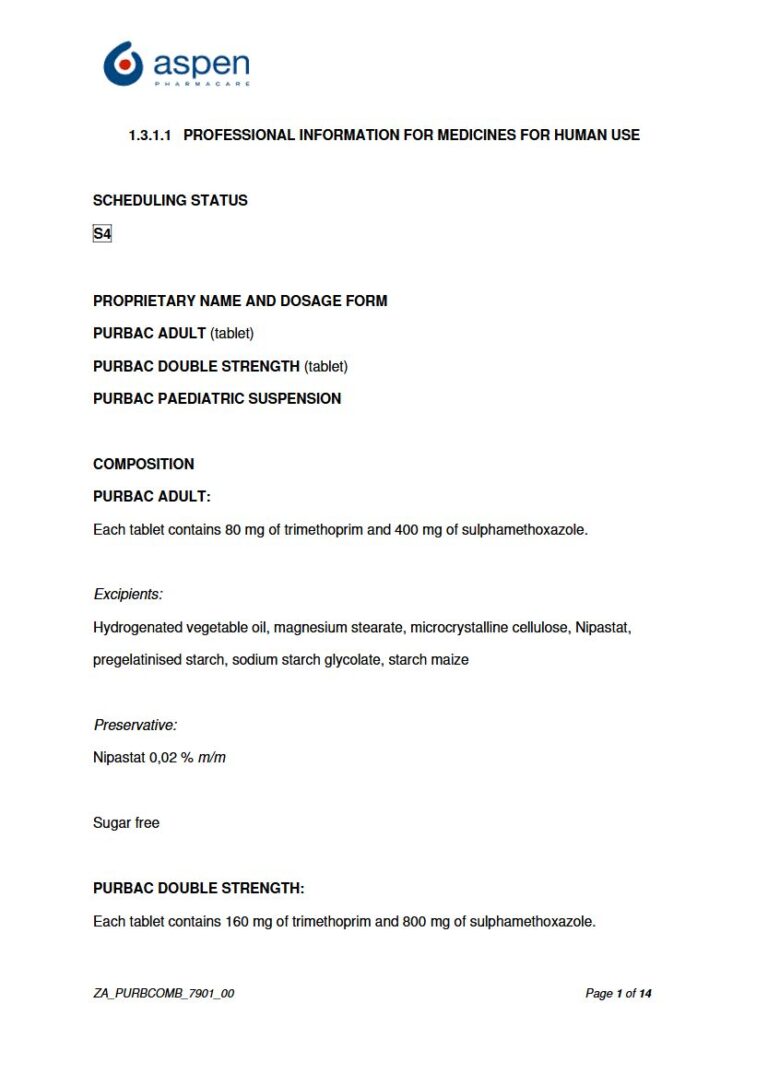
Purbac DS Tablets
PDF Leaflet Revision Date: 30 January 1979
Clinical Summary
Quick overview from the medicine insert
Indication
Effective against a wide range of Gram-positive and Gram-negative infections.
Dosage (summary)
Adults: 2 tablets every 12 hours; max 3 for severe cases. Children 6-12: 1 tablet every 12 hours.
Special Populations
- Elderly
- Renal impairment
- Immunocompromised patients
Pregnancy & Breastfeeding
Contraindicated in pregnancy and breastfeeding.
Key Drug Interactions
- Warfarin
- Methotrexate
- Phenytoin
- Diuretics
Contraindications
- Porphyria
- Liver damage
- Megaloblastic anemia
- Severe renal insufficiency
- Hypersensitivity to sulphonamides
Common side effects
- Skin rash
- Nausea
- Vomiting
- Diarrhea
- Thrombocytopenia
Counselling Points
- Take with plenty of fluids
- Report any rash immediately
- Avoid in pregnancy and breastfeeding
Serious warnings
- Risk of severe allergic reactions
- Monitor blood counts in prolonged use
- Caution in folate deficiency
Important Disclaimer
The Purbac DS Tablets professional information leaflet below is the property of Pharmacare and is provided on Medinsert exactly as issued, with no.. alterations or editorial changes. We make every effort to keep content current by updating documents as soon as new versions become available. Medinsert serves as a trusted access point for healthcare professionals, but does not replace official sources or clinical judgement. For more details, please read our full disclaimer. read more>>
 Healthcare Professionals Only
This content is for registered healthcare professionals
Sign in or create a free account to read the full package insert.
Free for HPCSA-registered professionals. Powered by Medinsert.
Clinical Particulars
Section 4 of the official insert — extracted exactly as issued, no alterations
4.1 Therapeutic indications
PURBAC is effective against a wide range of Gram-positive and Gram-negative organisms. It is indicated for:
- Upper and lower respiratory tract infections e.g. acute and chronic bronchitis, bronchiectasis, tonsillitis, sinusitis and pharyngitis, otitis media, pneumonia and Pneumocystis carinii pneumonitis (see WARNINGS AND SPECIAL PRECAUTIONS).
- Renal and urinary tract infections e.g. pyelitis, pyelonephritis, urethritis, acute and chronic cystitis and cystopyelitis, including prostatitis.
- Gastrointestinal tract infections e.g. enteritis, typhoid and paratyphoid fever, typhoid carriage, bacillary dysentery and cholera (as an adjunct to fluid and electrolyte replacement).
- Genital tract infections - both male and female including gonococcal infections.
- Skin infections e.g. pyoderma, boils, furuncles, abscesses.
- Other bacterial infections - acute brucellosis, mycetoma except those caused by true fungi, nocardiosis, acute and chronic osteomyelitis.
4.2 Posology and method of administration
Children 6 to 12 years: One PURBAC ADULT tablet every 12 hours after meals. Adults and children over 12 years: The usual dose is two PURBAC ADULT tablets or one PURBAC DOUBLE STRENGTH tablet every 12 hours after meals. The maximum dose (for particularly severe cases) is three PURBAC ADULT tablets or one and a half PURBAC DOUBLE STRENGTH tablets every 12 hours. The minimum dosage for long-term treatment (longer than 14 days) is one PURBAC ADULT or a half PURBAC DOUBLE STRENGTH tablet every 12 hours.
Paediatric Dosage PURBAC PAEDIATRIC SUSPENSION: The following dosage structure is recommended: 6 mg trimethoprim plus 30 mg sulphamethoxazole per kg body mass daily which approximately corresponds to the following dosage according to age: Children 6 to 12 years: Two medicine measures (10 ml) twice daily (BOTTLE TO BE SHAKEN BEFORE USE).
In the treatment of acute infections, PURBAC should be administered for at least 5 days or at least 2 days after the symptoms have disappeared. If clinical improvement is not evident after 7 days therapy, the patients should be reassessed.
Dosage recommendation in renal impairment: If PURBAC is indicated for patients with renal impairment, the following dosage scheme, based on creatinine clearance is suggested: Creatinine clearance: u2022 Above 25 ml/min - standard dosage. u2022 15 to 25 ml/min - standard dosage for a maximum of 3 days followed by half the standard daily dose. u2022 Below 15 ml/min - not to be administered unless haemodialysis facilities are available when half the standard daily dose may be given. Measurements of plasma concentrations of sulphamethoxazole at intervals of 2 days are recommended in samples obtained 12 hours after administration of PURBAC. If the concentration of total sulphamethoxazole exceeds 150 u03bcg/ml then treatment should be interrupted until the value falls below 120 u03bcg/ml. No information is available for children with renal failure.
4.3 Contraindications
PURBAC is contraindicated in patients suffering from porphyria, liver parenchymal damage, megaloblastic anaemia due to folic acid deficiency, severe renal insufficiency, and a history of hypersensitivity to sulphonamides or trimethoprim. PURBAC should not be administered during pregnancy, to women prior to delivery, or to nursing mothers. It should also not be used in premature or newborn infants during the first few weeks of life.
4.4 Special warnings and precautions for use
A high incidence of side effects occurs in immunocompromised patients, such as those suffering from AIDS or patients receiving immunosuppressive therapy. The adverse effects include skin rash, recurrent fever, neutropenia, thrombocytopenia and raised liver enzyme values. PURBAC may cause the occurrence of erythema multiforme, toxic dermal necrolysis and allergic vasculitis. Treatment should be discontinued immediately when a rash appears because of the danger of severe allergic reactions. PURBAC should be given with caution to patients with actual or possible folate deficiency because of possible interference with human folate metabolism by trimethoprim, and administration of folinic acid could be considered. PURBAC should also be used with caution in patients receiving pyrimethamine as they may develop megaloblastic anaemia due to the trimethoprim component. Adverse effects on the blood may be more severe in malnourished or elderly patients; therefore also appears to be an increased risk of thrombocytopenia in elderly patients concurrently receiving diuretics, mainly thiazides. All patients receiving prolonged treatment with PURBAC should be given regular blood examinations. PURBAC should be used cautiously and in reduced dosage in patients with impaired renal function. Because of the risk of crystalluria, an adequate fluid intake should be maintained and the administration of alkalis may be necessary if very large doses are used. Excipients PURBAC PAEDIATRIC SUSPENSION contains sucrose which may have an effect on the glycaemic control of patients with diabetes mellitus. Patients with rare hereditary conditions such as fructose intolerance, glucose-galactose malabsorption or sucrase-isomaltase insufficiency should not take PURBAC PAEDIATRIC SUSPENSION.
4.5 Interactions with other medicines
Cross sensitivity has been observed between sulphamethoxazole and chemically related compounds such as some diuretics, particularly acetazolamide and thiazides, and the sulphonylurea hypoglycaemic medicines. Sulphamethoxazole may potentiate the effects of some medicines, such as oral anticoagulants, methotrexate and phenytoin; this may be due to displacement of the compound from plasma protein binding sites or to inhibition of metabolism. High doses of sulphamethoxazole may have a hypoglycaemic effect; the antidiabetic effect of the sulphonylurea compounds may be enhanced by the concomitant administration of sulphamethoxazole. The action of sulphamethoxazole may be antagonised by para-aminobenzoic acid and compounds derived from it, particularly the procaine group of local anaesthetics. Paraldehyde has been reported to increase the acetylation of sulphamethoxazole with subsequent increased risk of crystalluria. Sulphamethoxazole may interfere with some diagnostic tests including those for urea, creatinine and urinary glucose and urobilinogen. Trimethoprim may potentiate the anticoagulant effect of warfarin. It also prolongs the half-life of phenytoin. Trimethoprim has been reported to interact with a number of other medicines by interfering with their clearance; such medicines include digoxin, procainamide and tolbutamide. Reversible deterioration in renal function has been reported in patients given trimethoprim and cyclosporine following renal transplantation. Trimethoprim may interfere with some diagnostic tests including serum methotrexate assay where dihydrofolate reductase is used, and the Jaffe reaction for creatinine.
4.6 Fertility, pregnancy and lactation
PURBAC should not be administered during pregnancy, to women prior to delivery, or to nursing mothers. It should also not be used in premature or newborn infants during the first few weeks of life (see CONTRAINDICATIONS).
4.7 Effects on ability to drive and use machines
No specific information is provided regarding the effects on the ability to drive and use machines.
4.8 Undesirable effects
Hypersensitivity reactions particularly involving the skin are among the most common adverse effects of PURBAC and are usually due to the sulphamethoxazole component. The Stevens-Johnson and Lyellu2019s syndromes have been reported. Adverse effects on the gastrointestinal tract may also occur fairly frequently. Sulphamethoxazole may cause nausea, vomiting and diarrhoea. Hypersensitivity reactions may occur. Those involving the skin include rashes, photosensitivity reactions, exfoliative dermatitis, toxic epidermal necrolysis (Lyellu2019s syndrome) and erythema nodosum. A severe, potentially fatal form of erythema multiforme, associated with widespread lesions of the skin and mucous membranes, termed the Stevens-Johnson syndrome may occur. Systemic lupus erythematosus, particularly exacerbations of pre-existing disease, has also been reported. Nephrotoxic reactions, which may result in renal failure, have been attributed to hypersensitivity to sulphamethoxazole. Lumbar pain, haematuria, oliguria and anuria may occur due to crystallisation in the urine of sulphamethoxazole or its less soluble acetylated metabolite. Blood disorders, mostly as a result of hypersensitivity reactions, may occur and include agranulocytosis, aplastic anaemia, thrombocytopenia, leucopenia, hypoprothrombinaemia and eosinophilia. Acute haemolytic anaemia often associated with glucose-6-phosphate dehydrogenase deficiency may occur. Other side effects which may be manifestations of a generalised hypersensitivity reaction to sulphamethoxazole include a syndrome resembling serum sickness, hepatotoxic reactions, myocarditis, pancreatitis, pulmonary eosinophilia and vasculitis including polyarteritis nodosa. Anaphylaxis has been reported. Sulphamethoxazole may cause cyanosis due to methaemoglobinaemia or sulphaemoglobinaemia. Other side effects include effects of the eyes such as optic neuropathy or transient myopia, fever, hypothyroidism, and neurological reactions including ataxia, dizziness, fatigue, headache, insomnia, peripheral neuritis and vertigo. Sulphamethoxazole may cause alterations of the bacterial flora in the gastrointestinal tract. There is, therefore, the possibility that pseudomembranous colitis may occur. Slow acetylators of sulphamethoxazole may be at greater risk of adverse reactions than fast acetylators. Trimethoprim: Side effects caused by trimethoprim include pruritus, skin rash, fever, nausea, vomiting and sore mouth.
4.9 Overdose
Possible symptoms of overdosage are those enumerated under side effects. Treatment is symptomatic and supportive.
