
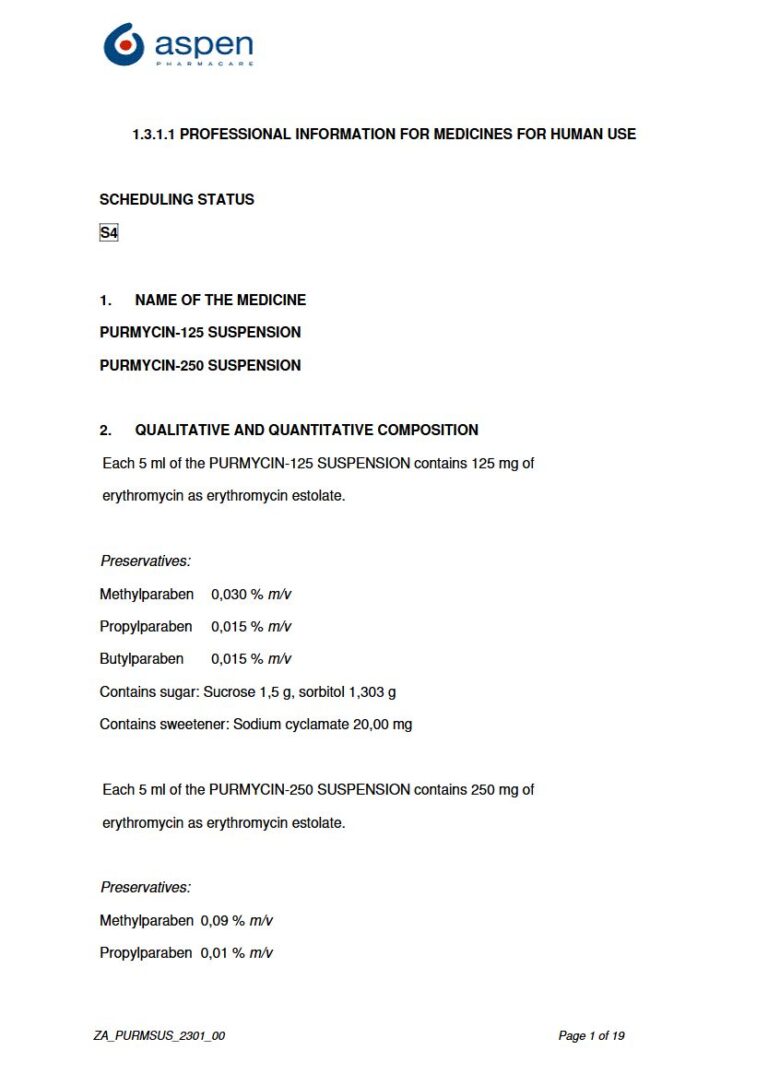
Purmycin 125 mg/250 mg Suspension
PDF Leaflet Revision Date: 03 January 2023
Clinical Summary
Quick overview from the medicine insert
Indication
Indicated for various infections including respiratory, urinary, gastrointestinal, and skin infections.
Dosage (summary)
Adults: 250-500 mg every 6 hours before meals; may double in severe infections.
Special Populations
- Elderly
- Patients with liver impairment
Pregnancy & Breastfeeding
Safety during pregnancy and lactation not established; caution advised.
Key Drug Interactions
- Increased effects of carbamazepine, corticosteroids, digoxin
- Avoid with simvastatin, terfenadine, pimozide
Contraindications
- Hypersensitivity to erythromycin
- Liver impairment
- QT prolongation history
Common side effects
- Nausea
- Vomiting
- Diarrhea
- Rash
- Torsade de pointes
Counselling Points
- Complete the prescribed course
- Monitor for signs of allergic reactions
- Inform about potential gastrointestinal side effects
Serious warnings
- Risk of pseudomembranous colitis
- Potential for serious allergic reactions
Important Disclaimer
The Purmycin 125 mg/250 mg Suspension professional information leaflet below is the property of Pharmacare and is provided on Medinsert exactly as issued, with no.. alterations or editorial changes. We make every effort to keep content current by updating documents as soon as new versions become available. Medinsert serves as a trusted access point for healthcare professionals, but does not replace official sources or clinical judgement. For more details, please read our full disclaimer. read more>>
 Healthcare Professionals Only
This content is for registered healthcare professionals
Sign in or create a free account to read the full package insert.
Free for HPCSA-registered professionals. Powered by Medinsert.
Clinical Particulars
Section 4 of the official insert — extracted exactly as issued, no alterations
4.1. Therapeutic indications
PURMYCIN SUSPENSION is indicated for:
- Respiratory infections: Atypical and typical pneumonia, Legionaireu2019s disease, diphtheria, pharyngitis, laryngotracheitis and otitis media
- Urinary tract infections: Uncomplicated endocervical, rectal and epydidymal infections and non-specific urethritis
- Gastrointestinal infections: Early bacterial gastroenteritis
- Skin and soft tissue infections: Erysipelas, u201cmalignant pustulesu201d and erythrasma
- Miscellaneous infections: Scarlet fever, tetanus, early syphilis (in patients allergic to penicillin), gonococcal arthritis-dermatitis syndrome, meningitis and bacteremia
- Prophylactic use (in patients hypersensitive to penicillin): Rheumatic fever and bacterial endocarditis
4.2. Posology and method of administration
Posology
In the treatment of beta-haemolytic streptococcal infections, a therapeutic dose should be administered for at least 10 days. Take the medicine at regular intervals. Complete the prescribed course unless otherwise directed.
Adults: 250 mg to 500 mg every 6 hours before meals. In severe infections these doses may be doubled.
Paediatric population
Children: 30 mg/kg to 50 mg/kg body-mass daily in divided doses before meals.
Method of administration
For oral administration.
4.3. Contraindications
PURMYCIN SUSPENSION is contraindicated in:
- Patients with impaired liver function or patients who have developed jaundice or other symptoms or liver toxicity during previous treatment with erythromycin as contained in PURMYCIN SUSPENSION.
- Known hypersensitivity to erythromycin.
- Patients taking simvastatin, tolterodine, mizolastine, amisulpride, astemizole, terfenadine, domperidone, cisapride or pimozide.
- Erythromycin as contained in PURMYCIN SUSPENSION should not be given to patients with a history of QT prolongation (congenital or documented acquired QT prolongation) or ventricular cardiac dysrhythmia, including torsades de pointes (see section 4.4 and 4.5).
- Erythromycin as contained in PURMYCIN SUSPENSION should not be given to patients with electrolyte disturbances (hypokalaemia, hypomagnesaemia due to the risk of prolongation of QT interval).
- Erythromycin as contained in PURMYCIN SUSPENSION is contraindicated with ergotamine and dihydroergotamine.
4.4. Special warnings and precautions for use
The safety of PURMYCIN SUSPENSION for use during pregnancy and lactation has not been established. A second course of treatment should be given with caution.
Erythromycin as contained in PURMYCIN SUSPENSION should be used with caution in the following:
- Patients with coronary artery disease, severe cardiac insufficiency, conduction disturbances or clinically relevant bradycardia.
- Patients concomitantly taking other medicinal products associated with QT prolongation (see section 4.3 and 4.5).
- Elderly patients may be more susceptible to medicines-associated effects on the QT interval (see section 4.8).
- Epidemiological studies investigating the risk of adverse cardiovascular outcomes with macrolides have shown variable results. Some observational studies have identified a rare short term risk of dysrhythmia, myocardial infarction and cardiovascular mortality associated with macrolides including erythromycin as contained in PURMYCIN SUSPENSION. Consideration of these findings should be balanced with treatment benefits when prescribing erythromycin as contained in PURMYCIN SUSPENSION.
- Pseudomembranous colitis has been reported with nearly all antibacterial agents, including macrolides, and may range in severity from mild to life-threatening (see section.4.8). Clostridium difficile-associated diarrhoea (CDAD) has been reported with use of nearly all antibacterial agents including erythromycin as contained in PURMYCIN SUSPENSION, and may range in severity from mild diarrhoea to fatal colitis.
- As with other macrolides, rare serious allergic reactions, including acute generalised exanthematous pustulosis (AGEP) have been reported. If an allergic reaction occurs, the medicine should be discontinued and appropriate therapy should be instituted. Physicians should be aware that reappearance of the allergic symptoms may occur when symptomatic therapy is discontinued.
- Treatment with antibacterial agents alters the normal flora of the colon, which may lead to overgrowth of C. difficile. CDAD must be considered in all patients who present with diarrhoea following antibiotic use. Careful medical history is necessary since CDAD has been reported to occur over two months after the administration of antibacterial agents.
- There have been reports suggesting erythromycin as contained in PURMYCIN SUSPENSION does not reach the foetus in adequate concentrations to prevent congenital syphilis. Infants born to women treated during pregnancy with oral erythromycin as contained in PURMYCIN SUSPENSION for early syphilis should be treated with an appropriate penicillin regimen.
- There have been reports that erythromycin as contained in PURMYCIN SUSPENSION may aggravate the weakness of patients with myasthenia gravis.
- Erythromycin as contained in PURMYCIN SUSPENSION interferes with the fluorometric determination of urinary catecholamines.
- Rhabdomyolysis with or without renal impairment has been reported in seriously ill patients receiving erythromycin as contained in PURMYCIN SUSPENSION concomitantly with statins.
Paediatric population
There have been reports of infantile hypertrophic pyloric stenosis (IHPS) occurring in infants following erythromycin as contained in PURMYCIN SUSPENSION therapy. Epidemiological studies including data from meta-analyses suggest a 2-3-fold increase in the risk of IHPS following exposure to erythromycin in infancy. This risk is highest following exposure to erythromycin during the first 14 days of life. Available data suggests a risk of 2,6 % (95 % CI: 1,5 -4,2 %) following exposure to erythromycin during this time period. The risk of IHPS in the general population is 0,1- 0,2 %. Since erythromycin may be used in the treatment of conditions in infants which are associated with significant mortality or morbidity (such as pertussis or chlamydia), the benefit of erythromycin therapy needs to be weighed against the potential risk of developing IHPS. Parents should be informed to contact their healthcare provider if vomiting or irritability with feeding occurs.
Excipients
Sucrose warning: PURMYCIN SUSPENSION contains sucrose which may have an effect on the glycaemic control of patients with diabetes mellitus. Patients with rare hereditary conditions such as fructose intolerance, glucose-galactose mal-absorption or sucrase-isomaltase insufficiency should not take PURMYCIN SUSPENSION.
Sorbitol warning: Patients with the rare hereditary condition of sorbitol intolerance should not take PURMYCIN-125 SUSPENSION.
4.5. Interaction with other medicines and other forms of interaction
Erythromycin as contained in PURMYCIN SUSPENSION has been reported to potentiate the effects of carbamazepine, corticosteroids and digoxin, probably by interfering with their metabolism. In addition, high and potentially toxic concentrations of theophylline may result when erythromycin as contained in PURMYCIN SUSPENSION is administered concomitantly. The dose of theophylline should be reduced while the patient is receiving concomitant erythromycin therapy. Erythromycin as contained in PURMYCIN SUSPENSION may enhance the effect of warfarin, dose adjustment of warfarin may be necessary. Concurrent use of chloramphenicol and lincomycins together with erythromycin as contained in PURMYCIN SUSPENSION is to be avoided as antagonism occurs. False elevation of serum glutamic oxaloacetic transaminase may appear in patients taking erythromycin as contained in PURMYCIN SUSPENSION. Increases in serum concentrations of the following medicines metabolised by the cytochrome P450 system may occur when administered concurrently with erythromycin as contained in PURMYCIN SUSPENSION: acenocoumarol, alfentanil, astemizole, bromocriptine, carbamazepine, cilostazol, cyclosporin, digoxin, dihydroergotamine, disopyramide, ergotamine, hexobarbitone, methylprednisolone, midazolam, omeprazole, phenytoin, quinidine, rifabutin, sildenafil, tacrolimus, terfenadine, domperidone, theophylline, triazolam, valproate, vinblastine, and antifungals e.g. fluconazole, ketoconazole and itraconazole. Appropriate monitoring should be undertaken and dosage should be adjusted as necessary. Particular care should be taken with medications known to prolong the QTc interval of the electrocardiogram. Medicines that induce CYP3A4 (such as rifampicin, phenytoin, carbamazepine, phenobarbital, St John's Wort) may induce the metabolism of erythromycin as contained in PURMYCIN SUSPENSION. This may lead to sub-therapeutic levels of erythromycin and a decreased effect. The induction decreases gradually during two weeks after discontinued treatment with CYP3A4 inducers. Erythromycin as contained in PURMYCIN SUSPENSION should not be used during and two weeks after treatment with CYP3A4 inducers. HMG-CoA Reductase Inhibitors: erythromycin as contained in PURMYCIN SUSPENSION has been reported to increase concentrations of HMG-CoA reductase inhibitors (e.g. lovastatin and simvastatin). Rare reports of rhabdomyolysis have been reported in patients taking these medicines concomitantly. Contraceptives: some antibiotics may in rare cases decrease the effect of contraceptive pills by interfering with the bacterial hydrolysis of steroid conjugates in the intestine and thereby reabsorption of unconjugated steroid. As a result of this plasma levels of active steroid may decrease. Antihistamine H1 antagonists: care should be taken in the coadministration of erythromycin as contained in PURMYCIN SUSPENSION with H1 antagonists such as terfenadine, astemizole and mizolastine due to the alteration of their metabolism by erythromycin as contained in PURMYCIN SUSPENSION. Erythromycin as contained in PURMYCIN SUSPENSION significantly alters the metabolism of terfenadine, astemizole and pimozide when taken concomitantly. Rare cases of serious, potentially fatal, cardiovascular events including cardiac arrest, torsade de pointes and other ventricular dysrhythmias have been observed (see sections 4.3 and 4.8). Anti-bacterial medicines: an in vitro antagonism exists between erythromycin as contained in PURMYCIN SUSPENSION and the bactericidal beta-lactam antibiotics (e.g. penicillin, cephalosporin). Erythromycin as contained in PURMYCIN SUSPENSION antagonises the action of clindamycin, lincomycin and chloramphenicol. The same applies for streptomycin, tetracyclines and colistin. Protease inhibitors: in concomitant administration of erythromycin as contained in PURMYCIN SUSPENSION and protease inhibitors, an inhibition of the decomposition of erythromycin as contained in PURMYCIN SUSPENSION has been observed. Oral anticoagulants: there have been reports of increased anticoagulant effects when erythromycin as contained in PURMYCIN SUSPENSION and oral anticoagulants (e.g. warfarin, rivaroxaban) are used concomitantly. Triazolobenzodiazepines (such as triazolam and alprazolam) and related benzodiazepines: erythromycin as contained in PURMYCIN SUSPENSION has been reported to decrease the clearance of triazolam, midazolam, and related benzodiazepines, and thus may increase the pharmacological effect of these benzodiazepines. Post-marketing reports indicate that co-administration of erythromycin as contained in PURMYCIN SUSPENSION with ergotamine or dihydroergotamine has been associated with acute ergot toxicity characterised by vasospasm and ischaemia of the central nervous system, extremities and other tissues (see section 4.3). Elevated cisapride levels have been reported in patients receiving erythromycin as contained in PURMYCIN SUSPENSION and cisapride concomitantly. This may result in QTc prolongation and cardiac dysrhythmias including ventricular tachycardia, ventricular fibrillation and torsades de pointes. Similar effects have been observed with concomitant administration of pimozide and clarithromycin, another macrolide antibiotic. There have been post-marketing reports of colchicine toxicity with concomitant use of erythromycin as contained in PURMYCIN SUSPENSION and colchicine. Hypotension, bradydysrhythmias and lactic acidosis have been observed in patients receiving concurrent verapamil, a calcium channel blocker. Cimetidine may inhibit the metabolism of erythromycin as contained in PURMYCIN SUSPENSION which may lead to an increased plasma concentration. Erythromycin as contained in PURMYCIN SUSPENSION has been reported to decrease the clearance of zopiclone and thus may increase the pharmacodynamic effects of this medicine.
4.6. Fertility, pregnancy and lactation
The safety of erythromycin as contained in PURMYCIN SUSPENSION for use during pregnancy and lactation has not been established.
Pregnancy
There are no adequate and well-controlled studies in pregnant women. However, observational studies in humans have reported cardiovascular malformations after exposure to medicinal products containing erythromycin during early pregnancy. Erythromycin as contained in PURMYCIN SUSPENSION has been reported to cross the placental barrier in humans, but foetal plasma levels are generally low. There have been reports that maternal macrolide antibiotics exposure within 7 weeks of delivery may be associated with a higher risk of infantile hypertrophic pyloric stenosis (IHPS).
Breastfeeding
Erythromycin as contained in PURMYCIN SUSPENSION can be excreted into breast-milk. Caution should be exercised when administering erythromycin as contained in PURMYCIN SUSPENSION to lactating mothers due reports of infantile hypertrophic pyloric stenosis in breast-fed infants.
Fertility
There is no fertility data.
4.7. Effects on ability to drive and use machines
PURMYCIN SUSPENSION has no influence on the ability to drive or operate machinery.
4.8. Undesirable effects
a) Tabulated list of adverse reactions
System organ class
Frequent
Less frequent
Frequency unknown (cannot be estimated from the available data)
Infections and infestations
super infection*
Blood and the lymphatic system disorders
Eosinophilia**
Immune system disorders
Hypersensitivity ranging from urticaria and mild rash to anaphylaxis have occurred.
Psychiatric disorders
Hallucinations
Nervous system disorders
Confusion, seizures and vertigo****
Eye disorders
Optic Neuropathy
Ear and labyrinth disorders
Reversible deafness^, tinnitus
Cardiac disorders
Torsade de pointes, palpitations, and cardiac rhythm disorders including ventricular tachydysrrhythmias. Cardiac arrest, ventricular fibrillation. Electrocardiogram QT prolonged
Vascular disorders
Hypotension.
Gastrointestinal disorders
Pseudomembranous colitis^^ (see section 4.4). Upper abdominal discomfort, nausea, vomiting, diarrhoea, pancreatitis, anorexia, infantile hypertrophic pyloric stenosis
Hepatobiliary disorders
Hepatitis Cholestatic***, jaundice, hepatic function abnormal, hepatomegaly, hepatic failure, hepato cellular hepatitis(see section 4.4).
Skin and subcutaneous tissue disorders
Skin eruptions ** Rash, pruritis, urticaria, exanthema, angioedema, Stevens-Johnson syndrome, toxic epidermal necrolysis, erythema multiforme.
Acute generalised exanthematous pustulosis (AGEP).
Renal and urinary disorders
Tubulo interstitial nephritis
General disorders and administrative site conditions
Chest pain, fever**, malaise.
Investigations
Hepatic enzyme increased
b) Description of selected adverse reactions
* Super-infection following oral administration may occur due to resistant bacteria or fungi.
** May occur alone or in combination.
*** Cholestatic hepatitis is the most striking allergic reaction. The illness starts after about 10 to 20 days of treatment and is characterised initially by nausea, vomiting and abdominal cramps, often mimicking the symptoms of acute cholecystitis. These symptoms are followed shortly by jaundice, which may be accompanied by fever, leukocytosis, eosinophilia, and elevated activities of transaminases in plasma; the cholecystogram is usually negative.
****There have been isolated reports of transient central nervous system side effects including confusion, seizures and vertigo; however, a cause and effect relationship has not been established.
^There have been isolated reports of reversible hearing loss occurring chiefly in patients with renal insufficiency or high doses.
^^Pseudomembranous colitis has been rarely reported in association with erythromycin therapy (see section 4.4).
Reporting of suspected adverse reactions
Reporting suspected adverse reactions after authorisation of the medicine is important. It allows continued monitoring of the benefit/risk balance of the medicine. Healthcare providers are asked to report any suspected adverse reactions to: SAHPRA: https://www.sahpra.org.za/health-products-vigilance/ Aspen Pharmacare: E-mail: [email protected] Tel: 0800 118 088
4.9. Overdose
Symptoms
Symptoms include hearing loss, severe nausea, vomiting and diarrhoea.
Treatment
Treatment is supportive and symptomatic.
