
Quatro-Soda Cranberry 4g Granules
PDF Leaflet Revision Date: 14 February 2023
Clinical Summary
Quick overview from the medicine insert
Indication
Gastric antacid and urinary alkaliniser.
Dosage (summary)
Adults: 4-8 g (1-2 measures) 3-4 times daily; Children (6-12 years): 4 g (1 measure) 2-3 times daily.
Special Populations
- Renal impairment
- Hepatic impairment
Pregnancy & Breastfeeding
Safety not established; caution in breastfeeding.
Key Drug Interactions
- Quinolones
- Methenamine
- Antacids
- Salicylates
- Tetracyclines
- Ketoconazole
- Lithium
Contraindications
- Hypersensitivity
- Metabolic alkalosis
- Severe renal disease
- Cardiac failure
Common side effects
- Increased thirst
- Hypernatraemia
- Stomach cramps
- Diarrhoea
Counselling Points
- Take on an empty stomach
- Drink after effervescence
- Report any adverse reactions
Serious warnings
- Risk of metabolic alkalosis
- Monitor electrolytes in renal patients
Important Disclaimer
The Quatro-Soda Cranberry 4g Granules professional information leaflet below is the property of Pharmacare and is provided on Medinsert exactly as issued, with no.. alterations or editorial changes. We make every effort to keep content current by updating documents as soon as new versions become available. Medinsert serves as a trusted access point for healthcare professionals, but does not replace official sources or clinical judgement. For more details, please read our full disclaimer. read more>>
 Healthcare Professionals Only
This content is for registered healthcare professionals
Sign in or create a free account to read the full package insert.
Free for HPCSA-registered professionals. Powered by Medinsert.
Clinical Particulars
Section 4 of the official insert — extracted exactly as issued, no alterations
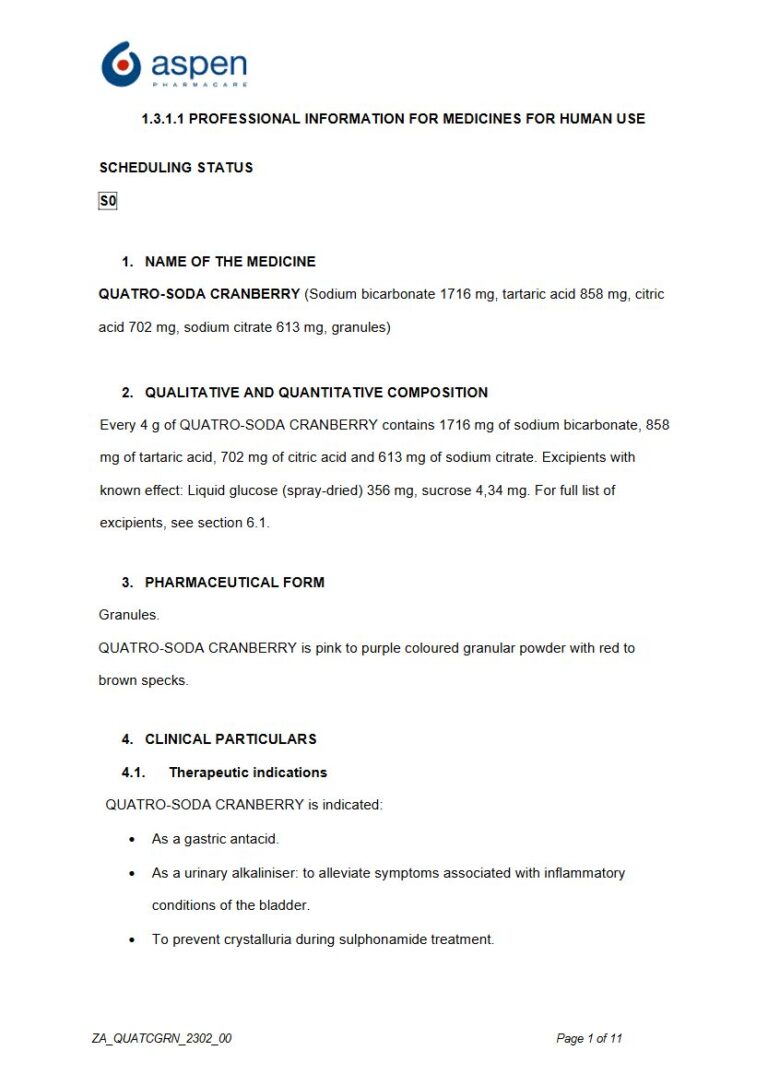
4.1. Therapeutic indications
QUATRO-SODA CRANBERRY is indicated:
- As a gastric antacid.
- As a urinary alkaliniser: to alleviate symptoms associated with inflammatory conditions of the bladder.
- To prevent crystalluria during sulphonamide treatment.
4.2. Posology and method of administration
Posology
Adults: One to two 5 ml medicine measures (4 g to 8 g) in half a glass of cold water 3 to 4 times daily, taken on an empty stomach and followed with additional water. Drink after effervescence.
Long-term therapy: One 5 ml medicine measure (4 g) daily (see section 4.8).
Special populations
Paediatric population
Children (6 to 12 years of age): One 5 ml medicine measure (4 g) in half a glass of cold water, 2 to 3 times daily, taken on an empty stomach and followed with additional water. Drink after effervescence.
Method of administration
Oral use.
4.3. Contraindications
QUATRO-SODA CRANBERRY is contraindicated in:
- Patients with hypersensitivity to sodium bicarbonate, tartaric acid, citric acid, sodium citrate or to any of the excipients in QUATRO-SODA CRANBERRY (see section 6.1).
- Patients with metabolic disturbances with alkalosis, hypocalcaemia or hypochlorhydria.
- Patients taking urinary antiseptics which require an acid urine, such as methenamine mandelate, methenamine hippurate, hexamine mandelate or hexamine hippurate (see section 4.5).
- Patients with severe renal disease, renal failure or hypernatraemia.
- Patients with overt and occult cardiac failure.
4.4. Special warnings and precautions for use
Metabolic alkalosis
Caution should be used in patients with peptic ulceration and patients with renal abnormalities, to avoid the condition of metabolic alkalosis. Patients with renal disease should have periodic determinations of serum electrolytes and acid-base balance to ensure that acid-base balance is maintained.
General
Caution should be observed in patients with cirrhosis of the liver, impaired renal function, congestive heart failure or hypertension, peripheral and pulmonary oedema and pre-eclampsia (see section 4.3)
Bacteriuria
Alkalinising medicines, such as QUATRO-SODA CRANBERRY, do not eradicate bacteriuria although they may temporarily relieve lower urinary tract symptoms.
Excipients
QUATRO-SODA CRANBERRY contains sucrose and glucose which may have an effect on the glycaemic control of patients with diabetes mellitus. Patients with the rare hereditary problems of fructose intolerance, glucose-galactose malabsorption or sucrase-isomaltase insufficiency should not take QUATRO-SODA CRANBERRY.
QUATRO-SODA CRANBERRY contains 613, 5 mg of sodium per 4 g, equivalent to 30 % of the WHO recommended daily intake of 2 g sodium for and adult.
4.5. Interaction with other medicines and other forms of interaction
Quinolones
Citrates, as in QUATRO-SODA CRANBERRY, may reduce the solubility of ciprofloxacin, norfloxacin or ofloxacin in the urine. Patients should be observed for signs of crystalluria and nephrotoxicity (see section 4.3).
Methenamine
Alkalinisation of the urine caused by sodium bicarbonate and citrates, as in QUATRO-SODA CRANBERRY, may reduce the effectiveness of methenamine by inhibiting its conversion to formaldehyde. Concurrent use with QUATRO-SODA CRANBERRY is contraindicated (see section 4.3).
Antacids
- Concurrent use of antacids with citrates, as in QUATRO-SODA CRANBERRY may result in systemic alkalosis.
- Concomitant administration of antacids with sodium citrate and sodium bicarbonate, as in QUATRO-SODA CRANBERRY, may promote the development of calcium stones in patients with uric acid stones and may also cause hypernatraemia.
- Concurrent use of aluminium-containing antacids with citrate salts, as in QUATRO-SODA CRANBERRY, can increase aluminium absorption, possibly resulting in acute aluminium toxicity, especially in patients with renal insufficiency.
Salicylates
Concurrent use of salicylates with citrates, as in QUATRO-SODA CRANBERRY, may increase the urinary excretion and decrease the therapeutic effects of salicylates due to alkalinisation of the urine.
Tetracyclines
Tetracycline absorption may be decreased when it is used concurrently with sodium bicarbonate, as in QUATRO-SODA CRANBERRY, because of the increase in intragastric pH. QUATRO-SODA CRANBERRY should not be taken within 1 to 2 hours of tetracyclines. Alkalisation of the urine by QUATRO-SODA CRANBERRY may therefore result in a decreased therapeutic effect of tetracyclines.
Ketoconazole
Sodium bicarbonate, as in QUATRO-SODA CRANBERRY, may cause increased gastrointestinal pH; concurrent administration with QUATRO-SODA CRANBERRY, may result in a marked reduction in absorption of ketoconazole. Patients should take QUATRO-SODA CRANBERRY at least 2 hours after ketoconazole.
Lithium
Alkalisation of the urine by QUATRO-SODA CRANBERRY may result in a decreased therapeutic effect of lithium.
Amphetamines/ephedrine/pseudoephedrine
Alkalinisation of the urine due to the use of QUATRO-SODA CRANBERRY may result in an increased effect of amphetamines and ephedrine/pseudoephedrine.
Chlorpropamide
Alkalisation of the urine by QUATRO-SODA CRANBERRY may result in a decreased therapeutic effect of chlorpropamide.
Laxatives
Concurrent administration of citrates, as in QUATRO-SODA CRANBERRY, with laxatives may have an additive effect.
4.6. Fertility, pregnancy and lactation
Safety of QUATRO-SODA CRANBERRY in pregnancy and lactation has not been established.
Pregnancy
Studies regarding the effect of citrates, as in QUATRO-SODA CRANBERRY have not been done.
Breastfeeding
Caution should be exercised when administered to a nursing mother.
Fertility
No data available.
4.7. Effects on ability to drive and use machines
QUATRO-SODA CRANBERRY has negligible effect on the ability to drive or to use machines. However, patients should be alerted to the risk of metabolic alkalosis which could cause mental disturbances and hypernatraemia, which could cause dizziness. Patients should therefore not drive, use machinery or perform any tasks that require concentration, until they are certain that QUATRO-SODA CRANBERRY does not adversely affect their ability to do so (see section 4.8).
4.8. Undesirable effects
a) Tabulated list of adverse reactions
System organ class
Less frequent
Frequency unknown
Metabolism and nutrition disorders
Increased thirst, hypernatraemia (dizziness, fast heartbeat, high blood pressure, irritability, muscle twitching, restlessness, seizures, swelling of feet or lower legs, weakness)
Metabolic alkalosis (shortness of breath, muscle weakness and mental disturbances such as restlessness, convulsions and coma) especially in patients with renal dysfunction. Excessive doses may lead to sodium overloading, hyperosmolality
Gastrointestinal disorders
Stomach cramps, laxative effect (diarrhoea or loose bowel movements). Abdominal distension, flatulence, belching, nausea (may occur if the QUATRO-SODA CRANBERRY is taken before effervescence is complete see section 4.2);
Musculoskeletal and connective tissue disorders
Muscle hypertonicity, twitching, tetany (especially in hypocalcaemic patients).
Reporting of suspected adverse reactions
Reporting suspected adverse reactions after authorisation of the medicine is important. It allows continued monitoring of the benefit/risk balance of the medicine. Healthcare providers are asked to report any suspected adverse reactions to: SAHPRA: https://www.sahpra.org.za/health-products-vigilance/ Aspen Pharmacare: E-mail: [email protected] Tel: 0800 118 088
4.9. Overdose
Symptoms
Overdose may result in metabolic alkalosis and hypernatraemia (see section 4.8).
Treatment
Symptomatic and supportive treatment should be instituted to correct fluid and electrolyte balance with complete withdrawal of QUATRO-SODA CRANBERRY. In these cases, regular electrolyte estimations should be taken, and the necessary therapy instituted.
