
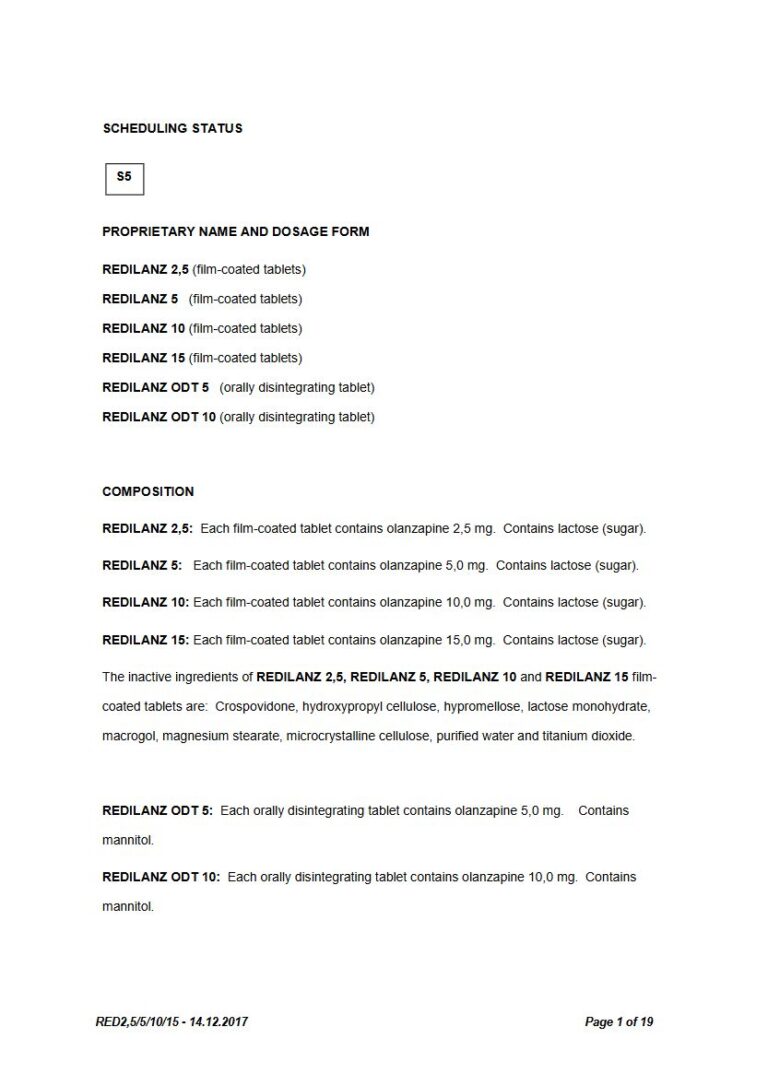
Redilanz 2,5 mg.5,0 mg.10,0 mg. 15,0 mg FC tablets
PDF Leaflet Revision Date: 14 December 2017
Clinical Summary
Quick overview from the medicine insert
Indication
Management of psychotic disorders and acute mania.
Dosage (summary)
Initial dose 5-10 mg/day, target 10 mg/day; range 5-20 mg/day.
Onset of Action / Duration
Onset: 5-8 hours, Duration: Not specified
Special Populations
- Elderly
- Hepatic impairment
- Renal impairment
Pregnancy & Breastfeeding
Safety during pregnancy and lactation not established.
Key Drug Interactions
- CNS depressants
- Levodopa
- Antihypertensives
- QT prolonging agents
Contraindications
- Hypersensitivity to olanzapine
- Narrow-angle glaucoma
- Children under 18
- Dementia-related psychosis
Common side effects
- Somnolence
- Weight gain
- Orthostatic hypotension
- Hyperglycaemia
Counselling Points
- Monitor for hyperglycaemia
- Avoid alcohol
- Gradual dose tapering recommended
- Caution with driving
Serious warnings
- Neuroleptic malignant syndrome
- Tardive dyskinesia
- Hyperprolactinaemia
- Withdrawal symptoms
Important Disclaimer
The Redilanz 2,5 mg.5,0 mg.10,0 mg. 15,0 mg FC tablets professional information leaflet below is the property of Dr Reddy’S Laboratories and is provided on Medinsert exactly as issued, with no.. alterations or editorial changes. We make every effort to keep content current by updating documents as soon as new versions become available. Medinsert serves as a trusted access point for healthcare professionals, but does not replace official sources or clinical judgement. For more details, please read our full disclaimer. read more>>
 Healthcare Professionals Only
This content is for registered healthcare professionals
Sign in or create a free account to read the full package insert.
Free for HPCSA-registered professionals. Powered by Medinsert.
Clinical Particulars
Section 4 of the official insert — extracted exactly as issued, no alterations
4.1 Therapeutic indications
REDILANZ and REDILANZ ODT are indicated for the management of the manifestations of psychotic disorders. Effectiveness for more than 6 weeks has not been established in controlled trials. REDILANZ and REDILANZ ODT are also indicated for the treatment of acute episodes of moderate to severe mania and for prevention of recurrence of manic or depressive episodes of bipolar disorder.
4.2 Posology and method of administration
Psychotic disorders
REDILANZ and REDILANZ ODT should be administered on a once-a-day schedule without regard to meals, generally beginning with an initial dose of 5 to 10 mg/day, with a target dose of 10 mg/day to be reached within several days. To evaluate efficacy and to guard against side-effects, dose increases should not be made before one week of treatment because steady state for olanzapine is only achieved after approximately one week. The dose range is from 5 to 20 mg per day. Increasing the dose above the recommended routine 10 mg daily dose is advised only after appropriate clinical assessment. It is recommended that responding patients be continued on REDILANZ or REDILANZ ODT at the lowest dose needed to maintain remission. Patients should be periodically reassessed to determine the need for maintenance treatment.
Acute mania in bipolar disorder
REDILANZ and REDILANZ ODT should be administered on a once-a-day schedule without regard to meals, generally beginning with 10 mg/day. Dosage adjustments within the dose range of 5 mg to 20 mg per day, if indicated, should generally occur at intervals of not less than 24 hours.
Preventing recurrence in bipolar disorder
The recommended starting dose is 10 mg/day. Patients who have been receiving REDILANZ or REDILANZ ODT for treatment of manic episodes, should be continued at the same dose to prevent recurrence. An increase to a dose greater than the recommended starting dose, within the range of 5 mg to 20 mg daily, is advised only after appropriate clinical assessment and should generally occur at intervals of not less than 24 hours. The safety of doses above 20 mg/day has not been evaluated in clinical trials. Gradual tapering of the dose is advised when treatment with REDILANZ or REDILANZ ODT is to be discontinued (see WARNINGS AND SPECIAL PRECAUTIONS).
4.3 Contraindications
Hypersensitivity to olanzapine or to any components of REDILANZ or REDILANZ ODT tablets. Patients with known risk of narrow-angle glaucoma. Children and adolescents: Safety and effectiveness in patients under 18 years of age have not been established. Dementia-related psychosis and/or behavioural disturbances in elderly patients (see WARNINGS AND SPECIAL PRECAUTIONS).
4.4 Special warnings and precautions for use
Warnings
u2022 Discontinuation of treatment
Discontinuation reactions which may consist of a cholinergic syndrome (diaphoresis, diarrhoea, sialorrhoea, nausea, vomiting, anxiety, agitation, insomnia and tremor) may occur, usually within a week of discontinuation of treatment with REDILANZ or REDILANZ ODT. Withdrawal should be gradual and tapered.
u2022 Hyperprolactinaemia: REDILANZ and REDILANZ ODT elevate prolactin levels and a modest elevation persists during chronic administration.
u2022 Neuroleptic malignant syndrome (NMS): NMS has occurred infrequently in association with olanzapine. NMS is a potentially fatal symptom complex. Clinical manifestations of NMS are hyperpyrexia, muscle rigidity, altered mental status and evidence of autonomic instability (irregular pulse or blood pressure, tachycardia, diaphoresis and cardiac dysrhythmia). Additional signs may include elevated creatine phosphokinase, myoglobinuria, rhabdomyolysis and acute renal failure. REDILANZ and REDILANZ ODT should be discontinued should any of the clinical manifestations of NMS or high fever without additional clinical manifestations of NMS be observed.
u2022 Seizures: REDILANZ and REDILANZ ODT should be used cautiously in patients who have a history of seizures or who are subject to factors which may lower seizure threshold. Seizures have been reported to occur infrequently in patients treated with olanzapine. In most cases, a history of seizures or risk factor for seizures was reported.
u2022 Tardive dyskinesia: Olanzapine is associated with a low incidence of treatment emergent dyskinesia. If signs or symptoms of tardive dyskinesia appear in a patient on REDILANZ or REDILANZ ODT a dose reduction or discontinuation of treatment with REDILANZ or REDILANZ ODT should be considered. The risk of tardive dyskinesia increases with long-term exposure and symptoms can temporarily deteriorate or even arise after discontinuation of treatment.
u2022 Hepatic impairment: Caution should be exercised in patients with signs and symptoms of hepatic impairment, in patients with pre-existing conditions associated with limited hepatic functional reserve and in patients who are being treated with potentially hepatotoxic medicines. Periodic assessment of transaminases is recommended in patients with significant hepatic disease. A starting dose of 5 mg should be considered for patients with moderate hepatic impairment.
u2022 Safety experience in dementia-related psychosis in elderly patients: Cerebrovascular accident adverse events (CVAE) including stroke in elderly dementia patients. REDILANZ and REDILANZ ODT are not approved for the treatment of dementia-related psychosis and/or behavioural disturbances as efficacy has not been established in this particular group (See CONTRAINDICATIONS). In addition, in placebo controlled studies, a 2-fold increase in the incidence of death in olanzapine-treated patients was reported. Risk factors that may predispose this patient population to increased mortality are age u2265 80 years, dysphagia, sedation, malnutrition and dehydration, pulmonary conditions (e.g. pneumonia, with or without aspiration), or concomitant use of benzodiazepines. Cerebrovascular adverse events (e.g. stroke, transient ischaemic attack) including fatalities, were reported, especially in elderly patients with dementia-related psychosis. All patients who experienced a cerebrovascular event had pre-existing risk factors known to be associated with an increased risk for a CVAE (e.g. history of previous CVAE or transient ischaemic attack, hypertension, cigarette smoking) and presented with co-current medical conditions and/or concomitant medications having a temporal association with CVAE.
u2022 Hyperglycaemia and diabetes mellitus: Hyperglycaemia, in some cases extreme and associated with ketoacidosis or hyperosmolar coma or death, has been reported in patients treated with olanzapine. Patients with an established diagnosis of diabetes mellitus who are started on REDILANZ or REDILANZ ODT should be monitored regularly for worsening of glucose control. Patients with risk factors for diabetes mellitus (e.g. obesity, family history of diabetes), who are starting treatment with REDILANZ or REDILANZ ODT should be monitored for symptoms of hyperglycaemia including polydipsia, polyuria, polyphagia and weakness. Patients who develop symptoms of hyperglycaemia during treatment with REDILANZ or REDILANZ ODT should undergo fasting blood glucose testing. In some cases, hyperglycaemia has resolved when olanzapine was discontinued. However, some patients required continuation of anti-diabetic treatment despite discontinuation of suspect medicine.
u2022 Caution should be exercised in dosing the elderly, especially if there are other factors that might additively influence medicine metabolism and/or pharmacodynamic sensitivity (See WARNINGS AND SPECIAL PRECAUTIONS).
4.5 Interactions with other medicines
Concomitant use of REDILANZ or REDILANZ ODT with:
Other centrally acting agents - Given the primary CNS effects of olanzapine, caution should be exercised when REDILANZ or REDILANZ ODT is taken in combination with other centrally acting agents (especially those that can cause CNS depression) and alcohol.
Levodopa - REDILANZ and REDILANZ ODT exhibit in vitro dopamine antagonism and may antagonise the effects of levodopa and dopamine agonists.
Antihypertensive agents - REDILANZ and REDILANZ ODT may enhance the effects of certain antihypertensive agents because of its potential for inducing hypotension.
Medicines that increase the QT or QTc intervals u2013 Increased QTc interval has been reported. Caution should be exercised when REDILANZ or REDILANZ ODT is prescribed together with other medicines known to increase the QTc interval, especially in the elderly, in patients with congenital long QT syndrome, congestive heart failure, heart hypertrophy, hypokalaemia or hypomagnesaemia. Olanzapine has u03b11 adrenergic antagonist activity. Caution should be exercised in patients who receive treatment with medicinal products that can lower blood pressure by mechanisms other than u03b11 adrenergic antagonism.
Potential for other medicines to affect REDILANZ and REDILANZ ODT - Antacids - Single doses of antacid (aluminium, magnesium) or cimetidine do not affect the oral bioavailability of olanzapine. However, the concomitant administration of activated charcoal reduced the oral bioavailability of olanzapine by 50 to 60 % and should therefore be taken at least 2 hours before or after REDILANZ or REDILANZ ODT. Fluoxetine in combination with REDILANZ or REDILANZ ODT, may cause an increase in the maximum concentration of olanzapine and a decrease in olanzapine clearance. The effect of repeat dosages and higher dosages of REDILANZ and REDILANZ ODT has not been evaluated. Combination therapy is not advised.
4.6 Fertility, pregnancy and lactation
The safety of REDILANZ and REDILANZ ODT during pregnancy and lactation has not been established.
4.7 Effects on ability to drive and use machines
REDILANZ and REDILANZ ODT may cause somnolence. Patients should be cautioned about operating hazardous machinery including motor vehicles until they are reasonably certain that REDILANZ or REDILANZ ODT therapy does not affect them adversely.
4.8 Undesirable effects
Blood and lymphatic system disorders
Frequent: Eosinophilia
Frequency unknown: Leucopenia, thrombocytopenia, neutropenia
Immune system disorders
Less frequent: Allergic reactions (anaphylactoid reaction, angioedema, pruritus, urticaria)
Metabolic and nutritional disorders
Frequent: Weight gain, increased appetite, hyperglycaemia, hypertriglyceridaemia
Frequency unknown: Development or exacerbation of diabetes, diabetic ketoacidosis, diabetic coma
Psychiatric disorders
Frequent: Personality disorder
Less frequent: Amnesia, anxiety, euphoria, hostility
Nervous system disorders
Frequent: Somnolence, dizziness, headache, akathisia, parkinsonism, dyskinesia, asthenia, agitation, movement disorder, abnormal gait, tremor, articulation impairment, hypertonia
Less frequent: Nervousness, myoclonus, insomnia, stuttering, extrapyramidal effects (neck rigidity, muscle spasms of face, neck or back), seizures, neuroleptic malignant syndrome, dystonia, tardive dyskinesia, speech disorders.
Eye disorders
Frequent: Amblyopia
Frequency unknown: Blepharitis, corneal lesion
Cardiac disorders
Frequent: Chest pain
Less frequent: Bradycardia, tachycardia, changes in ECG parameters, ventricular tachydysrhythmias
Vascular disorders
Frequent: Orthostatic hypotension, hypotension, peripheral oedema
Frequency unknown: Venous thromboembolism
Respiratory, thoracic and mediastinal disorders
Frequent: Rhinitis, pneumonia
Less frequent: Cough, pharyngitis
Frequency unknown: Respiratory infections
Gastrointestinal disorders
Frequent: Dry mouth, constipation
Less frequent: Abdominal pain, pancreatitis
Hepato-biliary disorders
Frequent: Transient asymptomatic elevations of hepatic transaminases (ALT, AST)
Less frequent: Hepatitis
Skin and subcutaneous tissue disorders
Frequent: Photosensitivity reaction
Less frequent: Rash
Musculoskeletal, connective tissue and bone disorders
Less frequent: Extremity pain (other than joint), joint pain, rhabdomyolysis
Frequency unknown: Back pain
Reproductive system and breast disorders
Less frequent: Premenstrual syndrome, priapism
Renal and urinary tract disorders
Frequency unknown: Urinary incontinence
General disorders and administration site conditions
Less frequent: Fever, intentional injury
Investigations
Frequent: Elevated prolactin levels
Less frequent: High creatine phosphokinase
Frequency unknown: Decreased erythrocyte count, haematocrit, haemoglobin, leucocyte count, lymphocytes, thrombocytes and platelets, increased MCHC, lymphocytes, monocytes and eosinophils, decreased bicarbonate, calcium phosphorous, albumin and total protein, increased chloride, GGT and phosphorous
4.9 Overdose
Signs and symptoms
Frequent symptoms of REDILANZ and REDILANZ ODT overdose include tachycardia, agitation/aggressiveness, dysarthria, various extrapyramidal symptoms and reduced level of consciousness ranging from sedation to coma. Other medically significant sequelae of REDILANZ and REDILANZ ODT overdose will include delirium, convulsion, possible neuroleptic malignant syndrome, respiratory depression, aspiration, hypertension or hypotension, cardiac dysrhythmias and cardiopulmonary arrest. Fatal outcomes have been reported for acute overdoses as low as 450 mg but survival has also been reported following acute overdose of 1 500 mg.
Treatment
The possibility of multiple medicine involvement should be considered. In case of acute overdosage, establish and maintain an airway and ensure adequate oxygenation and ventilation. Gastric lavage (after intubation, if patient is unconscious) and administration of activated charcoal together with a laxative should be considered. The possibility of obtundation, seizures or dystonic reaction of the head and neck following overdose may create a risk of aspiration with induced emesis. Cardiovascular monitoring should commence immediately and should include continuous electrocardiographic monitoring to detect possible arrhythmias. There is no specific antidote to REDILANZ or REDILANZ ODT, therefore appropriate symptomatic and supportive measures should be initiated. Hypotension and circulatory collapse should be treated with appropriate measures, such as intravenous fluids and/or sympathomimetic agents. Induction of emesis is not recommended. Do not use epinephrine (adrenaline), dopamine or other sympathomimetics with u03b2-agonist activity, since u03b2-stimulation may worsen hypotension in the setting of REDILANZ or REDILANZ ODT-induced u03b1-blockade. Close medical supervision and monitoring should continue until the patient recovers.
