
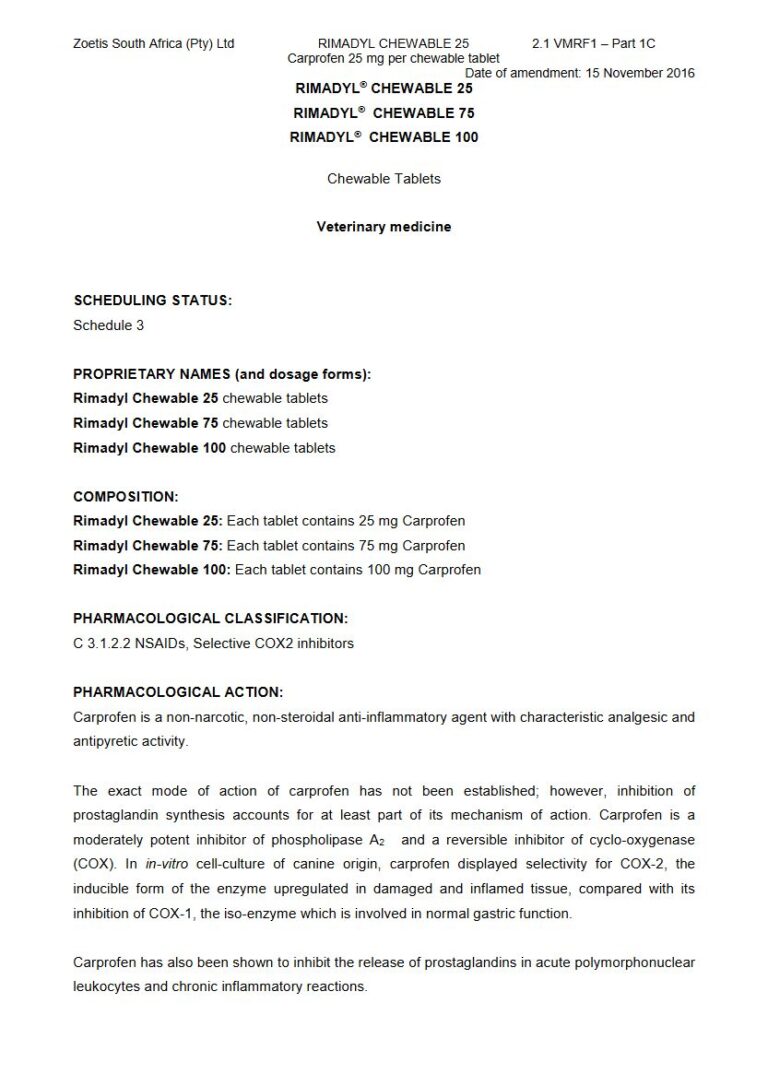
Rimadyl 25mg / 75mg / 100mg Chewable tablet
PDF Leaflet Revision Date: 15 November 2016
Clinical Summary
Quick overview from the medicine insert
Indication
Relief of pain and inflammation associated with musculoskeletal disorders in dogs.
Dosage (summary)
4.4 mg/kg once daily or 2.2 mg/kg twice daily.
Onset of Action / Duration
Onset: 1-3 hours, Duration: ~8 hours
Special Populations
- Renal impairment
- Hepatic impairment
Pregnancy & Breastfeeding
Safety in pregnant or lactating bitches not established.
Key Drug Interactions
- Avoid with corticosteroids
- Avoid with other NSAIDs
Contraindications
- Hypersensitivity to carprofen
- Bleeding disorders
Common side effects
- Vomiting
- Diarrhoea
- Inappetence
- Lethargy
Counselling Points
- Monitor for signs of drug intolerance
- Administer with food if needed
Serious warnings
- Ulcerogenic potential at 30 mg/kg
Important Disclaimer
The Rimadyl 25mg / 75mg / 100mg Chewable tablet professional information leaflet below is the property of Zoetis Sa and is provided on Medinsert exactly as issued, with no.. alterations or editorial changes. We make every effort to keep content current by updating documents as soon as new versions become available. Medinsert serves as a trusted access point for healthcare professionals, but does not replace official sources or clinical judgement. For more details, please read our full disclaimer. read more>>
 Healthcare Professionals Only
This content is for registered healthcare professionals
Sign in or create a free account to read the full package insert.
Free for HPCSA-registered professionals. Powered by Medinsert.
Clinical Particulars
Section 4 of the official insert — extracted exactly as issued, no alterations
4.1 Therapeutic indications
Rimadyl is indicated for the relief of pain and inflammation associated with musculoskeletal disorders in dogs. Rimadyl was shown to be clinically effective for the relief of signs associated with osteoarthritis in dogs.
4.2 Posology and method of administration
The recommended dosage for oral administration to dogs is 4.4 mg carprofen per kg of body weight daily. The total daily dose should be administered as 4.4 mg/kg of body weight once daily or divided and administered as 2.2 mg/kg twice daily. Tablets are scored and dosage should be calculated in half-tablet increments. Tablets can be halved by placing the tablet on a hard surface and pressing down on both sides of the score. Rimadyl Chewable tablets are palatable and willingly consumed by most dogs when offered by the owner. Therefore, they may be fed by hand or placed on food. Care should be taken to ensure that the dog consumes the complete dose.
4.3 Contraindications
Rimadyl should not be used in dogs exhibiting previous hypersensitivity to carprofen. Rimadyl is not recommended for use in dogs with bleeding disorders (e.g. Von Willebrandu2019s Disease), as safety has not been established in dogs with these disorders.
4.4 Special warnings and precautions for use
The ulcerogenic oral dosage in dogs was determined to be 30 mg/kg. The safe use of Rimadyl in pregnant bitches, dogs used for breeding purposes or in lactating bitches has not been established. Studies to determine the activity of Rimadyl when administered with other protein-bound drugs have not been conducted. Drug compatibility should be monitored closely in patients requiring additional therapy. All dogs should undergo a thorough history and physical examination before initiation of NSAID therapy. Appropriate laboratory tests to establish haematological and serum biochemical baseline data prior to, and periodically during, administration of any NSAID should be considered. Owners should be advised to watch for signs of drug intolerance. For use in dogs only. Do not use in cats.
4.5 Interactions with other medicines
Since many NSAIDs possess the potential to induce gastro-intestinal ulceration, concomitant use of Rimadyl with other anti-inflammatory drugs, such as corticosteroids and other NSAIDs, should be avoided or very closely monitored.
4.6 Fertility, pregnancy and lactation
The safe use of Rimadyl in pregnant bitches, dogs used for breeding purposes or in lactating bitches has not been established.
4.7 Effects on ability to drive and use machines
Not applicable.
4.8 Undesirable effects
As a class, cyclo-oxygenase inhibitory non steroidal anti-inflammatory drugs may be associated with gastro-intestinal and renal toxicity. The most frequently reported effects have been mild gastro-intestinal signs. Events involving suspected renal, haematologic, neurologic, dermatologic and hepatic effects have also been reported. Patients at greatest risk for renal toxicity are those on concomitant diuretic therapy, or those with renal, cardiovascular, and/or hepatic dysfunction. Dogs receiving Rimadyl should be observed for signs of drug intolerance, such as inappetence, vomiting, diarrhoea, melaena, polyuria, polydypsia, anaemia, jaundice, lethargy, ataxia, seizure or behavioural changes. Susceptibility to drug-associated adverse effects varies with the individual patient. The side-effects of this drug class, in rare situations, may be serious and if corrective action is not taken may result in hospitalization or even fatal outcomes. Side-effects include:
- Gastro-intestinal: Vomiting, diarrhoea, inappetance, melaena, haematemesis, gastro-intestinal ulceration.
- Behavioral: Sedation, lethargy, hyperactivity, restlessness.
- Hepatic: Inappetence, vomiting, jaundice, acute hepatic toxicity, hepatic enzyme elevation, abnormal liver function test(s), hyperbilirubinemia, hyperbilirubinuria, hypoalbuminemia. Approximately one-third of hepatic reports were in Labrador Retrievers.
- Renal: Haematuria, polyuria, polydypsia, urinary incontinence, urinary tract infection, azotaemia, acute renal failure, tubular abnormalities including acute tubular necrosis, renal acidosis, glucosuria.
- Neurological: Ataxia, paresis, paralysis, seizures, vestibular signs, disorientation.
- Haematological: Immune-mediated haemolytic anaemia, immune-mediated thrombocytopaenia, blood loss anaemia.
- Dermatological: Pruritus, increased shedding, alopecia, pyotraumatic moist dermatitis (hot spots), necrotizing panniculitis/vasculitis, ventral ecchymosis.
- Immunological or hypersensitivity: Facial swelling, hives, erythema.
4.9 Overdose
See u201cSide-effects and Special Precautionsu201d. Treatment is symptomatic and supportive.
