
Rotavac 5D 5 ml Oral liquid
PDF Leaflet Revision Date: 08 October 2024
Clinical Summary
Quick overview from the medicine insert
Indication
Active immunisation of infants from 6 weeks for prevention of rotavirus gastroenteritis.
Dosage (summary)
0.5 ml (5 drops) orally, 3 doses 4 weeks apart starting at 6 weeks of age.
Special Populations
- Immunocompromised infants
- Infants with HIV
Pregnancy & Breastfeeding
Not for use in adults or pregnant women; breastfeeding is permitted.
Key Drug Interactions
- Can be co-administered with routine childhood vaccines
Contraindications
- Hypersensitivity to vaccine components
- Severe Combined Immunodeficiency Disease (SCID)
- History of intussusception
- Ongoing gastroenteritis
Common side effects
- Fever
- Diarrhoea
- Cough
- Irritability
Counselling Points
- Administer orally, do not inject
- Observe hygiene after administration
- Report any adverse reactions
Serious warnings
- Increased risk of intussusception after first dose
- Monitor for symptoms of intussusception
Important Disclaimer
The Rotavac 5D 5 ml Oral liquid professional information leaflet below is the property of The Biovac Institute and is provided on Medinsert exactly as issued, with no.. alterations or editorial changes. We make every effort to keep content current by updating documents as soon as new versions become available. Medinsert serves as a trusted access point for healthcare professionals, but does not replace official sources or clinical judgement. For more details, please read our full disclaimer. read more>>
 Healthcare Professionals Only
This content is for registered healthcare professionals
Sign in or create a free account to read the full package insert.
Free for HPCSA-registered professionals. Powered by Medinsert.
Clinical Particulars
Section 4 of the official insert — extracted exactly as issued, no alterations
4.1 Therapeutic indications
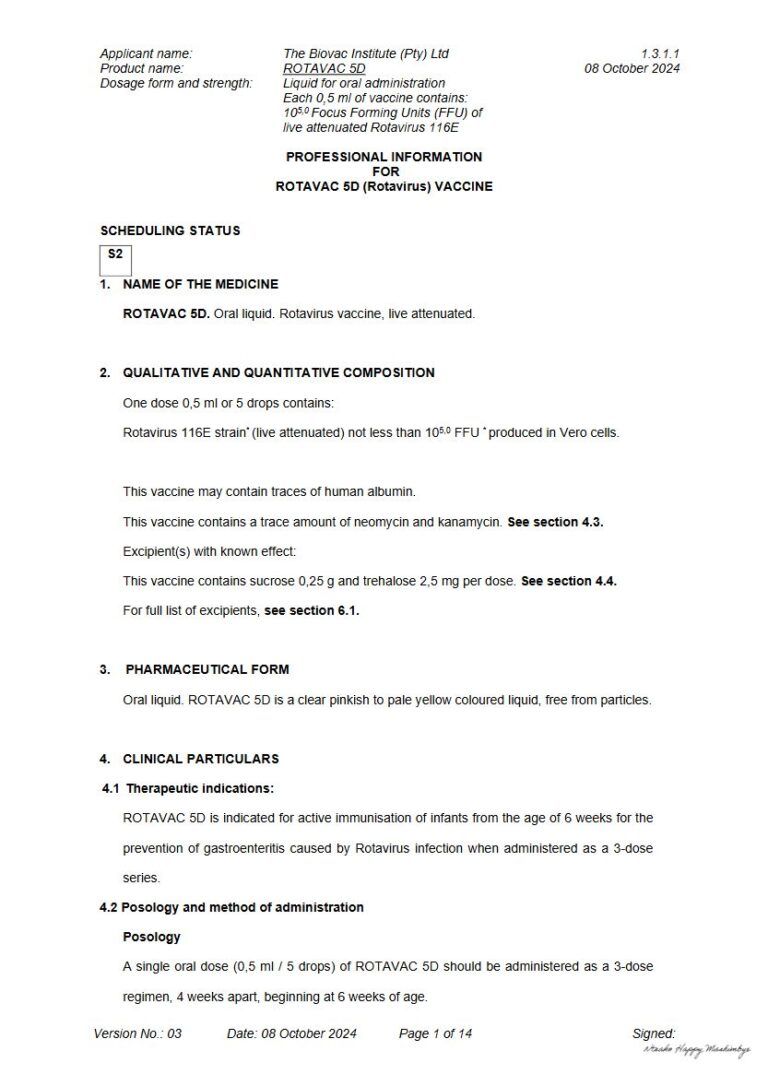
ROTAVAC 5D is indicated for active immunisation of infants from the age of 6 weeks for the prevention of gastroenteritis caused by Rotavirus infection when administered as a 3-dose series.
4.2 Posology and method of administration
A single oral dose (0,5 ml / 5 drops) of ROTAVAC 5D should be administered as a 3-dose regimen, 4 weeks apart, beginning at 6 weeks of age.
4.3 Contraindications
- ROTAVAC 5D should not be administered to infants with known hypersensitivity to any component of the vaccine. For the full list of excipients see section 6.1.
- Individuals who experienced a severe allergic reaction (e.g. anaphylaxis) after a previous dose.
- Individuals with Severe Combined Immunodeficiency Disease (SCID). Cases of gastroenteritis associated with live rotavirus vaccines have been reported in infants with SCID.
- Infants with a history of intussusception (IS) or intestinal malformations predisposing to intussusception and infants with a history of congenital abdominal disorders.
- Infants with ongoing gastroenteritis.
- Individuals allergic to neomycin or kanamycin as ROTAVAC 5D contains these antibiotics in its formulation.
- As with other vaccines, ROTAVAC 5D should be postponed in infants suffering from an acute severe febrile illness.
4.4 Special warnings and precautions for use
Available published data shows a small increased incidence of intussusception (IS) following the first dose of Rotavirus vaccine. The safety data from the clinical trials of ROTAVAC 5D did not show an increased risk of IS for ROTAVAC 5D when compared to placebo. However, it is advised that healthcare providers immediately follow-up on any symptoms suggestive of IS e.g. continuous vomiting, blood in stools, an abdominal lump or distension of the abdomen. Parents or caregivers should immediately inform their healthcare provider or go to the emergency department should these symptoms appear.
No safety or efficacy data is available from clinical trials regarding the administration of ROTAVAC 5D to immunocompromised infants, infants infected with HIV, infants with chronic gastroenteritis or infants with growth retardation.
Administration of ROTAVAC 5D may be considered with caution in immunocompromised infants and infants in close contact with immune deficient persons, if in the opinion of the physician, withholding the vaccine entails a greater risk. If given, precautions should be taken to avoid transmission of any excreted vaccine virus. Contacts of recent vaccinees should be advised to observe careful hygiene (including washing their hands after changing childu2019s nappies). Similarly, acute infection or febrile illness may be the reason for delaying the administration of ROTAVAC 5D, unless in the opinion of the physician, withholding the vaccine entails a greater risk. Low-grade fever and mild upper respiratory tract infection are not contraindications to ROTAVAC 5D. As with other vaccines, vaccination with ROTAVAC 5D may not result in complete protection against rotavirus induced gastroenteritis or gastroenteritis due to other pathogens. There is no data to support use of ROTAVAC 5D for post exposure-prophylaxis. ROTAVAC 5D contains sucrose and trehalose as excipients. Patients with rare hereditary conditions such as fructose intolerance, glucose-galactose malabsorption or sucrase-isomaltase insufficiency should not take ROTAVAC 5D. ROTAVAC 5D should under no circumstances be injected.
Traceability: In order to improve the traceability of biological medicinal products, the name and the batch number of the administered product should be clearly recorded.
4.5 Interactions with other medicines and other forms of interaction
Clinical data show that ROTAVAC 5D can be administered concomitantly with oral polio vaccine (OPV), inactivated polio vaccine (IPV) and combination (DTwP), hepatitis B vaccine (HBV) and Haemophilus influenzae type B vaccine (Hib). Three doses of ROTAVAC 5D can be safely administered with 3 doses of pentavalent vaccine (DTwP, HBV, Hib) and three doses of OPV as well as IPV without diminishing the antibody response to each component of these vaccines.
In other clinical trials, ROTAVAC 5D was co-administered with OPV/inactivated polio vaccine (IPV), pentavalent (DTwP, HBV, Hib) and pneumococcal conjugate vaccine (PCV). BCG vaccine was also offered to infants who had not received this vaccine before. The clinical studies concluded that ROTAVAC 5D is safe and well tolerated when administered concomitantly with routine EPI childhood vaccines. There are no restrictions on the infant's liquid consumption including breast milk, either before or after vaccination with ROTAVAC 5D.
4.6 Fertility, pregnancy and lactation
ROTAVAC 5D is a paediatric vaccine and should not be administered to adults, including pregnant women. Breastfeeding of infants was permitted in clinical studies. There was no evidence to suggest that breastfeeding reduced the protection against rotavirus gastroenteritis conferred by ROTAVAC 5D.
4.7 Effects on ability to drive and use machines
ROTAVAC 5D is not intended for use in adults.
4.8 Undesirable effects
a. Summary of the safety profile: The safety profile is based on clinical trial data obtained from studies conducted with ROTAVAC 5D. The most commonly observed adverse events during the clinical trials were fever, diarrhoea, cough and others such as running nose and irritability. No vaccine related serious adverse effects were reported. There was no vaccine related case of intussusception observed or reported. Fever was commonly observed; however, this could be due to concomitant injectable vaccines.
a. Tabulated list of adverse reactions: Adverse reactions reported are listed according to the following frequency definition:
- Very common: (u22651/10)
- Common: (u22651/100, <1/10)
- Uncommon: (u2265 1/1000, <1/100)
- Rare: (u22651/10000, <1/1000)
- Very rare: (<1/10 000)
Table 1: Tabulated summary of adverse reactions from clinical trials: Intussusception (IS) is a safety concern for all rotavirus vaccines. The Phase III Clinical studies revealed that six of 4532 (0,13 %) subjects in the Rotavirus Vaccine (Live, Oral) group and two of the 2267 (0,09 %) subjects receiving placebo had confirmed intussusception. The timing of the confirmed cases of IS with respect to the vaccination ranged from 36 to 291 days after the third dose; the lack of temporal association argues strongly against a causative relationship between Rotavirus Vaccine (live, oral) and IS.
Table 2: Adverse events (solicited) reported with post-marketing clinical studies (phase IV studies): System Organ Class Frequency Adverse reaction Nervous system disorders Common Crying Gastrointestinal disorders Common Diarrhoea, vomiting General disorders and administration site conditions Very common Fever For data from sources other than clinical trials data: System Organ Class Frequency Adverse reaction Respiratory, thoracic and mediastinal disorders Very common Cough Gastrointestinal disorders Common Diarrhoea General disorders and administration site conditions Very common Fever and irritability (crying). There are literature reports of other frequent adverse events in subjects receiving rotavirus vaccines which include fatigue, irritability, otitis media, nasopharyngitis and bronchospasm.
4.9 Overdose
No cases of overdose with ROTAVAC 5D have been reported. Overdose is unlikely for the single dose vial presentation. In overdose (multi-dose vial), side effects can be precipitated and/or be of increased severity, see section 4.8.
