
Sedabarb 30 mg Tablet
PDF Leaflet Revision Date: 10 November 2022
Clinical Summary
Quick overview from the medicine insert
Indication
Prophylactic treatment of convulsive epilepsy and as a general sedative.
Dosage (summary)
1 tablet twice daily for epilepsy; 1 tablet before bedtime for hypnotic; 1 tablet three times daily for sedative.
Special Populations
- Elderly
- Renal impairment
- Hepatic impairment
Pregnancy & Breastfeeding
Use in pregnancy only if benefits outweigh risks; not advisable during breastfeeding due to neonatal sedation risk.
Key Drug Interactions
- Alcohol
- Antidepressants
- Antiepileptics
- Anticoagulants
- Oral contraceptives
Contraindications
- Hypersensitivity to phenobarbitone
- Acute intermittent porphyria
- Severe respiratory depression
- Severe renal or hepatic impairment
Common side effects
- Drowsiness
- Respiratory depression
- Skin reactions
- Cognitive impairment
Counselling Points
- Avoid alcohol
- Monitor for suicidal thoughts
- Use effective contraception
- Do not drive or operate machinery
Serious warnings
- Dependence risk
- Withdrawal syndrome
- Suicidal ideation
- Severe skin reactions (SJS, TEN)
Important Disclaimer
The Sedabarb 30 mg Tablet professional information leaflet below is the property of Ranbaxy Pharmaceuticals and is provided on Medinsert exactly as issued, with no.. alterations or editorial changes. We make every effort to keep content current by updating documents as soon as new versions become available. Medinsert serves as a trusted access point for healthcare professionals, but does not replace official sources or clinical judgement. For more details, please read our full disclaimer. read more>>
 Healthcare Professionals Only
This content is for registered healthcare professionals
Sign in or create a free account to read the full package insert.
Free for HPCSA-registered professionals. Powered by Medinsert.
Clinical Particulars
Section 4 of the official insert — extracted exactly as issued, no alterations
4.1 Therapeutic indications
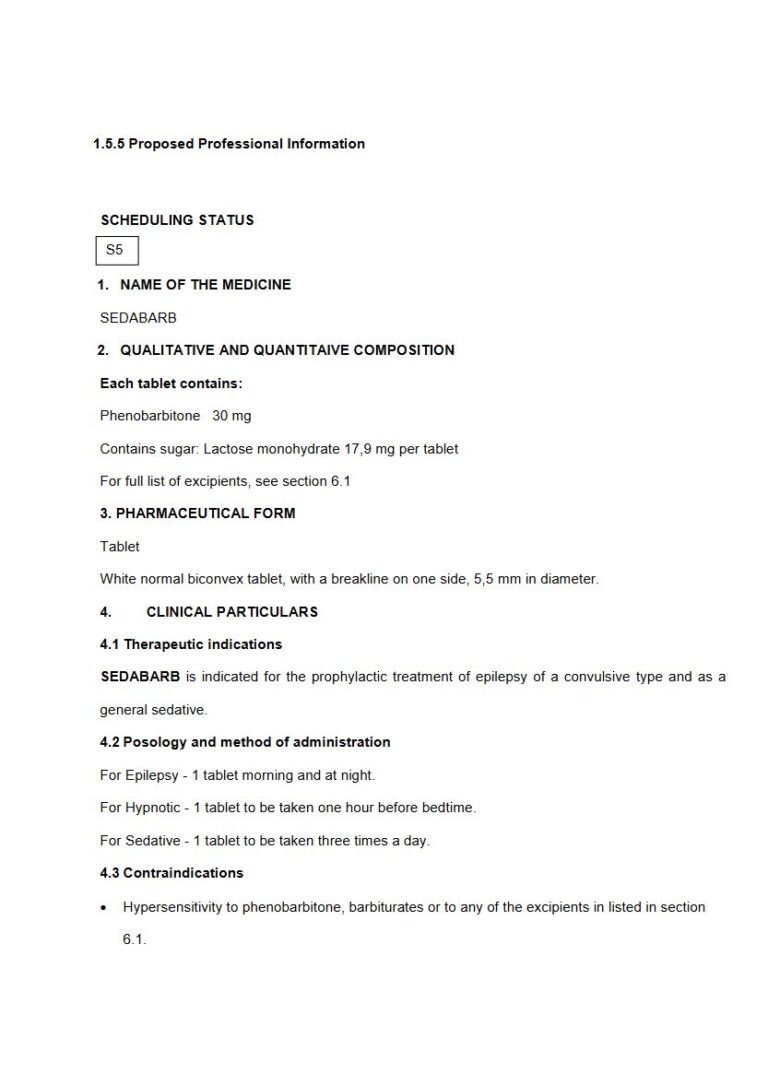
SEDABARB is indicated for the prophylactic treatment of epilepsy of a convulsive type and as a general sedative.
4.2 Posology and method of administration
For Epilepsy - 1 tablet morning and at night. For Hypnotic - 1 tablet to be taken one hour before bedtime. For Sedative - 1 tablet to be taken three times a day.
4.3 Contraindications
- Hypersensitivity to phenobarbitone, barbiturates or to any of the excipients in listed in section 6.1.
- Acute intermittent porphyia
- Severe respiratory depression
- Severe renal or hepatic impairment
4.4 Special warnings and precautions for use
- Prolonged use of SEDABARB may lead to dependence of the barbiturate - alcohol type.
- Abrupt withdrawal of SEDABARB may result in a severe abstinence syndrome, which includes grand mal seizures and delirium. Withdrawal of SEDABARB in these cases should be cautious and gradual.
- Tolerance to the hypnotic effects of SEDABARB may also occur after prolonged administration.
- SEDABARB should be administered cautiously to the elderly; reduced dosage should be employed until tolerance is assessed.
- It should be used with care in patients with impaired hepatic or renal function.
- Care is needed when SEDABARB is given to patients with severe respiratory insufficiency.
- Contains lactose monohydrate. Patients with rare hereditary problems of galactose intolerance, total lactase deficiency or glucose-galactose malabsorption should not take this medicine.
- Suicidal ideation and behavior have been reported in patients treated with anti-epileptic agents in several indications. A meta-analysis of randomized placebo controlled trials of anti-epileptic drugs has also shown a small increased risk of suicidal ideation and behaviour. The mechanism of this risk is not known and the available data do not exclude the possibility of an increased risk for phenobarbitone. Therefore patients should be monitored for signs of suicidal ideation and behaviours and appropriate treatment should be considered. Patients (and caregivers of patients) should be advised to seek medical advice should signs of suicidal ideation or behaviour emerge.
- Steven - Johnson syndrome and toxic epidermal necrolysis Life - threatening cutaneous reactions Stevens - Johnson syndrome (SJS) and toxic epidermal necrolysis (TEN) have been reported with the use of phenobarbital. Patients should be advised of the signs and symptoms and monitored closely for skin reactions. The highest risk for occurrence of SJS or TEN is within the first weeks of treatment. If symptoms or signs of SJS or TEN (e.g. progressive skin rash often with blisters or mucosal lesions) are present, Phenobarbital treatment should be discontinued. The best results in managing SJS and TEN come from early diagnosis and immediate discontinuation of any suspect drug. Early withdrawal is associated with a better prognosis. If the patient has developed SJS or TEN with the use of phenobarbital, phenobarbital must not be re-started in this patient at any time.
4.5 Interaction with other medicines and other forms of interaction
Effects of phenobarbital on other medicines:
- Alcohol u2013 concurrent administration with alcohol may lead to an additive CNS depressant effect. This is likely with concurrent administration with other CNS depressants.
- Antidepressants u2013 including MAOIs, SSRIs and tricyclics may antagonise the antiepileptic activity of phenobarbital by lowering the convulsive threshold.
- Antiepileptics - phenobarbital plasma concentrations Phenobarbital increases the rate of metabolism reducing serum concentrations of the following drugs:
- Anti-arrhythmics u2013 disopyramide and quinidine loss of arrhythmia control is possible. Plasma levels of antiarrhythmics should be monitored, if phenobarbital is added or withdrawn. Changes in dosage may be necessary.
- Antibacterials u2013 chloramphenicol, doxycycline, metronidazole and rifampicin. Avoid concomitant use of telithromycin during and for 2 weeks after Phenobarbital.
- Anticoagulants.
- Antidepressants u2013 paroxetine, mianserin and tricyclic antidepressants.
- Antiepileptics u2013 carbamazepine, lamotrigine, tiagabine, zonisamide, primidone and possibly ethosuxamide.
- Antifungals u2013 the antifungal effects of griseofulvin can be reduced or even abolished by concurrent use. Phenobarbital possibly reduces plasma concentrations of itraconazole or posaconazole. Avoid concomitant use of voriconazole.
- Antipsychotics u2013 phenobarbital possibly reduces concentration of aripiprazole.
- Antivirals u2013 phenobarbital possibly reduces plasma levels of abacavir, amprenavir, darunavir, lopinavir, indinavir, nelfinavir, saquinavir.
- Anxiolytics and Hypnotics u2013 clonazepam.
- Aprepitant u2013 phenobarbital possibly reduces plasma concentration of aprepitant.
- Beta-blockers u2013 metoprolol, timolol and possibly propranolol.
- Memantine u2013 the effect of Phenobarbital is possibly reduced.
- Methylphenidate u2013 plasma concentration of Phenobarbital is possibly increased.
- St John's wort (Hypericum perforatum) u2013 the effect of phenobarbital can be reduced by concomitant use of the herbal remedy St John's wort.
- Calcium channel blockers u2013 phenobarbital causes reduced levels of felodipine, isradipine, diltiazem, verapamil, nimodipine and nifedipine and an increase in dosage may be required.
- Cardiac Glycosides u2013 blood levels of digitoxin can be halved by concurrent use.
- Ciclosporin or tacrolimus.
- Corticosteroids.
- Cytotoxics u2013 phenobarbital possibly reduces the plasma levels of etoposide or irinotecan.
- Diuretics u2013 concomitant use with eplerenone should be avoided.
- Haloperidol - serum levels are approximately halved by concurrent use with phenobarbital.
- Methadone u2013 levels can be reduced by concurrent use of phenobarbital and withdrawal symptoms have been reported in patients maintained on methadone when phenobarbital has been added. Increases in the methadone dosage may be necessary.
- Montelukast.
- Oestrogens u2013 reduced contraceptive effect.
- Progestogens u2013 reduced contraceptive effect.
- Sodium oxybate u2013 enhanced effects, avoid concomitant use.
- Theophylline u2013 may require an increase in theophylline dose.
- Thyroid hormones - may increase requirements for thyroid hormones in hypothyroidism.
- Tibolone
- Tropisetron
- Vitamins u2013 barbiturates possibly increase requirements for vitamin D.
4.6 Fertility, pregnancy and lactation
Women of childbearing potential/Contraception Phenobarbitone should not be used in women of childbearing potential unless the potential benefit is judged to outweigh the risks following careful consideration of alternative suitable treatment options. A pregnancy test to rule out pregnancy should be considered prior to commencing treatment with phenobarbitone in women of childbearing potential. Women of childbearing potential should use highly effective contraception during treatment with phenobarbitone and for 2 months after the last dose. Due to enzyme induction, phenobarbitone may result in a failure of the therapeutic effect of oral contraceptive drugs containing oestrogen and/or progesterone. Women of childbearing potential should be advised to use other contraceptive methods while on treatment with phenobarbital, e.g. two complementary forms of contraception including a barrier method, oral contraceptive containing higher doses of estrogen, or a non-hormonal intrauterine device (see section 4.5).
Women of childbearing potential should be informed of and understand the risk of potential harm to the foetus associated with phenobarbitone use during pregnancy and the importance of planning a pregnancy. Women planning a pregnancy should be advised to consult in advance with her medical practitioner so that specialist medical advice can be provided and appropriate other treatment options can be discussed prior to conception and before contraception is discontinued. Antiepileptic treatment should be reviewed regularly and especially when a woman is planning to become pregnant. Women of childbearing potential should be counselled to contact her doctor immediately if she becomes pregnant or thinks she may be pregnant while on treatment with phenobarbitone.
Pregnancy Risk related to antiepileptic medicinal products in general Medical advice regarding the potential risks to a fetus caused by both seizures and antiepileptic treatment should be given to all women of childbearing potential taking antiepileptic treatment, and especially to women planning pregnancy and women who are pregnant. Antiepileptic treatment should be reviewed regularly and especially when a woman is planning to become pregnant. In pregnant women being treated for epilepsy, sudden discontinuation of antiepileptic drug (AED) therapy should be avoided as this may lead to breakthrough seizures that could have serious consequences for the woman and the unborn child. As a general principle, monotherapy is preferred for treating epilepsy in pregnancy whenever possible because therapy with multiple AEDs appear to be associated with a higher risk of congenital malformations than monotherapy, depending on the associated AEDs.
Risk related to phenobarbitone Phenobarbitone readily crosses the placenta following oral administration and is distributed throughout fetal tissue, the highest concentrations being found in the placenta, fetal liver and brain. Phenobarbitone therapy in epileptic pregnant women presents a risk to the fetus in terms of major and minor congenital defects including congenital craniofacial and cardiac defects, digital abnormalities and, less commonly, cleft lip and palate. Studies in women with epilepsy who were exposed to phenobarbitone during pregnancy identified a frequency of major malformations of 6 - 7 % in their offspring compared to the background rate in the general population of 2 - 3 %. Studies have found the risk of congenital malformations following in-utero exposure to phenobarbitone to be dose-dependent, however, no dose has been found to be without risk. Therefore, the lowest effective dose should be used. Adverse effects on neurobehavioral development have also been reported. Studies investigating neurodevelopmental effects of prenatally administered phenobarbitone were mostly small in numbers; however, significant negative effects on neurodevelopment and IQ were found following in utero and postnatal exposure. Data from a registry study suggest an increase in the risk of infants born small for gestational age or with reduced body length to women with epilepsy who were exposed to phenobarbitone during pregnancy compared to women exposed to lamotrigine monotherapy during pregnancy. Haemorrhage at birth and addiction are also a risk. Prophylactic treatment with vitamin K1 for the mother before delivery (as well as the neonate) is recommended, the neonate should be monitored for signs of bleeding. Patients taking phenobarbitone should be adequately supplemented with folic acid before conception and during pregnancy (see section 4.5).
Breast-feeding Phenobarbitone is excreted into breast milk and there is a small risk of neonatal sedation. Breast-feeding is therefore not advisable.
4.7 Effects on ability to drive and use machines
SEDABARB causes drowsiness and patients receiving it should not drive vehicles or operate machinery where loss of concentration could lead to injury.
4.8 Undesirable effects
System Organ Class Frequency Unknown Blood and the lymphatic system disorders: Megaloblastic anaemia (due to folate deficiency), granulocytosis, thrombocytopenia. Musculoskeletal and connective tissue disorders: Dupuytren's contracture, frozen shoulder, arthralgia, osteomalacia, rickets Psychiatric disorders: Paradoxical reaction (unusual excitement), hallucinations, restlessness and confusion in the elderly, mental depression, memory and cognitive impairment, drowsiness, lethargy. Nervous system disorders: Hyperactivity, behavioural disturbances in children, ataxia, nystagmus. Cardiac disorders: Hypotension. Respiratory disorders: Respiratory depression Hepato-biliary Hepatitis and cholestasis Skin and subcutaneous tissue disorders: Allergic skin reactions (maculopapular morbilliform or scarlatiniform rashes), other skin reactions such as exfoliative dermatitis, erythema multiforme. Severe cutaneous adverse reactions (SCARs): Stevens - Johnson syndrome (SJS) and toxic epidermal necrolysis (TEN) have been reported (see section 4.4). General disorders and administration site conditions Antiepileptic hypersensitivity syndrome (features include fever, rash, lymphadenopathy, lymphocytosis, eosinophilia, haematological abnormalities, hepatic and other organ involvement including renal and pulmonary systems which may become life threatening).
Reporting of suspected adverse reactions Reporting suspected adverse reactions after authorisation of the medicine is important. It allows continued monitoring of the benefit/risk balance of the medicine. Health care providers are asked to report any suspected adverse reactions to SAHPRA via the u201c6.04 Adverse Drug Reaction Reporting Formu201d, found online under SAHPRAu2019s publications: https://www.sahpra.org.za/Publications/Index/8
4.9 Overdose
Barbiturate overdosage is a frequent cause of acute poisoning and death; the toxic effects of overdosage include prolonged coma, respiratory depression; and cardiovascular depression, with hypotension and shock leading to renal failure. Absent bowel sounds are a sign of severe poisoning, their return sometimes heralding further absorption of any remaining barbiturate in the gastrointestinal tract, with resultant relapse. Hypothermia is common, with associated pyrexia during recovery. Characteristic erythematous or haemorrhagic blisters (bullae) may occur. Death is usually due to respiratory and circulatory failure. The aim in treating poisoning with Sedabarb is to prevent further absorption. Treatment is symptomatic and supportive.
