
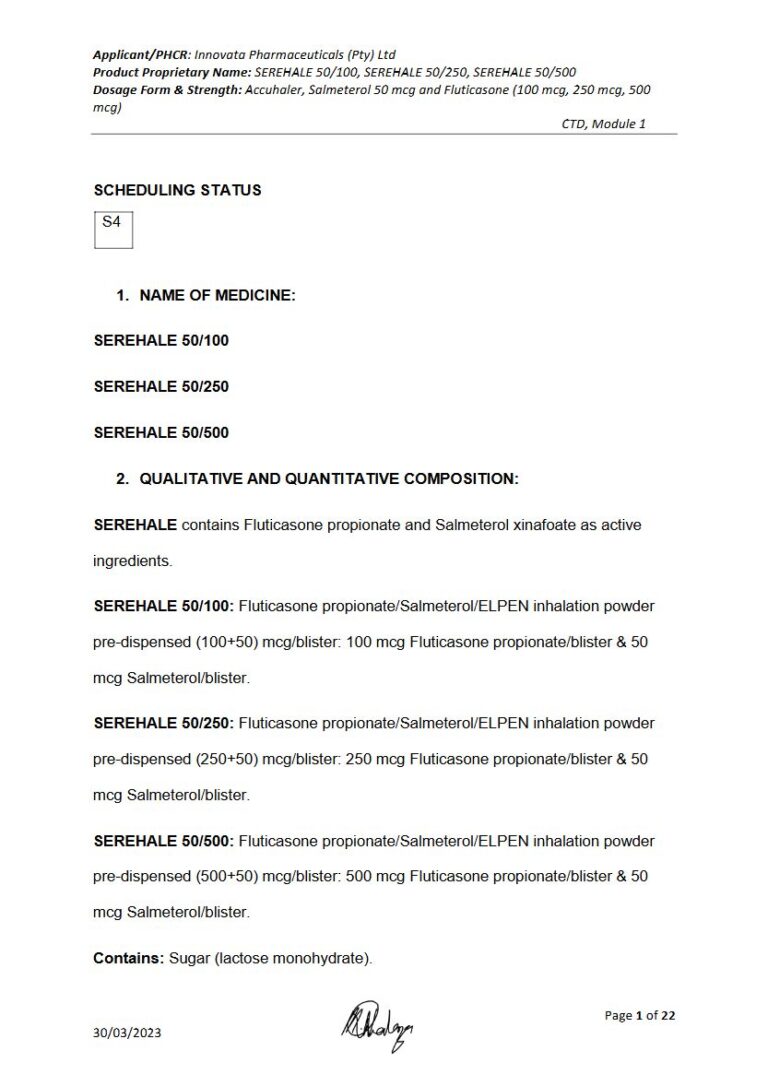
Serehale 100 mcg/250 mcg/500 mcg
PDF Leaflet Revision Date: 30 March 2023
Clinical Summary
Quick overview from the medicine insert
Indication
Prophylactic treatment of asthma and COPD.
Dosage (summary)
One inhalation twice daily for adults and children 12 years and older.
Onset of Action / Duration
Onset: 30 mins, Duration: 12 hours
Special Populations
- Elderly
- Renal impairment
- Hepatic impairment
Pregnancy & Breastfeeding
Safety not established; use with caution.
Key Drug Interactions
- u03b2 adrenergic blockers
- CYP3A4 inhibitors
Contraindications
- Hypersensitivity to fluticasone or salmeterol
Common side effects
- Candidiasis
- Headache
- Tachycardia
Counselling Points
- Use regularly for best effect
- Have rescue inhaler available
Serious warnings
- Not for acute symptom relief
- Potential adrenal suppression
Important Disclaimer
The Serehale 100 mcg/250 mcg/500 mcg professional information leaflet below is the property of Innovata Pharmaceuticals and is provided on Medinsert exactly as issued, with no.. alterations or editorial changes. We make every effort to keep content current by updating documents as soon as new versions become available. Medinsert serves as a trusted access point for healthcare professionals, but does not replace official sources or clinical judgement. For more details, please read our full disclaimer. read more>>
 Healthcare Professionals Only
This content is for registered healthcare professionals
Sign in or create a free account to read the full package insert.
Free for HPCSA-registered professionals. Powered by Medinsert.
Clinical Particulars
Section 4 of the official insert — extracted exactly as issued, no alterations
4.1 Therapeutic Indications
SEREHALE Accuhaler is indicated in regular prophylactic treatment of atopic asthma in children and adults, who have been stabilized on identical dosages of the components of SEREHALE given concurrently. Chronic Obstructive Pulmonary Disease (COPD): SEREHALE Accuhaler is indicated for the regular treatment of chronic obstructive pulmonary disease (COPD) including chronic bronchitis and emphysema. SEREHALE is indicated for symptomatic treatment of patients with severe COPD (FEV1 <50 % predicted normal) and a history of repeated exacerbations, who have significant symptoms despite regular bronchodilator therapy.
4.2 Posology and method of administration
Patients should be made aware that SEREHALE Accuhaler must be used regularly for optimum benefit even when asymptomatic. Patients should be regularly reassessed by health care provider. The dose should be titrated to the lowest dose at which effective control of symptoms is maintained. SEREHALE Accuhaler is not for relief of acute symptoms for which a fast and short-acting bronchodilator is required. Patients should always be advised to have their relief medicine available at all times.
Increasing use of short-acting bronchodilators to relieve asthma symptoms indicates deterioration of asthma control. Sudden and progressive deterioration in control of asthma is potentially life-threatening and the patients should be reviewed. Consideration should be given to increasing corticosteroid therapy. Also, where the current dosage of SEREHALE Accuhaler has failed to give adequate control of reversible obstructive airways disease, the patient should be reviewed. Consideration should be given to additional corticosteroid therapies, and to including administration of antibiotics if an infection is present.
Recommended doses:
- Adults and adolescents 12 years and older:
- One inhalation (SEREHALE 50/100 Accuhaler) twice daily, or
- One inhalation (SEREHALE 50/250 Accuhaler) twice daily, or
- One inhalation (SEREHALE 50/500 Accuhaler) twice daily.
- COPD Adults:
- One inhalation (SEREHALE 50/250 Accuhaler) or one inhalation (SEREHALE 50/500 Accuhaler) twice daily.
- Special population: There is no need to adjust the dose in elderly patients or in those with renal or hepatic impairment.
- Paediatric population: Children 4 years and older:
- One inhalation (SEREHALE 50/100 Accuhaler) twice daily. There are no data available for the use of SEREHALE Accuhaler in children under 4 years.
Method of administration: SEREHALE Accuhaler is for oral inhalation use only.
4.3 Contraindications
SEREHALE Accuhaler is contraindicated in patients with history of hypersensitivity to fluticasone propionate & salmeterol xinafoate or any of the excipients listed in section 6.1.
4.4 Special warnings and precautions for use
SEREHALE Accuhaler is not for relief of acute symptoms for which a fast and short-acting bronchodilator is required. Patients should be advised to have their relief medicine available at all times.
Increasing use of short-acting inhaled beta 2 -acting agonists to control symptoms indicates deterioration of asthma control. Under these conditions, the patient should be reassessed. Sudden and progressive deterioration in asthma control is potentially life-threatening and may have several causes. Consideration should be given to increasing corticosteroid dosage if not caused by otherwise treatable causes of deterioration.
Treatment with SEREHALE Accuhaler should not be stopped abruptly as adrenal insufficiency may be precipitated in this way. Systematic corticosteroid effects may occur in patients on fluticasone treatment. Patients transferred from other inhaled steroids or oral steroids remain at risk of impaired adrenal reserve for a considerable time after transferring to inhaled fluticasone propionate.
Patients with severe asthma may require high dose inhaled (see section 4.2) or oral corticosteroid therapy. Sudden worsening of symptoms may require increased corticosteroid dosage which should be administered under urgent medical supervision.
Patients weaned off oral steroids whose adrenocortical function is still impaired should carry systematic steroid warning card indicating that they may need supplementary systematic steroid during periods of stress, e.g. worsening asthma attacks, chest infections, major intercurrent illness, surgery, trauma, etc.
In cases inhaled therapy may unmask underlying eosinophilic conditions (e.g. Churg-Strauss syndrome). These cases have usually been associated with reduction or withdrawal of oral corticosteroid therapy. A direct causal relationship has not been established.
Systematic effects may occur with any inhaled corticosteroid, particularly at high doses prescribed for long periods; these effects are much less likely to occur than with oral corticosteroids. Possible systemic effects include adrenal suppression, growth retardation in children and adolescents, decrease in bone mineral density, cataract and glaucoma. It is important, therefore, that the dose of inhaled corticosteroid is titrated to the lowest dose at which effective control is maintained.
It is recommended that the height of children receiving prolonged treatment with inhaled corticosteroid is regularly monitored. Patients in medical or surgical emergency, who require high doses of inhaled steroids and/or intermittent treatment with oral steroids are at risk of impaired adrenal reserve. The extent of the adrenal impairment may require specialist advice before elective procedures. The possibility of residual impaired adrenal response should always be borne in mind in emergency and elective situations likely to produce stress and appropriate corticosteroid treatment must be considered.
In children taking recommended doses of inhaled fluticasone propionate, adrenal function and adrenal reserve usually remain within the normal range. However, the possible effects of previous of previous or intermittent treatment with oral steroids should be discounted.
Lack of response or severe exacerbations of asthma should be treated by increasing the dose of inhaled fluticasone propionate or by giving a systematic steroid and/or an antibiotic if there is an infection.
Special care is necessary in patients with active or quiescent pulmonary tuberculosis. SEREHALE should be administered with caution in patients with thyrotoxicosis. Patients on corticosteroid therapy may have adrenocortical suppression.
Cardiovascular effects: Seretide may cause cardiac dysrhythmias e.g. supraventricular tachycardia, extrasystoles and atrial fibrillation, and a mild transient reduction in serum potassium at high therapeutic doses. Seretide should be used with caution in patients with severe cardiovascular disorders or heart rhythm abnormalities and in patients with diabetes mellitus, thyrotoxicosis, uncorrected hypokalaemia or patients predisposed to low levels of serum potassium.
Hyperglycaemia: There have been reports of increases in blood glucose levels (see section 4.8) and this should be considered when prescribing to patients with a history of diabetes mellitus.
Visual disturbance: Visual disturbance may be reported with systemic and topical corticosteroid use. If a patient presents with symptoms such as blurred vision or other visual disturbances, the patient should be considered for referral to an ophthalmologist for evaluation of possible causes, which may include cataract, glaucoma or diseases such as central serous chorioretinopathy (CSCR) which have been reported after use of systemic and topical corticosteroids.
Excipients: SEREHALE contains lactose monohydrate. Patients with rare hereditary problems of galactose intolerance, total lactase deficiency or glucose galactose malabsorption should not take this medicine.
4.5 Interaction with other medicines and other forms of interaction
u03b2 adrenergic blockers may weaken or antagonise the effect of salmeterol. Both non-selective and selective u03b2 blockers should be avoided unless there are compelling reasons for their use. Potentially serious hypokalaemia may result from u03b22 agonist therapy. Particular caution is advised in acute severe asthma as this effect may be potentiated by concomitant treatment with xanthine derivatives, steroids and diuretics.
Concomitant use of other u03b2 adrenergic containing medicines can have a potentially additive effect.
Fluticasone Propriate: Under normal circumstances, low plasma concentrations of fluticasone propionate are achieved after inhaled dosing, due to extensive first pass metabolism and high systemic clearance mediated by cytochrome CYP3A4 in the gut and liver. Hence, clinically significant drug interactions mediated by fluticasone propionate are unlikely.
In an interaction study in healthy subjects with intranasal fluticasone propionate, ritonavir (a highly potent cytochrome CYP3A4 inhibitor) 100 mg twice a day increased the fluticasone propionate plasma concentrations several hundred-fold, resulting in markedly reduced serum cortisol concentrations. Information about this interaction is lacking for inhaled fluticasone propionate, but a marked increase in fluticasone propionate plasma levels is expected. Cases of Cushing's syndrome and adrenal suppression have been reported. The combination should be avoided unless the benefit outweighs the increased risk of systemic glucocorticoid side effects.
In a small study in healthy volunteers, the slightly less potent CYP3A inhibitor ketoconazole increased the exposure of fluticasone propionate after a single inhalation by 150%. This resulted in a greater reduction of plasma cortisol as compared with fluticasone propionate alone. Co-treatment with other potent CYP3A inhibitors, such as itraconazole and cobicistat-containing products, and moderate CYP3A inhibitors, such as erythromycin, is also expected to increase the systemic fluticasone propionate exposure and the risk of systemic side effects. Combinations should be avoided unless the benefit outweighs the potential increased risk of systemic corticosteroid side-effects, in which case patients should be monitored for systemic corticosteroid side-effects.
Salmeterol: Potent CYP3A4 inhibitors: Co-administration of ketoconazole (400 mg orally once daily) and salmeterol (50 micrograms inhaled twice daily) resulted in a significant increase in plasma salmeterol exposure (1.4-fold Cmax and 15-fold AUC). This may lead to an increase in the incidence of other systemic effects of salmeterol treatment (e.g. prolongation of QTc interval and palpitations) compared with salmeterol or ketoconazole treatment alone (see section 4.4). Clinically significant effects were not seen on blood pressure, heart rate, blood glucose and blood potassium levels. Co-administration with ketoconazole did not increase the elimination half-life of salmeterol or increase salmeterol accumulation with repeat dosing. The concomitant administration of ketoconazole should be avoided unless the benefits outweigh the potentially increased risk of systemic side effects of salmeterol treatment. There is likely to be a similar risk of interaction with other potent CYP3A4 inhibitors (e.g. itraconazole, telithromycin, ritonavir).
Moderate CYP 3A4 inhibitors: Co-administration of erythromycin (500 mg orally three times a day) and salmeterol (50 micrograms inhaled twice daily) in 15 healthy subjects for 6 days resulted in a small but non-statistically significant increase in salmeterol exposure (1.4-fold C max and 1.2-fold AUC). Co-administration with erythromycin was not associated with any serious adverse effects.
4.6 Fertility, pregnancy, and lactation
Pregnancy: Fluticasone propionate: Safety in pregnancy has not been established. Corticosteroids have been shown to be teratogenic in animals. As these medicines are absorbed when inhaled, teratogenicity following inhalation cannot be excluded.
Salmeterol: Safety in pregnancy has not been established.
Breastfeeding: Fluticasone propionate: Safety in lactation has not been established.
Salmeterol: Safety in lactation has not been established. There is no experience of the use of salmeterol in nursing mothers.
Fertility: There are no data available.
4.7 Effects on the ability to drive and use machines
SEREHALE is unlikely to produce an effect. SEREHALE causes visual disturbances.
4.8 Undesirable effects
As SEREHALE contains salmeterol and fluticasone propionate, the type and severity of adverse reactions associated with each of the compounds may be expected. There is no incidence of additional adverse events following concurrent administration of the two compounds.
System Organ Class Frequency Side effects Infections & Infestations Frequent Candidiasis of the mouth and throat, pneumonia (in COPD patients), bronchitis. Less frequent Oesophageal candidiasis.
Immune System Disorders Less frequent Hypersensitivity reactions with the following manifestations: Cutaneous hypersensitivity reactions, angioedema (mainly facial and oropharyngeal oedema), respiratory symptoms (Dyspnoea), respiratory symptoms (bronchospasm), anaphylactic reactions including anaphylactic shock.
Endocrine Disorders Less frequent Cushing's syndrome, cushingoid features, adrenal suppression, growth retardation in children and adolescents, decreased bone mineral density.
Metabolism & Nutrition Disorders Less frequent Hyperglycaemia Frequency unknown Hypokalaemia.
Psychiatric Disorders Less frequent Anxiety, sleep disorders, behavioural changes, including psychomotor hyperactivity and irritability (predominantly in children) Frequency unknown Depression, aggression (predominantly in children).
Nervous System Disorders Frequent Headache Less frequent Tremor.
Eye Disorders Less frequent Cataract, glaucoma Frequency unknown Vision, blurred.
Cardiac Disorders Less frequent Palpitations, tachycardia, cardiac arrhythmias (including supraventricular tachycardia and extrasystoles), atrial fibrillation, angina pectoris.
Respiratory, Thoracic & Mediastinal Disorders Frequent Nasopharyngitis, throat irritation, hoarseness/dysphonia, sinusitis Less frequent Paradoxical bronchospasm.
Skin and subcutaneous tissue disorders Frequent Contusions.
Musculoskeletal & Connective Tissue Disorders Frequent Muscle cramps, traumatic fractures, arthralgia, myalgia.
Reporting of suspected adverse reactions: Reporting suspected adverse reactions after authorisation of the medicine is important. It allows continued monitoring of the benefit/risk balance of the medicine. Health care providers are asked to report any suspected adverse reactions to SAHPRA via the u201c6.04 Adverse Drug Reactions Reporting Formu201d, found online under SAHPRAu2019s publications: https://www.sahpra.org.za/Publications/Index/8.
4.9 Overdose
The symptoms and signs of salmeterol overdose are tremor, headache and tachycardia. The preferred antidote for overdosage with salmeterol is a cardio-selective beta-blocking medicine. Both non-selective and selective beta-blockers should be avoided in patients with reversible obstructive airways disease unless there are compelling reasons for their use.
Acute: Inhalation of fluticasone propionate at dosages in excess of those recommended may lead to temporary suppression of adrenal function. This does not necessitate emergency action being taken. In these patients treatment with fluticasone propionate by inhalation should be continued at a dose sufficient to control asthma; adrenal function recovers in a few days and can be verified by measuring plasma cortisol.
Chronic: Use of inhaled fluticasone propionate at doses in excess of those recommended over prolonged periods may lead to some degree of adrenal suppression. Monitoring of adrenal reserve may be indicated. Treatment with inhaled fluticasone propionate should be continued at a dose sufficient to control asthma.
