
Sevonu Liquid 250 mL
PDF Leaflet Revision Date: 06 June 2022
Clinical Summary
Quick overview from the medicine insert
Indication
Induction and maintenance of general anaesthesia.
Dosage (summary)
Individualised; inspired concentrations of 0.5-3% for maintenance.
Onset of Action / Duration
Onset: <2 mins, Duration: variable.
Special Populations
- Elderly
- Paediatric
- Renal impairment
- Hepatic impairment
Pregnancy & Breastfeeding
Caution in pregnancy; not established in lactation.
Key Drug Interactions
- Beta-sympathomimetics
- Calcium antagonists
- Succinylcholine
Contraindications
- Hypersensitivity to sevoflurane
- Malignant hyperthermia
- Neuromuscular disease
Common side effects
- Hypotension
- Nausea
- Vomiting
- Agitation
Counselling Points
- Avoid driving post-anaesthesia
- Monitor for respiratory issues
- Skip breastfeeding for 48 hours post-use
Serious warnings
- Respiratory depression
- Malignant hyperthermia risk
- Hepatic dysfunction
Important Disclaimer
The Sevonu Liquid 250 mL professional information leaflet below is the property of Lamar International and is provided on Medinsert exactly as issued, with no.. alterations or editorial changes. We make every effort to keep content current by updating documents as soon as new versions become available. Medinsert serves as a trusted access point for healthcare professionals, but does not replace official sources or clinical judgement. For more details, please read our full disclaimer. read more>>
 Healthcare Professionals Only
This content is for registered healthcare professionals
Sign in or create a free account to read the full package insert.
Free for HPCSA-registered professionals. Powered by Medinsert.
Clinical Particulars
Section 4 of the official insert — extracted exactly as issued, no alterations
4.1 Therapeutic indications
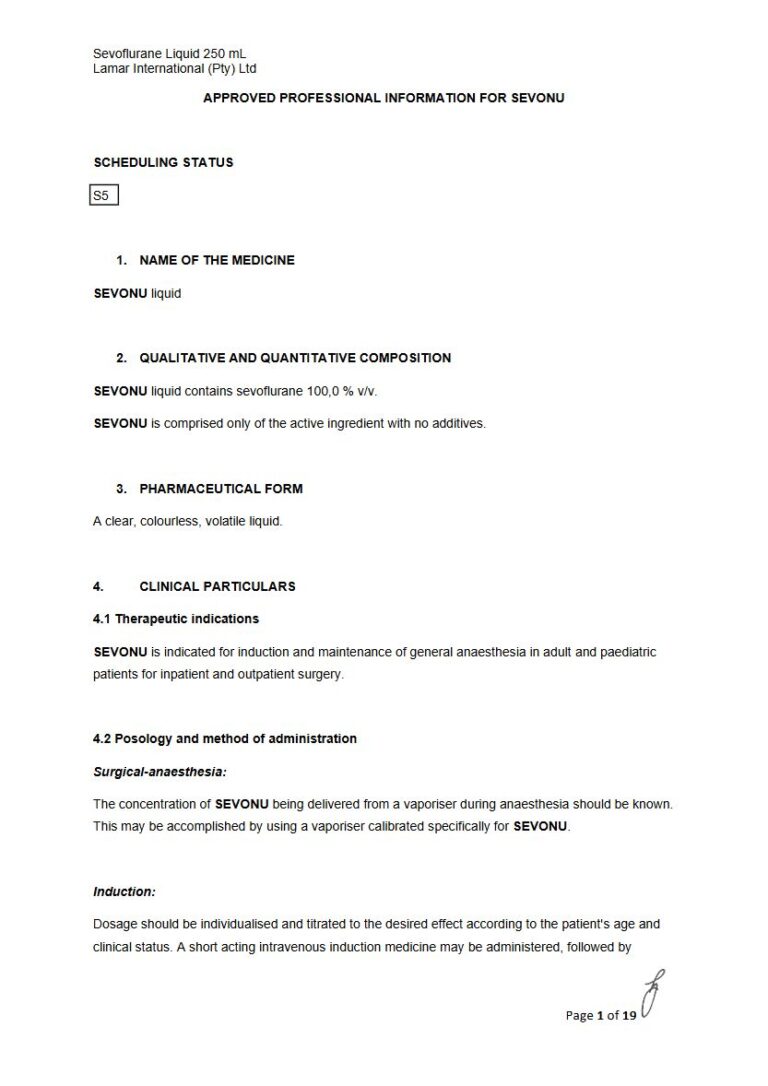
SEVONU is indicated for induction and maintenance of general anaesthesia in adult and paediatric patients for inpatient and outpatient surgery.
4.2 Posology and method of administration
Surgical - anaesthesia: The concentration of SEVONU being delivered from a vaporiser during anaesthesia should be known. This may be accomplished by using a vaporiser calibrated specifically for SEVONU. Induction: Dosage should be individualised and titrated to the desired effect according to the patient's age and clinical status. A short acting intravenous induction medicine may be administered, followed by inhalation of SEVONU. Induction with SEVONU may be achieved in oxygen or in combination with oxygen - nitrous oxide mixtures. Inspired concentrations of up to 8 % SEVONU usually produce surgical anaesthesia in less than 2 minutes in both adults and children. Maintenance: Surgical levels of anaesthesia may be sustained with concentrations of 0,5 - 3 % SEVONU with or without the concomitant use of nitrous oxide. MAC values in Adults and Paediatric Patients According to Age Age of patient (years) : Sevoflurane in oxygen : Sev oflurane in 65 % N2O/35 % O2 : 0 u2013 1 month* 3,3 % 2,0 %** 1 month u2013 < 6 months 3,0 % 6 months u2013 < 3 years 2,8 % 3 u2013 12 2,5 % 25 2,6 % 1,4 % 40 2,1 % 1,1 % 60 1,7 % 0,9 % 80 1,4 % 0,7 % * Neonates are full - term gestational age. MAC in premature infants has not been determined. ** In 3 u2013 < 5 year old paediatric patients, 60 % N2O/40 % O2 was used. Emergence: Emergence times are generally short following SEVONU anaesthesia. Therefore, patients may require postoperative pain relief earlier. Special populations Elderly population: Lesser concentrations of SEVONU are normally required to maintain surgical anaesthesia. Paediatric population: Refer to Table above for MAC values for paediatric patients according to age.
4.3 Contraindications
- SEVONU should not be used in patients with known or suspected hypersensitivity to sevoflurane or other halogenated medicines (e.g. history of hepatotoxicity, usually including elevated liver enzymes, fever, leukocytosis and/or eosinophilia temporally related to anaesthesia with one of the medicines).
- SEVONU should not be used in patients with known of suspected genetic susceptibility to malignant hyperthermia (see section 4.4).
- SEVONU should not be used in patients with latent as well as overt neuro - muscular disease, particularly Duchenne muscular dystrophy (see section 4.4).
4.4 Special warnings and precautions for use
Sevoflurane may cause respiratory depression, which may be augmented by narcotic premedication or other medicines causing respiratory depression. Respiration should be supervised and if necessary, assisted. SEVONU should be administered only by persons trained in the administration of general anaesthesia. Facilities for maintenance of a patent airway, artificial ventilation and oxygen enrichment and circulatory resuscitation must be immediately available. The concentration of sevoflurane being delivered from a vaporiser must be known exactly. Since levels of anaesthesia may be altered easily and rapidly, only vaporisers specifically calibrated for SEVONU should be used. The administration of general anaesthesia must be individualised based on the patient's response. Hypotension and respiratory depression increase as anaesthesia is deepened.
Malignant hyperthermia: In susceptible individuals SEVONU may trigger a skeletal muscle hypermetabolic state leading to high oxygen demand and the clinical syndrome known as malignant hyperthermia (see section 4.8). The clinical syndrome is signalled by hypercapnia, and may include muscle rigidity, tachycardia, tachypnoea, cyanosis, dysrhythmias, and/or unstable blood pressure. Some of these non - specific signs may also appear during light anaesthesia, acute hypoxia, hypercapnia and hypovolaemia. Fatalities have occurred. Treatment of malignant hyperthermia includes discontinuation of SEVONU administration of intravenous dantrolene sodium and application of supportive therapy. Such therapy includes vigorous efforts to restore body temperature to normal, respiratory and circulatory support as indicated, and management of electrolyte - fluid - acid - base abnormalities. Renal failure may appear later, and urine flow should be monitored and sustained if possible.
Peri - operative Hyperkalaemia: Use of inhaled anaesthetic medicines, including SEVONU, has been associated with increases in serum potassium levels that have resulted in cardiac dysrhythmias and death in paediatric patients during the peri - operative period. Patients with latent as well as overt neuromuscular disease, particularly Duchenne muscular dystrophy, appear to be most vulnerable (see section 4.3). Concomitant use of succinylcholine has been associated with most, but not all, of these cases. These patients also experienced significant elevations in serum creatine phosphokinase levels and, in some cases, changes in urine consistent with myoglobinuria. Despite the similarity in presentation to malignant hyperthermia, none of these patients exhibited signs or symptoms of muscle rigidity or hypermetabolic state. Early and aggressive intervention to treat the hyperkalaemia and resistant dysrhythmias is recommended, as is subsequent evaluation for latent neuromuscular disease.
Reports of QT prolongation, associated with Torsades de Pointes (in exceptional cases, fatal), have been received. Caution should be exercised when administering SEVONU to susceptible patients. Isolated cases of ventricular dysrhythmia were reported in paediatric patients with Pompe's disease. Caution should be exercised in administering general anaesthesia, including SEVONU, to patients with mitochondrial disorders.
Hepatic: Cases of mild, moderate and severe post - operative hepatic dysfunction or hepatitis with or without jaundice have been reported. In addition, there have been reports of hepatic failure and hepatic necrosis associated with the use of potent volatile anaesthetic agents, including sevoflurane. However, the actual incidence and relationship of sevoflurane to these events cannot be established with certainty (see section 4.8). Caution should be exercised when SEVONU is used in patients with underlying hepatic conditions or under treatment with medicines known to cause hepatic dysfunction (see section 4.8). It has been reported that previous exposure to halogenated hydrocarbon anaesthetics may increase the potential for hepatic injury.
General: During maintenance of anaesthesia, increasing the concentrations of SEVONU produces dose - dependent decreases in blood pressure. Excessive decrease in blood pressure may be related to depth of anaesthesia and in such instances may be corrected by decreasing the inspired concentration of SEVONU. Particular care must be taken when selecting the dosage for patients who are hypovolaemic, hypotensive, or otherwise hemodynamically compromised, e.g., due to concomitant medications. Maintenance of haemodynamic stability is important to the avoidance of myocardial ischaemia in patients with coronary artery disease. Caution should be observed when using SEVONU during obstetric anaesthesia because the relaxant effect on the uterus could increase the risk of uterine bleeding (see section 4.6).
The recovery from general anaesthesia should be assessed carefully before patients are discharged from the post - anaesthesia care unit. Rapid emergence from anaesthesia is generally seen with sevoflurane so early relief of postoperative pain may be required. Although recovery of consciousness following SEVONU administration generally occurs within minutes, the impact on intellectual function for two or three days following anaesthesia has not been studied. As with other anaesthetics, small changes in mood may persist for several days following administration (see section 4.7). Rapid emergence in children may be associated with agitation and lack of co - operation (in about 25 % of cases).
Replacement of Desiccated CO2 Absorbents: Cases of extreme heat, smoke and/or spontaneous fire in the anaesthesia machine have been reported during SEVONU use in conjunction with the use of desiccated CO2 absorbent, specifically those containing potassium hydroxide (e.g. Baralyme). An unusually delayed rise or unexpected decline of inspired SEVONU concentration compared to the vaporiser setting may be associated with excessive heating of the CO2 canister. The exothermic reaction that occurs with SEVONU and CO2 absorbents is increased when the CO2 absorbent becomes desiccated, such as after an extended period of dry gas flow through the CO2 absorbent canisters. SEVONU degradants (methanol, formaldehyde, carbon monoxide and Compounds A, B, C and D) were observed in the respiratory circuit of an experimental anaesthesia machine using desiccated CO2 absorbents and maximum SEVONU concentrations (8 %) for extended periods of time (u2265 2 hours). (Compound A is pentafluoroisopropanyl fluoromethyl ether, Compound B is the methoxy addition product formed after reaction of Compound A with methanol, and Compound B can undergo further HF elimination to form Compounds C, D and E). Concentrations of formaldehyde observed at the anaesthesia respiratory circuit (using sodium hydroxide containing absorbents) were consistent with levels known to cause mild respiratory irritation. The clinical relevance of the degradants observed under this extreme experimental model is unknown. When a health care professional suspects that the CO2 absorbent may be desiccated, it should be replaced before administration of SEVONU. The colour indicator of most CO2 absorbents does not necessarily change as a result of desiccation. Therefore, the lack of significant colour change should not be taken as an assurance of adequate hydration. CO2 absorbents should be replaced routinely regardless of the state of the colour indicator.
Renal Impairment: Because of the small number of patients with renal insufficiency studied (baseline serum creatinine greater than 15 mg/L (133 u03bcmol/L), the safety of SEVONU administration in this group has not yet been fully established. Therefore, SEVONU should be used with caution in patients with renal insufficiency.
Neurosurgery & Neuromuscular Impairment: In patients at risk for an increase in intracranial pressure, SEVONU should be administered cautiously in conjunction with measures to reduce intracranial pressure (such as hyperventilation).
Seizures: Cases of seizures have been reported in association with SEVONU use (see section 4.8). Use of sevoflurane, as in SEVONU, has been associated with seizures occurring in children and young adults as well as older adults with and without predisposing risk factors. Clinical judgment is necessary before sevoflurane is used in patients at risk of seizures. In children the depth of anaesthesia should be limited. EEG may permit the optimization of SEVONU dose and help avoid the development of seizure activity in patients with a predisposition for seizures (see section Paediatric use, below).
Paediatric use: The use of SEVONU has been associated with seizures. Many of these have occurred in children and young adults starting from 2 months of age, most of whom had no predisposing factors. Clinical judgement should be exercised when using SEVONU in patients who may be at risk for seizures. Dystonic movements in children have been observed (see section 4.8).
Hypersensitivity: Reports of hypersensitivity (including contact dermatitis, rash, dyspnoea, wheezing, chest discomfort, swelling face or anaphylactic reaction) have been received, including cases of association with long - term occupational exposure to SEVONU.
4.5 Interaction with other medicines and other forms of interaction
Beta - sympathomimetic medicines like isoprenaline and alpha - and beta - sympathomimetic medicines like adrenaline and noradrenaline should be used with caution during sevoflurane narcosis, due to a potential risk of ventricular dysrhythmia. Epinephrine/Adrenaline: Sevoflurane is similar to isoflurane in the sensitisation of the myocardium to the arrhythmogenic effect of exogenously administered adrenaline. Indirect - acting Sympathomimetics: There is a risk of acute hypertensive episode with the concomitant use of sevoflurane and indirect - acting sympathomimetics products (amphetamines, ephedrine). Non - selective MAO - inhibitors: Risk of crisis during the operation. It is generally recommended that treatment should be stopped 2 weeks prior to surgery. Sevoflurane may lead to marked hypotension in patients treated with calcium antagonists, in particular dihydropyridine derivates. Caution should be exercised when calcium antagonists are used concomitantly with inhalation anaesthetics due to the risk of additive negative inotropic effect.
Concomitant use of succinylcholine with inhaled anaesthetic medicines has been associated with rare increases in serum potassium levels that have resulted in cardiac dysrhythmias and death in paediatric patients during the post - operative period. Sevoflurane has been shown to be safe and effective when administered concurrently with a wide variety of medicines commonly encountered in surgical situations such as central nervous system medicines, autonomic medicines, skeletal muscle relaxants, anti - infective medicines including aminoglycosides, hormones and synthetic substitutes, blood derivatives and cardiovascular medicines, including epinephrine. Beta blockers: Sevoflurane may increase the negative inotropic, chronotropic and dromotropic effects of beta blockers (by blocking cardiovascular compensatory mechanisms). Verapamil: Impairment of atrioventricular conduction was observed when verapamil and sevoflurane were administered at the same time. Barbiturates: SEVONU administration is compatible with barbiturates as commonly used in surgical practice. Benzodiazepines and Opioids: Benzodiazepines and opioids decrease the MAC of SEVONU. SEVONU administration is compatible with benzodiazepines and opioids as commonly used in surgical practice. Inducers of CYP2E1: Medicines and compounds that increase the activity of cytochrome P450 isoenzyme CYP2E1, such as isoniazid and alcohol, may increase the metabolism of SEVONU and lead to significant increases in plasma fluoride concentrations. Concomitant use of sevoflurane, as in SEVONU, and isoniazid can potentiate the hepatotoxic effects of isoniazid.
As with other medicines, lesser concentrations of sevoflurane may be required following use of an intravenous anaesthetic e.g. propofol. Significant increases in plasma fluoride concentrations have been observed following the increased activity of CYP2E1. St John's Wort: Severe hypotension and delayed emergence from anaesthesia with halogenated inhalational anaesthetics have been reported in patients treated long - term with St John's Wort. Nitrous oxide: The MAC of SEVONU is decreased when administered in combination with nitrous oxide. The MAC equivalent is reduced approximately 50 % in adult and approximately 25 % in paediatric patients. Altitude may affect the effects of nitrous oxide. Neuromuscular blocking medicines: SEVONU affects both the intensity and duration of neuromuscular blockade by non - depolarising muscle relaxants. When used to supplement alfentanil - N2O anaesthesia, SEVONU potentiates neuromuscular block induced with pancuronium, vecuronium or atracurium. The dosage adjustments for these muscle relaxants when administered with sevoflurane are similar to those required with isoflurane. The effect of SEVONU on succinylcholine and the duration of depolarising neuromuscular blockade has not been studied. Dosage reduction of neuromuscular blocking medicines during induction of anaesthesia may result in delayed onset of conditions suitable for endotracheal intubation or inadequate muscle relaxation because potentiation of neuromuscular blocking medicines is observed a few minutes after the beginning of SEVONU administration.
Among non - depolarising medicines, vecuronium, pancuronium and atracurium interactions have been studied. In the absence of specific guidelines: (1) for endotracheal intubation, do not reduce the dose of non - depolarising muscle relaxants, (2) during maintenance of anaesthesia, the dose of non - depolarising muscle relaxants is likely to be reduced compared to that during N2O/opioid anaesthesia. Administration of supplemental doses of muscle relaxants should be guided by the response to nerve stimulation.
4.6 Fertility, pregnancy and lactation
Pregnancy: Safety in pregnancy or lactation has not been established. The safety of SEVONU in labour and delivery has not been demonstrated. SEVONU may be used for anaesthesia during Caesarean section. Published animal studies of some anaesthetic/sedation medicines have reported adverse effects on brain development in early life. SEVONU has relaxant effects on the uterus with the potential risk for uterine bleeding. Caution should be observed when using SEVONU during obstetric anaesthesia.
Breastfeeding: It is not known whether SEVONU is excreted in human milk. Caution should be exercised when SEVONU is administered to a breastfeeding woman. Women should be advised to skip breast - feeding for 48 hours after administration of sevoflurane and discard milk produced during this period.
Fertility: A fertility study in rats has revealed no evidence of impaired fertility due to sevoflurane.
4.7 Effects on ability to drive and use machines
Patients should be advised that performance of activities requiring mental alertness, such as decision making or operating a motor vehicle or hazardous machinery, may be impaired for some time after general anaesthesia. Patients should not be allowed to drive for a suitable period after sevoflurane anaesthesia.
4.8 Undesirable effects
Summary of the safety profile: As with all potent inhaled anaesthetics, sevoflurane may cause dose - dependent cardio - respiratory depression. Most adverse reactions are mild to moderate in severity and are transient in duration. Nausea, vomiting, and delirium have been observed in the postoperative period, common sequelae of surgery and general anaesthesia, which may be due to inhalational anaesthetic, other medicines administered intra - operatively or post - operatively, and to the patient's response to the surgical procedure. The most frequently reported adverse reactions were as follows: In adult patients: hypotension, nausea and vomiting; In elderly patients: bradycardia, hypotension and nausea; and In paediatric patients: agitation, cough, vomiting and nausea.
Tabulated summary of adverse reactions: System Organ Class : Frequency : Side effects : Blood and the lymphatic system disorders Less frequent Leukopenia, leukocytosis Immune system disorders Frequency unknown Anaphylactic reaction, anaphylactoid reaction, hypersensitivity Psychiatric disorders Frequent Less frequent Agitation Confusional state Nervous system disorders Frequent Somnolence, dizziness, headache Frequency unknown Convulsion, dystonia Cardiac disorders Frequent Less frequent Frequency unknown Bradycardia, tachycardia Atrioventricular block complete, atrial fibrillation, dysrhythmia, ventricular extrasystoles, supraventricular extrasystoles, extrasystoles QT prolongation associated with Torsade, cardiac arrest Vascular disorders Frequent Hypotension, hypertension Respiratory, thoracic and mediastinal disorders Frequent Less frequent Frequency unknown Cough, respiratory disorder, laryngospasm Apnoea, hypoxia, asthma Bronchospasm, dyspnoea, wheezing, pulmonary oedema Gastrointestinal disorders Frequent Nausea, vomiting, salivary hypersecretion Hepato - biliary disorders Frequency unknown Hepatitis, hepatic failure, hepatic necrosis Skin and subcutaneous tissue disorders Frequency unknown Pruritus, rash, urticaria, contact dermatitis, face swelling Musculoskeletal, and connective tissue disorders Frequency unknown Muscle twitching Renal and urinary disorders Less frequent Frequency unknown Urinary retention, glycosuria Acute renal failure General disorders and administration site conditions Frequent Frequency unknown Chills, pyrexia Malignant hyperthermia, chest discomfort Investigations Frequent Less frequent Increased blood glucose, abnormal liver function test, increased white blood cell count, increased fluoride*, increased aspartate aminotransferase Increased alanine aminotransferase, increased blood creatinine, increased blood lactate dehydrogenase Injury, poisoning and procedural complications Frequent Hypothermia *Increases in serum inorganic fluoride levels may occur during and after SEVONU anaesthesia. Concentrations of inorganic fluoride generally peak within two hours of the end of SEVONU anaesthesia and return within 48 hours to pre - operative levels. In clinical trials, elevated fluoride levels were not associated with impairment of renal function.
4.9 Overdose
In the event of apparent overdosage, the following action should be taken: Discontinue administration of SEVONU, maintain a patent airway, initiate assisted or controlled ventilation with oxygen and maintain adequate cardiovascular function.
