
Soskain 50 000,0 IU Capsule
PDF Leaflet Revision Date: 06 September 2022
Clinical Summary
Quick overview from the medicine insert
Indication
Treatment of vitamin D deficiency (< 25 nmol/L).
Dosage (summary)
50,000 IU/week for 6-8 weeks, then 1 capsule/month.
Special Populations
- Renal impairment
- Hepatic impairment
Pregnancy & Breastfeeding
Not recommended in pregnancy or breastfeeding.
Key Drug Interactions
- Anticonvulsants
- Thiazide diuretics
- Glucocorticoids
- Cardiac glycosides
Contraindications
- Hypersensitivity to cholecalciferol
- Hypercalcaemia
- Severe renal impairment
- Hypervitaminosis D
- Pregnancy
- Children under 18
Common side effects
- Hypercalcaemia
- Pruritus
- Rash
- Urticaria
Counselling Points
- Take with a meal
- Monitor calcium levels
- Report symptoms of overdose
Serious warnings
- Caution in renal impairment
- Risk of soft tissue calcification
- Increased fracture risk in elderly with high doses
Important Disclaimer
The Soskain 50 000,0 IU Capsule professional information leaflet below is the property of Austell Pharmaceuticals and is provided on Medinsert exactly as issued, with no.. alterations or editorial changes. We make every effort to keep content current by updating documents as soon as new versions become available. Medinsert serves as a trusted access point for healthcare professionals, but does not replace official sources or clinical judgement. For more details, please read our full disclaimer. read more>>
 Healthcare Professionals Only
This content is for registered healthcare professionals
Sign in or create a free account to read the full package insert.
Free for HPCSA-registered professionals. Powered by Medinsert.
Clinical Particulars
Section 4 of the official insert — extracted exactly as issued, no alterations
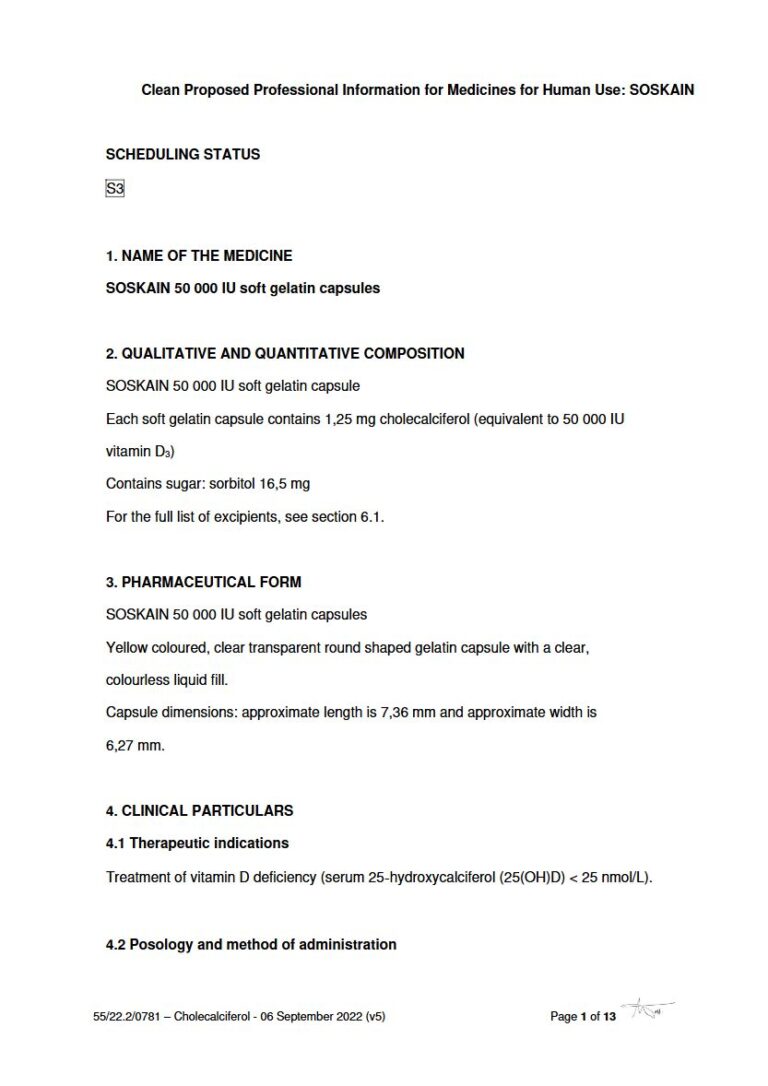
4.1 Therapeutic indications
Treatment of vitamin D deficiency (serum 25 - hydroxycalciferol (25(OH)D) < 25 nmol/L).
4.2 Posology and method of administration
Posology
One SOSKAIN capsule contains 50 000 IU vitamin D 3 .
Adults
u2022 Treatment of vitamin D deficiency (< 25 nmol/L) 50 000 IU/week (1 capsule) for 6 u2013 8 weeks, followed by maintenance therapy (such as 1 capsule per month; follow up 25(OH)D measurements should be made upon completion of the treatment phase and approximately three to four months after initiating the maintenance therapy in order to confirm that blood levels have normalised or the set target level, within the normal range, has been achieved). Higher doses may be required in certain situations, see below.
Certain populations are at high risk of vitamin D deficiency, and may require higher doses and monitoring of serum 25(OH)D:
u2022 Institutionalised or hospitalised individuals
u2022 Individuals with Fitzpatrick IV and upwards skin type
u2022 Individuals with limited effective sun exposure due to protective clothing or consistent use of sunscreens
u2022 Obese individuals
u2022 Patients being evaluated for osteoporosis
u2022 Use of certain concomitant medications (e.g. anticonvulsant medications, glucocorticoids)
u2022 Patients with malabsorption, including inflammatory bowel disease and coeliac disease
u2022 Those recently treated for vitamin D deficiency and requiring maintenance therapy.
Special populations
Renal impairment
SOSKAIN should not be used in combination with calcium in patients with severe renal impairment.
Hepatic impairment
No posology adjustment is required in patients with hepatic impairment.
Pregnancy and breastfeeding
Due to insufficient clinical data, SOSKAIN is not recommended (see section 4.3 and section 4.6).
Paediatric population
Due to insufficient clinical data, SOSKAIN should not be used in children under the age of 18 years (see section 4.3).
Method of administration
SOSKAIN is developed as per oral administration. The capsules should be swallowed whole with water. Patients should be advised to take SOSKAIN preferably with a meal (see section 5.2)
4.3 Contraindications
- Hypersensitivity to cholecalciferol or to any of the excipients listed in section 6.1
- Hypercalcaemia and/or hypercalciuria
- Nephrolithiasis and/or nephrocalcinosis
- Severe renal impairment
- Hypervitaminosis D
- Pseudohypoparathyroidism as the vitamin D requirement may be reduced due to phases of normal vitamin D sensitivity, involving the risk of prolonged overdose. Better-regulatable vitamin D derivatives are available for this.
- Pregnancy
- Children and adolescents (under 18 years of age)
4.4 Special warnings and precautions for use
Impaired renal function
Vitamin D should be used with caution in patients with impairment of renal function and the effect on calcium and phosphate levels should be monitored. The risk of soft tissue calcification should be taken into account.
Cardiovascular disease
Caution is required in patients receiving treatment for cardiovascular disease (see section 4.5).
Sarcoidosis
SOSKAIN should be prescribed with caution in patients with sarcoidosis, due to a possible increase in the metabolism of vitamin D in its active form. In these patients the serum and urinary calcium levels should be monitored.
Vitamin D supplementation
Prescribers should take in account the dose of vitamin D by unit dose (50 000 IU) and any other prescription of vitamin D. Allowances should be made for the total dose of vitamin D in cases associated with treatments already containing vitamin D, foods enriched with vitamin D, cases using milk enriched with vitamin D, and the patient's level of sun exposure. Additional administration of vitamin D should be carried out under strict medical supervision.
Calcium supplements
There is no clear evidence for causation between vitamin D supplementation and renal stones, but the risk is plausible, especially in the context of concomitant calcium supplementation. The need for additional calcium supplementation should be considered for individual patients. Calcium supplements should be given under close medical supervision.
Fractures
Oral administration of high-dose vitamin D (500 000 IU by single annual bolus) was reported to result in an increased risk of fractures in elderly subjects, with the greatest increase occurring during the first 3 months after dosing.
4.5 Interaction with other medicines and other forms of interaction
Anticonvulsants: i.e. phenytoin and barbiturates
Concomitant use of anticonvulsants (such as phenytoin) or barbiturates (and possibly other medicines that induce hepatic enzymes) may reduce the effect of vitamin D by metabolic inactivation.
Thiazide diuretics
In cases of treatment with thiazide diuretics, which decrease urinary elimination of calcium, monitoring of serum calcium concentration is recommended.
Glucocorticoids
Concomitant use of glucocorticoids can decrease the effect of vitamin D.
Cardiac glycosides
In cases of treatment with medicines containing digitalis and other cardiac glycosides, the administration of vitamin D may increase the risk of digitalis toxicity (dysrhythmia).
Serum calcium concentrations
Strict medical supervision is needed, together with serum calcium concentration and electrocardiographic monitoring if necessary.
Reduced bioavailability
Simultaneous treatment with ion exchange resin such as cholestyramine, colestipol hydrochloride, orlistat or laxative such as paraffin oil may reduce the gastrointestinal absorption of vitamin D.
Actinomycin and imidazole antifungal medicines
The cytotoxic medicine actinomycin and imidazole antifungal medicines interfere with vitamin D activity by inhibiting the conversion of the cholecalciferol metabolite, calcifediol (25-OHD 3 ), to the primary active metabolite calicitriol (1 u03b1, 25-(OH) 2 D 3 ) by the kidney enzyme, 25-OH-D 3 -1-hydroxylase. See section 5.2.
4.6 Fertility, pregnancy and lactation
Pregnancy
SOSKAIN should not be used in pregnancy. See section 4.3.
Breastfeeding
SOSKAIN should not be taken by mothers who are breastfeeding.
Fertility
There is no data regarding treatment with vitamin D 3 and its effects on fertility.
4.7 Effects on ability to drive and use machines
There are no data on the effects of SOSKAIN on the ability to drive. However, an effect on this ability is unlikely.
4.8 Undesirable effects
The table below shows all Adverse Drug Reactions (ADRs) observed as per reported clinical trials and post-market spontaneous reports with cholecalciferol.
System Organ Class Frequency Frequent Less Frequent Not known Metabolism and nutrition disorders Hypercalcaemia and hypercalciuria Skin and subcutaneous tissue disorders Pruritus, rash, and urticaria.
Reporting of suspected adverse reactions
Reporting suspected adverse reactions after authorisation of the medicine is important. It allows continued monitoring of the benefit/risk balance of the medicine. Healthcare professionals are asked to report any suspected adverse reactions to SAHPRA via the u201c6.04 Adverse Drug Reaction Reporting Formu201d, found online under SAHPRAu2019s publications: https://www.sahpra.org.za/Publications/Index/8
4.9 Overdose
Signs and symptoms
Ergocalciferol (vitamin D 2 ) and cholecalciferol (vitamin D 3 ) have a relatively low therapeutic index. The threshold for vitamin D intoxication is between 40 000 and 100 000 IU daily for 1 to 2 months in adults with normal parathyroid function. Infants and small children may react sensitively to far lower concentrations. Therefore, it is warned against intake of SOSKAIN without medical supervision.
Overdose leads to increased serum and urinary phosphorus levels, as well as hypercalcaemic syndrome and consequently calcium deposits in the tissues and above all in the kidneys (nephrolithiasis, nephrocalcinosis) and the vessels.
Discontinue SOSKAIN when calcaemia exceeds 10,6 mg/dL (2,65 mmol/L) or if the calciuria exceeds 300 mg/24 hours in adults or 4 u2013 6 mg/kg/day in children.
Chronic overdosage may lead to vascular and organ calcification, as a result of hypercalcaemia.
The symptoms of intoxication are characteristic and manifest as nausea, vomiting, initially also diarrhoea, later constipation, loss of appetite, weariness, headache, muscle pain, joint pain, muscle weakness, persistent sleepiness, ataxia, confusion, uraemia, polydipsia and polyuria and, in the final stage, dehydration. Typical biochemical findings include hypercalcaemia, hypercalciuria, as well as increased serum 25 hydroxy cholecalciferol concentrations.
Treatment
Symptoms of chronic SOSKAIN overdosage may require forced diuresis as well as administration of glucocorticoids or calcitonin. Overdosage requires measures for treating the often persisting and under certain circumstances life-threatening hypercalcaemia. The first measure is to discontinue taking SOSKAIN, it takes several weeks to normalise hypercalcaemia caused by vitamin D intoxication. Depending on the degree of hypercalcaemia, measures include a diet that is low in calcium or free of calcium, abundant liquid intake, increase of urinary excretion by means of the medicine furosemide, as well as the administration of glucocorticoids and calcitonin. If kidney function is adequate, calcium levels can be reliably lowered by infusions of isotonic sodium chloride solution (3 - 6 litres in 24 hours) with addition of furosemide and, in some circumstances, also 15 mg/kg body weight/hour sodium edetate accompanied by continuous calcium and ECG monitoring. In oligoanuria, in contrast, haemodialysis (calcium-free dialysate) is necessary. No special antidote exists. It is recommended to point out the symptoms of potential overdose to patients under chronic therapy with higher doses of vitamin D (nausea, vomiting, initially also diarrhoea, later constipation, anorexia, weariness, headache, muscle pain, joint pain, muscle weakness, persistent sleepiness, azotaemia, polydipsia and polyuria).
