
Spasmomen 40 mg FC tablets.
PDF Leaflet Revision Date: 15 September 2025
Clinical Summary
Quick overview from the medicine insert
Indication
Symptomatic treatment of irritable bowel syndrome (IBS) in adults.
Dosage (summary)
80-120 mg daily (1 tablet 2-3 times daily).
Special Populations
- Hepatic impairment
- Renal impairment
- Elderly patients
Pregnancy & Breastfeeding
Use only if necessary under medical supervision; limited data available.
Contraindications
- Hypersensitivity to otilonium bromide or excipients
Common side effects
- Headache
- Vertigo
- Dry mouth
- Nausea
- Upper abdominal pain
Counselling Points
- Swallow whole with water, preferably 20 mins before meals.
- Monitor for adverse reactions.
Serious warnings
- Caution in glaucoma, prostatic hypertrophy, pyloric stenosis
Important Disclaimer
The Spasmomen 40 mg FC tablets. professional information leaflet below is the property of Menarini South Africa and is provided on Medinsert exactly as issued, with no.. alterations or editorial changes. We make every effort to keep content current by updating documents as soon as new versions become available. Medinsert serves as a trusted access point for healthcare professionals, but does not replace official sources or clinical judgement. For more details, please read our full disclaimer. read more>>
 Healthcare Professionals Only
This content is for registered healthcare professionals
Sign in or create a free account to read the full package insert.
Free for HPCSA-registered professionals. Powered by Medinsert.
Clinical Particulars
Section 4 of the official insert — extracted exactly as issued, no alterations
4.1 Therapeutic indications
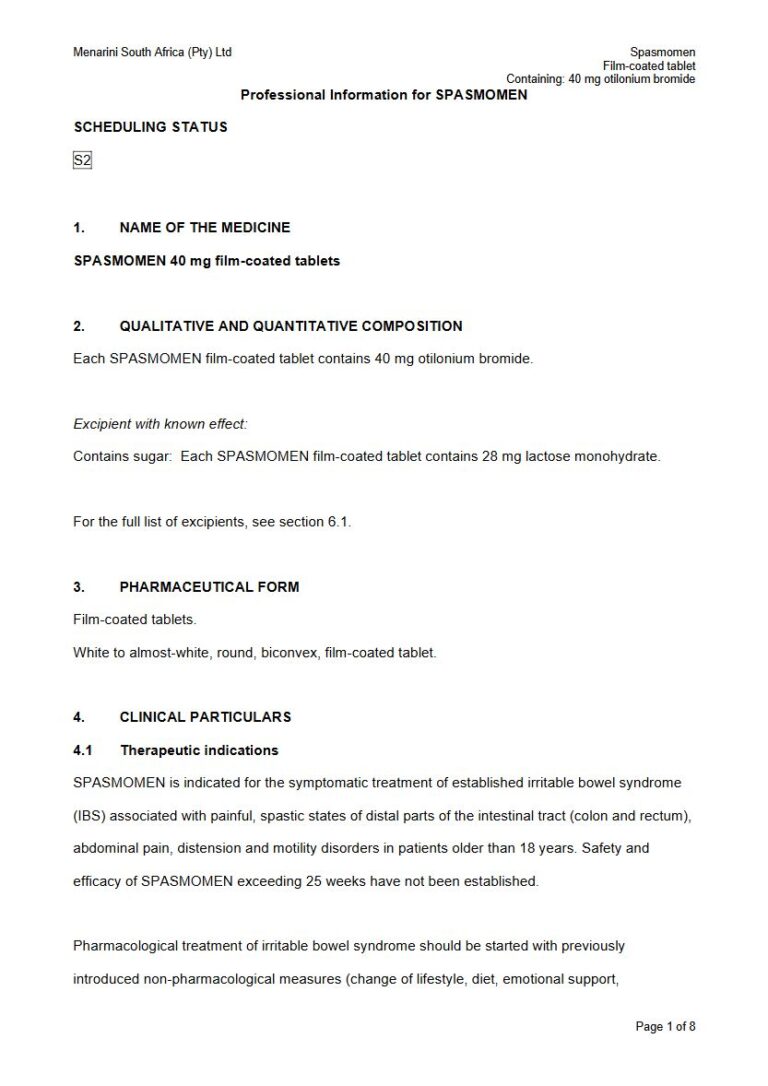
SPASMOMEN is indicated for the symptomatic treatment of established irritable bowel syndrome (IBS) associated with painful, spastic states of distal parts of the intestinal tract (colon and rectum), abdominal pain, distension and motility disorders in patients older than 18 years. Safety and efficacy of SPASMOMEN exceeding 25 weeks have not been established. Pharmacological treatment of irritable bowel syndrome should be started with previously introduced non-pharmacological measures (change of lifestyle, diet, emotional support, psychotherapy) if they did not bring the wanted therapeutic effect on their own.
4.2 Posology and method of administration
Posology: Recommended daily dose is 80 u2013 120 mg (1 tablet 2 to 3 times daily). Dosage is prescribed depending on the clinical picture and response to treatment, and in accordance with therapeutic guidelines for the treatment of irritable bowel syndrome. Duration of treatment: Doctors should periodically assess the need for continued treatment. Safety and efficacy have been shown up to 25 weeks.
Special populations: Patients with hepatic or renal impairment: Dose adjustment is not necessary (see section 5.2). Elderly patients: Dose adjustment is not necessary. Paediatric population: Clinical data on the use of SPASMOMEN in paediatric patients below 18 years is limited, therefore SPASMOMEN is not recommended for use in this population.
Method of administration: Tablets should be swallowed whole, with a glass of water, preferably 20 minutes before meals.
4.3 Contraindications
Hypersensitivity to otilonium bromide or to any of the excipients listed in section 6.1.
4.4 Special warnings and precautions for use
Caution is needed when used in patients with glaucoma, prostatic hypertrophy and pyloric stenosis. SPASMOMEN contains lactose. Patients with rare hereditary problems of galactose intolerance (e.g. galactosaemia), the lactase deficiency or glucose-galactose malabsorption should not take SPASMOMEN. SPASMOMEN contains sodium. SPASMOMEN contains less than 1 mmoL sodium (23 mg) per film-coated tablet, that is to say essentially u2018sodium - freeu2019.
4.5 Interaction with other medicines and other forms of interaction
No interaction studies of SPASMOMEN with other products were performed. It seems that the effect of SPASMOMEN on total time of gastrointestinal transit, at the recommended dose of 40 mg 2 or 3 times daily, is not relevant for the absorption of other, orally taken concomitant medicines.
4.6 Fertility, pregnancy and lactation
There are no clinical data about the use of SPASMOMEN in pregnant and lactating women. Animal studies did not show embryotoxic, teratogenic or mutagenic effects or reproductive or developmental toxicity. SPASMOMEN should only be recommended to pregnant women and nursing mothers if absolutely necessary and under close medical supervision.
4.7 Effects on ability to drive and use machines
SPASMOMEN has no or negligible influence on the ability to drive and use machines.
4.8 Undesirable effects
In the clinical trial conducted with SPASMOMEN, otilonium bromide was well tolerated, the reported adverse events were few in number and superimposable to those reported in placebo/reference medicine groups (see table below). The frequency of adverse reactions occurring in patients treated with SPASMOMEN is classified as follows: common (u2265 1/100 to < 1/10), uncommon (u2265 1/1 000 to < 1/100) and rare (u2265 1/10 000 to < 1/1 000).
System organ class: Adverse reaction: Nervous system disorders Uncommon: Headache Ear and labyrinth disorders Uncommon: Vertigo Gastrointestinal disorders Uncommon: Dry mouth Nausea Upper abdominal pain Skin and subcutaneous tissue disorders Uncommon: Pruritus Erythema General disorders and administration site conditions Uncommon: Fatigue Asthenia
Post-marketing data: During post-marketing surveillance, reports on skin hypersensitivity reactions (urticaria, angioedema) have been received. Because these reactions are reported voluntarily from a population of uncertain size, it is not possible to reliably estimate their frequency, which therefore is not known.
Reporting of suspected adverse reactions: Reporting suspected adverse reactions after authorisation of SPASMOMEN is important. It allows continued monitoring of the benefit/risk balance of SPASMOMEN. Health care providers are requested to report any suspected adverse drug reactions via the Med Safety APP (Medsafety X SAHPRA) and eReporting platform (who-umc.org) found on SAHPRA website.
4.9 Overdose
SPASMOMEN was proven practically devoid of toxicity in animals, used in doses that exceeded many times the usual pharmacological dose (please see section 5.3). Therefore, no symptoms of overdose are expected in humans. In case of overdose an appropriate symptomatic and supporting therapy is recommended.
