
Synapause Vaginal Cream 1mg CREAM
PDF Leaflet Revision Date: 06 June 2014
Clinical Summary
Quick overview from the medicine insert
Indication
Hormone replacement therapy for urogenital atrophy.
Dosage (summary)
1 application daily for 2-3 weeks, then reduce to 1 application twice a week.
Special Populations
- Elderly
- Postmenopausal women
Pregnancy & Breastfeeding
Contraindicated in pregnancy and lactation; may decrease milk production.
Key Drug Interactions
- Anticonvulsants
- Antibiotics
- St. John's wort
Contraindications
- Hypersensitivity
- Breast cancer
- Oestrogen-dependent tumors
- Undiagnosed vaginal bleeding
- Venous thromboembolism
- Pregnancy
- Liver disease
Common side effects
- Breast tenderness
- Breakthrough bleeding
- Local irritation
- Gall bladder disease
Counselling Points
- Report any unusual breast changes
- Avoid use if pregnant
- Use the lowest effective dose for the shortest duration
Serious warnings
- Increased risk of breast cancer
- Risk of venous thromboembolism
- Increased risk of stroke
- Monitor for liver function
Important Disclaimer
The Synapause Vaginal Cream 1mg CREAM professional information leaflet below is the property of Pharmacare and is provided on Medinsert exactly as issued, with no.. alterations or editorial changes. We make every effort to keep content current by updating documents as soon as new versions become available. Medinsert serves as a trusted access point for healthcare professionals, but does not replace official sources or clinical judgement. For more details, please read our full disclaimer. read more>>
 Healthcare Professionals Only
This content is for registered healthcare professionals
Sign in or create a free account to read the full package insert.
Free for HPCSA-registered professionals. Powered by Medinsert.
Clinical Particulars
Section 4 of the official insert — extracted exactly as issued, no alterations
4.1 Therapeutic indications
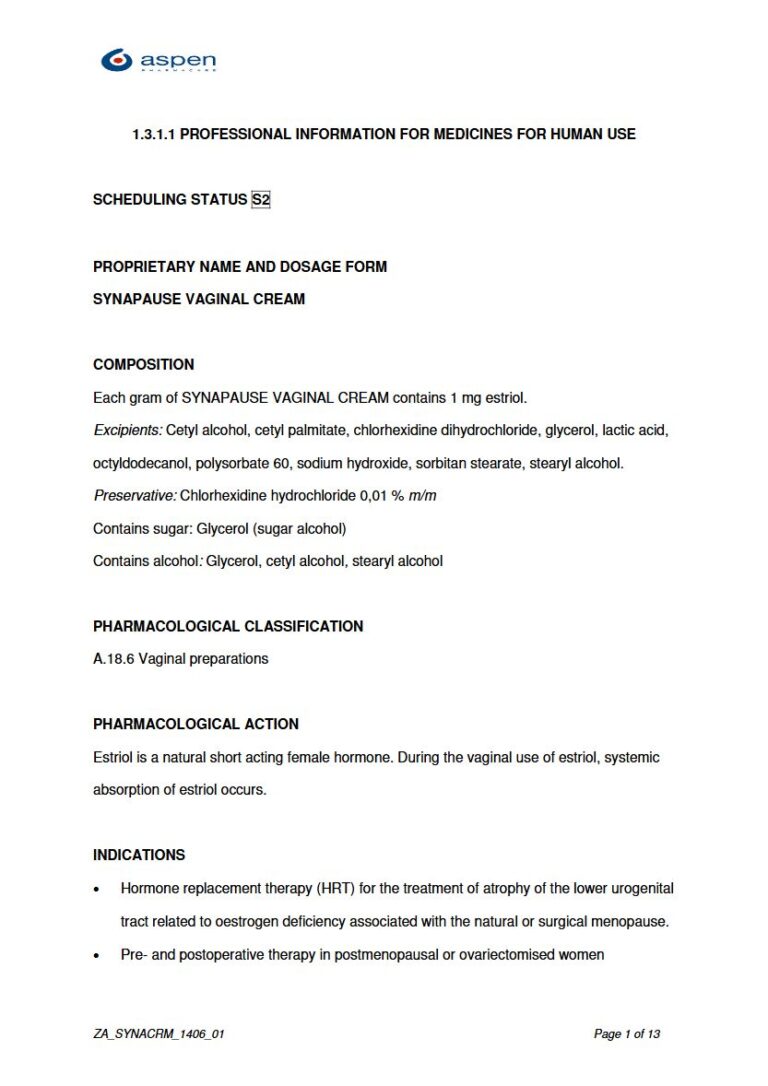
u2022 Hormone replacement therapy (HRT) for the treatment of atrophy of the lower urogenital tract related to oestrogen deficiency associated with the natural or surgical menopause.
u2022 Pre- and postoperative therapy in postmenopausal or ovariectomised women undergoing vaginal surgery.
4.2 Posology and method of administration
u2022 For atrophy of the lower urogenital tract in conditions of oestrogen deficiency: 1 application per day for the first 2 to 3 weeks, followed by a gradual reduction based on relief of symptoms, until a maintenance dosage of 1 application twice a week is reached.
u2022 As pre- and postoperative therapy in post-menopausal or ovariectomised women undergoing vaginal surgery: 1 application per day in the 2 weeks before surgery; 1 application twice a week in the 2 weeks after surgery. Post-surgery treatment can be started as soon as application of the cream is possible. SYNAPAUSE VAGINAL CREAM should be administered intravaginally by means of a calibrated applicator before retiring at night. One application (applicator filled to the ring mark) contains 0,5 g SYNAPAUSE VAGINAL CREAM, which corresponds with 0,5 mg estriol. A missed dose should be administered as soon as remembered, unless the missed dose is noticed at the day of the next dose. In the latter case the missed dose should be skipped and the regular dosing scheme continued. Two doses must never be administered on the same day. For initiation and continuation of treatment of post-menopausal symptoms, the lowest effective dose for the shortest duration (see Warnings) should be used.
4.3 Contraindications
u2022 Known hypersensitivity to the active substances or to any of the inactive ingredients
u2022 Known, past or suspected breast cancer
u2022 Known or suspected oestrogen-dependent malignant tumours (e.g. endometrial cancer)
u2022 Undiagnosed vaginal bleeding
u2022 Untreated endometrial hyperplasia
u2022 Previous idiopathic or current venous thromboembolism (deep venous thrombosis, pulmonary embolism, or a risk factor thereof e.g. known thrombophilic disease in a patient)
u2022 Known thrombophilic disorders/diseases (e.g. Protein C, protein S or antithrombin deficiency) (see WARNINGS AND SPECIAL PRECAUTIONS)
u2022 Pregnancy and lactation
u2022 Active or recent arterial thromboembolic disease (e.g. angina, myocardial infarction)
u2022 Acute liver disease or a history of liver disease as long as liver function tests failed to return to normal
u2022 Porphyria
4.4 Special warnings and precautions for use
Warnings
u2022 Before initiation or re-instituting treatment with SYNAPAUSE VAGINAL CREAM, a complete personal and family medical history should be taken. Physical (including pelvic and breast) examination should be guided by this, and by the contraindications and warnings for use. During treatment, periodic check-ups are recommended of a frequency and nature adapted to the individual woman. Women should be advised what changes in their breasts should be reported to their doctor or nurse (see Breast cancer below). Investigations and mammography should be carried out in accordance with currently accepted screening practices, modified according to the clinical needs of the individual.
u2022 If any of the following conditions are present, have occurred previously and/or have aggravated during pregnancy or previous hormone treatment, the patient should be closely supervised. It should be taken into account that these conditions may recur or be aggravated during treatment with SYNAPAUSE VAGINAL CREAM, in particular:
- Leiomyoma (uterine fibroids) or endometriosis
- Risk factors for thromboembolic disorders (see Venous thromboembolism below)
- Risk factors for oestrogen dependent tumours e.g. 1st degree heredity for breast cancer
- Hypertension
- Liver disorders (e.g. liver adenoma)
- Diabetes mellitus with or without vascular involvement
- Cholelithiasis
- Migraine or (severe) headache
- Systemic lupus erythematosus
- A history of endometrial hyperplasia (see Endometrial hyperplasia and carcinoma below)
- Epilepsy
- Asthma
- Otosclerosis
Reasons for immediate withdrawal of therapy
Therapy should be discontinued in case a contraindication is discovered and in the following situations:
- Jaundice or deterioration in liver function
- Significant increase in blood pressure
- New onset of migraine-type headache
- Pregnancy.
Endometrial hyperplasia and carcinoma
In order to prevent endometrial stimulation, the daily dose should not exceed 1 application (0,5 mg estriol), nor should this maximum dose be used for longer than several weeks. Vaginal bleeding during treatment should always be investigated. The patient should be informed to contact a doctor if vaginal bleeding occurs.
Breast cancer
u2022 HRT may increase mammographic density. This may complicate the radiological detection of breast cancer.
u2022 A randomised placebo-controlled trial, the Womenu2019s Health Initiative study (WHI) and epidemiological studies, including the Million Women Study (MWS), have reported an increased risk of breast cancer in women taking oestrogens, oestrogen-progestogen combinations, or tibolone for HRT for several years (see SIDE EFFECTS and WARNINGS AND SPECIAL PRECAUTIONS). For all HRT, an excess risk becomes apparent within a few years of use and increases with duration of intake, but returns to baseline within a few (at most 5) years after stopping treatment.
u2022 In the Million Women Study (MWS), the relative risk of breast cancer with conjugated equine oestrogens or estradiol (E2) was greater when a progestogen was added, either sequentially or continuously, and regardless of type of progestogen. There was no evidence of a difference in risk between the different routes of administration.
u2022 In the WHI study, the continuous combined conjugated equine oestrogen and medroxyprogesterone acetate product used, was associated with breast cancers that were slightly larger in size, and had local lymph node metastases compared to placebo.
Venous thromboembolism
u2022 HRT is associated with a higher relative risk of developing venous thromboembolism (VTE) i.e. deep vein thrombosis or pulmonary embolism. One randomised controlled trial and epidemiological studies found a 2 to 3 fold higher risk for users compared with non-users. For non-users it is estimated that the number of cases of VTE that will occur over a 5 year period is about 3 per 1 000 women aged 50 to 59 years, and 8 per 1 000 women aged 60 to 69 years. It is estimated that in healthy women who use HRT for 5 years, the number of additional cases of VTE over a 5 year period will be between 2 and 6 (best estimate = 4) per 1 000 women aged 50 to 59 years, and between 5 and 15 (best estimate = 9) per 1 000 women aged 60 to 69 years. The occurrence of such an event is more likely in the first year of HRT than later (see SIDE EFFECTS).
u2022 Patients with known thrombophilic states have an increased risk of VTE and HRT may add to this risk. HRT is therefore contraindicated in these patients (see CONTRAINDICATIONS).
u2022 Generally recognised risk factors for VTE include a personal or family history of VTE, obesity (Body Mass Index > 30 kg/m2), pregnancy/postpartum period, systemic lupus erythematosus (SLE) and cancer.
u2022 Prophylactic measures need be considered to prevent VTE following surgery. If prolonged immobilisation is to follow elective surgery temporarily stopping HRT 4 to 6 weeks earlier is recommended. Treatment should not be re-started until the woman is completely mobilised.
u2022 Consideration should be given to prophylactic treatment against thrombosis.
u2022 In women with no personal history of VTE, but with a first degree relative with a history of thrombosis at young age, screening may be offered after careful counselling regarding its limitations (only a proportion of thrombophilic defects are identified by screening). If a thrombophilic defect is identified, which segregates with thrombosis in family members or if the defect is u201csevereu201d (e.g. anti-thrombin, protein S, or protein C deficiencies or a combination of defects), HRT is contraindicated. Patients with a history of recurrent VTE or known thrombophilic states have an increased risk of VTE. SYNAPAUSE VAGINAL CREAM may add to this risk. Personal or strong family history of thromboembolism or recurrent spontaneous abortion, should be investigated in order to exclude a thrombophilic predisposition. Until a thorough evaluation of thrombophilic factors has been made or anticoagulant treatment initiated, use of HRT in such patients should be viewed as contraindicated (see CONTRAINDICATIONS).
u2022 Women already on anticoagulant treatment require careful consideration of the benefit-risk of use of HRT.
u2022 If VTE develops after initiating SYNAPAUSE VAGINAL CREAM therapy, the product should be discontinued. Patients should be told to contact their doctors immediately when they are aware of potential thromboembolic symptoms (e.g. painful swelling of a leg, sudden pain in the chest, dyspnoea).
Coronary artery disease (CAD)
u2022 There is no evidence from randomised controlled trials of cardiovascular benefit with continuous combined conjugated oestrogens and medroxyprogesterone acetate. Two large clinical trials (WHI and HERS i.e. Heart and Oestrogen/progestin Replacement Study) showed a possible increased risk of cardiovascular morbidity in the first year of use and no overall benefit. For other HRT products there are only limited data from randomised controlled trials examining effects in cardiovascular morbidity or mortality.
Ischaemic stroke
u2022 One large randomised clinical trial (WHI-trial) found as a secondary outcome, an increased risk of ischaemic stroke in healthy women during treatment with continuous combined conjugated oestrogens and medroxyprogesterone acetate. For women who do not use HRT, it is estimated that the number of cases of stroke that will occur over a 5 year period is about 3 per 1 000 women aged 50 to 59 years, and 11 per 1 000 women aged 60 to 69 years. It is estimated that for women who use conjugated oestrogens and medroxyprogesterone acetate for 5 years, the number of additional cases will be between 0 and 3 (best estimate = 1) per 1 000 users aged 50 to 59 years, and between 1 and 9 (best estimate = 4) per 1 000 users aged 60 to 69 years.
Ovarian cancer
u2022 Long-term (at least 5 to 10 years) use of oestrogen-only HRT products in hysterectomised women has been associated with an increased risk of ovarian cancer in some epidemiological studies. It is not known whether long term use of SYNAPAUSE VAGINAL CREAM confers similar risks.
Other conditions
u2022 Oestrogens may cause fluid retention, and therefore patients with cardiac or renal dysfunction should be carefully observed. Patients with terminal renal insufficiency should be closely observed, since it is expected that the level of circulating active ingredient in SYNAPAUSE VAGINAL CREAM is increased.
u2022 There is no conclusive evidence for improvement of cognitive function. There is some evidence from the WHI trial of increased risk of probable dementia in women who start using continuous combined conjugated oestrogens (Conjugated Equine Oestrogens) and medroxyprogesterone acetate after the age of 65. It is unknown whether the findings apply to younger post-menopausal women or other HRT products.
u2022 With vaginal infections a concomitant specific treatment is recommended.
Special precautions
Breast cancer risk
u2022 The level of risk is related to the duration of use (see Warnings)
Ovarian cancer
Long-term use of oestrogen-only and combined oestrogen-progestogen HRT has been associated with an increased risk of ovarian cancer. In the Million Women Study (MWS) 5 years of HRT resulted in 1 extra case per 2 500 users.
Risk of venous thromboembolism
HRT is associated with a 1,3 to 3-fold increased relative risk of developing venous thromboembolism (VTE) i.e. deep vein thrombosis or pulmonary embolism. The occurrence of such an event is more likely in the first year of using HRT (see Warnings).
Risk of coronary artery disease
The risk of coronary artery disease is increased in users of combined oestrogen-progestogen HRT over the age of 60 (see Warnings).
Risk of ischaemic stroke
The use of oestrogen-only and oestrogen-progestogen therapy is associated with an up to 1,5 fold increased relative risk of ischaemic stroke. The risk of haemorrhagic stroke is not increased during use of HRT. This relative risk is not dependent on age or on duration of use, but as the baseline risk is strongly age-dependent, the overall risk of stroke in women who use HRT will increase with age (see Warnings).
4.5 Interactions with other medicines
No examples of interactions between SYNAPAUSE VAGINAL CREAM and other medicines have been reported in clinical practice. The metabolism of oestrogens may be increased and the efficacy may be decreased by concomitant use of substances known to induce drug-metabolising enzymes, specifically cytochrome P450 enzymes, such as anticonvulsants (e.g. hydantoins, barbiturates, carbamazepine), anti-infectives (e.g. griseofulvin, rifamycins, the antiretroviral agents nevirapine and efavirenz), and herbal preparations containing St Johnu2019s wort (Hypericum perforatum). Ritonavir and nelfinavir although known as strong inhibitors, by contrast exhibit inducing properties when used concomitantly with steroid hormones. Clinically, an increased metabolism of oestrogens may lead to decreased effect and changes in the uterine bleeding profile. Conversely, estriol may possibly change the effectiveness of insulins and oral anticoagulants, and increase the pharmacological effects of beta-adrenergic blockers, succinylcholine, theophyllines and troleandomycin.
4.6 Fertility, pregnancy and lactation
SYNAPAUSE VAGINAL CREAM is contraindicated during pregnancy. If pregnancy occurs during medication with SYNAPAUSE VAGINAL CREAM, treatment should be withdrawn immediately. SYNAPAUSE VAGINAL CREAM is contraindicated during lactation. Estriol is excreted in breast milk and may decrease milk production.
4.7 Effects on ability to drive and use machines
As far as is known SYNAPAUSE VAGINAL CREAM has no effect on alertness and concentration.
4.8 Undesirable effects
The following adverse effects may occur:
Neoplasms benign and malignant (including cysts and polyps)
Unknown frequency: Endometrial cancer (see CONTRAINDICATIONS and WARNINGS AND SPECIAL PRECAUTIONS)
Psychiatric disorders
Unknown frequency: Dementia
Hepatobiliary disorder
Unknown frequency: Gall bladder disease
Skin and subcutaneous tissue disorders
Unknown frequency: Local irritation and itching. Chloasma/melasma, erythema multiforme, erythema nodosum and vascular purpura
Reproductive system and breast disorders
Unknown frequency: Breast tension, tenderness and enlargement, breakthrough bleeding/spotting, cervical discharge, endometrial hyperplasia
4.9 Overdose
Should large quantities be ingested nausea, vomiting and withdrawal bleeding in females may develop. No specific antidote is known. Symptomatic treatment can be given if necessary.
