
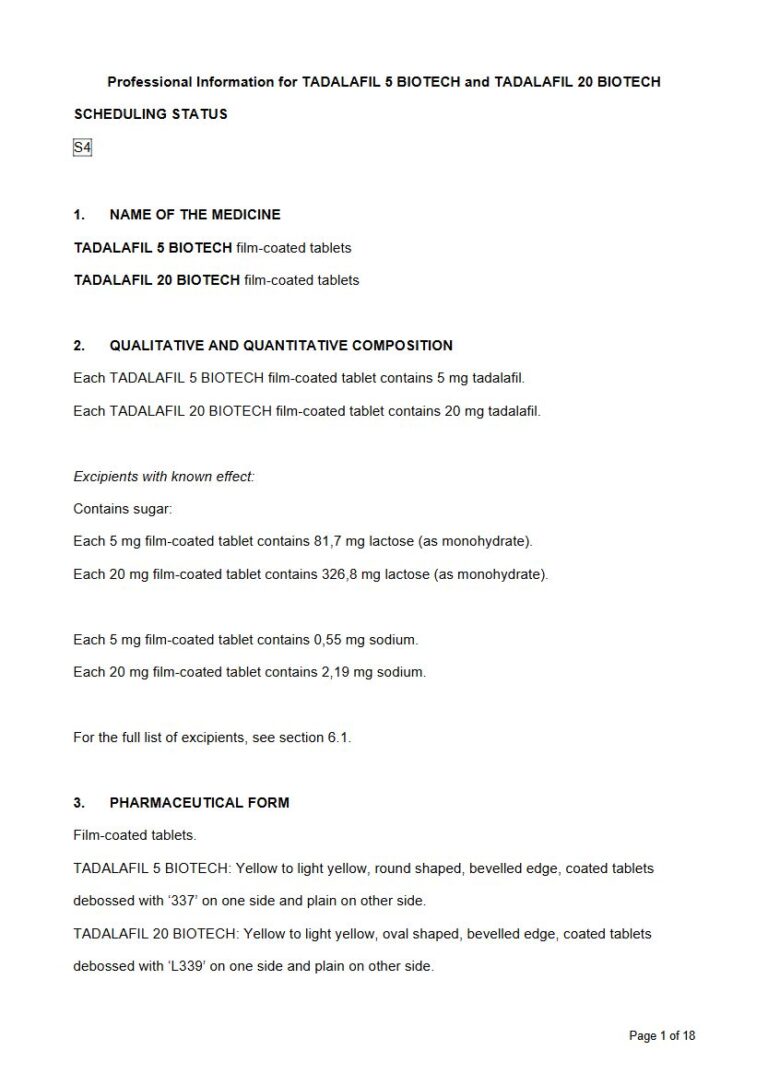
Tadalafil 5 mg/20 mg Film-Coated Tablets
PDF Leaflet Revision Date: 26 July 2022
Clinical Summary
Quick overview from the medicine insert
Indication
Treatment of erectile dysfunction.
Dosage (summary)
5 mg once daily; max 20 mg prior to sexual activity.
Onset of Action / Duration
Onset: 16 mins, Duration: up to 36 hours
Special Populations
- Renal impairment
- Hepatic impairment
Pregnancy & Breastfeeding
Not indicated for women; not safe during pregnancy or breastfeeding.
Key Drug Interactions
- Nitrates
- CYP3A4 inhibitors
- Alpha-1 blockers
Contraindications
- Hypersensitivity to tadalafil
- Severe hepatic insufficiency
- Use with nitrates
Common side effects
- Headache
- Dyspepsia
- Back pain
- Myalgia
Counselling Points
- Take at the same time daily
- Avoid nitrates
- Seek help for erections lasting over 4 hours
Serious warnings
- Risk of NAION
- Risk of sudden hearing loss
- Cardiovascular risks
Important Disclaimer
The Tadalafil 5 mg/20 mg Film-Coated Tablets professional information leaflet below is the property of Biotech Laboratories and is provided on Medinsert exactly as issued, with no.. alterations or editorial changes. We make every effort to keep content current by updating documents as soon as new versions become available. Medinsert serves as a trusted access point for healthcare professionals, but does not replace official sources or clinical judgement. For more details, please read our full disclaimer. read more>>
 Healthcare Professionals Only
This content is for registered healthcare professionals
Sign in or create a free account to read the full package insert.
Free for HPCSA-registered professionals. Powered by Medinsert.
Clinical Particulars
Section 4 of the official insert — extracted exactly as issued, no alterations
4.1 Therapeutic indications
TADALAFIL BIOTECH is indicated for the treatment of erectile dysfunction. In order for TADALAFIL BIOTECH to be effective, sexual stimulation is required.
4.2 Posology and method of administration
Posology
In adult men
The recommended dose is 5 mg taken once a day at approximately the same time of day. The recommended maximum dose of TADALAFIL BIOTECH is 20 mg taken prior to anticipated sexual activity and without regard to food. TADALAFIL BIOTECH 20 mg can be taken up to 36 hours and as early as 16 minutes prior to sexual activity. Patients may initiate sexual activity at varying time points relative to dosing in order to determine their own optimal window of responsiveness. The maximum recommended dosing frequency is once per day.
Special populations
Renal impairment
Dosage adjustments are not required in patients with mild or moderate renal impairment. Once-a-day dosing of TADALAFIL BIOTECH is not recommended in patients with severe renal impairment.
Paediatric population
TADALAFIL BIOTECH is not indicated for children under the age of 18 years.
Method of administration
For oral use.
4.3 Contraindications
- Hypersensitivity to the active substance, tadalafil, or to any of the excipients of TADALAFIL BIOTECH listed in section 6.1.
- Administration of TADALAFIL BIOTECH to patients who are using any form of organic nitrate.
- Patients with severe hepatic insufficiency (Child-Pugh Class C).
- Previous experience of loss of vision in one or both eyes because of non-arteritic anterior ischaemic optic neuropathy (NAION), regardless whether this episode was in connection or not with previous phosphodiesterase type 5 (PDE5) inhibitor exposure (see section 4.4).
- Previous experience of unilateral or bilateral decrease or loss of hearing with or without associated vestibular symptoms.
4.4 Special warnings and precautions for use
Before treatment with TADALAFIL BIOTECH
A medical history and physical examination should be undertaken to diagnose erectile dysfunction and determine potential underlying causes, before pharmacological treatment is considered. Sexual activity carries a potential cardiac risk for patients with pre-existing cardiovascular disease. Prior to initiating any treatment for erectile dysfunction, medical practitioners should consider the cardiovascular status of their patients. Tadalafil has vasodilator properties, resulting in mild and transient decreases in blood pressure (see section 5.1) and as such potentiates the hypotensive effect of nitrates (see section 4.3). TADALAFIL BIOTECH should not be used in men with cardiac disease for whom sexual activity is inadvisable.
It is not known if TADALAFIL BIOTECH is effective in patients who have undergone pelvic surgery or radical non-nerve-sparing prostatectomy.
Cardiovascular
Tadalafil has systemic vasodilatory properties that may result in transient decreases in blood pressure. Prior to prescribing TADALAFIL BIOTECH, medical practitioners should carefully consider whether their patients with underlying cardiovascular disease could be affected adversely by such vasodilatory effects. In patients receiving concomitant antihypertensive medicines, tadalafil may induce a blood pressure decrease. When initiating daily treatment with TADALAFIL BIOTECH, appropriate clinical considerations should be given to a possible dose adjustment of the antihypertensive therapy.
In patients who are taking alpha-1 blockers, concomitant administration of TADALAFIL BIOTECH may lead to symptomatic hypotension in some patients (see Section 4.5). The combination of tadalafil and doxazosin is not recommended.
In a clinical pharmacology study of 18 healthy volunteers who received a single dose of TADALAFIL BIOTECH, no symptomatic hypotension was observed with simultaneous administration of tamsulosin, an u03b1 -[1A] blocker (see section 4.5).
The use of TADALAFIL BIOTECH is not recommended in the following patients:
- with myocardial infarction within the last 90 days.
- with unstable angina or angina occurring during sexual intercourse.
- with New York Heart Association Class 2 or greater heart failure in the last 6 months.
- with uncontrolled dysrhythmia, hypotension (< 90/50 mm Hg), or uncontrolled hypertension.
- with a stroke within the last 6 months.
Patients who experience symptoms upon initiation of sexual activity should be advised to refrain from further sexual activity and should report the episode to their medical practitioner.
Vision
Non-arteritic anterior ischemic optic neuropathy (NAION) is a cause of decreased vision including permanent loss of vision. Visual defects and cases of NAION have been reported in connection with the intake of TADALAFIL BIOTECH and other PDE5 inhibitors. Analyses of observational data suggest an increased risk of acute NAION in men with erectile dysfunction following exposure to tadalafil or other PDE5 inhibitors. As this may be relevant for all patients exposed to tadalafil, the patient should be advised that in case of sudden visual defect, he should stop taking TADALAFIL BIOTECH and consult a medical practitioner immediately (see section 4.3). Medical practitioner should also discuss with patients that individuals who have already experienced NAION are at increased risk of NAION.
Decreased or sudden hearing loss
Cases of sudden hearing loss have been reported after the use of tadalafil. Patients should be advised to stop taking TADALAFIL BIOTECH and seek prompt medical attention in the event of sudden decrease or loss of hearing. These events may be accompanied by tinnitus and dizziness.
Renal and hepatic impairment
Due to increased tadalafil exposure (AUC), limited clinical experience and the lack of ability to influence clearance by dialysis, once-a-day dosing of tadalafil is not recommended in patients with severe renal impairment. Once-a-day administration has not been evaluated in patients with hepatic insufficiency.
Priapism and anatomical deformation of the penis
Patients who experience erections lasting 4 hours or more should be instructed to seek immediate medical assistance. If priapism is not treated immediately, penile tissue damage and permanent loss of potency may result. TADALAFIL BIOTECH should be used with caution in patients with anatomical deformation of the penis (such as angulation, cavernosal fibrosis, or Peyronie's disease) or in patients who have conditions which may predispose them to priapism (such as sickle cell anaemia, multiple myeloma or leukaemia).
Use with CYP3A4 inhibitors
Caution should be exercised when prescribing TADALAFIL BIOTECH to patients using potent CYP3A4 inhibitors (ritonavir, saquinavir, ketoconazole, itraconazole, and erythromycin), as increased tadalafil exposure (AUC) has been observed if the medicines are combined (see section 4.5).
TADALAFIL BIOTECH and other treatments for erectile dysfunction
The safety and efficacy of combinations of TADALAFIL BIOTECH and other PDE5 inhibitors or other treatments for erectile dysfunction have not been studied. The patients should be informed not to take TADALAFIL BIOTECH in such combinations.
Lactose
Patients with rare hereditary problems of galactose intolerance, total lactase deficiency or glucose-galactose malabsorption should not take TADALAFIL BIOTECH.
Sodium
This medicine contains less than 1 mmol sodium (23 mg) per tablet, that is to say essentially u2018sodium-freeu2019.
4.5 Interaction with other medicines and other forms of interaction
Effects of other medicines on TADALAFIL BIOTECH
Cytochrome P450 inhibitors
TADALAFIL BIOTECH is principally metabolised by CYP3A4. A selective inhibitor of CYP3A4, ketoconazole (200 mg daily) increased TADALAFIL BIOTECH (10 mg single-dose) exposure (AUC) 2-fold and C max by 15 %, relative to the AUC and C max values for tadalafil alone. Ketoconazole (400 mg daily), increased tadalafil 20 mg single-dose exposure (AUC) 4-fold and C max by 22 %.
Transporters
The role of transporters (for example, p-glycoprotein) in the disposition of tadalafil is not known. Therefore, there is the potential of interactions mediated by inhibition of transporters.
Cytochrome P450 inducers
A selective CYP3A4 inducer, rifampicin (rifampicin, 600 mg daily), reduced tadalafil single-dose exposure (AUC) by 88 % and C max by 46 %, relative to the AUC and C max values for tadalafil alone. This reduced exposure can be anticipated to decrease the efficacy of tadalafil; the magnitude of decreased efficacy is unknown. It can be expected that concomitant administration of other CYP3A4 inducers, such as phenobarbitone, phenytoin and carbamazepine may also decrease plasma concentrations of tadalafil.
Ritonavir (200 mg twice daily) an inhibitor of CYP3A4, 2C9, 2C19 and 2D6, increased tadalafil single-dose exposure (AUC) by 124 % with no change in C max. Although specific interactions have not been studied, other HIV protease inhibitors, such as saquinavir, and other CYP3A4 inhibitors such as erythromycin and itraconazole, would likely increase tadalafil exposure.
Antacids
Simultaneous administration of an antacid (magnesium hydroxide/aluminium hydroxide) and tadalafil reduced the apparent rate of absorption of tadalafil without altering exposure (AUC) to tadalafil.
H2-antagonists
An increase in gastric pH resulting from administration of nizatidine, an H2-antagonist, had no significant effect on tadalafil pharmacokinetics.
Effects of TADALAFIL BIOTECH on other medicines
Nitrates
In clinical studies, tadalafil was shown to augment the hypotensive effects of nitrates. Therefore, administration of TADALAFIL BIOTECH to patients who are using any form of organic nitrate is contraindicated (see section 4.3).
Antihypertensives
Tadalafil has systemic vasodilatory properties and may augment the blood pressure lowering effects of antihypertensive medicines. Additionally, in patients taking multiple antihypertensive medicines whose hypertension was not well controlled, greater reductions in blood pressure were observed. These reductions were not associated with hypotensive symptoms in the vast majority of patients. Appropriate clinical advice should be given to patients when they are treated with antihypertensive medications and tadalafil.
Tadalafil had no clinically significant effect on blood pressure changes due to tamsulosin, an u03b1 -adrenergic receptor blocking agent. The co-administration of doxazosin (4 and 8 mg daily) and tadalafil (5 mg daily dose and 20 mg as a single dose) increases the blood pressure-lowering effect of this alpha-blocker in a significant manner. This effect lasts at least twelve hours and may be symptomatic, including syncope. Some patients experienced dizziness. Therefore, this combination is not recommended (see section 4.4).
CYP1A2 substrates
Tadalafil had no clinically significant effect on the pharmacokinetics or pharmacodynamics of theophylline, a CYP1A2 substrate.
Ethinylestradiol and terbutaline
Tadalafil has been demonstrated to produce an increase in the oral bioavailability of ethinylestradiol; a similar increase may be expected with oral administration of terbutaline, although the clinical consequence of this is uncertain.
Alcohol
Tadalafil did not affect alcohol concentrations and alcohol did not affect tadalafil concentrations. At high doses of alcohol (0,7 g/kg), the addition of tadalafil did not induce statistically significant mean blood pressure decreases. In some subjects, postural dizziness and orthostatic hypotension were observed. When tadalafil was administered with lower doses of alcohol (0,6 g/kg), hypotension was not observed and dizziness occurred with similar frequency to alcohol alone.
Cytochrome P450 metabolised medicines
Tadalafil does not inhibit or induce CYP450 isoforms, including CYP1A2, CYP3A4, CYP2C9, CYP2C19, CYP2D6 and CYP2E1.
CYP2C9 substrates (e.g. R-warfarin)
Tadalafil had no clinically significant effect on exposure (AUC) to S-warfarin or R-warfarin (CYP2C9 substrate), nor did tadalafil affect changes in prothrombin time induced by warfarin.
Aspirin
Tadalafil did not potentiate the increase in bleeding time caused by aspirin.
Antidiabetic medicines
Specific interaction studies with antidiabetic medicines were not conducted.
Riociguat
Studies have shown an additive systemic blood pressure lowering effect when PDE5 inhibitors were combined with riociguat. Riociguat has been shown to augment the hypotensive effects of PDE5 inhibitors. There was no evidence of favourable clinical effect of the combination. Riociguat should not be used concomitantly with PDE5 inhibitors such as tadalafil.
5-alpha reductase inhibitors
No new adverse reactions were identified when tadalafil was co-administered with finasteride. However, as a formal interaction study evaluating the effects of tadalafil and 5-alpha reductase inhibitors (5-ARIs) has not been performed, caution should be exercised when tadalafil is co-administered with 5-ARIs.
4.6 Fertility, pregnancy and lactation
TADALAFIL BIOTECH is not indicated for use by women. Safety and efficacy of TADALAFIL BIOTECH in pregnancy and lactation have not been established.
Pregnancy
TADALAFIL BIOTECH should not be used during pregnancy.
Breastfeeding
TADALAFIL BIOTECH should not be used during breastfeeding.
Fertility
Although animal studies indicate impairment of fertility, subsequent clinical studies suggest this is unlikely in humans. A decrease in sperm concentration has however, been seen in some men.
4.7 Effects on ability to drive and use machines
TADALAFIL BIOTECH has a negligible influence on the ability to drive or use machines. However, there have been reports of dizziness, therefore patients should be aware of how they react to TADALAFIL BIOTECH before driving or using machines.
4.8 Undesirable effects
Summary of the safety profile
The most commonly reported adverse reactions in patients taking tadalafil for the treatment of erectile dysfunction were headache, dyspepsia, back pain and myalgia, in which the incidences increase with increasing dose of tadalafil. The adverse reactions reported were transient, and generally mild or moderate. The majority of headaches reported with tadalafil once-a-day dosing are experienced within the first 10 to 30 days of starting treatment.
Tabulated list of adverse reactions
| SYSTEM ORGAN CLASS | FREQUENCY | ADVERSE REACTION |
|---|---|---|
| Immune system disorders | Less frequent | Hypersensitivity reactions, angioedema |
| Nervous system disorders | Frequent | Headache |
| Less frequent | Dizziness, stroke (including haemorrhagic events), syncope, transient ischaemic attacks, migraine, seizures, transient amnesia | |
| Eye disorders | Less frequent | Blurred vision, sensations described as eye pain, visual field defect, swelling of eyelids, conjunctival hyperaemia, non-arteritic anterior ischaemic optic neuropathy (NAION), retinal vascular occlusion |
| Ear and labyrinth disorders | Less frequent | Tinnitus, sudden hearing loss |
| Cardiac disorders | Less frequent | Tachycardia, palpitations, myocardial infarction, unstable angina pectoris |
| Vascular disorders | Frequent | Flushing |
| Less frequent | Hypotension, hypertension | |
| Respiratory, thoracic and mediastinal disorders | Frequent | Nasal congestion |
| Less frequent | Dyspnoea, epistaxis | |
| Gastrointestinal disorders | Frequent | Dyspepsia |
| Less frequent | Abdominal pain, vomiting, nausea, Gastro-oesophageal reflux | |
| Skin and subcutaneous tissue disorders | Less frequent | Rash, urticaria, Stevens-Johnson syndrome, exfoliative dermatitis, hyperhidrosis (sweating) |
| Musculoskeletal, connective tissue and bone disorders | Frequent | Back pain, myalgia, pain in extremity |
| Renal and urinary disorders | Less frequent | Haematuria |
| Reproductive system and breast disorders | Less frequent | Prolonged erections, priapism, penile haemorrhage, haematospermia |
| General disorders and administration site conditions | Less frequent | Chest pain, peripheral oedema, fatigue, facial oedema, sudden cardiac death |
1 Most of the patients had pre-existing cardiovascular risk factors (see section 4.4).
2 Post marketing surveillance reported adverse reactions not observed in placebo-controlled clinical trials.
3 More commonly reported when tadalafil is given to patients who are already taking antihypertensive medicines.
Description of selected adverse events
A slightly higher incidence of ECG abnormalities, primarily sinus bradycardia, has been reported in patients treated with tadalafil once a day as compared with placebo. Most of these ECG abnormalities were not associated with adverse reactions.
4.9 Overdose
Single doses of up to 500 mg have been given to healthy subjects, and multiple daily doses up to 100 mg have been given to patients. Adverse events were similar to those seen at lower doses. In cases of overdose, standard supportive measures should be adopted, as required. Haemodialysis contributes negligibly to tadalafil elimination.
