
Talinop Sterile Ophthalmic Emulsion 5 mL
PDF Leaflet Revision Date: 26 July 2022
Clinical Summary
Quick overview from the medicine insert
Indication
Reduction of elevated intraocular pressure in glaucoma and ocular hypertension.
Dosage (summary)
One drop in the affected eye(s) once daily, preferably in the evening.
Onset of Action / Duration
Onset: 3-4 hours, Duration: 24 hours
Special Populations
- Elderly
- Paediatric patients
- Renal impairment
- Hepatic impairment
Pregnancy & Breastfeeding
Contraindicated in pregnancy and breastfeeding.
Key Drug Interactions
- Additive effect with beta-blockers
- Avoid use with other prostaglandins
Contraindications
- Hypersensitivity to latanoprost or excipients
- Pregnancy
- Breastfeeding
Common side effects
- Increased iris pigmentation
- Eye irritation
- Conjunctival hyperemia
- Eyelash changes
Counselling Points
- Inform about potential eye color change
- Remove contact lenses before use
- Do not drive until vision is clear after instillation
Serious warnings
- Potential for permanent iris color change
- Caution in patients with a history of herpetic keratitis
- Risk of macular edema
Important Disclaimer
The Talinop Sterile Ophthalmic Emulsion 5 mL professional information leaflet below is the property of Ranbaxy Pharmaceuticals and is provided on Medinsert exactly as issued, with no.. alterations or editorial changes. We make every effort to keep content current by updating documents as soon as new versions become available. Medinsert serves as a trusted access point for healthcare professionals, but does not replace official sources or clinical judgement. For more details, please read our full disclaimer. read more>>
 Healthcare Professionals Only
This content is for registered healthcare professionals
Sign in or create a free account to read the full package insert.
Free for HPCSA-registered professionals. Powered by Medinsert.
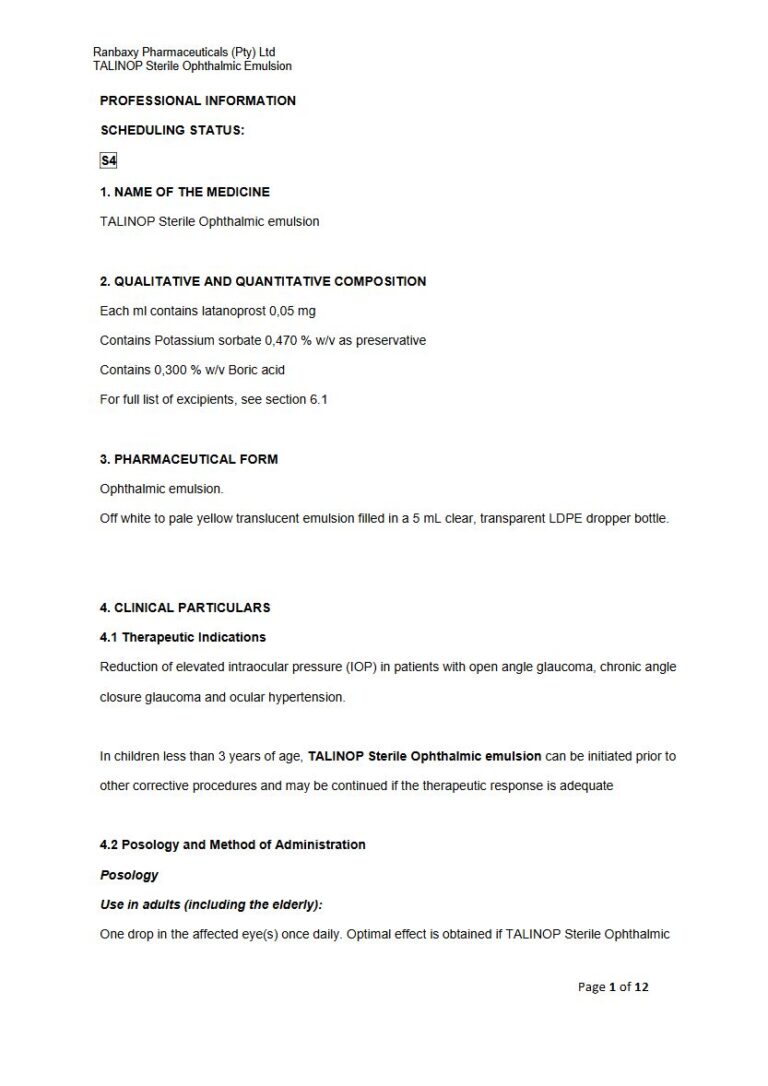
Clinical Particulars
Section 4 of the official insert — extracted exactly as issued, no alterations
4.1 Therapeutic Indications
Reduction of elevated intraocular pressure (IOP) in patients with open angle glaucoma, chronic angle closure glaucoma and ocular hypertension. In children less than 3 years of age, TALINOP Sterile Ophthalmic emulsion can be initiated prior to other corrective procedures and may be continued if the therapeutic response is adequate.
4.2 Posology and Method of Administration
Posology
Use in adults (including the elderly): One drop in the affected eye(s) once daily. Optimal effect is obtained if TALINOP Sterile Ophthalmic emulsion is administered in the evening. The dosage of TALINOP Sterile Ophthalmic emulsion should not exceed once daily since it has been shown that more frequent administration decreases the intra-ocular pressure lowering effect. If one dose is missed, treatment should continue with the next dose as normal. Reduction of the intraocular pressure starts about three to four hours after administration and maximum effect is reached after 8 to 12 hours. Pressure reduction is maintained for at least 24 hours. TALINOP Sterile Ophthalmic emulsion may be used concomitantly with other classes of topical ophthalmic medicines to lower intraocular pressure. If more than one topical ophthalmic medicine is being used, the medicines should be used at least five minutes apart (see section 4.5). Contact lenses should be removed before instillation of the Ophthalmic emulsion and may be reinserted after 15 minutes.
Paediatric population
TALINOP Sterile Ophthalmic emulsion may be used in paediatric patients at the same posology as in adults. No data are available for preterm infants (less than 36 weeks gestational age.) Data in the age group < 1 year are limited.
Method of administration
For ophthalmic use.
4.3 Contraindications
Known hypersensitivity to latanoprost or any other excipient in TALINOP Sterile Ophthalmic emulsion listed in Section 6.1. Pregnancy and lactation (see section 4.6).
4.4 Special warnings and precautions for use
Latanoprost may gradually increase the brown pigment of the iris. Before treatment is instituted, patients should be informed of the possibility of a permanent change in eye colour. The eye colour change is due to increased melanin content in the stromal melanocytes of the iris, rather than to an increase in number of melanocytes. Typically, the brown pigmentation around the pupil spreads concentrically towards the periphery of the iris and the entire iris or parts of the iris become more brownish. The change in iris colour is mild in the majority of cases and may not be detected clinically. The increase in iris pigmentation in one or both eyes has been reported predominantly in patients who have mixed coloured irises that contain the colour brown at baseline i.e. blue-brown, grey-brown, yellow-brown and green-brown. Neither naevi nor freckles of the iris have been affected by treatment. No accumulation of pigment in the trabecular meshwork or elsewhere in the anterior chamber has been reported in clinical trials. In a reported clinical trial designed to assess iris pigmentation over five years, there was no reported evidence of adverse consequences due to increased pigmentation even when administration of latanoprost continued. In addition, IOP reduction was reported to be similar in patients regardless of the development of increased iris pigmentation. Therefore, treatment with TALINOP Sterile Ophthalmic emulsion can be continued in patients who develop increased iris pigmentation. These patients should be examined regularly and, depending on the clinical situation, treatment may be stopped. Onset of increased iris pigmentation typically occurs within the first year of treatment, rarely during the second or third year, and has not been reported after the fourth year of treatment. The rate of progression of iris pigmentation decreases with time and is stable by five years. The effects of increased pigmentation beyond five years have not been reported. During reported clinical trials, the increase in brown iris pigment has not been shown to progress further upon discontinuation of treatment, but the resultant colour change may be permanent (see section 4.8). There is limited reported experience of latanoprost in chronic angle closure glaucoma, open angle glaucoma of pseudophakic patients and in angle closure congenital or pigmentary glaucoma. There is no reported experience of latanoprost in inflammatory and neovascular glaucoma or inflammatory ocular conditions. Latanoprost has no or little effect on the pupil but there is no experience reported in acute attacks of closed angle glaucoma. Therefore, it is recommended that TALINOP Sterile Ophthalmic emulsion should be used with caution in these conditions until more experience is obtained. In patients with known predisposing risk factors for iritis/uveitis, latanoprost can be used with caution. Limited study data have been reported on the use of latanoprost during the peri-operative period of cataract surgery. TALINOP Sterile Ophthalmic emulsion should be used with caution in these patients. TALINOP Sterile Ophthalmic emulsion should be used with caution in patients with a history of herpetic keratitis, and should be avoided in cases of active herpes simplex keratitis and in patients with a history of recurrent herpetic keratitis specifically associated with prostaglandin analogues. Eyelid skin darkening, which may be reversible, has been reported in association with the use of latanoprost (see section 4.8). Periorbital skin discolouration has been reported. Periorbital skin discolouration is not permanent and in some cases has reversed while continuing treatment with latanoprost (see section 4.8). Latanoprost may gradually change eyelashes and vellus hair in the treated eye and surrounding areas; these changes include increased length, thickness, pigmentation, and number of lashes or hairs and misdirected growth of eyelashes. Eyelash changes are reversible upon discontinuation of treatment. The potential for heterochromia exists for patients receiving unilateral treatment (see section 4.8). Macular oedema, including cystoid macular oedema, has been reported during treatment with latanoprost. These reports have mainly occurred in aphakic patients, in pseudophakic patients with torn posterior lens capsule or anterior chamber lenses, or in patients with known risk factors for macular oedema (such as diabetic retinopathy and retinal vein occlusion). Caution is recommended when using TALINOP Sterile Ophthalmic emulsion in these patients (see section 4.8).
General precaution
Latanoprost is hydrolysed in the cornea. The effect of continued administration of latanoprost in the corneal epithelium has not been fully reported.
Asthma
There is limited experience reported in patients with asthma, but cases of asthma, asthma aggravation, acute asthma attack, coughing and dyspnoea have been reported. Asthmatic patients should therefore be treated with caution (see section 4.8). Latanoprost has not been studied in patients with renal or hepatic impairment and should therefore be used with caution in such patients. There have been reports of bacterial keratitis associated with the use of multiple dose containers of topical ophthalmic products. Patients must not let the tip of the dispensing container contact the eye or surrounding structures because this could cause the tip to become contaminated by common bacteria known to cause ocular infections.
Paediatric population
Efficacy and safety data in the age group < 1 year are very limited. No data are available for preterm infants (less than 36 weeks gestational age). In children from 0 to < 3 years old that mainly suffer from PCG (Primary Congenital Glaucoma), surgery(e.g. trabeculotomy/goniotomy) remains the first line treatment, as these children, prior to surgery for congenital glaucoma, respond poorly to latanoprost treatment. Long-term safety in children has not yet been established.
4.5 Interaction with other medicines and other forms of interaction
Latanoprost is effective as monotherapy. The IOP reducing effect of latanoprost has been reported to be additive to that of beta-adrenergic antagonists (timolol). In reported short term studies (up to 2 weeks) the effect of latanoprost was additive in combination with adrenergic agonists (dipivefrin), and oral carbonic anhydrase inhibitors (acetazolamide) and at least partly additive with cholinergic agonists (pilocarpine).
In case of combined therapy, the ophthalmic emulsion should be administered with an interval of at least five minutes. There have been reports of paradoxical elevations in IOP following the concomitant ophthalmic administration of two prostaglandin analogues. Therefore, the use of two or more prostaglandins, prostaglandin analogues, or prostaglandin derivatives is not recommended.
Incompatibilities:
Reported in vitro studies have shown that precipitation occurs when ophthalmic emulsions containing thiomersal are mixed with latanoprost. If such medicines are used the ophthalmic emulsions should be administered with an interval of at least five minutes.
Paediatric population
Interaction studies have only been reported in adults.
4.6 Fertility, pregnancy and lactation
Pregnancy
The use of TALINOP Sterile Ophthalmic emulsion in pregnancy is contraindicated (see section 4.3). TALINOP Sterile Ophthalmic emulsion have has potential hazardous pharmacological effects with respect to the course of pregnancy, to the unborn or the neonate, and should therefore not be used in pregnancy.
Breastfeeding
TALINOP Sterile Ophthalmic emulsion is contraindicated in breastfeeding women (see section 4.3). Latanoprost and its metabolites may pass into breast milk and TALINOP Sterile Ophthalmic emulsion should therefore not be used in breast-feeding women or breast-feeding should be stopped.
Fertility
Latanoprost has not been reported to have any effect on male or female fertility in animal studies (see Section 5.3).
4.7 Effects on ability to drive and use machines
Instillation of ophthalmic emulsion may cause transient blurring of vision. Until this has resolved, patients should not drive or use machines.
4.8 Undesirable Effects
Summary of the safety profile
It has been reported that most undesirable effects relate to the ocular system. Latanoprost has been reported to cause increased pigmentation of the iris (see Section 4.4).
Systemic events
The most frequently reported systemic adverse events with latanoprost were upper respiratory tract infection, colds and flu; pain in muscle, joints, back, chest pain and angina pectoris.
Tabulated list of adverse reactions
Table 1: Adverse events with latanoprost in reported clinical trials
System Organ Class Frequency Undesirable effects
Infections and infestations Less frequent Herpetic keratitis
Eye disorders Frequent Increased pigmentation of the iris, eye irritation (burning, grittiness, itching, stinging and slight foreign body sensation), blepharitis, eye pain, eyelid oedema, mild to moderate conjunctival hyperaemia, photophobia, transient punctate epithelial erosions mostly without symptoms, Less Frequent Dry eye, trichiasis, distichiasis, iris cyst, pseudopemphigoid of ocular conjunctiva, periorbital and lid changes resulting in deepening of the eyelid sulcus
Cardiac disorders Less frequent Angina, palpitation, angina unstable. Aggravation of angina in patients with pre-existing disease
Skin and subcutaneous tissue disorders Frequent Skin rash
Table 2: Reported post-marketing experience (Frequency not known)
MedDRA System Organ Class Undesirable effects
Nervous system disorders Dizziness, headache
Eye disorders Eyelash and vellus hair changes (increased length, thickness, pigmentation and number), conjunctivitis, vision blurred, iritis/uveitis, keratitis, macular oedema including cystoid macular oedema, symptomatic corneal oedema and erosions, misdirected eyelashes sometimes resulting in eye irritation, periorbital oedema
Respiratory, thoracic and mediastinal disorders Asthma, dyspnoea, asthma aggravation, acute asthma attacks
Skin and subcutaneous tissue disorders Localised skin reaction on eyelids, darkening of palpebral skin of the eyelids
Musculoskeletal and connective tissue disorders Muscle/joint pain
General disorders and administration site conditions Non-specific chest pain
Description of selected adverse reactions
Macular oedema including cystoid macular oedema has been reported infrequently during latanoprost ophthalmic emulsion treatment, mainly in patients with aphakia and pseudophakia with torn posterior lens capsule or anterior chamber lenses.
Paediatric population
The safety profile in paediatric patients was similar to that in adults and no new adverse events were reported. Adverse events reported more frequently in the paediatric population as compared to adults are: nasopharyngitis and pyrexia.
Reporting of suspected adverse reactions
Reporting suspected adverse reactions after authorisation of the medicine is important. It allows continued monitoring of the benefit/risk balance of the medicine. Health care providers are asked to report any suspected adverse reactions to SAHPRA via the u201c6.04 Adverse Drug Reaction Reporting Formu201d, found online under SAHPRAu2019s publications: https://www.sahpra.org.za/Publications/Index/8
4.9 Overdose
In overdose, side effects will be exacerbated and exaggerated. Apart from ocular irritation and conjunctival hyperaemia, no other ocular side effects are known if latanoprost is overdosed. If TALINOP Sterile Ophthalmic emulsion is accidentally ingested the following information may be useful: One 2,5 mL bottle contains 125 u03bcg latanoprost. More than 90 % is metabolised during the first pass through the liver. Intravenous infusion of 5,5 u2013 10 micrograms/kg in healthy volunteers caused nausea, abdominal pain, dizziness, fatigue, hot flushes and sweating. Bronchoconstriction was not induced by latanoprost in patients with moderate bronchial asthma when applied topically to the eyes in a dose of seven times the clinical dose of latanoprost. If overdosage with latanoprost occurs, treatment should be symptomatic and supportive.
